airBaltic
and the ACMI solution
Sep/Oct 2024

AirBaltic is the world’s second largest operator of A220s, after Delta, with 49 currently in its fleet and firm plans to expand to 100 A220-300s by 2029/30. Despite difficult financials, It hopes to privatise and move from Latvian state ownership through an IPO, maybe next year.
Wet leasing out
When we last looked at air Baltic (Aviation Strategy, September 2021) the big question was: how could an airline with a peak prepandemic annual traffic volume of under 5m passengers, which collapsed to just 1.3m in 2021, a fleet of 30 A220s and a limited home market absorb a further 20 aircraft scheduled for delivery over the following two years?
In fact, it got close to its targets — passenger volume was 4.5m in 2023 and is expected to rise to around 5.2m this year while the fleet increased by 17 units — largely by becoming a wet lease operator. In the summer of 2024 airBaltic contracted out 17 A220s to Lufthansa/Eurowings and SWISS. Its “IPO and Beyond” business plan envisaged 10 to 20% of airBaltic’s capacity being outsourced on ACMI leases. It has already reached the 20% mark.
Lufthansa is the critical partner and this July a three-year agreement was signed for airBaltic to operate up to 21 A220s on behalf of the German flag-carrier. Outside the Lufthansa Group, there may be opportunities for airBaltic with Air France-KLM, another significant A220s operator. The airline is also exploring wet lease possibilities in Saudi Arabia, India and central Africa.
airBaltic contends that it can provide a superior service compared to ACMI specialist companies because it itself is a full-service scheduled airline. It is interesting to note that the world’s largest ACMI operator, with 215 aircraft, is Avia Solutions, which is Lithuanian controlled, although it moved its headquarters from Vilnius to Dublin in 2023
With its first half 2024 results airBaltic provided for the first time some detail on its segmental performance. It revealed that EBITDAR (adjusted for fleet overheads) margins were four times higher for its ACMI operation than for its own network. The figures (see table) relate to the second quarter which is low season for scheduled operations, nevertheless, the gap does raise questions about the sustainability of its wet lease pricing.
(€ millions, Q2 2024)
| Revenues | Adj EBITDAR | EBITDAR Margin | |
|---|---|---|---|
| Own Network | 154.9 | 25.4 | 16.4% |
| ACMI Out | 52.1 | 33.5 | 64.3% |
| Total | 207.0 | 58.9 | 28.5% |
New fleet plan
In 2012 Martin Gauss was brought in as CEO and became the architect of airBaltic’s current strategy based on the A220. Herr Gauss had previously been at Malév in Budapest and Deutsche BA in Munich, and is still qualified as an A220 pilot.
airBaltic’s revised fleet plan is for 100 A220 -300s, configured with 145 seats, by the end of decade. It has converted ten of the 30 options it had in addition to the 50 unit firm order it placed as launch customer back in 2016. It has placed a further firm order for 30 units with deliveries from 2026. We estimate that the price for the 50 additional aircraft in the current plan would be around $1.6bn. All the aircraft being financed through sale and leasebacks, so the airline is reliant on the appetite of the lessors for A220s.
| A220-300s | |
|---|---|
| 2024 | 49 |
| 2025 | 54 |
| 2026 | 66 |
| 2027 | 77 |
| 2028 | 87 |
| 2029 | 100 |
| 2030 | 100 |
airBaltic is effusive about the A220’s environmental characteristics — a much smaller noise footprint and markedly lower carbon emissions compared to comparable aircraft. It is a very green-orientated company.
The A220 is claimed, probably correctly, to be the optimal aircraft for its business model — economical over short hops feeding traffic to/from the Riga hub and also capable of a commercial range of 4,575km. It operates to Gran Canaria and Sharm El Sheik, both routes of around 4,500km.
On a trip cost basis, the 145-seat A220s is competitive with A320 neos and 737 MAXes, about 10% lower. But on a per seat basis it would be about 20% higher and on a per passenger basis (comparing airBaltic’s 76 % load factors to the 90%-plus achieved by the LCCs), the difference would be around 30%.
Network
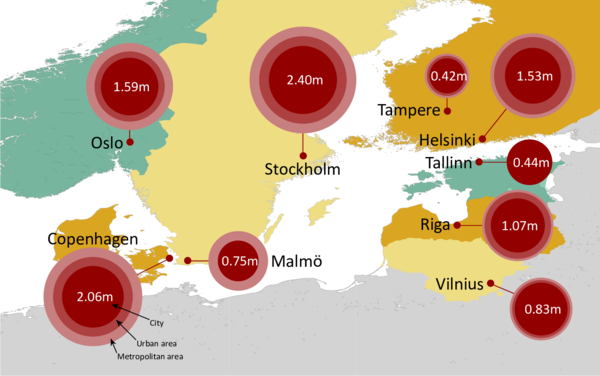
The three Baltic capitals and Tampere are small in comparison to the main population centres in Denmark, Norway, Sweden and Finland (see map) but airBaltic has a truly niche hub and spoke system at Riga, the capital of Latvia. It also has bases at the Estonian capital Tallinn and the Lithuanian capital Vilnius plus a new operation based at Tampere, Finland’s second city. In 2023 2.3m passengers were flown to/from Riga, compared to 0.77m at Tallinn, 0.44m at Vilnius and 0.12m at Tampere.
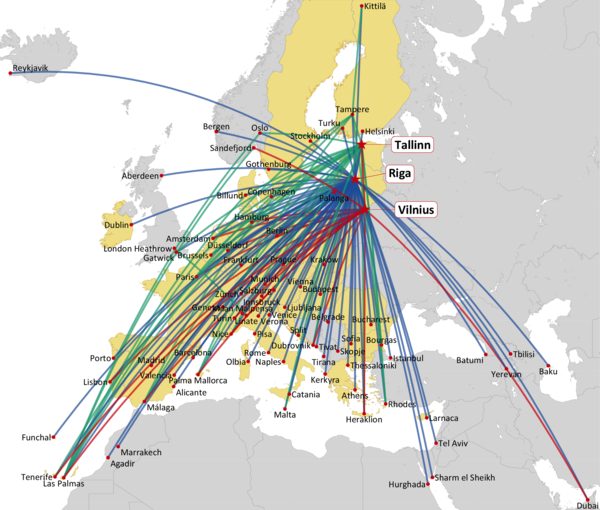
By the end of this year the airline will have a network of over 130 routes — a mean average of under 40,000 passengers per route per year. The operating model depends on connecting lots of thin traffic flows (some of 2024’s new routes include Riga-Tirana and Riga-Madeira) yet only 30% of the airline’s Riga passengers transited at the airport, while 70% were on direct flights. The airline seems to be finding it difficult to push its load factor up to current European standards — in 2023 the load factor was 76.7%.
In allocating capacity between the three Baltic countries, the airline has to manage intense intra-Baltic rivalries, Although some aircraft carry the national flags of Lithuania and Estonia, politicians in these two countries still seem to want to restore their flag-carriers.
Product
airBaltic describes itself as a hybrid, meaning having a cost structure something like the LCCs and service quality akin to the best of the European network carriers. airBaltic is keen on NPS (Net Promoter Scores), a measurement of how satisfied customer are with a product or service. Its score in the first half of 2024 was 66 compared to 36 for the rest of the European industry (or at least those airlines that report NPVs).
It achieved in 2023 an average revenue per passenger of €120 per passenger in compared to €73 at Ryanair. It also offers a Business Class product, but which generated only 6% of its passenger revenue. Logically, the airline has not joined a Global Branded Alliance (too expensive), but it does have an extensive series of codeshare agreements — 23 in total. It denotes its key partners as the Lufthansa Group, BA, SAS and Air France-KLM, in short, the European airline establishment.
airBaltic has an innovative loyalty programme — Planies, which is the world’s first Non-Fungible Token (NFT)-based airline programme. According to the airline, Planies are digital collectible NFTs, each of which consists of a unique cartoon artwork of an aircraft with 180 different traits, such as mouth, eyes, wings, engines, etc., stored on the Ethereum blockchain. They are issued, or minted, through the airline’s website and then can be traded on the OpenSea marketplace. Holders of the Planies receive airBaltic Club points and other benefits. If this is not entirely clear, please visit www.airbaltic.com/planies-nft.
Tourism is important for the three countries. Riga, Vilnius and Tallinn have beautifully preserved or reconstructed mediæval Old Towns. Tampere has the Moomin Museum, a major attraction for the many fans of Tove Larsson.
Financials
The financial history of airBaltic since it was renationalised in 2011, after years of losses under SAS (joint ownership with the Latvian state when set up in 1995) and an independent company called BAS owned by the then CEO, has been stressful. In the four years before the Covid-19 crisis, airBaltic just about broke even — a net profit margin of 1% — but a public/private equity injection of €131m in 2016 was required to stabilise the company. Then the pandemic hit the airline particularly hard.
| Jan-Jun | |||||||||||
|---|---|---|---|---|---|---|---|---|---|---|---|
| FY end Dec | 2018 | 2019 | 2020 | 2021 | 2022 | 2023 | 2023 | 2024 | @ End June | 2024 | |
| Revenues | 409 | 503 | 138 | 204 | 500 | 668 | 291 | 339 | Fleet and RoU Assets | 1,198 | |
| Net result | 5 | (8) | (265) | (136) | (54) | 34 | 15 | (89) | Current Assets | 94 | |
| Operating Cashflow | 47 | 87 | (89) | (8) | 70 | 138 | 63 | 77 | Cash | 105 | |
| Net Capex | (53) | (65) | (42) | (13) | (27) | (9) | 0 | (13) | Total Assets | 1,397 | |
| Other Income | 28 | 25 | 15 | 5 | 7 | 7 | 3 | 1 | LT debt and lease | 1,177 | |
| Free Cashflow | 22 | 47 | (116) | (16) | 50 | 136 | 66 | 65 | Current liabilities | 354 | |
| Change in Net Debt | (29) | 70 | (109) | (98) | (46) | (145) | (63) | 11 | |||
| Equity injection | 250 | 45 | 45 | Total Liabilities | 1,531 | ||||||
| Total Cashflow | (7) | 117 | 25 | (69) | 49 | (9) | 3 | 76 | Shareholders' Equity | (134) | |
During 2020-22 airBaltic accumulated a net loss of -€455m on revenues of €842m. The Latvian government responded with a series of equity injections totalling €340m, which was approved as emergency aid by the European Commission. As a result, the Latvian state ownership of the airline is now 99%.
2023 showed promise with traffic rebounding by 41% and the airline was able to report a net profit of €34m, a 5% margin on turnover of €668m. However, results for the first half of this year were disappointing: the company reported a net loss of -€89m compared to a profit of €15m the previous year.
airBaltic claims that about half of that loss can be attributed to exceptional events, principally the industry-wide problems with Pratt and Whitney’s PW1000G engines. As at mid-year the airline had six aircraft on the ground and had had to lease in capacity. airBaltic is still negotiating with P&W regarding compensation and commercial support related to the engine issues. Judging from settlements at other affected airlines, airBaltic can expect a generous package.
In July this year airBaltic resolved the challenge of a €200m bond issued in 2019 and expensively priced at 6.75% pa which was falling due. The airline was successful in placing a €340m bond issue. But this new bond was considerably more expensive: 14.50% pa over 5.2 years and secured on seven A220s. Unsurprisingly, since this could be considered as a quasi-sovereign bond, the issue was massively oversubscribed and in the end was allocated to over 100 local and international insitutional investors.
Despite the various equity injections airBaltic’s balance sheet as at mid-year showed the carrier to be technically bankrupt with a deficit of-€134m in shareholders’ funds. The cash balance was €105m bolstered by proceeds from the bond issue, equivalent to about 50 days of total expenses.
S&P earlier this year revised its stand-alone credit profile (SACP) on air Baltic to b- from ccc+ based on its view of “airBaltic’s strong links with, and important role for, the Latvian government”, emphasising the “ moderately high likelihood that the Latvian government would provide extraordinary support to Air Baltic in case of need”.
The airline and the Latvian government place great hope on the IPO, originally mooted for the end of 2024, now scheduled perhaps for 2025. In August Martin Gauss stated: “After the successful development of airBaltic in the first half of 2024 we are now together with banks and international advisors in an intense preparation for listing airBaltic at the stock exchange.”
But an IPO would take away, or at least dilute, what the credit agencies regards as the airline’s financial strength — its ownership by the state. Indeed, some of the statements that are made in Riga seem to reflect political aspiration rather than commercial reality; for instance, after receiving the €250m state equity injection in 2020, airBaltic stated that “the investment is planned to be returned to the Latvian state in form of proceeds from selling shares during a planned IPO.” But it now clearly needs all the funds for an IPO for its own operations and the planned $1.6bn capex on new A220s.
The hoped-for solution is an industry investor. Inevitably, there have been reports that airBaltic is in pre-IPO talks with Lufthansa. There are obvious links, but does Lufthansa have the appetite for another strategic investment, with uncertain financial benefits and certain political complexities, having expended so much effort on ITA (Aviation Strategy, July/August 2024)?
| Customer | Ordered | Operational | Backlog |
|---|---|---|---|
| Airlines | |||
| Delta | 145 | 71 | 74 |
| AirBaltic | 90 | 48 | 42 |
| jetBlue | 100 | 38 | 62 |
| Air France | 60 | 37 | 23 |
| Air Canada | 60 | 33 | 27 |
| Swiss | 30 | 30 | |
| Breeze | 90 | 29 | 61 |
| ITA Airways | 7 | 16 | |
| Egyptair | 12 | 10 | 2 |
| Korean | 10 | 10 | |
| Iraqi Airways | 5 | 5 | |
| Air Tanzania | 4 | 4 | |
| Air Austral | 3 | 3 | |
| Qantas | 29 | 2 | 27 |
| Ibom Air | 10 | 1 | 9 |
| Lufthansa | 40 | 40 | |
| Odyssey | 10 | 10 | |
| Air Niugini | 6 | 6 | |
| Air Vanuatu | 3 | 3 | |
| 714 | 337 | 377 | |
| Lessors | |||
| Air Lease Corp | 76 | 76 | |
| Macquarrie | 26 | 26 | |
| Azorra | 22 | 22 | |
| Aviation Capital Group | 20 | 20 | |
| Ilyushin Finance | 14 | 14 | |
| Nordic Aviation Capital | 8 | 8 | |
| Griffin Global Asset Managers | 6 | 6 | |
| GTLK | 6 | 6 | |
| Carlyle Aviation Partners | 1 | 1 | |
| 179 | 179 | ||
| Others | |||
| Governments/Private | 11 | 2 | 9 |
| Undisclosed | 8 | 8 | |
| 19 | 10 | 9 | |
| Total | 912 | 347 | 565 |
