JetBlue: Recovery
from Self-Inflicted Damage
Sep/Oct 2024

Through the 2010s, JetBlue was remarkably successful. It achieved average revenue growth of 10% a year, operating margins of 12% and net margins of 6%. It successfully introduced a quality “value” focused product to undermine the incumbent majors, particularly on the transcontinental routes, and grew to hold the position of the sixth largest carrier in the US (behind Alaskan).
But since the resumption of “normality” in the airline industry after the ending of the pandemic, it has lost its way: it lost a total of $411m in 2022 and 2023 on a revenue base that was some 15% higher than that in 2019. Forecasts suggest it could lose an additional $300m in the current year.
Some of its misfortune is of its own making.
Risky route expansion
In a highly risky move, in 2020 (at the height of the pandemic) the airline aggressively opened 60 new routes — nearly four times as many as the average over the previous ten years.
The then CEO, Robin Hayes, explained that in normal (pre-Covid) times substantially all of the airline’s growth had come from adding capacity to existing routes, with only a handful of aircraft available to take on the “risk” of experimenting with new routes. But in the pandemic, he said, “everything is risky... Suddenly, we have planes on the ground and business travel demand that’s depressed. It’s a fabulous time to experiment with routes.”
The view was recovery in demand, when it came, would lead fully into JetBlue’s strengths: short haul, domestic, point-to-point, and leisure oriented. In the pre-crisis market, over 80% of its traffic was leisure- or VFR-based, and 85-90% point-to-point.
Unfortunately, this is also what other Low Cost competitors did. At the same time, the network carriers — faced with a (possible) fundamental change in the dynamics of corporate business demand — aggressively promoted their basic economy fares.
JetBlue was particularly harmed by the industry overcapacity in the Caribbean and South America. At the full year 2023 results announcement, the airline stated that Latin American routes accounted for 35% of its capacity; and that capacity to the region was 60% higher than it had been in 2019.
Focus Cities
| Share | Rank | Share | ||||||
|---|---|---|---|---|---|---|---|---|
| Market | Passengers (m) | 2024 | Δ v2019 | 2024 | Δ v2019 | Largest competitor | 2024 | Δ v2019 |
| New York† | 9.4 | 14.2% | ↑1.4pts | 3 | -- | United | 21.4% | ↑2.3pts |
| Boston | 4.7 | 25.1% | ↓3.9pts | 1 | -- | Delta | 21.1% | ↑6.5pts |
| Fort Lauderdale | 3.2 | 19.3% | ↓4.4pts | 2 | ↓1 | Spirit | 30.4% | ↑7.3pts |
| Orlando | 2.5 | 9.4% | ↓2.4pts | 6 | ↓2 | Southwest | 20.9% | ↓0.7pts |
| Los Angeles† | 1.6 | 3.2% | ↓1.1pts | 8 | ↓2 | Southwest | 19.7% | ↑7.6pts |
| San Juan | 1.5 | 24.3% | ↓8.4pts | 1 | -- | Frontier | 15.8% | ↑9.8pts |
Notes: † includes all airports
JetBlue has lost ground in all but one of its “focus cities” (see table). These have seemingly been chosen either as major metropolises that can be the source of strong originating demand, or those where there is equally strong demand as a leisure destination.
New York is the carrier’s largest market — it dubs itself New York’s Official Home Town Airline. JetBlue is still the third largest carrier there, but has managed to increase its share of the market by 1 point to 14% since 2019.
Boston too is a major strength, and while JetBlue remains the largest player, the data from Form 41 seem to suggest that in the 12 months to end June 2024 it carried nearly 20% fewer passengers than it had in 2019, that its share of total passengers fell by nearly 4 points; and that Delta has made strong inroads, increasing its share by 6.5 points to 21%.
JetBlue is also the largest carrier in San Juan (Puerto Rico) as it was in 2019. However, it has seen a substantial incursion of competition, losing eight points of market share to 24% — more than made up for by growth from Frontier, which is now the second largest airline plying the island. Much the same story pertains at Fort Lauderdale, where Spirit — with 30% of the market — toppled JetBlue from pole position.
Meanwhile, JetBlue dropped two places in the leadership rank at the highly competitive Orlando well behind market leader Southwest.
In Los Angeles, the story is a little more complicated. JetBlue had had a major presence at Long Beach airport, but moved its entire operation there to LAX when it and American created their abortive North-East Alliance in October 2020. Over the past few years, Southwest has pushed a lot of capacity into the bay area and, with a near 20% share, has nudged American from top spot.
North-East Alliance with American
In 2020, JetBlue and American Airlines announced the signing of a “strategic partnership”: the North-East Alliance (NEA). This was to encompass a mass of codeshare agreements and loyalty benefits to be focused on the US northeast coast and particularly JetBlue’s strengths at New York and Boston — JetBlue (in more normal times) carried twice as many passengers as American at JFK and 50% more than American at Boston. American saw the region as a gap in its nationwide coverage. The two carriers described the alliance as providing seamless connections between their two networks, and the usual marketing hype of “giving customers new options with improved schedules, competitive fares and nonstop access to more domestic and international destinations”.
What they failed to realise was a change in regulatory oversight under the Biden administration. The deal was tacitly approved by the DoT in November 2020. But in May 2023 the DoJ won a lawsuit against the airlines, ordering them to end the partnership. The court ruled that the NEA violated the Sherman Antitrust Act by: reducing competition between two of the four largest domestic carriers in the northeast; weakening JetBlue’s independence; allowing the airlines to divide the market horizontally; and, requiring significant operational and pricing collusion. The two have been forbidden further collusion attempts for ten years.
Spirit Merger
Spirit and Frontier announced an agreed $2.9bn merger, subject to regulatory approval, in February 2022. It would have made a lot of sense: both had the same ULCC operating model, each operating A320s, modest route overlap; and both with the legacy of Bill Franke’s backing. It might have created a meaningful US ULCC.
In April of the same year JetBlue trumped the offer, and finally won the deal to acquire Spirit for $3.8bn in October 2022.
Again JetBlue misread the political and regulatory environment. It possibly did not help that Robin Hayes explained that the rationale for the acquisition was to “become bigger”. The plan seemed to be little more than a way of getting hold of over 200 A320s (and an order book for 60 more) and removing a competitor on some of its important leisure routes. The merged entity would have created the fifth largest carrier in the US.
What he perhaps failed to realise was that there was significant route overlap from the potential merger, and that competition regulators don’t really like mergers specifically designed to take out competitors to reduce competition.
The deal was blocked in January 2024 and formally abandoned in March. An expensive strategic error: JetBlue had to stump up a reverse breakup fee of $69m to Spirit, and $400m to Spirit’s shareholders (on top of the $400m it had spent in the previous two years).
JetForward
Robin Hayes was replaced as CEO in February 2024 by Joanna Geraghty (who had been the airline’s President since 2018, and becomes the first woman to run a US airline). She brought back JetBlue veteran Marty St. George as her President, rescuing him from what must have been an interesting job as COO of LATAM Airlines that he had held since 2020. They promulgated a restructuring programme, dubbed JetForward, to get the airline back into sustained profitability.
In the company’s presentation of the strategy in September, it said that, simply stated, the strategy was to be loved and be profitable — for crewmembers, customers, and owners.
The target is modest: to increase operating profits by $800-$900m over 2025-27, through four priority moves.
- Reliability: a “reliable and caring service drives choice, satisfaction and cost savings”,
- Network: "best East Coast leisure network where our value proposition is positioned to win”,
- Product: “products and perks customers value to capture growing share of premium customers”,
- Financial Future: “a secure financial future that sustains our cost advantage to our peers and restores our balance sheet”.
Network optimisation
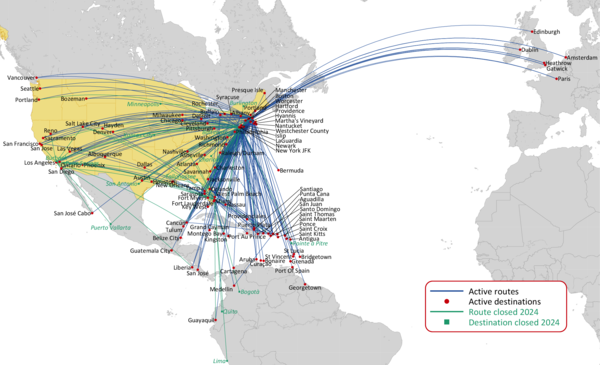
Core to the strategy is undoing the risky over-expansion of the network of 2020. JetBlue announced the closure of 15 underperforming “Blue Cities” and over 50 routes by January 2025 (see map). Roughly 20% of its flying programme is being redeployed to focus on its core North East leisure routes.
It has substantially drawn down services from Los Angeles, exiting its handful of west coast routes, services to Central America and Florida. It is retreating from Fort Lauderdale, where it has been pressured by Spirit, and dropping services to domestic destinations outside its core New England heartland and those to Bogotá, Quito, Guayaquil, and Lima. It is cutting services from its North East bases to destinations in the MidWest, and other non-leisure routes. It has significantly downsized operations at New York’s LaGuardia airport.
But then it has redeployed aircraft on new routes from smaller airports in New England to leisure destinations in Florida and the Caribbean, added frequencies on core North East leisure and transcontinental routes. It is also “seasonalizing” its Mint fleet — redeploying transatlantic aircraft to select domestic routes in the low winter season.
“Capital Light” financial policy
To achieve its financial goals, it is pursuing what it calls a “capital light” policy. Like many other A320 operators JetBlue has been hit by the Pratt & Whitney geared turbofan reliability issues: during 2024 an average of 11 aircraft have been grounded, and it expects grounded aircraft on average to be in the high teens throughout 2025.
In January it “smoothed the upcoming delivery stream” of new aircraft; and then in July renegotiated (again) with Airbus to push 44 of the 48 A321neo aircraft it had originally planned to acquire between 2025 and 2029 into the long grass — now not expected until the 2030s (see table). By this move it will avoid (or defer) capex of some $3bn. It also plans to extend leases (or purchase off lease) up to 30 A320s to maintain capacity in the core fleet.
| In Service | Planned Deliveries∗ | |||||||||
|---|---|---|---|---|---|---|---|---|---|---|
| Sep 24 | [parked] | Avg Age | Q4 2024 | 2025 | 2026 | 2027 | 2028 | 2028+ | Total | |
| A220 | 38 | [5] | 1.6 | 6 | 20 | 20 | 5 | 7 | 4 | 68 † |
| A320 | 130 | [6] | 19.2 | (2) | (5) | |||||
| A321 | 63 | [3] | 8.4 | |||||||
| A321neo | 36‡ | [8] | 3.0 | 1 | 4 | 44 | 49 | |||
| E190 | 20 | 15.3 | (13) | (7) | ||||||
| Total | 287 | [25] | 12.2 | (8) | 12 | 20 | 5 | 7 | 48 | 87 |
Notes: ∗ (contractual return); † Options for 20 A220 2027-28; ‡ Includes 11 LR
It nevertheless continues with its acquisition of A220s (of which it has 48 on order, with 20 options, to be delivered between 2025 and 2028). The aim is to remove the last of its E190s during 2025 leaving it with a two aircraft type fleet. The company states that the A320 have 90% more premium seats and deliver 30% lower unit costs than the E190s leaving the fleet.
In August the airline raised some $3.2bn through three financing transactions: including an expensive $2bn senior secured loan on a near 10% coupon, and a $765m term loan credit at 550bp over base, backed by the assets of its frequent flyer programme, TrueBlue. This leaves it at the end of September with total long term debt of $7.9bn, up from $4.9bn at the start of the year (against a net asset value of $2.6bn), but it does have $4bn in cash — equivalent to 40% of turnover — and the availability of a further $600m from its (undrawn) revolving credit facility.
| FY end December | 2018 | 2019 | 2020 | 2021 | 2022 | 2023 | @ end June | 2024 | |
|---|---|---|---|---|---|---|---|---|---|
| Revenue | 7,658 | 8,094 | 2,957 | 6,037 | 9,158 | 9,615 | Flight equipment | 10,396 | |
| Net income | 487 | 568 | (1,576) | (797) | (260) | (151) | Right of use assets | 555 | |
| Other assets | 1,121 | ||||||||
| Operating cash flow | 1,200 | 1,449 | (683) | 1,642 | 379 | 400 | Current Assets | 4,555 | |
| Capex | (1,114) | (1,156) | (791) | (995) | (923) | (1,206) | Of which Cash∗ | 4,008 | |
| Spirit Acquisition | (297) | (131) | Total Assets | 16,627 | |||||
| Other income (expenditure) | (15) | (15) | 207 | (5) | (46) | (3) | Current liabilities | 3,755 | |
| Free cash flow | 71 | 278 | (1,267) | 642 | (887) | (940) | Long term debt | 7,868 | |
| Inc (dec) in debt | 465 | 658 | 2,504 | (882) | (369) | 1,062 | Lease liabilities | 511 | |
| Equity (dividends/buy back) | (334) | (491) | 481 | 52 | 46 | 49 | Other liabilities | 1,849 | |
| Total Liabilities | 13,983 | ||||||||
| Total change in cash∗ | 202 | 445 | 1,718 | (188) | (1,210) | 171 | Shareholders’ equity | 2,644 |
Product development
JetBlue heralded 2024 with plans to enhance revenue by $300m through various “revenue initiatives”. In January it started charging $49 for “Core Preferred Seats” — the window and aisle seats in the row immediately behind their “Even More Space” premium economy cabin — although elite members of their frequent flyer programme can book these without payment. And it is progressively promoting the Even More Space seats to encourage higher uptake.
From September, the airline changed the specification of the basic economy fare “Blue Basic” to allow passengers booking it to bring on board carry-on luggage to fit in an overhead bin. This brings it more into line with the major network carriers' basic fare products (except for United).
JetBlue has relented to pressure, and with the stated aim “to be loved” by premium leisure passengers, announced plans to open its first ever airport lounges — at JFK towards the end of 2025, to be followed by one at Boston Logan. It also plans to offer a new “Premium” co-branded credit card which will allow holders complimentary access to the lounges, alongside TrueBlue Mosaic 4 members (the highest elite status in the FFP), and customers flying transatlantic Mint (its lie-flat “business class”).
Recent Results
The results for 2024 so far do not make for comfortable reading — although in the company’s presentation on the Q3 results, management prided themselves on improving the quarter’s underlying operating margin by 5 percentage points — albeit to a negative 0.4%.
For the three months to end September, capacity fell by 4% year on year, demand in passenger miles dropped by 2% (and 3% in passenger numbers). Unit revenues grew by 4.3%, helped (probably by the reduction in capacity), while it mentioned that it had achieved a cumulative $275m of its $300m planned “revenue initiatives”, and it was on track to exceed the initial targets. The company also noted that there appeared to be some moderation of the competitive excess capacity on Latin American routes. Costs fell by 4%, helped by a 17% decline in fuel cost. But operating losses (ex special items) came in at $(11)m compared with $(123)m loss in the prior year period, and it generated net losses of $(54)m down from $(129)m in 2023.
For the nine months it achieved underlying operating losses of $(110)m against a $5m profit in the same period last year; and net losses of $(173)m — more than double the $(74)m loss in the comparable period.
Guiding to a full year revenue decline of around 4.5%, and looking at the prospect of flat capacity growth over the next couple of years, returning to historic levels of profitability is possibly going to be a drawn out and tough task.
The market does not yet seem convinced: the shares have underperformed by 85% relative to the rest of the industry since the beginning of 2020.
But at least the company has abandoned its misguided strategies; and the management will be able to focus on “bringing humanity back to air travel”, to be loved, and to be profitable.
