airBaltic: One mini-hub, two micro-bases
and 50 A220s
September 2021

AirBaltic is the world’s second largest operator of A220s, after Delta, 31 currently in its fleet and another 19 scheduled for delivery over the next two years. It is a truly niche airline operating a hub and spoke system at Riga, the capital of Latvia. It also has bases at the Estonian capital Tallinn and the Lithuanian capital Vilnius.
These three capitals are small in comparison to the main population centres in Denmark, Norway, Sweden and Finland, yet the core strategy is to capture passengers to/from the countries and funnel the thin flows through Riga to cities in western, southern and eastern Europe and even the Middle East; pre-pandemic, about 44% of airBaltic’s passengers connected through Riga. Tallinn and Vilnius are essentially point-to-point operations with only two or three aircraft based at each airport.
The three Baltic states are not like the Scandinavian block. For a start, whereas the Danes, Norwegians and Swedes can, with effort, understand each other, Latvian and Lithuanian belong to Balto-slavic, a unique language family, unintelligible to outsiders and also mutually unintelligible between Lithuanians and Latvians. Estonian is a Finnic-Uralic language related to Finnish which itself is unrelated to any other European language (except remotely to Hungarian and maybe Basque). There are also significant ethnic Russian minorities in Latvia and Estonia and, to a lesser extent, Lithuania. (Thank goodness for English!)
What the three Baltic states do have in common is a long history of being controlled by their powerful neighbours, having been ruled at various times by Sweden, Germany, Russia and Poland. Until 1992 they were part of the USSR, and the political legacy is very strong in all three countries. Although they have been members of the EU since 2004, it is difficult to feel secure with President Putin’s Russia as the regional super-power, and it is perhaps even more disconcerting to have President Lukashenko’s Belarus as a neighbour.
Securing connectivity with the rest of western Europe is an understandable obsession, hence each of the states has tried to establish its own national carrier regardless of the commercial logic — Estonian Air, FlyLAL, airLituanica and others were set up as flag-carriers and failed. We developed the business analysis for airLituanica back in 2012 and produced financial projections for the Vilnius-based carrier which indicated that it would probably be unviable, yet the airline went ahead as the result of political thinking that Lithuania could not risk being isolated from the rest of the EU. Also the Baltic governments generally do not trust LCCs like Ryanair to assure continuous operations, which is sort of justified given the number of times Ryanair has threatened to stop services in order to win disputes over airport fees.
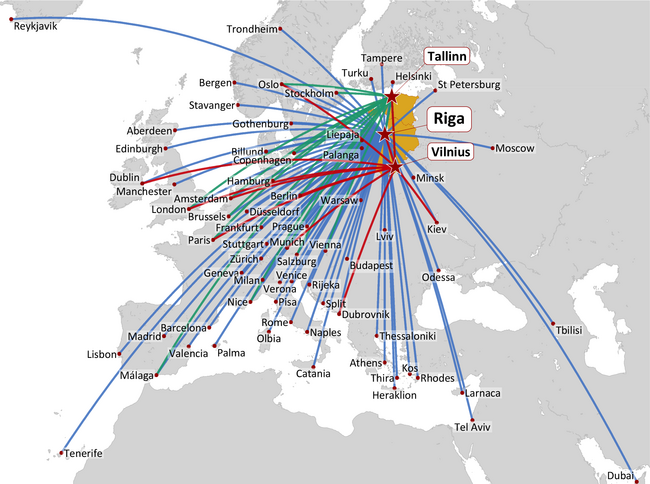
airBaltic, pre-pandemic, came close to solving this politico-economic dilemma, and managing sometimes intense intra-Baltic rivalries, through having three bases in the three states (and painting some aircraft with the national flags of Lithuania and Estonia) although the Latvian operation remains the dominant core of the airline. Over 80 points are served from Riga compared to 15 from Tallinn and 11 from Vilnius.
Tourism is important for the three countries. Riga, Vilnius and, especially, Tallinn have beautifully preserved or reconstructed medieval Old Towns, which we would thoroughly recommend for a city-break holiday.
airBaltic itself has a chequered history. The airline was established in 1995 as a joint venture between SAS, with 47%, and the Latvian state, 53%, with the main purpose of feeding SAS’s hubs. However, by 2009 SAS had had enough of persistent losses and sold its stake to a company called BAS which was wholly owned by the then CEO Bertolt Flick. Herr Flick was a colourful multilingual character who raised the profile of airBaltic partly through remarkably generous trips to Riga for the press, but his tenure ended in acrimony and lawsuits. In 2011 the airline was in effect fully renationalised with a new capital injection from the Latvian state. Martin Gauss was brought in as CEO and became the architect of airBaltic’s current strategy based on the A220. Herr Gauss had previously been at Malév in Budapest and Deutsche BA in Munich, and has qualified as an A220 pilot at airBaltic.
airBaltic became a launch customer for the A220 in 2016 when it placed an order for 50 A220-300s (then Bombardier CS300s) plus 30 options. We estimate that the price for the 50 firm orders was in the order of $1.4bn, all the aircraft being financed through sale and leasebacks, notably with ACG and Chorus Aviation Capital
| End 2019 | Mid 2021 | End 2023† | |
|---|---|---|---|
| A220-300 | 22 | 31 | 50 |
| 737-300 | 4 | ||
| Q400 | 12 | 12* | |
| Total | 38 | 43 | 50 |
The A220 strategy is at the core of the airline’s business plan, entitled “Destination 2025 CLEAN”, which in its latest version submitted to the Latvian government in June envisages all the firm orders being delivered by the end of 2023, bringing the fleet to 50 units from 31 in September this year. The 737-300s have already been deleted from the fleet and the 12 Q400s have been parked permanently and are due to be returned to the lessor, Nordic Aviation, in 2022 and 2023, at a cost of €90m to airBaltic.
airBaltic is effusive about the 145-seat jet, emphasizing its environmental characteristics — a much smaller noise footprint and markedly lower carbon emissions compared to comparable aircraft, hence the “CLEAN” in the business plan title. It is a very green-orientated company; indeed, its 2020 “Sustainability and Annual Report” devoted many more pages to ESG issues than to financials.
The A220 is claimed, probably correctly, to be the optimal aircraft for its business model — economical over short hops feeding traffic to/from the Riga hub and also capable of a commercial range of 4,575km. It operates to Tenerife and Dubai, both routes of around 4,500km.
However, competing with LCCs while using a connecting hub system and flying 145-seaters remains a huge challenge. The table updates an A220 fuel economics comparison from a table in airBaltic’s 2018 bond prospectus, which sourced data from Bombardier/Airbus, and showed the airBaltic A220 having a 12-14% fuel cost advantage over Wizz’s A320 NEO or Ryanair’s 737 MAX in terms of trip costs. But this turns into 13-16% cost disadvantage on a cost per seat basis, and a 29-32% cost disadvantage per passenger when the different average load factors are factored in (75% for airBaltic, 93% for the LCCs).
| A220-300 | A320 NEO | 737 MAX 8 | |||
|---|---|---|---|---|---|
| (airBaltic) | (Wizz) | (Ryanair) | |||
| Trip fuel (tonnes) | 4.75 | 5.31 | 5.4 | ||
| Trip (1 hour) cost Euros | 2,778 | 3,105 | 3,158 | ||
| Compared to A220 | 100% | 112% | 114% | ||
| Cost per Seat | 19.2 | 16.7 | 16.0 | ||
| Compared to A220 | 100% | 87% | 84% | ||
| Cost per Pax | 25.2 | 18.0 | 17.2 | ||
| Compared to A220 | 100% | 71% | 68% |
Notes: Current fuel price, $680/tonne, seat capacities = 145, 186 and 197, load factors= 76%, 93% and 93%
airBaltic describes itself as a hybrid, meaning having a cost structure something like the LCCs and service quality akin to that of the European networks (better, one would hope). It does achieve an average revenue per passenger of just over €100 per passenger in normal times compared to total revenue of €55 at Ryanair. It also offers a Business Class product — same 32” pitch as in the rest of the plane but you get two seats and plenty of frills like lounges and three course meals. Logically the airline has not joined a Global Branded Alliance (too expensive) but it does have an extensive series of codeshare agreements — 27 in total.
In the four years before the Covid-19 crisis, airBaltic just about broke even — a net profit margin of 1%. Operating cashflow during the period was €189m which was inadequate to cover capex, even allowing for cash inflows from sale/leasebacks. Free cashflow was negative, totalling -€191m, and was covered by an increase in debt of €181m and a public/private equity injection of €131m in 2016. This should have at least stabilised airBaltic’s finances, but Covid-19 hit airBaltic hard.
| Total | Jan-Jun | ||||||||
|---|---|---|---|---|---|---|---|---|---|
| FY (Jan-Dec) | 2016 | 2017 | 2018 | 2019 | 2020 | 5 years | 2020 | 2021 | |
| Revenues | 284 | 347 | 409 | 503 | 138 | 1,681 | 82 | 50 | |
| Net result | 19 | 4 | 5 | (8) | (265) | (245) | (185) | (62) | |
| Operating Cashflow | 12 | 43 | 47 | 87 | (89) | 100 | (33) | (14) | |
| Capex | (127) | (148) | (53) | (65) | (42) | (435) | (16) | (30) | |
| Other Income (Exp) | (18) | (22) | 28 | 25 | 15 | 28 | 2 | 11 | |
| Free Cashflow | (133) | (127) | 22 | 47 | (116) | (307) | (47) | (33) | |
| Inc (Dec) in debt | 45 | 95 | (29) | 70 | (109) | 72 | (30) | (47) | |
| Equity injection | 131 | 250 | 381 | 250 | |||||
| Total Cashflow | 43 | (32) | (7) | 117 | 25 | 146 | 173 | (80) | |
Traffic volumes collapsed by 74% to 1.3m in 2020 and a net loss of -€245m was reported. With schedule cutbacks the connections at Riga no longer worked and the transfer ratio at Riga was halved to 23% of total passengers (which pushed up average yield by 10%). The main cost-cutting response was to reduce the workforce by 40% from 1700 to 1,000, though it seems that many or most of these will be re-employed as the A220 deliveries are continued through 2023.
In May 2020 the Latvian government injected €250m of new equity into airBaltic as an EU-approved emergency measure. But the first half of 2021 was even worse than the same period of 2020 in terms of traffic numbers — passengers down 59%. Although the net loss was reduced to -€61m from -€185m in the same period of 2020 through cost-cutting,, the airline rapidly burnt through the 2020 cash injection, necessitating another €90m agreed by the state shareholder in August this year and also approved by the EU. This brought the state ownership of airBaltic up to 96% and mostly wiped out the 20% stake held by Lars Thuesens, a Danish entrepreneur who jointly invested in airBaltic along with the Latvian state back in 2016.
airBaltic’s balance sheet as at mid-year showed the carrier to be technically bankrupt with -€44m of shareholders’ funds. The cash balance was €68m which compares to a negative free cashflow of -€33m in the first half of 2021. The €90m injection in August looks like a short-term palliative in this context.
After receiving the latest equity injection airBaltic stated that “the investment is planned to be returned to the Latvian state in form of proceeds from selling shares during a planned IPO.” Is an IPO feasible, especially in the short term, 2023 or 2024, as implied by the company and hoped for by the government?
The Destination 2025 CLEAN plan presented by the airline to the Latvian government apparently contained detailed projections showing the way to an IPO. Unfortunately, they are not available to outside analysts.
Prior to the pandemic the Latvian government hired two investment banks, Lazards and Greenhill, to try and find an private equity investor for the airline and to operate in partnerships with the state. That failed and the financial numbers continue to be challenging.
Since 2016 the airline has absorbed about €400m of state funding — we suspect that another cash injection may be necessary next year — and presumably the government is expecting a large portion of this to be returned from the proceeds of any IPO. There is also the €200m bond issued in 2019 and expensively priced at 6.75% pa which falls due in 2024. Meanwhile, the airline by maintaining its aggressive fleet growth plan — 19 additional A220s — will incur over €500m in capex over the next two years. These will be financed through sale and leasebacks, so the airline is relying on the appetite of the lessors for A220s.
Adding so much new capacity when demand is so depressed and the outlook so uncertain seems like a very risky strategy. The airline simply states that it will lease out spare capacity to other carriers.
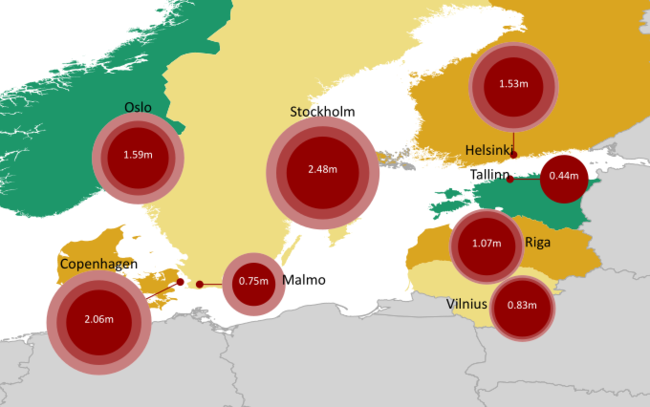
Assuming that the airBaltic fleet reaches 50 units by the end of 2023 and the European market rebounds from the Covid-19 depression then airBaltic might be expected to carry around 7.5m passengers in 2024, a 50% increase from the 5m achieved in 2019 — see chart. Is this feasible?
The chart shows a high-level estimate of capacity scheduled pre-pandemic from the four Scandinavian countries to other European destinations. This is the main traffic flow from which airBaltic has to try and capture connecting passengers. Very roughly it is (or was pre-pandemic) a market of 52m passengers. If airBaltic restores fully its 2019 traffic base then it would need to capture about 3% of this traffic flow (assuming growth comes mainly from connecting rather than direct services) in order to achieve 7.5m passengers. It is possible.
Overall though, airBaltic seems to be being over-ambitions — or the Latvian government’s expectations are unrealistic. The airline has a very good reputation, a truly niche hubbing strategy and a modern fleet of highly efficient aircraft, but it remains a small player in the European scene, vulnerable to LCC competition and with delicate finances. In the post-pandemic European market its future may remain tied to state ownership, as it describes itself, “a strategic facilitator of the Latvian economy”.
| Owners | In Fleet | Firm Orders | Options |
|---|---|---|---|
| Delta | 50 | 45 | 50 |
| airBaltic | 31 | 19 | 30 |
| SWISS | 30 | ||
| Air Canada | 24 | 21 | |
| Egyptair | 10 | ||
| Korean | 10 | ||
| JetBlue | 6 | 64 | |
| Airbus | 5 | ||
| GTLK Leasing | 5 | ||
| Air Austral | 3 | ||
| Air Tanzania | 2 | 2 | |
| Ibom Air | 2 | ||
| Air Manas | 1 | ||
| Breeze | 80 | ||
| Air France | 60 | ||
| ALC | 50 | 25 | |
| Macquarie | 29 | ||
| LCI | 20 | ||
| Nordic AC | 20 | ||
| Ilyushun Finance | 14 | ||
| Unannounced | 11 | ||
| Air Senegal | 8 | ||
| Iraqi AL | 5 | ||
| Air Vanuatu | 3 | ||
| Falcon AS | 2 | ||
| TOTAL | 179 | 453 | 105 |
