Lufthansa buys
into Italy
Jul/Aug 2024

Lufthansa has finally been given the green light to acquire a major stake in Italia Trasporte Aereo (ITA), the latest phoenix-like reincarnation from the ashes of the failed Alitalia.
For a modest €325m injection of new capital into the airline (matched by €250m new equity from the Italian government), Lufthansa will get a 41% stake, two of the five seats on the board, and the right to appoint ITA’s CEO. ITA will be under joint operational control of Lufthansa and the Italian Ministero dell’Economia e delle Finanze (MEF), and the deal is structured in such a way that Lufthansa will not need to consolidate ITA in its accounts. There is a clause giving Lufthansa the right for a full takeover with call options between 2025 and 2033, and the Italian government put options, subject to undisclosed conditions.
Alitalia was the fourth largest European airline when it last made an operating profit in 1998. Since then it has all been downhill: bankruptcy in 2008 (from which it emerged two-thirds its former size); further restructuring in 2014 with a €560m investment from Etihad as part of its Hunter Strategy (see Aviation Strategy, April 2015). Alitalia finally ran out of cash in 2017 (before the COVID pandemic made it fashionable), and its troubled 49% shareholder Etihad walked away.
The Italian government provided a €900m short term loan and the airline was put into special administration with the hope of finding a buyer. Several suitors appeared, including the state-owned railway Ferrovie dello Stato (see Aviation Strategy, May 2019) and Delta (which, having splurged $1.9bn on a 20% stake in LATAM in 2019 — what timing! — baulked at paying more than €100m for 10% of Alitalia’s equity). After the pandemic hit, hope was abandoned, and renationalisation became the only option.
A new state-owned company, Italia Trasporte Aereo (ITA), with €3bn of funding was formed at the end of 2020 to acquire the “good” parts of Alitalia — the brand, the frequent flyer programme MilleMiglia, and the slots at Milan Linate. The new airline was launched in October 2021 — a much slimmed-down version of its predecessor. Alitalia in 2019 had had over 100 aircraft, carried 23m passengers and employed 10,000 staff, and probably generated turnover of around €3.1bn.
ITA in 2022 had 66 aircraft, around 3,900 employees on its payroll (the flight and cabin crew contracts had been completely renegotiated, and it had no legacy pension obligations from the former Alitalia), carried 10m pax and revenues reached €1.5bn. It currently operates 99 aircraft, and in 2023, its second full year, carried 15m pax with a turnover of €2.4bn. With an homogenous leased Airbus fleet, fully outsourced maintenance and ground handling, and a “reset of the IT and supplier landscape”, Lufthansa describes ITA as having been “fully restructured and set up as a structurally competitive airline”.
| Alitalia | ITA Airways | |||
|---|---|---|---|---|
| 2019 | avg age | 2024 | avg age | |
| 777 | 12 | 16.0 | ||
| A350 | 6 | 4.8 | ||
| A330 | 14 | 10.5 | 18 | 5.5 |
| A319 | 22 | 12.6 | 10 | 15.9 |
| A320 | 38 | 12.9 | 43 | 9.5 |
| A321 | 10 | 22.0 | 6 | 0.6 |
| A220 | 16 | 1 | ||
| E175 | 15 | 7.4 | ||
| E190 | 5 | 7.9 | ||
| Total | 116 | 12.7 | 99 | 7.2 |
The graph may justify that statement. The data is taken from Skailark’s Airline Economics data analytics, and shows ITA as having the lowest stage length adjusted unit cost of any airline in the Lufthansa Group (although unit revenues are another matter).
Note: stage length adjusted revenues and costs per ASK, twelve months to June 2024.
Remedies
Lufthansa made its original bid early in 2023. The intervening 18 months seem to have involved significant horsetrading between Lufthansa and DG Comp in Brussels (and no doubt the Italian Government), to allay the Competition Authority’s concerns of market concentration. At one point Brussels is reported to have suggested that ITA should not be allowed to join the metal neutral immunised joint venture between Lufthansa Group, United and Air Canada — a demand that would have scuppered the deal.
The agreed solution required a divestment of a sixth of the joint slot portfolio at Milan Linate — leaving Lufthansa/ITA with only 50% of the slots down from 60%.
DG Comp voiced concern over the potential reduction of competition on routes from Italian airports particularly to points in Central and Eastern Europe where it saw significant overlap between Lufthansa Group airlines and ITA (bizarrely Brussels doesn’t seem to regard Ryanair or Wizz as viable competitors).
It therefore required the new combination to ensure a new competitor on ten direct short haul routes (accounting for 3% of ITA’s capacity) — and, oddly, give the new competitor access to ITA’s domestic feed.
On long haul, Lufthansa and ITA are to facilitate new direct or indirect competition on three routes from Rome to Washington, San Francisco and Toronto for three years. This accounts for about 7% of ITA’s intercontinental capacity. In the (somewhat likely) event that no new direct competitors are forthcoming, the remedy can be delivered by creating a new indirect routing through a competitor hub with no more than a three-hour connect in Europe or a four-hour connect in the US.
This also is a bit bizarre. Lufthansa said that this remedy could be met by ITA operating a new short-haul service to a competitor hub — eg London (if it could get the slots), Paris, Madrid, Dublin or Lisbon — with the right timing, thus creating an interline routing with BA, Air France, Iberia, Aer Lingus or TAP.
Rationale for ITA
Why does Lufthansa want to buy a small national flag-carrier? Historically, Lufthansa has justified its acquisition policy on concentrating on its tedescophone “natural” area: Germany, Austria, and parts of Switzerland and Belgium speak variations of German. But then, so does a small part of northern Italy.
But Italy is also the third largest economy in the EU (post Brexit), the third largest airline market in Europe (post Brexit) and Lufthansa regards it as the fifth largest market for the Group (after its four “home” markets and the USA). Lufthansa notes that Milan is the second largest destination for local passenger traffic in the EU, and Rome the sixth.
Lufthansa contends that there is an attractive proposition to grow a profitable long haul business out of Rome Fiumicino, and that it is well positioned “to take advantage of Italy’s importance as top private travel destination” (for which read in-bound tourist traffic) and that there is “potential to increase the feed of passengers into the Group’s existing long-haul network including JV partners”.
There are expectations of synergies. Lufthansa will be able to plug ITA into its multi-airline structure — subsuming non customer-facing activities (finance, revenue management, network planning, IT, fleet management, procurement) into existing Lufthansa Group functions. There is the strong possibility of good benefits from linking ITA Airways into services from Lufthansa Technik and Lufthansa Cargo. Taken perhaps by the idea that its acquisition target is based in a country with some of the best food in the world, Lufthansa describes the amalgamation process as “One kitchen, many restaurants”.
The acquisition will add Rome Fiumicino and Milan Linate to Lufthansa’s agglomeration of restricted hubs. It currently controls Frankfurt, Munich, Zürich, Vienna and Brussels. Each of the group’s hubs, despite being some of the largest airports in Europe, have relatively small local catchment areas, some have relatively low true O&D traffic and are reliant on feeder transfer networks.
In the map we show the population density distribution within Europe, the top four Western Europe airports, Lufthansa’s seven hubs and their respective catchment populations. The mass of European population runs in a blue crescent from London through the Ruhrgebiet to Milan and the Po Valley.
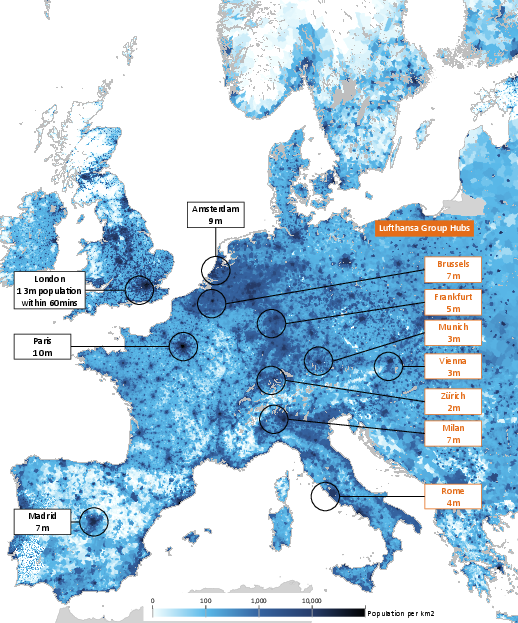
Milan has a catchment population of 7m people within an hour of access to the airport. But ITA’s involvement there for historical and political reasons is exclusively in the downtown Linate airport (annual passenger throughput of 9.5m) which is limited to short haul intra-European flights. At the beginning of 2024 ITA withdrew its last remaining Milan-based long haul flight — to JFK — from the larger Milan Malpensa (29mppa in 2019): it lacked a feeder network.
Rome has a catchment population of 4m, and Fiumicino is ITA’s choice of long haul network hub but there are geographical disadvantages. The key long haul market to and from Italy is the US, and there is good inbound demand from select points in Asia. But these are highly seasonal and Rome is too far south and east effectively to feed traffic from populous intra-European destinations on to these routes; there are limited opportunities to garner feed from European destinations to its east on to North Atlantic services.
South Atlantic is more promising. Argentina and Brazil have significant Italian diasporas that provide meaningful long haul markets for ITA, the routes to Argentina particularly benefitting from weak competition. Even so, Spain and Portugal are better placed to act as hubs between Europe and Latin America.
Lufthansa’s suggestion that it could develop routes through Rome into Africa is probably more wishful thinking than a likely prospect: Italy was late to the game in its colonial ambitions (colonial legacy being a large reason for the strength of long-haul demand to African destinations for British Airways, Air France and Brussels Airlines), and its establishment of colonies in Ethiopia, Somalia, Eritrea and Libya as part of the Italian Empire is best forgotten.
†Heathrow, ‡Roissy Charles de Gaulle, §Gatwick,¶Orly, ∗Malpensa.
Network Analysis
The chart shows the competitive analysis of ITA Airways' network. The data (again) comes from Skailark’s airline economics dataset showing the airline’s relative market share on individual city-pairs plotted against its costs of operating those routes as a proportion of the costs of its competitors on those routes. We’ve excluded the handful of monopoly routes.
There are very few clear winners — where ITA has a leading market share and costs lower than the competition. These include routes from Rome to Buenos Aires, New York, Tokyo and Delhi. Its service to São Paulo almost makes it. Surprisingly a handful of domestic routes also appear: Rome to Trieste, Firenze and Milan to Firenze. (With a relative market share of 8 these are near monopolies.)
Those routes where ITA has a reasonable cost advantage, but market share weakness, are primarily on other North American routes: Rome to San Francisco, Washington, Chicago, Toronto and Boston.
There are a sizeable number of city-pair routes where it has market share advantage but a cost disadvantage, but nearly 50% of the city-pair routes it operates with competition it lags in both cost and market position. And despite its restructured cost base, on average its costs are twice those of its competitors.
This is not surprising. ITA Airways does not control its domestic or short haul international markets. Taking advantage of Alitalia’s weakness and ITA’s remodelling, Ryanair, easyJet, Wizz and Vueling have all muscled in. Ryanair has a commanding market position with over 40% of the domestic capacity (nearly twice the size of ITA Airways). Ryanair is also the largest operator on international routes with nearly 30% of the seats: here, ITA Airways trails in fourth place behind easyJet and Wizz.
