PIA: Will Privatisation
Succeed?
Jan/Feb 2026

Pakistan has had to go cap-in-hand to the International Monetary Fund for a bailout 24 times since joining it in 1950; and three times in the past six years (2019, 2023 and 2024) for a total of $11bn. One of the conditions in the 2023 agreement was the privatisation of the country’s flag-carrier Pakistan International Airlines (PIA). After several aborted attempts this was finally achieved in December 2025, the Government selling a 75% stake for ₨135bn (US$482m) in a publicly televised auction in an Islamabad hotel to a consortium headed by the Arif Habib Corporation.
Founded in 1955 following the nationalisation of Orient Airways, PIA was once among Asia’s most innovative carriers. It helped launch several aviation “firsts”, including early jet operations in the region (a B707 leased from PanAm in 1960 and used on a route to London), the first airline to show films on international flights (in 1962 — TWA had pioneered the innovation on domestic US services the year before) and the establishment of training and engineering capabilities that supported other emerging airlines in Asia. It claimed the accolade of being “the second best airline in the world” in the 1960s.
For decades the airline served as a flagship enterprise for Pakistan’s aviation ambitions. However, by the early 2000s the company had entered a prolonged period of decline characterised by chronic financial losses, political interference, significant over-staffing and, underinvestment in its fleet. It has been persistently loss-making at the operating and net level (see chart) requiring constant funding top-ups from the State. Between 2014 and 2022 it achieved an annual average negative operating margin of -19%, and a -46% negative net margin. Between 2005 and 2023 it lost a total of ₨754bn (US$6.2bn) without having reported a positive result in any single year.
Over that period PIA allowed its natural dominance over the nation’s air travel to fail. The domestic air travel market stagnated at at 6-7m passengers a year. New entrants arrived and PIA saw its domestic market share fall from 72% in 2010 to 29% in 2025 behind new entrant LCC Fly Jinnah (see graph). The International market in contrast had grown at a compound annual rate of over 7% between 2010 and 2019: and 2025 the 18m pax carried was 13% higher than the prepandemic peak in 2018. However, substantially, all that growth was on routes to the Arabian Peninsula to satisfy the Pakistani diaspora not only in the Gulf, but also, through the superconnecting hubs, that in the UK. PIA’s international market share fell from 44% in 2010 to 16% in 2025 (see graph).
Operational inefficiencies were stark. At one point the airline employed over 450 staff per aircraft, far above international productivity benchmarks — Delta for example gets by with a staff-to-plane ratio of 100+, and low cost paragon Ryanair with around 20. The average number of employees has fallen by two-thirds since 2010 to 6,625 in 2024, but this is still equivalent to 210 staff per aircraft.
The company’s problems worsened following the fatal crash of PIA Flight 8303 in May 2020, which exposed irregularities in pilot licensing oversight within Pakistan’s aviation system. The aviation minister announced to Parliament in June of that year that 262 out of the 860 pilots in the country had bogus licences, alleging that they had paid someone else to take the exam for them. Regulatory authorities in Europe, the UK and USA subsequently banned the airline from operating to their markets. The EU ban was finally lifted in November 2024; the UK’s in September 2025.
Restructuring before privatisation
The path to privatisation required significant financial and organisational restructuring. PIA had accumulated enormous liabilities over decades of government ownership. The 2023 accounts show total debt (including accrued interest, and pensions) of ₨570bn ($2bn) supported by a negative net worth of ₨(553)bn ($-2bn).
To make the airline attractive to investors, the Pakistani government transferred the airline into a subsidiary of a government owned PIA HoldCo, which retained all the long term debt and the “bad bits” of the former group, effectively recapitalising the airline prior to sale. The FY 2024 accounts showed net debt of ₨28.8bn ($103.5mn) and a net asset value of ₨3.6bn ($12.7mn). The airline even reported its first net profit in decades — all resulting from the write-back of deferred taxes.
Structure of the deal
In December 2025, the Pakistani government sold a 75% majority stake in PIA to a consortium led by Arif Habib Corporation for ₨135bn. The majority of the funds will be used as a capital injection into the airline, with the government retaining ₨10bn of the cash. The first financial closing of the transaction is expected by the end of April. At that stage, the consortium will be required to pay about two-thirds of the bid amount. The investor group will also then indicate whether it intends to exercise the option to purchase the government’s remaining 25% stake in PIA at a premium of 12%.
The consortium included companies from several sectors and include some unusual bedfellows:
- Arif Habib Corp is a major Pakistani holding company founded by Arif Habib, with a diversified portfolio in brokerage, investment, energy, and industry. A former head of the Karachi Stock Exchange he runs Pakistan’s largest largest securities brokerage, investment banking, and research firm. He has also served (a decade ago) on the board of PIA;
- AKD Group Holdings Limited, founded by Aqeel Karim Dhedhi (who also started in stockbroking), is also a diversified conglomerate operating securities brokerage, investment banking, venture capital, private equity, telecoms, real estate development, oil & gas exploration and asset management;
- Fertiliser company Fatima Fertilizer, based in Lahore (a joint venture between Arif Habib Corp and Fatima Corp);
- Private school network City Schools, and
- Real estate firm Lake City Holdings Limited.
Another (military-backed) fertiliser conglomerate, and Pakistan’s premier producer of urea, the Rawalpindi-based Fauji Fertilizer Company joined the consortium after the bid was accepted. (It’s also into wind energy, food processing and banking).
A successful privatisation serves multiple objectives for Pakistan’s government: reduce fiscal burden of state-owned enterprises; satisfy reform commitments linked to IMF financing programmes; improve efficiency and service quality in the aviation sector.
From the investor perspective, the acquisition may represent a turnaround opportunity in a large and underserved aviation market. Pakistan’s population of more than 240 million, combined with strong labour migration flows to the Middle East and Europe, provides substantial demand for international air travel.
Quoted in a Bloomberg article, Aqeel Karim Dhedhi said: “There are no direct flights from Pakistan and currently passengers are taking transit flights from airlines based in Qatar, Abu Dhabi, Saudi Arabia and Turkey. We will take our business back from these airlines. Passengers who can have a direct flight would never want to take a transit flight.”
Plans?
The airline currently has 32 aircraft, a mixture of 17 A320s, 12 777s and one ATR42. Of these 14 are currently in store (see table). The fleet is pretty ancient, with an average age of 18 years. And the fleet size is small relative to the airline’s historic network footprint. Boeing’s backlog shows it still has outstanding orders for five 777-300ERs, from an order the airline placed in 2012. But the 777-300 production line effectively closed following the delivery of the last of the type to Ethiopian in late 2024, so these orders may be somewhat theoretical.
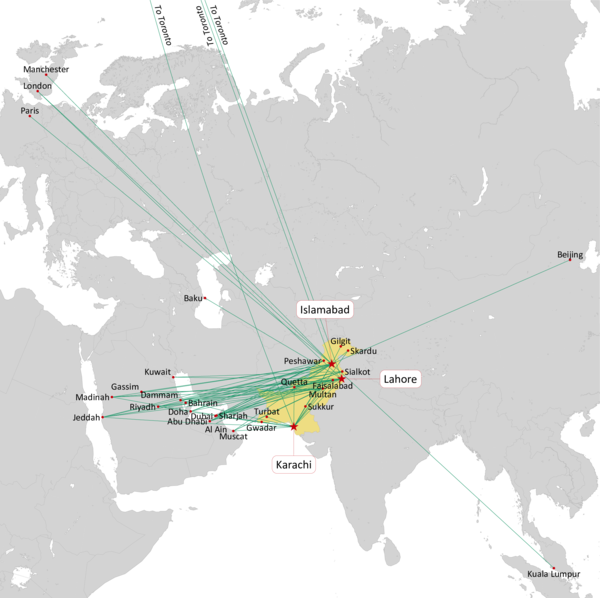
The airline currently serves 33 destinations in 13 countries (see map). (At its peak in 1999 it served 83 destinations in 39 countries). Apart from the route to Beijing, these mostly reflect the pressure of demand from the 10m strong Pakistani diaspora — London, Manchester, Toronto and the Gulf States. (Because of on-going diplomatic tensions there are no routes to India — both India and Pakistan having closed their airspace to the other’s airlines). Somewhat surprisingly missing are destinations in the US — up to 2017 the airline tagged a route onto New York from Manchester — but PIA is waiting for a result of an audit by the FAA to allow it to resume services. Two other Islamic nations appear on its current route network: Azerbaijan and Malaysia.
The success of privatisation will depend largely on the new owners’ ability to implement a coherent strategic transformation. Three priorities are likely to dominate the airline’s agenda. Fleet renewal may represent the most urgent strategic requirement. The consortium apparently plans to bring back six of the aircraft in storage by the end of 2026 to give an operating fleet of 24 units, build that to 38 by end 2027 and aims to have 60 operational in five years time. The agreement requires it to plan for 65 units in the longer term. Dhedhi suggests that the consortium is in discussion with Airbus and Boeing for future orders, but since there is currently little availability for new aircraft before the early 2030s, PIA would get their help to secure interim second hand leases.
Historically, labour productivity has been one of PIA’s greatest weaknesses. State ownership led to politically motivated hiring, resulting in an employee-to-aircraft ratio far above industry norms. Privatisation may create the opportunity for voluntary retirement programmes, productivity reforms, and new performance-based employment structures. However, labour restructuring remains politically sensitive, and the privatisation agreement reportedly requires the new owners to retain existing employees for at least one year. This suggests workforce reform will be gradual rather than immediate.
Perhaps the most difficult challenge facing PIA is reputational recovery. Over the past decade the airline’s brand has suffered from safety controversies, operational disruptions, and dire financial instability. Rebuilding customer trust will require sustained improvements in onboard product, punctuality, service quality and may include investment in digital distribution and a loyalty programme. Brand repositioning may also involve re-launching PIA as a modern national carrier emphasising reliability and hospitality.
The consortium has suggested that it aims to float the airline on the Karachi stock exchange through an IPO later in 2026.
| In service | Parked | Total | Avg age | On order | |
|---|---|---|---|---|---|
| A320ceo | 11 | 6 | 17 | 16.8 | |
| 777-200 | 4 | 4 | 8 | 21.0 | |
| 777-300ER | 2 | 2 | 4 | 18.3 | 5 |
| ATr42 | 1 | 2 | 3 | 19.4 | |
| Total | 18 | 14 | 32 | 18.0 | 5 |