Iran War: The Gentler Scenario
Jan/Feb 2026


There seem to be two basic scenarios for the development of the Iranian war, which alas depend on what is going on in President Trump’s head.
Escalation: US troops on the ground in Kharg Island, intensified bombing of Iran and retaliation by Iran and its proxies on Israel and the Gulf Arab states, complete closure of the Strait of Hormuz and pipeline attacks, while Houthis attack in the Red Sea. The consequences for the global economy and political stability are simply unknowable, and the implications for the airline industry seem irrelevant.
Deescalation: US declares victory and withdraws its forces, missile strikes diminish, but a new hardline theocratic regime remains in Tehran threatening ship movements through the Strait. This seems marginally more probable, and we can add a couple of observations from past experience.
That experience incidentally dates back to 1980 when the author was first engaged on an analysis of the oil tanker business resulting from a closure of Hormuz during the Iran/Iraq war. Then, as now, the Strait was never fully closed, and some shipowners were willing to make the transit. The part-closure was mitigated using pipelines, a logistic that may have been underestimated this time. The Saudis can send most of their production from the northern oilfields through the Transarabian Pipeline to Yanbu on the Red Sea from where it can be carried to Asia directly in VLCCs or to Europe, via Suez or the parallel Sumed pipeline, in medium-size ships. From Kuwait there is a pipeline to Ceyhan in Turkey and from the UAE a pipeline to Fujairah in the Indian Ocean.
The huge spike in crude and jet kerosene prices is shown in the graph with the differential between the two widening markedly as airlines scrambled for supplies. These are of course spot prices; the actual impact on individual airlines depends on their forward purchasing and hedging policies (generally well hedged for European airlines, not covered for US carriers).
The spike is, however not as pronounced as that caused by the Russian invasion of Ukraine, and we would expect a relatively short period of high prices before the decline that always takes place once a crisis has passed.
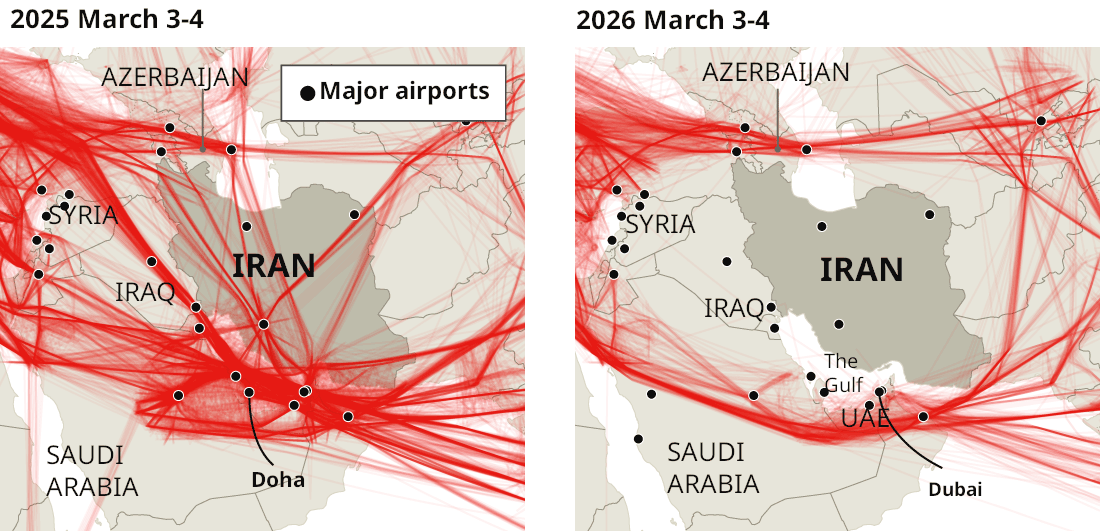
The war banished civilian aircraft from around Iran, in effect shutting the mega-hubs of the Gulf — see maps. But by the end of March Emirates and Etihad had resumed some 60% of their schedules and Qatar 40%, albeit at load factors reported to be only around the 50% mark.
The graphs are a reminder of the residence of the super-connectors which have recovered most of their traffic and all of their revenues since the pandemic. In that crisis it was speculated that the super-connector model would be fatally undermined as the global connecting systems would act as a global super-spreaders of viruses.
The systems may, nevertheless, concede some of their markets to THY and its super-capacity facilities at İstanbul. European and Asian network carriers expect to capture additional premium traffic on direct routes but they do not have the capacity to compete with the super-connectors on volume. Chinese airlines are building their own global connecting networks, and the Iran war might add to the advantages they already have by being able to fly through Russian airspace.