THY: Ten Years of
Super-growth
Jul/Aug 2024


THY was one of the first airlines to achieve a genuine postpandemic turn-around. Its strong upward trajectory continues as it aims to establish itself as the leading global superconnector.
THY managed to produce a marginal net profit during the pandemic years of the 2021 and 2022, mainly by converting into a cargo carrier. It then surged ahead, with almost 200 jets added to the fleet during 2022 and 2023. Passengers carried increased by 16.1% from 71.8m in 2022 to 83.4m in 2023, capacity (ASKs) by 16.3% to 235bn. Total revenues reached $20.9bn in 2023 and net profits of $2.9bn were reported (ex-exceptionals), a remarkable 14% margin for a network carrier.
All this was achieved against a background of financial crisis in Türkiye as President Erdoğan’s years of booming growth, fragilely based on grandiose infrastructure projects and populist spending, disintegrated into hyper-inflation. The inflation rate peaked at 85% at the end of 2022 and has since moderated to just 62%, Erdoğan having been forced to accept increases in interest rates to 50%. The Turkish Lira has depreciated sharply, by about 20% over the past year.
THY’s operations protect it to a large extent from exchange rate volatility. Its revenue split is 55% US dollar or dollar-correlated, 33% Euro, 10% Turkish Lira, 2% other. Its cost split is: 55% dollar, 32% Lira, 10% Euro, 3% other. However, operating in a hyper-inflationary environment causes potential distortion of financial results and bizarre accounting complications.
The reporting currency for THY’s IFRS accounts is the US dollar but its statutory tax accounts are denominated in Lira. This meant that, among other, things the original values of the THY fleet expressed in Lira were markedly undervalued, exposing THY to a major tax liability when the dollar values of the fleet were converted into Lira. However, when an inflation-related adjustment was applied this liability was reversed. This is why THY has reported profit for 2023 of $6.02bn, comprising a “real” profit of $2.9bn plus an exceptional income of $3.1bn relating to “Reversal of deferred tax liability due to inflation adjustment on the statutory tax accounts”.
The table provides a snapshot of THY in the first half of 2024 compared to prepandemic 2019. Total revenues were up 75%, on the back of a 38% increase in capacity (ASKs), while operating costs were restricted to a 60% increase, turning an operating loss of $163m into a profit of $633m. In brief, the financial turnaround has been the result of a 27% improvement in unit revenue (RASK) compared to a 16% increase in unit costs (CASK).
Visionary plan
This year THY resumed the publication of its long-term plan, an exercise that was suspended during the pandemic. Its new vision for the period to 2033, which will be its hundredth year, is anything but modest.
- Increasing passenger volume by an average of over 7% pa from 83m in 2023 to 170m in 2033.
- Achieving revenues of over $50bn by 2033, compared to $21bn last year.
- Maintaining its current EBITDAR margin of 20-25% during 2023-2033.
- Expanding the fleet from 460 at end-2023 to over 800 aircraft by 2033.
- Growing the passenger network from 295 to 400 online destinations.
- Total employment (including subsidiaries) estimated at 150,000 by 2033, double the current total.
- Doubling the cargo volume, making Turkish Cargo one of the top three cargo carriers globally by 2033.
- Growing the low-cost subsidiary, Ajet, as a competitive force, with a fleet of 200 aircraft targeted for 2033, twice the current fleet.
- Improving customer experience and brand recognition through “a customised service across all service channels”, as well as providing the best digital experience globally.
- Becoming a “Carbon Neutral” airline by 2050.
The foundation for this 10-year expansion is a mega-order for around 600 aircraft, split equally between the two OEMs and equally in expenditure terms between narrowbodies and widebodies. THY made its intentions clear back in 2022 but there have been some issues that held up the transactions.
At the end of last year THY and Airbus confirmed an order for 150 A321 NEOs (plus options for a further 100), bringing the current backlog to 192 units. But this year the airline has faced engine reliability and availability problems with the PW1100G-JM that powers the A321 NEO, causing a disruption of delivery schedules. However, in July reached a compensation settlement with IAE.
THY also ordered 70 A350s (50 A350-900s, 15 A350-1000s and 5 A350Fs), following on from two orders from the manufacturer for 14 A350-900s earlier in the year. Total A350 backlog is 87 units.
Negotiations, or rather renegotiations as an original order was cancelled in 2021, with Boeing on for 150 737 MAXs and 75 787s have been protracted, with the two parties unable to agree on the pricing for CFM’s LEAP engines, the sole provider for the 737 MAXs. Currently, THY’s Boeing backlog consists of just 7 787-9s plus 4 777Fs.
Financing the mega-order
Even allowing for significant discounts the total order will be in the range of $30-35bn, implying an annual average capex from now to 2033, three times that of the average of the past ten years.
However, the balance sheet looks quite solid: $15.6bn of equity against $11.0bn on long-term debt, $6.0bn in cash and equivalents. And the airline is 49% owned by the Turkey Wealth Fund, the national investment vehicle, which facilitates access to bank funding and should keep down its cost of capital. This year Moody’s upgraded THY credit rating by two notches to Ba3, which is the highest rating below investment grade, with a Positive outlook.
Scalability of operating model
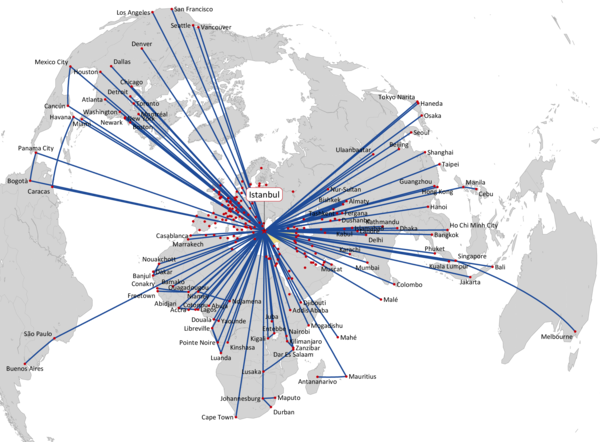
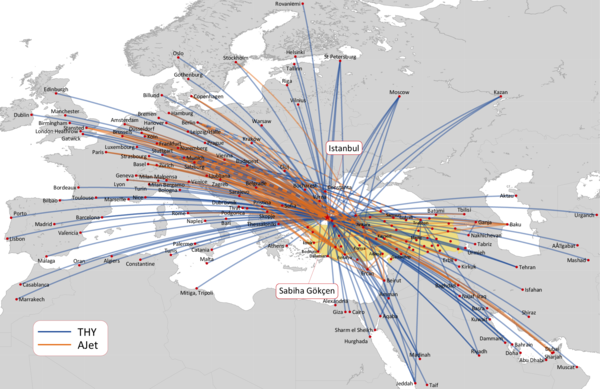
THY’s growth strategy has been essentially to add more cities, add more aircraft so that traffic grew exponentially through the multiplication of city-pairs connected through the İstanbul hub. İstanbul’s geography means that about 50% of the global air traffic market is within narrowbody range, and by using MAXs and A321s THY can open up thinner routes. With the build-up of its widebody fleet of A350s and 787s, THY’s network has been extended to cover 90% of the global market.
The extrapolation effect is illustrated by THY’s calculation that its 535 international destinations (including codeshare flights) can offer 52,000 connection options (defined as meaningful O&Ds with a detour factor from direct service of less than 1.4). Each new point introduced theoretically adds about 100 routes to the network.
Before the pandemic there were concerns that growth was not necessarily translating into profits; for instance, between 2016 and 2019 revenues grew by over 10% pa but net profit margins were in the zero to 6% range. But that appears to have changed post pandemic, with improved margins throughout the network. In its latest investor presentation, THY identified these future routes:
- Americas: Detroit, Denver, Orlando, Lima, Santiago, Rio de Janeiro;
- Europe: Bergen, Glasgow, Iasi, Katowice, Nantes, Newcastle, Timisoara, Bayburt, Yozgat;
- Middle East: Abha, Salalah;
- Africa: Aswan, Brazzaville, Hargeisa, Lome, Monrovia, Port Sudan, Windhoek;
- Asia: Sydney, Melbourne, Phnom Penh, Atyrau, Osaka.
This is certainly a diverse group, indicating the gaps still to be filled in the global network. One important role THY can play is connecting the emergent economic super-powers of China and India to both the developed and developing worlds.
The mega-hub
THY’s greatest asset is its hub at İGA, located 50km north-west of Istanbul city centre on the European side of the Bosphorus, has a capacity of 90m passengers a year with a single terminal and two sets of parallel runways. Planned expansion will take it to 120m by 2025 and 150m passengers by 2027 with eight runways and a second terminal. It is clear that İGA will soon overtake Heathrow as Europe’s biggest airport, and may well the world’s, biggest airport. Moreover, user reaction to the new airport has been very favourable: for instance, it won the “Airport of the Year” at the “Air Transport Awards 2024” ceremony for the fourth time in five years.
The downside for THY is some of the highest airport charges in Europe as the pandemic discounts are unwound. The airport owners, a private Turkish consortium, having paid €22.1bn for the 25-year concession, have to recoup their investment.
Competitive reaction
The most important competitors for THY have been the three Middle East super-connectors (ME3), and as the graph indicates, THY’s expansion plans pose a further threat to Emirates, Qatar and Etihad. Before the pandemic approximately 62% of THY’s international seat capacity operated to the same destinations as Emirates and 65% to the same destinations as Qatar.
One of THY’s strategic advantages is that has a more diverse network structure and, importantly, a significant domestic market (as opposed to or not having any domestic market in the case of the ME3). In the first half of 2024, 37% of its passenger total was domestic and a further 5% domestic/international transfer. International to international transfer accounted for 38% and international direct for 21%. Its mix of narrowbody and widebody equipment gives it more flexibility in developing the network.
Currently, Emirates and Qatar appear to be consolidating rather than expanding aggressively, but this could change. There is also the unknown threat from the new Saudia.
Cargo superconnector
Cargo revenues increased to 16% of THY’s total in the first half of this year compared to 13% a year ago. Building from its the cargo hub, SmartIST, one of the largest air cargo terminals in the world with capacity of 5m tonnes/year, THY has cargo operations to 366 destinations using 21 freighters as well as bellyhold. Its frequently stated ambition is the be one of the three biggest cargo carriers in the world, which implies that it would displace Emirates. In fact, THY claims to have already achieved the third position globally in terms of FTKs in the first half in this year.
The plan in 2021/22 was to spin Turkish Cargo (TC) off as a separate brand and to form a joint venture with a major player in the cargo sector. However, that joint venture has not yet materialised, one complicating factor being that FedEx has set up its own hub at İGA. Also THY’s operations have been impacted by the postpandemic normalisation of the air cargo market: it is able to grow volume, but yields have fallen substantially, so eroding profitability in this segment.
Ajet: LCC proposition
Ajet, rebranded from Anadolujet, is described as a “Growth Platform”. It has been operating independently from THY since April this year. The intention appears to be to IPO the airline at some point, though financial details are sparse at present.
By mid-2024, 95 737-800s, MAXs and A320 Family aircraft were operating under the Ajet brand on 162 routes compared to just 30 in 2020. 2024 traffic volume is expected to be around 22m passengers.
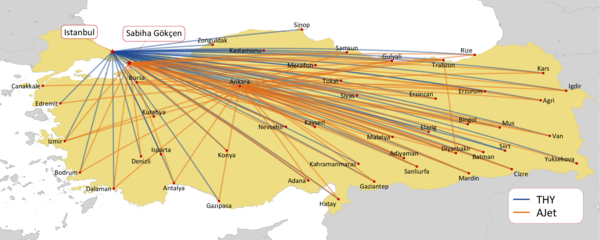
Ajet is a classic LCC model: the aircraft are densely configured, 189 seats on the 737s, and the network is pure point-to-point, separate from the THY hub network. The focus is on price-sensitive passengers in Europe and the Middle East. The main bases are Sabiha Gökçen, the second İstanbul airport where it has a 23% international market share, and Ankara Esenboğa, both much less expensive airports than İGA.
The risk with such LCC subsidiaries is conflicts of interest between management and unions at the mainline and subsidiary companies, plus the possibility of cannibalisation of mainline traffic and undermining of THY’s hub economics, although the two markets appear distinct.
Ajet also has the classic LCC-subsidiary role of trying to protect the parent from aggressive competition, in this case from Pegasus, also based at Sabiha Gökçen (see Aviation Strategy, September 2023).
(US$ millions)
| FY (Jan-Dec) | 2018 | 2019 | 2020 | 2021 | 2022 | 2023 | @ end Dec | 2023 | |
|---|---|---|---|---|---|---|---|---|---|
| Revenues | 12,855 | 13,229 | 6,734 | 10,686 | 18,426 | 20,942 | Fleet assets | 6,075 | |
| Net result | 753 | 788 | (836) | 959 | 2,725 | 6,021 | Right of Use assets | 16,928 | |
| Cash etc | 6,027 | ||||||||
| Operating Cashflow | 1,457 | 2,111 | 389 | 3,703 | 6,011 | 5,184 | Other assets | 6,641 | |
| Capex | (1,242) | (1,068) | (1,153) | (769) | (994) | (1,186) | Total Assets | 35,671 | |
| Other Income (Expenditure) | (1,161) | 52 | 784 | 258 | (684) | (4,522) | Long term debt | 11,021 | |
| Free Cashflow | (946) | 1,095 | 20 | 3,192 | 4,333 | (524) | Short term debt | 3,723 | |
| Increase (Decrease) in debt | 691 | (656) | (284) | (2,326) | (2,948) | (2,856) | Other liabilities | 5,369 | |
| Total Change in Cash | (255) | 439 | (264) | 866 | 1,385 | (3,380) | Total Liabilities | 20,113 | |
| Shareholders' Equity | 15,558 |
(Jan-June periods)
| US$ Millions | 2019 | 2024 | Change | % |
|---|---|---|---|---|
| Pax Revenue | 4,971 | 8,421 | 3,450 | 69% |
| Cargo Revenue | 799 | 1,635 | 836 | 105% |
| Other | 179 | 374 | 195 | 109% |
| Total Revenue | 5,949 | 10,430 | 4,481 | 75% |
| Fuel | 1,836 | 3,123 | 1,287 | 70% |
| Personnel | 1,041 | 2,117 | 1,076 | 103% |
| Aircraft Ownership | 895 | 1,091 | 196 | 22% |
| Airports and Navigation | 548 | 830 | 282 | 51% |
| Sales and Marketing | 575 | 686 | 111 | 19% |
| Ground Handling | 391 | 717 | 326 | 83% |
| Passenger Services | 298 | 459 | 161 | 54% |
| Maintenance | 384 | 517 | 133 | 35% |
| Others | 174 | 257 | 83 | 48% |
| Total Operating Costs | 6,142 | 9,797 | 3,655 | 60% |
| Operating Result | (193) | 633 | 826 | |
| Investment Income | 768 | |||
| Net Finance Costs | (123) | (375) | (252) | |
| PBT | (316) | 1,026 | 1,342 | |
| Tax Refund | 113 | 143 | 30 | |
| Net Result | (203) | 1,169 | 1,372 |