Air India Group:
Mega-transformation
Mar/Apr 2023

So is the new Tata-controlled Air India Group capable of exploiting the potential of the Indian aviation market?
Appointed in mid-2022, the new CEO of the Air India Group, Campbell Wilson, a New Zealander, has been blitzing the media with his vision for a new Air India. His background is the SIA Group, where he was VP of sales and marketing and CEO of Scoot, SIA’s LCC. The task that he oversees is to rejuvenate the dinosaur Air India, whose privatisation process lasted over 20 years; integrate it with a different type of full service carrier — Vistara, a joint venture between Tata, with 51%, and SIA, with 49%, which started up in 2015, and is based at Delhi; at the same time as merging Air India Express, with another LCC, though one with a very different operating model — AIX Connect, which is the rebranded Air Asia India, Air Asia having sold out its stake to Tata.
Campbell Wilson maintains that his approach is to regard the new Air India as a type of start-up, working from clean sheet of paper. The clean sheet of paper approach is complicated enough for a start-up LCC (we had some deep experience of Indian complexities, working on the first wave of start-ups 20 years ago) but the reality is that all the sheets of paper are embossed with Legacy issues. The management team has somehow to totally dismantle embedded systems and demolish entrenched hierarchies to create a new Air India.
However, there is the huge advantage of having Tata as the purchaser. The financial details of the transaction were that the Tata bid totalled ₹180bn ($2.4bn) for Air India and Air India Express plus 50% of the ground handling company jointly owned by Air India and Singapore Airport Terminal Services (SATS). Only ₹27bn ($360m) of the purchase price was in cash, the remaining ₹150bn was the assumption of debt.
The mega-order
In February, Air India announced a mega-order for 190 737-8 and -10 MAXs, 20 787-9/10s, and 10 777Xs, plus options for another 50 MAXs and 20 787-9s. The airline also placed an order for 40 A350-900/1000s and confirmed its order for 210 A320/21neos.
President Biden himself revealed the Boeing deal apparently after taking a telephone call from Indian Prime Minister Narendra Modi. However, it may be interesting that as at the end of April Boeing was not showing the order in its official backlog, nor was Airbus. The Airbus press release did not actually confirm the order, carefully stating: “Air India has announced its commitment to order 250 Airbus aircraft to boost its domestic and international operations.”
There is a major practical issue in obtaining delivery slots, given the size of MAX and NEO backlogs and the production delays that have affected all types, but especially the widebody A340s and 787s. Consequently, Air India will be taking six Airbus A350-900s that were designated for Aeroflot, keeping the Russian interiors.
So it is currently unclear as to when the fleet build-up will take place. And a sizeable proportion of the orders will be for replacement of elderly A320ceos and 777s in the current fleet of 230 aircraft (see table).
| Orders in | ||||||||||
|---|---|---|---|---|---|---|---|---|---|---|
| Air India | Vistara | AI Express | AIX Connect | Total | Avg age | Mfr Backlog† | Mega Order | Options | ||
| A319 | 18 | 18 | 15.0 | |||||||
| A320ceo | 9 | 23 | 32 | 12.3 | ||||||
| A320neo | 27 | 46 | 5 | 78 | 3.6 | 8 | 140 | |||
| A321ceo | 14 | 14 | 14.0 | |||||||
| A321neo | 2 | 8 | 10 | 1.1 | 70 | |||||
| A350 | 40 | |||||||||
| 777 | 20 | 20 | 13.7 | 10 | ||||||
| 787 | 27 | 4 | 31 | 8.0 | 3 | 20 | 50 | |||
| 737 | 1 | 26 | 27 | 11.9 | 190 | |||||
| Total | 117 | 59 | 26 | 28 | 230 | 8.7 | 11 | 470 | 50 |
The 470-unit order has great symbolic value: it reflects Air India’s intent to grow to the same scale as the 600-unit fleets of the main Chinese carriers or even the 900-unit fleets of the US majors. But in terms of numerical fleet size and orders the Air India Group lags way behind IndiGo which has a current firm backlog of 485 A320neos and an operating fleet of 267.
As for financing the mega-order — the value of which would be around $30bn, estimated on likely transaction prices not list prices — details are sparse at present, the airline referring to a combination debt, equity and leases.
Potentially Tata brings formidable financial muscle to negotiations with the OEMs. Although still largely controlled by family trusts, there are 29 stockmarket-quoted Tata companies with a combined equity market valuation of around $250bn (about 25 times greater than IAG’s, for comparison). Each unit — Chemicals, Steel, Motors, IT, Consultancy, Retail, Hotels, etc operates independently and has its own credit rating, usually investment grade because of the parentage of the Tata Group, which itself is reputed to have a quasi-sovereign credit status.
Four airlines, two mergers
Under the new regime there appear to be encouraging signs of an improvement in the financial health of the Group with the Indian press hinting at positive results in the latest two quarters. However, the actual results available simply underline the loss-generating ability of the Group.
Air India’s financials pre-pandemic were almost as bad as during the pandemic — see graph (and there are serious suspicions that its losses were understated). In the financial year to March 2021 Air India reported a net loss of ₹71bn ($0.9bn) on revenues of ₹121bn.
Unfortunately, Vistara too has been consistently loss-making since inception, necessitating equity injections from its parents, Tata and SIA. In FY 2022 (year to March 2022) it produced a net loss of ₹21bn ($250m) or 40% on its revenues of ₹53bn.
So merging the two full-service carriers will not generate immediate synergies. There is not one successful model that can be applied to the new Air India. The implication is that creative destruction is needed.
Then there is the issue of the new low-cost Air India airline, which is being built around Air India Express, subsuming AirAsia India. This will give some desperately needed scale to the low-cost operation: in 2022 Air India Express and AirAsia India carried just 10.8m passengers between them, nowhere near the volume of the leading LCC IndiGo which carried 68m.
However, again the two operating models are not obviously compatible. Air India Express is an almost purely international airline based at Cochin in the state of Kerala. Remarkably for a state-owned company, it has found a specialist role — transporting Indian workers to/from Kerala and the Arabian Gulf — and was consistently profitable in the years immediately before the pandemic, though its FY 2022 results showed a net loss of ₹7bn ($87m).
AirAsia India, set up in 2013 as a joint venture between Tata (51%) and AirAsia (49%), the idea being to import the Malaysian LCC’s expertise into the Indian domestic market, has been consistently loss-making. Now fully owned by Tata It recorded a net loss of ₹15bn ($180m) in FY2022, more than its revenue. With its main base at Bangalore, the global IT hub, AirAsia India has just not achieved the scale to compete with IndiGo or even SpiceJet in the domestic market.
Also there is no fleet communality. Air India Express is a 737-800 operator, while AirAsia India is a A320 operator. The new entity will be 737MAX operator with reportedly 50 units out of the mega-order being allocated to Air India Express. AirAsia India has been shrinking its operation, returning A320s to AirAsia in Malaysia.
The big question is: how will the full-service and the low-cost airlines operate alongside each other. Domestic India and India-Middle East is essentially an LCC market, with price-sensitive demand, an average stage length domestically of only about 970km, and a point-to-point network rather than a hub and spoke network.
In 2022 Air India and Vistara combined carried about 18% of domestic passengers with AirAsia India and Air India Express combined carrying a further 6%. IndiGo, by contrast, had nearly half the market.
The universal truth with low-cost subsidiaries is that they cannibalise traffic from the mainline carriers. This outcome would seem inevitable in the Indian market. The logical solution might be to move all domestic and India-Middle East operations to the new Air India Express, but that would cause union and, maybe, political ructions.
Branding
Although Vistara had the stronger brand among the Indian business travel community, its name (in Sanscrit meaning “limitless expansion”) will go, subsumed into Air India. History made this brand decision inevitable — Tata founded the airline back in the 1930s and the Executive Chairman until 1978 was the legendary industrialist, J.R.D. Tata.
The aim is to recapture the image of the airline when it was known as Maharajah. A London-based brand and design consultancy — Futurebrands — has been commissioned to create Air India’s new identity — something global, airline of choice, equivalent to Emirates or SIA, etc.
The airline’s customers would just be happy with an improvement in booking practices, reliability and onboard service. Skytrax reviews generally award Air India two or three stars out of five. One of the Legacy problems involve the reservation and yield management system at the carrier which have not changed much since the 70s or 80s. Radical change is now promised apparently involving using ChatGPT, which sounds intriguing. The seating product or products have yet to be defined, but Vistara’s three-cabin offer on all domestic routes will surely disappear.
International network
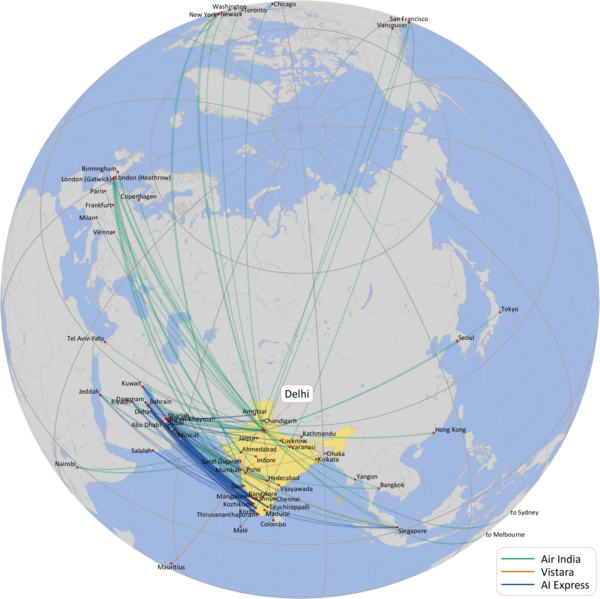
The map Illustrates the international network using an isometric projection centred on Delhi.
The dense medium-haul operation to the Arabian Gulf states is characterised by intense competition from the super-connectors and, increasingly, the A321NEO/737MAX operations of the Indian LCCs — IndiGo, and SpiceJet — and the Arabian LCCs — Air Arabia, Flydubai, Jazeera, flyadeal, Wizz Abu Dhabi, etc.
Air India’s problem here is that to grow in this market it has to abandon its traditional regulatory conservatism. Air India had no competitive response to the rise of the super-connectors, retaining a narrow bilateral mentality, regarding sixth freedom traffic as being somehow unfair.
And this policy does not appear to have changed: earlier this year India refused to expand bilateral rights on India-Dubai from the 6.9m total annual seats allocated to each country. Emirates is at the limit of its allocation and was frustrated by India’s refusal to expand capacity. Chairman Tim Clarke commented: “It will be in India’s best interests to open up because … every country that embraces liberalisation and wants investment has to open up”. Perhaps the new Air India just isn’t ready yet.
The Middle East carriers — Emirates, Qatar, and Etihad — are Air India’s main, and dominant, competitors on India-Europe routes, connecting traffic flows over their global hubs. THY is an increasingly important player, and the new Saudia may add more competition — see Aviation Strategy, December 2022.
However, in the India-Europe market Air India could create a lucrative business, offering direct service to main and secondary European cities from Delhi and other Indian cities, assuming it can get its pricing and product right. The London route is by far the most important. Air India has been able to push weekly frequencies up to 17 for summer 2023 from 14, operating to Heathrow from Delhi and Mumbai, and has also moved four Heathrow services to Gatwick, from Goa, Cochin, Ahmedabad and Amritsar.
There are at least 20 cities with populations of over 20m in India, which points to a potential network for Air India that could compete effectively with the super-connectors and the European flag-carriers. On many of the Indian non-hub to European non-hub sectors, there could be enough local traffic to justify direct service, which would also solve the problem of gaining additional slots at Heathrow, Gatwick or CDG. The bilaterals would, of course, have to be liberalised.
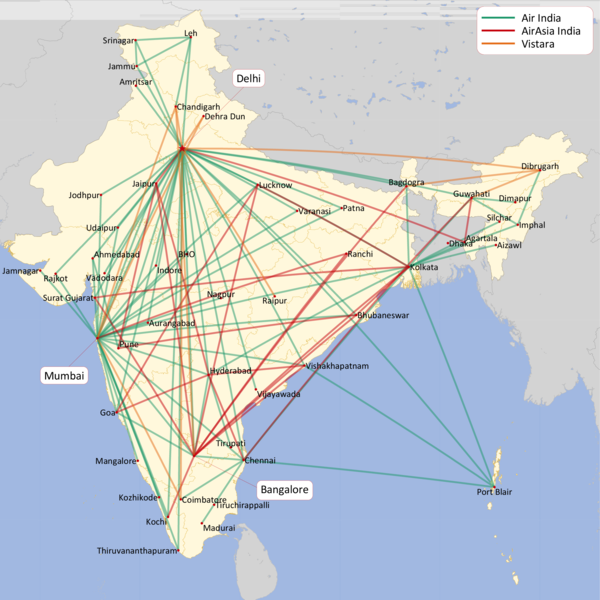
Air India has talked about developing a multiple international hub structure in the subcontinent, which may essentially be the same strategy as outlined above. Developing Delhi as a global hub to compete with the Middle Eastern hubs has been mooted, but surely is a non-starter for commercial, logistical and regulatory reasons.
The route network to North America is an illustration of India’s geopolitical status — a flawed but huge Western-style democracy but maintaining cordial relations with Russia.
As the map reveals, Air India operates to seven North American cities overflying Russia, which, following the invasion of Ukraine, is sanctioned for all European and North American airlines. In the process, Air India is further breaking Western sanctions by paying en route charges to the Russian state.
A4A is raising objections In Washington, calling for airlines (Emirates and others as well as Air India) that operate trans-Russia routes to be banned from US. This could cause friction between Air India and its Star Alliance partner United; Air India has been hoping to deepen its relationships with United and Lufthansa.
Labour conflict
One of Air India’s many problems has been its bloated and frequently intransigent workforce. But the key battle, as always, is with the pilots unions — the Indian Commercial Pilots Association (ICPA) and the Indian Pilots Guild (IPG) at Air India — a battle which is partly symbolic rather than purely financial. Campbell Wilson’s team have tackled entrenched practices and the unions who have responded with some emotional language and, predictably, an attempt to undermine the new management by going directly to the Tata Group Chairman, Natarajan Chandrasekaran.
The proposed new pay structure includes a flying allowance component of only 40 hours/month in place of 70, has condemned as “draconian” by the pilots unions, even though the 70-hour rule would imply that every pilot was flying at the maximum regulatory limit (about 840 hours a year).
Taking on legacy pilots is a frustrating exercise for any management team. Senior pilots tend to be entrenched in their aviation world view and are usually cushioned by pensions, savings, and longstanding political and military relationships. Their resistance to change is perfectly logical from their perspective. And their position is bolstered by a global shortage of cockpit crew and the fact that the new management cannot threaten to cut back premium long-haul services.
Indian airline competition
There are two relative cost problems for the Air India Group
Firstly, the cost gap within the Group: according to an analysis by DGCA of 2021/22 stage length-adjusted unit costs Air India’s cost per ASK, at the equivalent of US¢9.2 was about 55% higher than Vistara’s US¢5.9. Secondly, the cost gap between the lower cost Group airlines, Air India Express and AirAsia India, and the LCC competition: they had a unit cost averaging US¢4.8/ASK, 12% above IndiGo’s US¢4.3. The new ULCC — Akasa — will be aiming for costs roughly half of the Air India Group LCCs.
These comparisons encapsulate Air India’s basic problem — how to compete on cost with IndiGo and the other Indian carriers.
Last year the highly respected Pieter Elbers arrived from KLM to take over as CEO at IndiGo, after a slightly turbulent period when the two founders, Rahul Bhatia, head of the InterGlobe conglomerate, and Rakesh Gangwal, previously CEO of USAirways fell out and battled in court. FY2023 (to March) financials are not yet available, but the third quarter results were promising — a net profit of ₹14bn ($170m) on revenues of ₹149bn.
Elbers has stated that IndiGo is “embarking on the next level of growth” — we will cover the airline in detail in the next issue of Aviation Strategy. Meanwhile, its passenger share of the Indian domestic market was 49% in 2022 compared to 24% for the Air India Group, and its share of the international market (Indian carriers only) was 37% compared to 49% for Air India, Vistara, and Air India Express combined.
Opportunities for both IndiGo and Air India are emerging as a result of shake-outs among the other carriers, which could leave capacity gaps as well as taking out substantial aircraft orders placed in more optimistic times.
SpiceJet, the first of the low-cost new entrants back in 2004, has teetered on the edge of bankruptcy in recent years, and had to ground its MAX fleet in 2019 before the pandemic hit. Compensation from Boeing, some clever negotiating with lessors and a strong performance from its cargo unit SpiceXpress appear to have rescued the carrier for the time being at least. It had about 9% of the domestic market last year, and has 129 MAXs on order.
SpiceJet’s prospects have been improved with the voluntary liquidation of Go First, blamed on a dispute with P&W over the reliability of engines for its 55-unit A320 fleet. This event enabled SpiceJet to borrow $500m from the government’s Emergency Credit Line Guarantee Scheme (ECLGS) in order to return 25 of its grounded 737s to service.
It is not clear whether Go First will cease operating or restructure (it is owned by the very wealthy Wadia Group), but its problems go beyond the P&W issue. The smallest of the wave of LCCs that entered the Indian market around 2005, Go Air (as it was then) never found the scale of IndiGo nor achieved genuine LCC operational performance. In 2021, it announced a strategy to transition to the ULCC model and planned an IPO which did not materialise. Go First, nevertheless, achieved a market share of about 9% domestically in 2022, and has 88 A320neos on firm order.
Perhaps a better bet for a disruptive ULCC in the Indian market is Akasa — because it is starting from a clean sheet of paper. Akasa was founded by Rakesh Jhunjhunwala, a high-profile investor, starting up in August 2022 at what he assessed as being the bottom of the market. It currently operates 19 737 MAXs and plans to expand rapidly with a further 52 units on order. But it has also announced plans for international services which may not fit in the ULCC model, at least at this stage of its development.
Finally, there is JET Airways, which because of various creditor disputes, has not managed to restart despite being awarded an AOC over a year ago. It still officially has an order backlog of 135 MAXs.
So there are lots of exciting challenges for the Air India Group — merger implantation, fleet planning, bilateral liberalisation, brand enhancement, LCC versus full service balance, cost reduction and competitive response, etc. Tata has given the new entity a five-year timeframe to effect the transition.
