Saudi Arabia’s Astounding
2030 Aviation Vision
Nov/Dec 2022

If the Saudi Vision 2030 project becomes a reality, Middle Eastern aviation will be transformed in the same way as Emirates Airline, copied by Etihad and Qatar, developed the super-connector concept. Saudi’s aviation project goes beyond mega, it is on a giga scale.
Saudi Vision 2030 was initiated by Saudi Arabia’s de facto ruler, Crown Prince Mohammed bin Salman (universally known as MBS). It aims to propel Saudi Arabia into a global post-oil power through rapid transformation of all sectors of the economy and a parallel modernisation of society. Travel and tourism are at the heart of the plan, which has been developed largely by US management consultancy firms — McKinsey has embedded itself throughout the Saudi administration (the Ministry of Planning is sometimes referred to as the Ministry of McKinsey), but the main authors of Vision 2030 were the Boston Consulting Group. Funding for Vision 2030 comes from the sovereign wealth fund, PIF, which has assets of up to US$1tn.
The economics
Saudi Arabia retains its role as the central bank for global oil. Current output is around 10.5m barrels/day, which makes it the world’s largest producer after the US and by some margin the world’s largest exporter, a position that has consolidated with Russia embargoed by the West. Proven reserves are still immense, enough to allow production at current rates for at least 70 years. But as the legendary late Saudi oil minister Sheik Yamani once observed: “The stone age didn’t end because the world ran out of stone.”
Although in 2022 the government is expected to produce a fiscal surplus of about US$25bn, the Saudi government has consistently spent more than it has taken in tax receipts: the average deficit for the previous six years was around US$55bn. Boosted by the surge in oil in crude oil prices, Saudi GDP growth will be around 7% in 2022 but preceding years have shown little or negative growth. Perhaps surprisingly average GDP per capita is only around US$27,000 which reflects the marked income and wealth inequality in the Kingdom. And economic tensions are intensified by the youthfulness of the population: over half are under 25 years old.
The participation of Saudi nationals in the workforce is less than half the potential number while 7-8 million foreigners are based in the country ranging from Filipina maids to McKinsey consultants. Job prospects for foreign professionals of all types but particularly those in the construction, aviation and tourism sectors are in theory very promising.
There is, however, the critical issue of civil rights, repression of minorities and fundamentalist religious intolerance. There are various reports from the Kingdom as to MBS’s willingness to take on some elements of the Wahhabi establishment, but he is certainly no reforming liberal in the Western sense. But, overall, it may well be that opening up the Kingdom to western visitors will accelerate reform.
Qatar’s hosting of the football World Cup in December is on balance regarded as a success: Doha looked very impressive albeit that there is now a large surfeit of stadiums. On the other hand, the Qatari authorities had to face some pretty stiff criticism about minority rights, particularly gay rights, and the spotlight was thrown on the poor conditions under which migrant workers from Pakistan and Nepal had been working.
The Saudi government has mostly used oil revenue windfalls to invest abroad and to distribute largesse to its nationals, MBS’s vision is to use these funds to invest for the long term in the Kingdom.
In the past the Saudis have nationalised foreign-owned companies — most importantly Aramco (Arab-American Oil Company) in the late 70s — but now the idea is more to invite in foreign expertise to in effect denationalise moribund state enterprises.
The scale of the Saudi aviation and tourism plans are mesmerising.
The Riyadh aerotropolis
To begin with there is the new King Salman Airport at Riyadh for which Foster+Partners, the London-based studio, has won the design competition. This is a $100bn-plus project, which of course is endorsed by MBS and financed by the PIF, and is intended to transform the Riyadh city economy into one of the world’s top ten by 2030, in the process growing the population from 7.5m to 15-20m.
King Salman Airport is planned for an area of 57 square kilometres — in fact it has been designated as an aerotropolis rather than a mere global hub. It will include the world’s tallest building — at a proposed 2km, more than twice the height of the Burj Khalifa in Dubai — as well as six parallel runways. The official target is for 120m passengers by 2030 then 185m by 2050, plus cargo capacity of 4.5m tons. Inevitably, it will incorporate the latest logistical technology and will have impeccable green credentials.
“King Salman Airport will become centred around a seamless customer journey, world-class efficient operations, and innovation. Riyadh’s identity and the Saudi culture will be taken into consideration in the airport’s design to ensure a unique travel experience for visitors and transit travellers”, according to the PIF press release.
To put all this in some sort of context Dubai World Centre airport has an ultimate capacity of 160m in addition to around 90m at DXB; Doha Airport in Qatar has plans to increase its capacity to around 50m while Abu Dhabi in theory can accommodate 25m-plus. So the Riyadh investment will add 40-60% to Middle East global hub capacity. Of course, none of these facilities are currently operating at anywhere near full capacity. And then there is the new THY hub at İstanbul İGA which has medium term plans to get to 200m passengers.
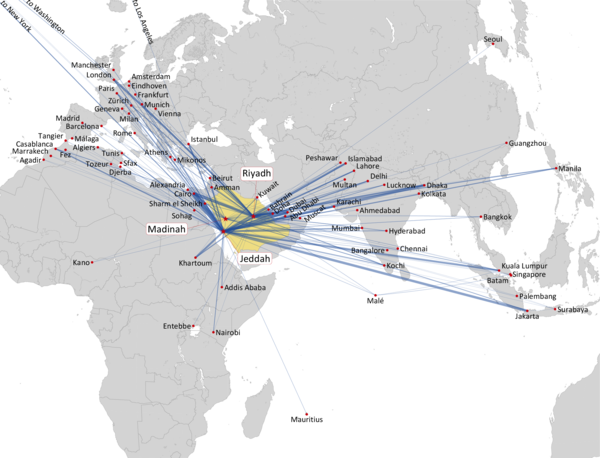
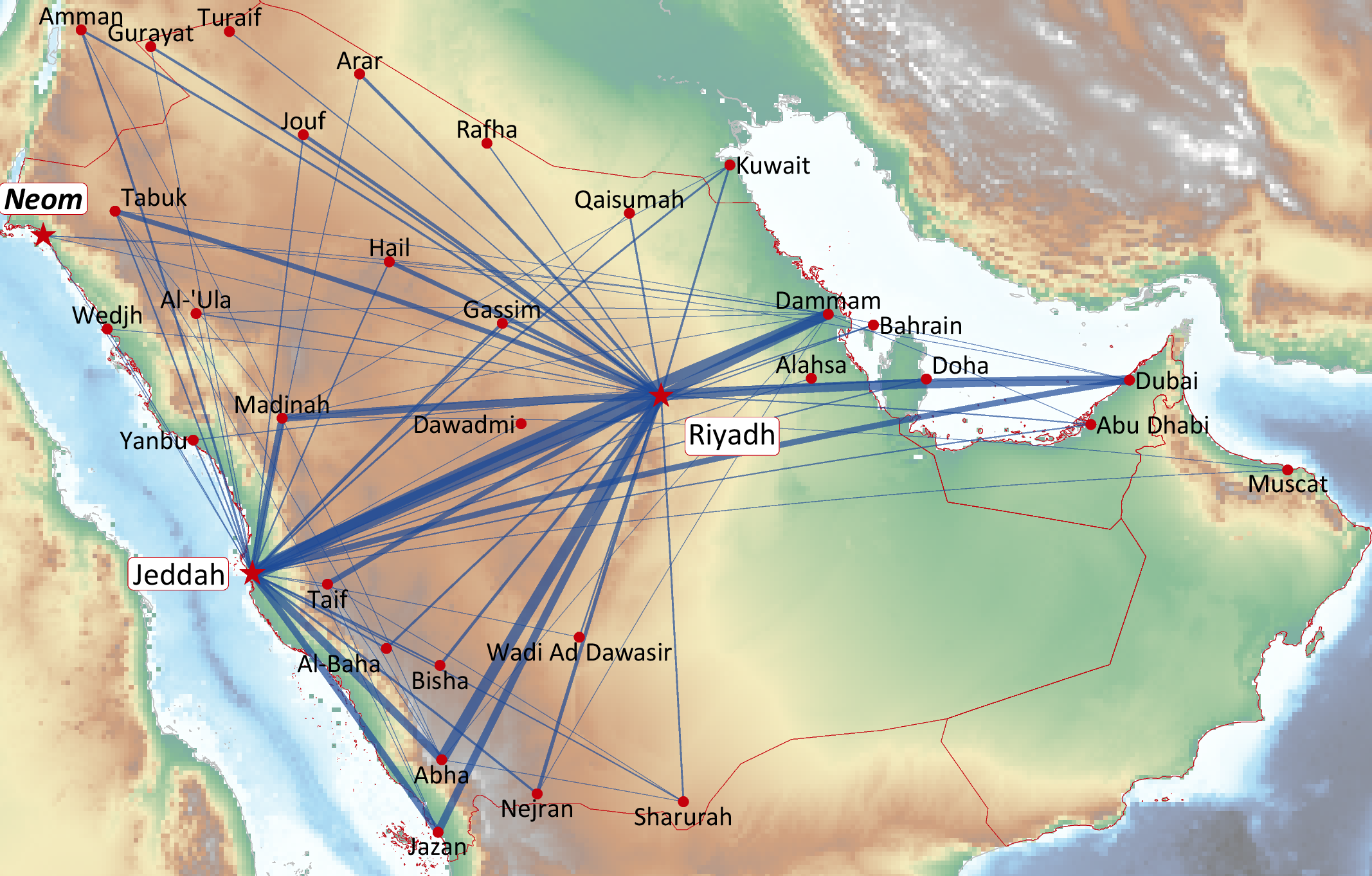
One advantage that Saudi Arabia claims over the UAE and Qatar is that it has a strong domestic market with a population of over 36m. The large majority of domestic traffic, roughly 30m passengers pre-pandemic, is along the Jeddah-Riyadh-Dammam corridor from the Red Sea to the Gulf. There are another 25 airports civilian airports throughout the country of which the most significant are Madinah and Abha.
In the new Saudi Arabia it appears that you cannot have too many airports: three additional airports are planned for Neom in addition to the existing facility at Neom Bay Airport.
The main Saudi airports fared better during the pandemic than the global hubs of the super-connectors, with a much lower reliance on international to international connecting traffic, and recovery to prepandemic traffic levels has been somewhat faster at the Saudi hubs. Scheduled capacity at Riyadh, Jeddah and Dammam was 7% lower in 2022 compared to 2019 whereas capacity at Dubai, Abu Dhabi and Doha was down 17%. In total the three Saudi airports combined offered roughly the same capacity as Dubai in in 2022.
RIA — the new flag-carrier
Plans for the new Saudi flag-carrier — provisionally titled RIA (Riyadh International Airline)— are being expedited. Tony Douglas, who had previously been occupied in Abu Dhabi dismantling Etihad’s reckless over-expansion, has been appointed CEO of RIA which will probably be launched in early 2023, financed by the PIF with US$30bn of capital (this figure seems excessive even by Saudi standards and must include the list price of the proposed 250 unit fleet order).
It is not entirely clear whether RIA will replace Saudia or whether there will be two flag-carriers. The most likely development would appear to be for RIA to take on the role of a superior quality medium- and long-haul carrier, a Saudi version of Emirates Airline, while Saudia would have the role of focusing on domestic and regional traffic, mostly catering for traditional passengers, including Hajj and Umrah visitors. (To confuse matter further, there have been reports of a third national carrier to be based at Neom.)
There are some tricky service issues to be sorted for RIA not least of which is the provision of alcohol on board. But the most urgent question Is fleet renewal.
Saudia’s fleet is ageing: the A320 family aircraft are on average 9 years old while the A330 and 777 wide body fleet is on average 8 years old. The current orderbook consists of 50 A321s which will be split between the mainline carrier and the lower cost subsidiary Flyadeal.
It is perhaps surprising that given all the other infrastructure announcements that there has not yet been a mega-order from the Saudis. In 2021 there was speculation about an imminent order for 250 units but nothing materialised. As of the end of 2022 Saudi authorities were reported to be in negotiations with Airbus for an order of 40 A350s and with Boeing for a similar order for 787s.
| SAUDIA ARABIAN | FLYADEAL | FLYNAS | TOTAL | |||||
|---|---|---|---|---|---|---|---|---|
| In Service | On Order | In Service | On Order | In Service | On Order | In Service | On Order | |
| A320/21ceo | 46 | 11 | 14 | 71 | ||||
| A320/21neo | 15 | 35 | 16 | 15 | 22 | 75 | 53 | 125 |
| A330 | 32 | 3 | 35 | |||||
| 777-300 | 33 | 33 | ||||||
| 787-9/10 | 18 | 3 | 18 | 3 | ||||
| 747F | 3 | 3 | ||||||
| 777F | 4 | 4 | ||||||
| TOTAL | 151 | 38 | 27 | 15 | 39 | 75 | 217 | 128 |
Saudia, as it is currently set up, would not appear to be capable of a rapid fleet and network expansion. It is a largely unreconstructed legacy flag-carrier, completely reliant on the support of the state. It reported 37m passengers carried in 2019 but Its financials are non-existent, beyond vague statements from management to the effect that the airline expects to break even in 2023.
Greater financial transparency will be one of the challenges for RIA, especially in the light of US and European antitrust allegations against the super-connectors. To take one example, the price Saudia pays for its fuel has long been a matter of speculation; one of the reasons that Saudi low cost new entrants like Sama found it so hard to compete in the domestic market was that, slightly ironically, regulatory caps were placed on key domestic fares which could not be raised when jet kerosene prices escalated, restrictions that did not seem to impact Saudia.
The Saudi domestic market is again dominated by Saudia and its subsidiary Flyadeal which together account for 80% of domestic seat capacity. The other airline is Flynas which was established as Nasair in 2007 when the domestic market was partly deregulated and two new entrants were permitted. It currently operates a fleet of 22 A320s but has 75 on order. In early 2022 it was reported that the airline was to increase its orderbook to a total of 250 aircraft to be used on a greatly expanded international network.
The extent to which Flynas will compete with RIA and how the Saudi aviation market could absorb potentially 500 new aircraft is a matter of speculation. However, Flynas is firmly in the Saudi establishment, being partly owned by Kingdom Holdings which is an investment fund set up by Prince Alwaleed Bin Talal and which has assets of about US$15bn
AviLease — the new leasing venture
Given the urgency of the Saudi aviation policy, one way to rapidly build a new technology fleet would be through a leasing company. In June 2022 PIF set up an operating lease company, AviLease, based in Dublin and headed by Edward O’Byrne, formerly CEO of Carlyle Aviation. The stated strategy is to grow initially through purchase-and-lease-back transactions with airlines, then portfolio acquisitions, and direct orders from aircraft manufacturers. Sovereign-type credit rating and liquidity is guaranteed through 100% ownership by PIF.
The first transaction was immediately concluded with Flynas for 12 A320neos to be delivered before the end of 2023. This was followed by a contract to deliver 20 A320neos on long term leases to Flyadeal.
All the noises coming from Saudi Arabia suggest a rapid expansion for AviLease. Conditions in the operating lease business are likely to become more challenging with the surge in dollar interest rates, so it would not be surprising to see a major portfolio purchase by AviLease or even a takeover of another lessor.
No doubt MBS is aware of the role that Sheikh Ahmed bin Saeed Al Maktoum plays in the Dubai aviation industry — heading up Emirates Airline, flydubai, the airports, the handling company, the duty free operation, and DAE the operating lessor — which he might well like to replicate in Saudi Arabia.
The new tourism
Saudi Arabia is not the most obvious tourist resort, but it is promoting itself strongly through a key series of campaigns on television, in newspapers and in social media. The target for inbound visitors is 50 million by 2030, a four-fold increase on the current level. Naturally there is a certain amount of scepticism about Saudi Arabia as efforts to reinvent itself as a welcoming exciting alternative to Bali, Majorca or Florida.
Visitors to the Kingdom have traditionally been associated with pilgrimages to the holy Islamic sites — 25% of the global population is Muslim. The Hajj to Mecca is the largest human gathering in the world with about 2.5 million pilgrims in 2019. It has been closed to foreigners during the pandemic.
Hajj visas are issued proportionate to the Muslim population in origin countries, and had been expected to increase 3% to 4% a year in line with population trends. But this growth rate is now in doubt because Ramadan, following the lunar calendar, is moving into the hottest months of the year which is raising serious safety concerns.
Umrah — religious trips at any time of the year — is, however, more or less unconstrained. Some 6 million Umrah pilgrims a year visited the Kingdom pre-pandemic. Unlike Hajj visitors Umrah travellers usually use scheduled air services rather than specialist charters. One idea is for Umrah visitors to take holidays in the Kingdom which combine religious duty with more secular pleasures.
Neom represents the new Saudi Arabia — see box for a quick guide to MBS’s futuristic dream — but there are many other projects under development: for example, a chain of artificial islands in the Red Sea, up to 90 apparently, and a $10bn investment in an entertainment park called Qiddiyah, which will feature the world’s fastest, longest, tallest and scariest roller coaster.
And it’s all about eco-tourism — the world’s largest exporter of crude oil is setting itself up as the world’s first zero-carbon holiday destination.
Tourists not only have to be persuaded of the charm that is Saudi Arabia but they also have to be able to fly easily to the country. The Saudi Air Connectivity Program (ACP) was established in 2021 explicitly to support tourism growth in Saudi Arabia by enhancing air connectivity and developing existing and prospective air routes. The idea is to incentivise foreign and Saudi airlines, through partnership agreements and, presumably, support payments, to start up new services to/from Saudi Arabia, and to connect air travellers to the new tourist facilities. The target is to have 250 points linked directly to Saudi Arabia.
Wizz Air is the most significant participant in the ACP so far, potentially operating 23 routes (see Aviation Strategy, October 2022). Emirates has also signed an MoU with the Saudi Tourism Authority designed to boost inbound tourism, though details are hazy.
Opportunities and threats
So how real are the Saudi aviation and tourism plans?
In the old Saudi Arabia, a slump in the oil price would almost certainly mean that these ambitious projects would disappear. In the new Saudi Arabia, things may well be different: it all depends on MBS. He is in a unique position with access to huge, but not unlimited, financial resources and possessed of an absolute determination to transform the Kingdom’s economy. Even if only half his projects are realised, Saudi Arabia’s role in the world will be changed from just being the major supplier of carbon energy. The country will no longer just be dependent on the West for technological support; its major trading partners are now China and India.
The aviation/tourism sector is highly visible, and as the civil aviation authority, GACA, states, has “unlimited support … from the Saudi leadership.” Aviation will be symbolic of the success, or failure, of MBS’s innovations.
In the short term foreign airlines stand to benefit from the boost to air travel associated with the infrastructure projects and the tourist developments but in the longer term RIA (or whatever it is called) must pose a threat to the super-connectors. About 25% of Emirates’ seat capacity is deployed in the Gulf region including Saudi Arabia, and RIA will be aiming to capture a substantial share of this traffic.
As for intercontinental connecting traffic Emirates and Qatar can continue to rely on their brands but RIA is going to erode some of this traffic. And there is the probability of a renewed level of over-capacity in the Middle East connecting market, putting pressure on unit revenues, negating the benefits of rationalising Etihad. Also, there should be a major concern about the extent to which RIA’s operations will be subsidised by the Saudi government.
For Emirates and Qatar the emergence of Saudi Arabia as a new aviation force comes at the same time as radical changes now taking place in the Indian market, with Air India/Vistara, now under the ownership of the Tata group also about to place a mega order for 250 new aircraft. An outside possibility, however, is that Emirates might be invited to play some role in the development of RIA, perhaps through a management contract.