Hawaiian Airlines: Aloha to
Amazon
Mar/Apr 2023


Hawaiian Airlines is a long-established niche player. The eleventh largest commercial passenger airline in the USA, it is a destination carrier: it exists to bring tourists into Hawai’i and cater for the travel needs of residents of the pelagic State. Niches have their problems, especially in a commodity market such as aviation: too attractive and competitors encroach. In the post-pandemic leisure-oriented recovery, Hawaiian Airlines is facing intensified competition. But it may have found a way to diversify while sticking to its roots.
Dependence on tourism
Hawaiʻi is a collection of 137 (mostly uninhabited) volcanic islands in the middle of the Pacific Ocean, spanning a distance of 2,400km and itself 3,500km or so from the West coast of the USA. It is the only island State in the Union, the only one in the tropics, the only one to have an Asian-majority population (and the only one to have formerly been an independent Kingdom, let alone feature the British Union Jack on its flag).
It is also possibly the only place in the world — following the 1986 introduction of the Aloha Spirit Law — where everyone is constitutionally required to be nice.
The state has a resident population of 1.4m, over two-thirds living on the island of Oʻahu, home to the state capital Honolulu. With a total coastline of 1,200km it has a plethora of tropical beaches and at 20° North of the equator is an attractive year-round tourist destination.
In 2019 there had been 10.2m visitors inbound to the state, 5% up on the previous year, and reflecting a compound average growth rate of 5%pa over the previous decade. Average length of stay appears to be 8-10 days, suggesting that on average the number of visitors staying on the islands is equivalent to 20% of the resident population. Tourism is a vital part of the economy, accounting (in normal times) for over 20% of GDP.
Nearly two-thirds of visitors are domestic: 45% from the West Coast of continental US and 21% from the East Coast (8,000km away). In 2019 Japan contributed a further 15% and Canada 5%. Visitors from other parts of Asia and Pacific account for relatively small parts of the total, but had portrayed strong growth in the previous decade: visitors from Australasia had grown by an average 10% a year and accounted for 4% of the total: those from Korea by 16%pa to a 2% share.
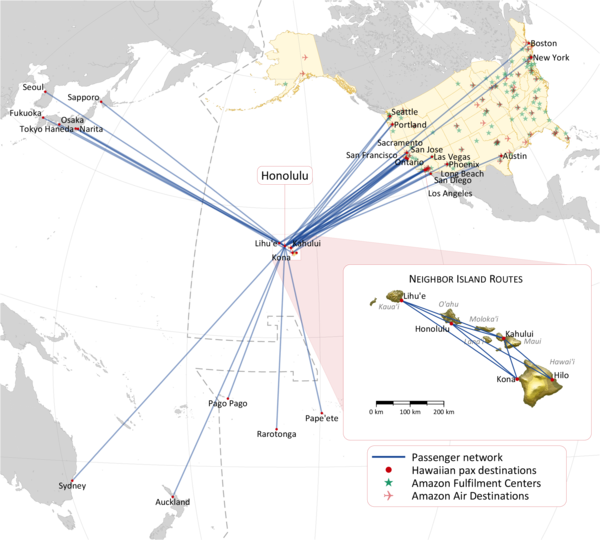
Honolulu is the main entry point, with pre-pandemic 62% of air capacity, but there is also a substantial level of service into Kahului on the island of Maui (20% of the total), with Līhuʻe on Kauaʻi and Kona on the Big Island (Hawaiʻi) each about 10%.
Hawaiian Airlines has a strong 20% market share of the North American traffic, slightly behind market leader United, but is open to significant competition from the three legacy majors, United, Delta and American which along with Alaskan (with its strong West Coast presence) have the ability to funnel demand through their connecting hubs on the mainland. In 2019, Southwest entered the market (see Aviation Strategy Jan/Feb 2020) — introducing 14 daily departures to the islands from four points in California: Oakland, San Jose, Sacramento and San Diego.
Southwest also entered the intra-island market. Hawaiiwan had a commanding position in what it refers to as the “Neighbor Island” routes, with a near monopoly following the collapse of Hawaiian Island Air in 2017. Air travel is essential to get around the archipelago and the market is characterised by high frequency very short haul routes — the densest route, with over 30 flights a day, is between Honolulu and Kahului a distance of 160km; the longest between Kona and Līhuʻe, a mere 420km.
Pandemic slump and swift recovery
From mid-March 2020 the islands were closed and remained so for the rest of that year. In April the Hawaiʻi Visitors and Convention Bureau (HVCB) even requested the media to refrain from “publishing any stories about Hawaiʻi that might encourage people to travel to the islands”. The total number of inbound visitors to Hawaii in 2020 fell by 74% year-on-year to 2.7m.
But in 2021 there was a strong rebound in air capacity from continental USA as airlines there chased a recovery trend in leisure traffic (for want of anywhere else to put long range aircraft). Southwest extended its aggressive expansion into the islands (over the last two years adding services from Los Angeles, Long Beach, Phoenix and Las Vegas) and building a 30% share of seats offered on Near Neighbor routes. In 2021 North American seat capacity to Hawaii rebounded to a level 10% higher than it had been in 2019. This trend continued into 2022 resulting in seat capacity 15% higher than pre-Covid levels — roughly where it would have been expected to have been had the pandemic not taken place.
Traffic continued to be impacted by the waves of Covid-19 variants, and visitors from continental USA in 2021 were still some 6% below 2019 levels. But in 2022 domestic visitor arrivals exceeded 7.7m, 13% higher than in 2019.
International recovery has been slower: Asia kept its borders tightly closed, and Japan in particular did not reopen for foreign travel until November 2022. It did not help that the US Dollar strengthened by 20% on a trade weighted basis in the three years of the pandemic. International visitors to Hawaii in 2021 were 90% down on 2019 levels (those from Japan down by 99%) and still 63% below pre-pandemic volumes in 2022 (Japan 87%).
Profits recovery elusive
In the five years to 2019 the airline had been strongly profitable with operating margins averaging 14% over the period, and net margins 9%. Fiscal 2020 was wipeout, as it was for many airlines, with net losses of over $500m on revenues 70% down (see chart). But the carrier did well to limit losses in the second year of the pandemic to $140m with revenues only 45% lower than “normal”. Over the two years of the crisis the group raised over $40m in equity; slashed capital spending and sold assets; took on $1.2bn in debt; and rescheduled deliveries of the 12 787 aircraft is has on order (the first is now due to be delivered towards the end of 2023, to commence service in 2024).
| $m | 2017 | 2018 | 2019 | 2020 | 2021 | 2022 | @end December | 2019 | 2022 | |
|---|---|---|---|---|---|---|---|---|---|---|
| Revenue | 2,675 | 2,837 | 2,832 | 845 | 1,597 | 2,641 | Property and equipment | 2,317 | 1,874 | |
| Net income | 331 | 233 | 224 | (511) | (145) | (240) | Right of use assets | 633 | 459 | |
| Other LT assets | 303 | 128 | ||||||||
| Operating cash flow | 331 | 509 | 485 | (311) | 251 | (58) | Current assets | 875 | 1,678 | |
| Net capex | (308) | (353) | (394) | 9 | (39) | (35) | of which cash etc | 619 | 1,394 | |
| Inc in debt | (62) | 15 | 117 | 518 | 615 | (188) | Current liabilities | (1,075) | (1,120) | |
| Equity raised | 41 | Debt and leases | (1,204) | (2,007) | ||||||
| Dividends and buy-backs | (114) | (130) | (93) | (12) | Other liabilities | (766) | (679) | |||
| Net increase in cash | (152) | 40 | 116 | 245 | 828 | (282) | Shareholders’ equity | 1,082 | 333 |
But its fourth quarter and full year results for 2022 disappointed observers. There was a strong performance on North American routes where revenues proved to be 24% higher for the year than they had been in 2019. But international revenues, still waiting for reopening of borders, remained 55% below pre-pandemic levels (accounting for 12% of passenger revenues down from 26% in more normal times), and revenues on the inter-island “Near Neighbor” routes, experiencing intense competition from Southwest, were 25% below 2019 levels.
In addition, in October 2022 Honolulu airport started work on resurfacing and re-engineering runways which has caused significant delays and disruption particularly to the high frequency inter-island services. The damage to Hawaiian’s operational performance toppled the airline from the accolade of having the best on-time performance in the US industry — a position it had held for 18 years.
For 2022 as a whole the Group suffered another net loss of $240m.
These challenges have continued into the current year. For the first quarter the company reported robust leisure demand from North America and a restoration of its international network giving “solid demand” of bookings from Australia, New Zealand and South Korea. It noted that sales in Japan were disappointing and “far from recovery”, but mentioned that international traffic “was buoyed by strong US point-of-sale activity”. (This may be surprising: there are no doubt many Hawaiian residents eager to visit Japan, but the state’s 1.4m population is not that large a market; while travellers from continental US connecting on to Hawaiian’s international network would be taking very circuitous routes.)
Works on the runways at Honolulu appear to have overrun and continue to provide operational challenges. In addition, the company is constrained by supply chain issues for P&W engine delays: five of its 18 A321s are currently grounded waiting spares, and the airline is operating the larger A330s suboptimally to fill in. The Near Neighbor routes continue to see yield pressure from Southwest’s aggressive incursion, but management takes comfort in that Hawaiian is “resoundingly outperforming” its competitor.
First quarter revenues totalled $612m, 28% up on the prior year period, following a 15% increase in capacity and an eight point improvement in load factors (the corresponding period last year had a negative impact from the Omicron variant). But the airline suffered an adjusted net loss of $112m, an $18m improvement on the same quarter in 2022.
Amazon Transformation
In October last year, Hawaiian signed an extensive agreement with Amazon.com to provide air cargo services for the e-commerce giant. Amazon will lease a fleet of 10 converted A330-300 freighters and pay Hawaiian to operate them on its behalf between its “completion centers” within the US. The deal is for an initial eight year period (extendable to 15 years), and Amazon has the option to add to the fleet.
The first A330 will arrive in Q4 2023, and it is expected that all ten aircraft will be operational in 2024.
Hawaiian will be paid a fixed monthly fee per aircraft, a per-flight-hour fee and a fee for each flight cycle operated. Amazon will also reimburse Hawaiian for operating expenses, including fuel, certain maintenance and insurance premia. To support the new cargo operation, Hawaiian said it will establish a pilot base on the continental US, grow existing maintenance bases and expand the hiring of pilots and other personnel.
The A330 will be the largest aircraft in Amazon’s fleet. The retailer started its own virtual cargo airline in 2015 partly perhaps to reduce dependency on FedEx and UPS. It has grown it rapidly and currently has 90 aircraft in service — with a mixture of 767F, 737F and ATRs. The aircraft are operated on its behalf by a collection of different airlines round the world (including Atlas Air, Air Transport Intl and Sun Country Airlines in the US, Cargojet in Canada, ASL Airlines Ireland in Europe and Quikjet in India) and only carry Amazon parcels.
In many of the partner airlines, Amazon has taken an equity stake, or has options or warrants to do so. So with Hawaiian: it has issued warrants allowing Amazon to acquire a 15% equity stake over the next nine years. Some of the warrants vested on signing. Future vesting will depend on Amazon spending up to $1.8bn for Hawaiian’s air cargo services.
“This relationship provides a catalyst to grow our business and the unique opportunity to diversify our revenue sources while capitalizing on our established strengths,” said Hawaiian CEO Peter Ingram. “In the 17 years I’ve been at Hawaiian this is the most exciting and transformational move we’ve made.”
Going by the share price performance, the markets don’t quite yet believe him. In time they will.
| In service | Δ v2019 | Avg Age | Orders | Options | |
|---|---|---|---|---|---|
| 717 | 19 | -1 | 21.2 | ||
| A321 | 18 | +1 | 4.3 | 9 | |
| A330 | 24 | 9.8 | |||
| 787-9 | 12 | 8 | |||
| ATR42/72 | -7 | ||||
| Total | 61 | -7 | 11.7 | 12 | 17 |
