Volotea: Niche LCC
Seeking Investment
Jan/Feb 2025

Volotea has established itself as an attractive LCC operating in an unusual market — thin routes connecting secondary and tertiary cities. Battered by the pandemic, it needs to rebuild its balance sheet by attracting new capital and, maybe an airline partner.
Volotea was founded in 2011 by Carlos Muñoz and Lázaro Ros, who had previously set up Vueling. The two remain major shareholders in Volotea, along with private equity investors.
Carlos Muñoz who is CEO is a high-profile figure, adept at promoting his enthusiasm and vision for the airline and persuading industry investors, most of whom have been American, of its potential: Greg Brenneman, ex-President and COO of Continental was a founding investor; David Siegel, senior aviation advisor to Apollo Global Management, ex CEO of Frontier and AWAS is currently chairman of Volotea (and Sun Country Airlines); Mark Dunkerly, ex-CEO of Hawaiian Airlines has a small stake in Volotea.
Last year Aegean Airlines invested in Volotea (more below), and this year additional capital has been agreed from PAR Capital Management and Hill City Capital, an investment of €100m in total. PAR Capital is a Boston-based hedge fund, with over €3bn of assets under management (AUM) and investments in United, Expedia, Delta and Ryanair. Hill City, also based in Boston, is an investment firm with $1.6bn of AUM which recently participated in the buy-out of Atlas Air. So what is the attraction of Volotea for these investors?
The model
The route map gives the impression of a substantial airline operating across the continent with a southern focus, though the carrier remains relatively small — 11.4m passengers in 2024.
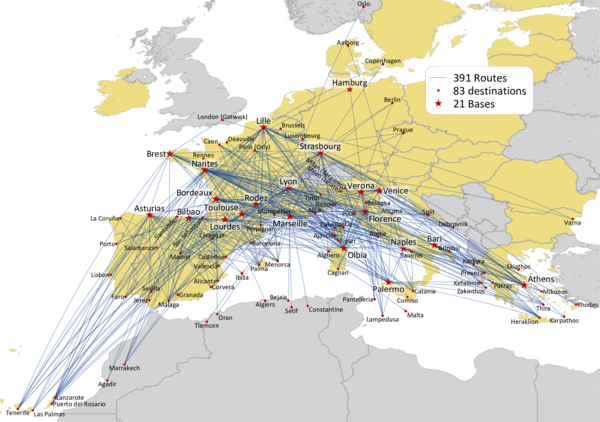
Volotea is a niche LCC, focusing on routes that are too thin for the Networks, LCCs and ULCCs. It connects 110 small and medium-sized cities, where 330m or two-thirds of the Western European population live. Its offer is direct service between these points, nearly 450 routes in total, avoiding the need to connect at a central metropolis. The target market is VFR and leisure travellers.
The airline has a total of 20 bases, which means an average of just two aircraft per base. France has 10 bases — Bordeaux, Brest, Lille, Lyon, Lourdes, Marseille, Nantes, Rodez, Strasbourg and Toulouse. Despite being headquartered at Barcelona, Volotea’s Spanish bases are Asturias and Bilbao. In Italy there is Bari, Florence, Naples, Olbia, Palermo, Venice and Verona. There is also a base at Athens which is due to be closed following the agreement with Aegean.
France, which is very Paris-centric, is the largest market, with domestic and international services accounting in 2025 for about 50% of Volotea’s seat capacity. Italy represents 27% of Volotea’s capacity; there may be growth potential here from slot divestment following Lufthansa’s purchase of ITA. Spain accounts for about 23% of capacity, though this may increase this year as Volotea expects to take over services abandoned by Ryanair in the wake of a baggage charging dispute. However, a proposed joint venture with the South American Abra Group, the parent company of Avianca and GOL, to exploit divested Madrid slots, was cancelled when IAG gave up on its takeover of Air Europa.
The German market is served in a joint venture/codeshare agreement with Eurowings covering 150 routes, 46 operated by Volotea and 104 by Eurowings, which was finalised in 2023. For example, the agreement links Berlin, Düsseldorf, Hamburg, and Stuttgart directly with Volotea bases at Bordeaux, Lyon, Nantes, Florence and Verona.
Efficiencies
Operating a network comprised almost entirely of thin routes — average route density at Volotea is 28,000 seats per year, in contrast to around 100,000 at easyJet and 80,000 at Ryanair — poses some challenges to the traditional LCC model, in terms of minimising unit operating and capital costs and maximising both seat load factor and aircraft utilisation.
| In Service | |
|---|---|
| A319-100 | 20 |
| A320-200 | 25 |
| Total | 45 |
Volotea’s original fleet strategy was to use a fleet of Boeing 717s (a 125-seat McDonnell Douglas orphan, also known as the MD-95) bought from Southwest when it took over AirTran. These aircraft had relatively low capital costs compared to operating costs so it was feasible to ground the aircraft at low-demand times in order to maintain load factors and unit revenues — a strategy that worked for some time at Allegiant in the US. But, as at Allegiant, Volotea found that the economics of the 717 became untenable, and by 2022 it had transitioned to a A320 family fleet. As at early 2025 the airline has a fleet of 20 156-seat A319s and 25 180-seat A320-200s, with no aircraft on order.
To illustrate the operational efficiency challenge, the following table compares Volotea with the ultimate LCC benchmark, Ryanair. (The comparison is not to imply that Volotea and Ryanair are direct competitors — they’re not at all, and in fact Volotea has no direct competitors on half its routes — but to indicate the type of KPIs needed to produce profitability in the European low-cost sector.)
| Ryanair | Volotea | |
|---|---|---|
| Pax total (m) | 184 | 11.4 |
| Load factor | 94% | 92% |
| Total Revenue per Pax | € 73.20 | € 71.20 |
| Flights per Aircraft per Day | 5.1 | 4.8 |
| Block Hours per Aircraft per Day | 11.4 | 8.6 |
| Operating Margin | 15% | 5% |
| Net Profit Margin 2024 | 14% | na |
| Net Profit Margin 2023 | 12% | -14% |
Note: 2024 aircraft utilisation data refers to 12 months to Sept 2024
Volotea has got its load factor up to very close to Ryanair’s, but Ryanair’s average aircraft size is 192 seats as against Volotea’s 169. On aircraft utilisation, estimated from the Skailark analytical database, Volotea gets 25% fewer hours per day per aircraft than Ryanair. The contrast in financial ratios is stark.
However, Volotea can claim that that these operational statistics do not tell the full story. Volotea has a very good reputation for customer service, regularly picking up industry awards. According to Skytrax in its global passenger satisfaction survey, Volotea was the “Best Low-Cost Airline in Europe” in both 2023 and 2024. It has won “Europe’s Leading Low-Cost Airline” at the World Travel Awards in 2021, 2022, and 2024.
According to a glowing report by the aviation analytics company Cirium: “Volotea’s strategic focus extends beyond just on-time departures to encompass efficient turn times and judicious use of spare aircraft. This comprehensive approach ensures minimal disruption, reduced cancellations, and keeps operational costs in check, allowing the airline to offer high value at the lowest possible cost as their customers demand. Such operational excellence directly correlates with positive passenger experiences, as evidenced by Volotea’s commendable NPS (Net Promoter Score). Volotea’s passenger experience is further underscored by exceptional review across independent sources”.
This service superiority has, however, not yet translated into a revenue advantage. In 2024 Volotea’s revenue (including ancillaries) per passenger was about €71, marginally below Ryanair’s.
Moreover, Volotea has an imminent re-fleeting decision to make. Its A319s are on average 20 years old, and its A320s 16 years old. In interview in Skift last year, Carlos Muñoz, oberved that 180-seaters are perfect for 75% of the airline’s market, while the other 25% could be served by A220s or Embraer E2s. Placing an order for new aircraft would be a big step for Volotea — its fleet strategy has been to take second-hand aircraft on operating leases — and it would almost certainly require an injection of new funds.
Financials
The financial results for 2024, published in February, were delivered with an air of optimism by Carlos Muñoz, who reported “ the strongest financial performance since 2012” and noted that “the outlook for 2025 is very promising, and we anticipate another substantial improvement in margins”.
Passenger volume in 2024 at 11.4m was 50% above prepandemic 2019, but there will be almost no growth this year. Across its entire network, the airline is planning for just a 1% capacity increase.
Revenues were up by 17% to €811m while operating profit (EBIT) was reported as €35m and EBITDA as a record €148m. Volotea is a private company, and its annual financial press releases tend to lack some detail. Year-on-year comparisons are not always clear, and the company tends to focus on EBITDA, which can be a flexible metric, and omits the bottom line, net profit. However, full accounts are filed with the Registro Mercantil, Spain’s official registry of companies, the latest being for 2023.
The table summarises the latest financials for Volotea, using both sources. 2024 indeed shows a strong recovery in the operating result — from a loss of €(53)m in 2023 to a profit of €35m — and we would tentatively estimate that at the net level Volotea broke even in 2024, or was marginally positive, compared to a net loss in 2023 of €(97)m, a margin of -14%.
| €m | 2022 | 2023 | 2024 |
|---|---|---|---|
| Total Revenues | 544 | 694 | 811 |
| EBITDA | 79 | 96 | 148 |
| EBIT | (161) | (53) | 35 |
| Net Result | (162) | (97) | b/e est |
The big problem for Volotea is the balance sheet, re-emphasising the need for new capital.
As at the end of 2023 Volotea had total assets of €462m (including €71m in intangibles such as the loyalty programme, Megavolotea) and total liabilities, including provisions, of €885m, meaning that the shareholders’ equity in the airline was very negative, to the tune of €(423)m.
Put another way the negative equity was the result of accumulated losses of €(485)m over the airline’s history, mostly but not totally caused by the pandemic.
| End 2023 | |
|---|---|
| Fixed Assets | 279 |
| Other Assets | 128 |
| Cash and equivalents | 55 |
| Total Assets | 462 |
| Long term Debt | 322 |
| Short term Debt | 59 |
| Other Liabilities | 504 |
| Total Liabilities | 885 |
| Shareholder Equity | (423) |
| Equity Covid Adjustment | 214 |
| Adj Shareholder Equity | (209) |
The extent of Volotea’s negative net worth might have triggered company dissolution under Spanish commercial law had it not been for emergency Covid legislation and intervention by SEPI (Sociedad Estatal de Participaciones Industriales, a Spanish state-owned holding company that has a role supporting and restructuring strategic sectors of the Spanish economy by providing financial assistance to companies in difficulty).
SEPI in effect allowed Volotea to adjust its official negative equity by excluding €139m of losses in 2020 and a further €75m in 2021, which by the end of 2023 brought the adjusted shareholders’ funds up to €(209)m.
New debt and equity
Volotea suffered badly during the pandemic, with traffic more than halving in 2020 and 2021; and when traffic recovered in 2022 Volotea was impacted badly by the escalation in fuel prices, with no hedging in place. It was obliged to take on very substantial state-guaranteed debt:
-
A €200m loan from SEPI, due in in 2029, with interest based on a variable component plus a margin, and an additional variable component contingent on positive net results.
-
A €145m syndicated loan by a group of six Spanish banks and the ICO (Instituto de Crédito Oficial, a state-owned institution) which guaranteed 70% of the total.
Importantly, in 2024 Volotea reached a agreement for a €100m convertible loan from Aegean Airlines (50%) and other investors, including Carlos Muñoz himself and the management team plus PAR and Hill City equity funds (50%). The first tranche was paid last year and the second tranche in due in the first half of this year. The loan matures in 2034 and interest is composed of a fixed component and a variable component based on Volotea pre-tax profit. It is subordinate to the SEPI and ICO loans.
According to Volotea, if Aegean’s contribution from the first tranche is converted into shares, this would translate into a 13% stake in Volotea. If the second tranche is also converted, Aegean’s overall stake in Volotea could reach 21%. This implies a total value for Volotea of €192-238m; for comparison, Aegean’s stockmarket value is €925m.
Carlos Muñoz has stated that his preference for a capital raise would be an IPO. But it is not clear that market conditions are right for an IPO, and the company’s balance sheet might be a difficult sell to retail investors. The sales message to industry investors is clearer: Volotea’s negative book value is almost all due to the pandemic, it has spent over 12 years building its unique network and attractive brand, and is now poised to convert its potential into financial success.
Aegean has not only injected cash into Volotea it has also added to its credibility and investability. But what is Aegean’s perspective?
Aegean: Niche Hybrid
Investing in New Projects
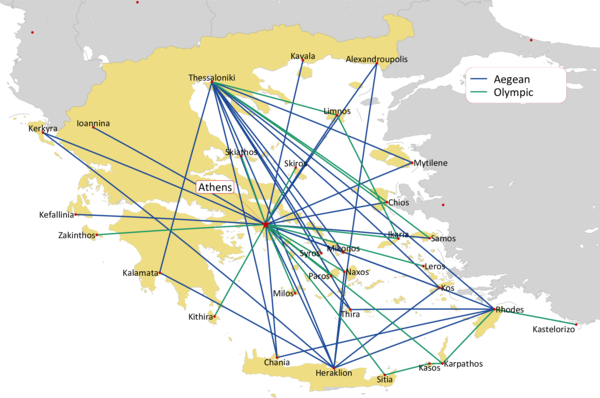
Aegean is also a niche carrier, a financially very successful one — a hybrid full-service/ LCC carrying 16.3m passengers in 2024. Under the long-term leadership of CEO Dimitrios Gerogiannis and chairman Eftichios Vassilakis, Aegean has developed a reputation for a laser-like focus on shareholder returns, avoiding distractions from its core strategy — operating A320s on short/medium-haul intra-European services from its Athens base to primary and secondary cities in addition to extensive inter-island services using A320s and turboprops. It is the antithesis of the former flag-carrier Olympic Airlines, which it bought in 2011 from Marfin Capital, two years after its privatisation.
The company is quoted on the Athens stockmarket with about 56% of its shares in free float, valuing the company at around €925m as at early 2025. The Vassilakis family owns about 35%, and other Greek entrepreneurs the remainder.
Aegean was badly hit by the pandemic in 2020 when traffic dropped by two thirds and it lost €228m, though it managed to break even the next year. It received €120m in state aid, with the Hellenic Republic being granted warrants worth €85m giving the state the right to own 11.5% of the airline. Aegean was able to buy back the warrants in 2024, clearing the company of any government liabilities.
Prepandemic, Aegean vied with Ryanair for the mantle of Europe’s most profitable airline, and it was able to stage a strong recovery after the market reopened, achieving net profits of €169m in 2023, a 10% margin on revenue. 2024 are expected to be a bit down — €127m, a 7%, margin, according to a research report by Barclays. This is mainly attributed to the grounding of aircraft, nine currently, due the GTF engine problems.
| €m | 2022 | 2023 | 2024 Est |
|---|---|---|---|
| Total Revenues | 1,337 | 1,693 | 1,751 |
| EBITDA | 275 | 400 | 376 |
| Operating Result (EBIT) | 147 | 246 | 199 |
| Net Result | 107 | 169 | 127 |
The balance sheet is solid, with total assets of over €2.5bn, including €500m of cash and equivalents, exceeding total liabilities of €2.0 bn, and giving the company a net book value of about €545m at the end of 2024.
| €m at end | 2024E |
|---|---|
| Fixed Assets | 1,465 |
| Other Assets | 563 |
| Cash and equivalents | 505 |
| Total Assets | 2,533 |
| Debt | 969 |
| Other Liabilities | 1,019 |
| Total Liabilities | 1,988 |
| Shareholder Equity | 545 |
Aegean has succeeded in fending off major incursion by LCCs and ULCCs into the Greek market. Its 2024 market share of seats offered is estimated at 31% by Barclays, compared to 9% for Ryanair and 6% for easyJet. A new entrant, Sky Express, has grown rapidly to 12%; it has attempted to duplicate Aegean’s strategy, but there is uncertainty about its sustainability, given its opaque finances.
Given Aegean’s operational and financial strength, the investment in Volotea would appear to be low risk with perhaps a strong upside. In a presentation to its own investors at the end of last year, Aegean explained its rationale.
-
Aegean is providing Volotea with convertible debt, an investment of €50m in two tranches which could convert into 21% of Volotea’s equity, but it is not obliged to convert into equity.
-
The investment is linked to the existing codeshare agreement between the two carriers, enhancing cross-selling and distribution through their respective websites.
-
There is the potential to jointly develop international services from Greek regional airports like Heraklion, Chania and Rhodes to significant source markets like France, Italy, and Spain.
-
More generally, the partnership will improve Aegean’s presence in Spain, Italy, and France, and the two airlines will aim to combine resources and expertise.
-
Aegean will provide MRO and Flight Simulator services to Volotea.
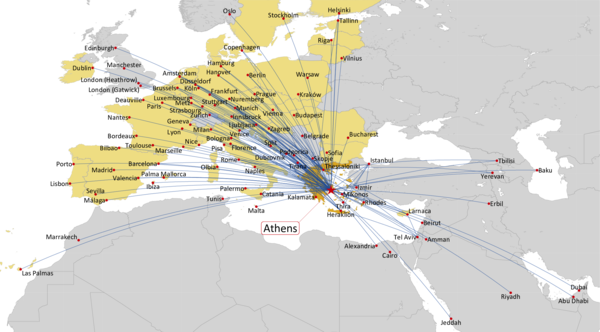
Aegean’s hub and network strategy is very different to Volotea’s. It is centred on Athens International Airport (AIA), where it bases some 50 aircraft. It is mostly point-to-point, but there is a significant domestic/international connecting operation. There are 156 destinations, 31 domestic and 125 international. There is a second, much smaller hub at Thessaloniki in the north of Greece.
As with Volotea, Aegean in planning on low overall capacity growth. Unlike Volotea it has a fleet plan in place — 17 A321neos are on order, configured with 220 seats, except for four which have been converted to a lower density long-haul version
| In Service | On Order | |
|---|---|---|
| A320ceo | 29 | |
| A321neo | 19 | |
| A321ceo | 5 | |
| A321neo | 14 | 17 |
| Turboprops | 17 | |
| Total | 84 | 17 |
The A321neo LR does represent a somewhat different direction for Aegean. Deliveries are scheduled to start in 2026, and the aircraft are expected to be deployed to new markets in the Arabian Gulf, India and Africa, with flight times of up to 7.5 hours. The market appears to be rich tourists and business travellers: there will be lie-flat Business class seats and an enhanced product in Economy.
Aegean’s investment on the A320neo LR operation is probably in the order of €230m, and there is the risk that if the market does not develop as expected it will be difficult to re-deploy these aircraft within Europe. So the A320neo LR project may be the priority for Aegean’s management.