Emirates: Frustrated despite
Soaring Profit
Jan/Feb 2025

Emirates celebrates its fortieth birthday this year. Over the past four decades it has grown to become the world’s largest international airline (measured in international RPK) flying to 139 destinations in 77 countries across six continents with a fleet of 264 widebody aircraft. It has achieved many accolades including “World’s Best Airline” from Skytrax in 2016 and “Best Airline in the World” from the prestigious ULTRAs 2024 awards.
Emirates has been consistently, if moderately, profitable. In the decade leading up to the 2020 pandemic, even while the numbers of passengers carried grew by a compound annual average 12%, and it suffered intense competition from close neighbours Qatar and Etihad — both trying to emulate Emirates’ success — it returned an average 6% operating margin and 4% net.
Coming out of the two disastrous years of the Covid-19 crisis, the airline has recovered reasonably quickly, although it has not quite returned to the peak level of activity pre-pandemic: the number of passengers carried in its financial year to end March 2024 reached 51.9m, still 12% below the numbers for 2019 (see chart).
However, its financial returns have soared: revenues for the year to end March 2023 were 10% higher than the pre-pandemic peak, and those for 2024 24% higher at 121bn dirhams (US $33bn). The operating margin jumped to 13% in FY 2023 and a 17% in FY 2024. It was able to report a record net profit of 17.2bn Dhs ($4.7bn) for FY 2024 reflecting 14% of revenues. This strength of result enabled it to declare a dividend to its owner (the Emir of Dubai) of 4.5bn Dhs, four times higher than the last dividend in 2019 and due recompense for the 15bn Dhs equity he injected during the crisis.
Records continue to be broken. For the six months to end September 2024, total seat capacity was up by 4%, passenger numbers increased by 3%, revenue grew by 5% and pretax profits (Emirates does not report operating profits in its half year results) 2% higher at AED 9.7bn ($2.6bn). The pretax margin of 16% compares with a 15.8% margin reported for the same period in the prior year. Net profit declined by 7%: but this was because 2024-25 is the first year that UAE corporate income tax applies to the Emirates Group financial reporting.
|
|
Why so profitable all of a sudden?
Emirates’ great strength is that it was the first to target and exploit the geographical advantage provided by a sixth freedom hub based in the Persian Gulf — providing access to 80% of the world’s population within reach of an eight-hour flight. A large reason behind its success is the support of the Group’s founder and Chairman, HH Sheikh Ahmed bin Saeed Al Maktoum and his pursuit of the UAE’s long term Vision 2030 to diversify its economy away from oil — in this case through aviation and tourism.
It helps that, besides being the Chairman and CEO of the Emirates Group (which includes ground and catering services operated by dnata) as well as 737 operator Flydubai (run independently from Emirates, but sharing the same owner), the Sheikh is President of Dubai’s Civil Aviation Authority; Chairman of Dubai Airports, Dubai World and Dubai Aviation City; Chairman of Dubai Duty Free; and Chairman of Dubai Aerospace.
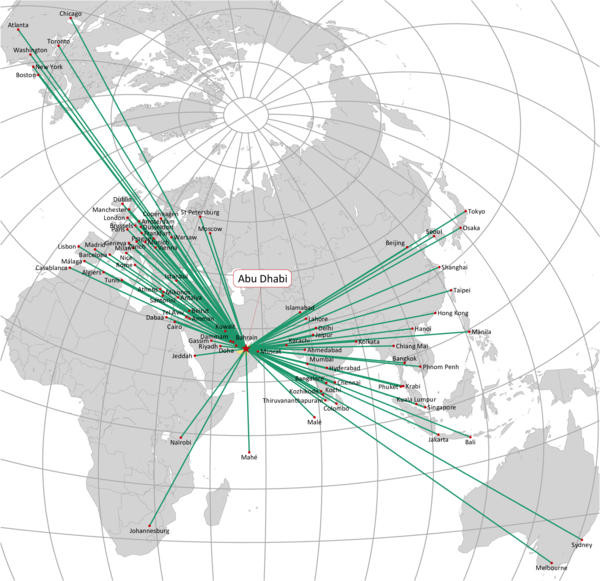
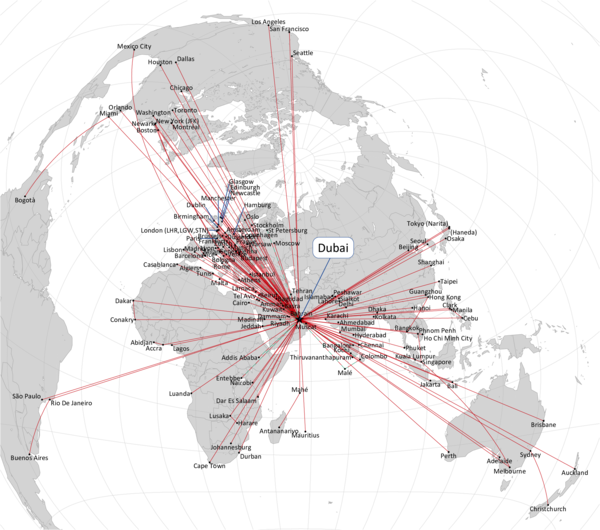
Qatar based in Doha and Etihad from Abu Dhabi followed Emirates’ strategy — although without the same devotion to the A380 — and through the 2010s provided substantial competition; and the three airlines’ route networks provided a significant level of directly competing overlap (see chart). (Note that both Qatar and Etihad operate narrowbody equipment which inflates the raw destination numbers: in revenue terms Emirates is 50% larger than Qatar; and five times the size of Etihad.)
Rationalisation may help to explain the current profitability. Qatar scrapped 20% of its A380 fleet in early 2020, and Etihad 30%; Emirates scrapped seven in the same year although this only accounted for 5% of its fleet. All have been subject to the supply chain issues plaguing the OEMs and the delay in new aircraft deliveries may have helped in restricting capacity as demand has returned.
More pertinent may be geopolitics, and a result of Russia’s February 2022 invasion of Ukraine. Unlike their European and US competitors, the Gulf carriers have not been excluded from using Russian airspace, which gives Emirates and its neighbour competitors some advantage for flights to the USA, notably Los Angeles, San Francisco and Seattle but also New York and Midwestern destinations.
Maintaining operations into Russia helps to provide nationals of the beleaguered country with means to access treasured tourist destinations (such as Dubai): Emirates serves Leningrad and Moscow (while Flydubai serves these and 12 other destinations in Russia).
It also strengthens competitiveness of their offerings for one-stop flights from Europe to China, North and South East Asia.
For the European carriers has proved very difficult to compete against Chinese carriers (who also are permitted to use Russian airspace). There is a natural cost disadvantage for the Chinese carriers, but this is exacerbated by the longer routes necessary for the Europeans to avoid the war-torn nations.
The route for Lufthansa to fly from Frankfurt Beijing avoiding Russian airspace is 1,400km longer; that for BA from London 1,700km; and Finnair’s flight from Helsinki to Shanghai needs another 3,700km, four hours and 20t fuel.
Further, Europe-China route demand is predominantly domestic China originating, giving the Chinese carriers a major marketing advantage against foreign airlines.
Emirates, currently flying to three destinations in mainline China (apart from Hong Kong and Taipei), recently announced plans to start services to Shenzhen, Hangzhou and Chengdu, (incidentally helping provide China with transport connections to its investments in Africa).
It is also expanding services into SE Asia with routes (tagged on from Bangkok) to Da Nang in Vietnam and Siem Reap in Cambodia.
Fleet dilemma
As the airline with the largest fleet of A380s, the decision by Airbus to kill production of the model came a blow to Emirates — it received the last of the type in 2021. Tim Clark, Emirates’ President, has repeatedly pressed for a re-engined model, and although Airbus has not officially ruled it out, it is highly unlikely that Airbus would retool to build a new version of the super-jumbo.
| In Service | Average Age | On order | |
|---|---|---|---|
| A380 | 116 | 10.2 | |
| A350 | 3 | 0.3 | 62 |
| 777-200 | 10 | 16.8 | |
| 777-300ER | 120 | 11.8 | |
| 777X | 205 | ||
| 787-8 | 15 | ||
| 787-10 | 15 | ||
| Total Passenger | 249 | 11.1 | 297 |
| 777F | 10 | 7.1 | 13 |
| Total Fleet | 259 | 11.0 | 310 |
This leaves Emirates with a dilemma. The A380 is a key element of its business plan: feeding huge quantities of passengers through its Dubai hub. The seven A380s it scrapped in 2020 were only 10-12 years old at the time (it sensibly is using their bits as spare parts). Its current fleet has an average age of just over ten years.
The airline has over 300 aircraft on order, including 62 A350s, 205 777Xs and 30 787s, and has been frustrated by the delivery delays from both manufacturers. The 777X, announced in 2013 and originally targeted for entry into service by 2020, might not now be certified until 2026: Emirates now seems to suggest they expect to receive the first in the second quarter of 2027. Had Boeing been able to deliver the 777-9 on time, the airline points out, it would have had 85 of the next generation aircraft in its fleet by now.
Emirates took delivery of its first A350 in November last year. It originally ordered 50 of the type in 2019 (along with 30 787s), and added a further 15 in 2023. This is its first new aircraft type since it took its first A380 in 2008.
At the press conference celebrating the aircraft’s arrival in Dubai, Emirates Airline President Sir Tim Clark said: “We are expansionist and we’ve had our wings clipped because of Covid and supply chains. We are a frustrated entity because we need aeroplanes, and we need them now. We’re champing at the bit to try to activate our network and grow it considerably more than it is today. These aircraft coming into us are vital.”
But as a result of these delays, Emirates seems to be considering keeping the A380s into the late 2030s and extending the lives of the 777-300s. It has set up a $4bn programme to retrofit 191 aircraft in the A380 and 777-300 fleet with its new cabin interior design, “including its latest 4-class Boeing 777 that feature a new 1-2-1 layout of lie-flat seats with personal minibars in Business Class, and the popular Emirates Premium Economy”.
Flydubai
Dubai’s hybrid low cost carrier, Flydubai, is officially independent from Emirates although they have the same owner, and cooperate closely.
Flydubai has a heavily modified LCC model, operating all its aircraft with a premium class and offering a full-service connecting facility at Dubai, both for its own network and on most of Emirates’ routes; last year 15% of its passengers were connecting on its code-share with Emirates. Emirates’ loyalty programme, Skywards, is applicable on Emirates/flydubai connecting flights, as is lounge access for higher-tier Skywards members flying on the flydubai network. For Emirates, flydubai has a dual strategic role: providing feed onto its own flights and securing a defence against the influx of LCCs into the Middle East market.
| In service | Age | Orders | |
|---|---|---|---|
| 737-800 | 29 | 9.9 | |
| 737 MAX8 | 56 | 3.5 | 127 |
| 737 MAX9 | 3 | 6.2 | |
| 737 MAX10 | |||
| 787-9 | 30 | ||
| Total Fleet | 88 | 5.7 | 127 |
Flydubai is a 737 operator with 88 aircraft in operation with an average age of 5.7 years, and 127 737MAX8/9s on order. It was hit badly by the grounding of the 737MAXs in 2019 even before the pandemic. These started to come back into service from 2021, but it too has been plagued by Boeing’s delivery delays: the company received four new aircraft in the first half of 2024, but they had been delayed from the backlog of previous years. The airline received none of the aircraft that had been contractually scheduled to be delivered in 2024 (and as a result extended the leases on four 737NGs that it had planned to return to lessors).
It too has instituted a retrofit programme to upgrade 25 of its 737NGs with the installation of the carrier’s flagship lie-flat Business Class seats and the new generation of its Economy Class seats that mirror the cabin product on its newer aircraft.
At the 2023 Dubai airshow the airline announced an order for 30 787s, which it hopes will be delivered from 2026 onwards. Ghaith Al Ghaith, CEO of flydubai, was quoted as saying: “The primary objective of the Boeing 787 will be to extend our reach into new markets. I envision destinations like London in Europe, Bangkok in Thailand, and even Australia, which the Dreamliners will empower us to access due to their remarkable range. Additionally, we intend to deploy them to bolster capacity in areas of robust demand.” And regarding the in-flight experience, “it is highly likely that, unlike all our other aircraft, the Dreamliners will feature not two, but three classes, potentially including the introduction of a premium economy cabin.”
He would not be drawn on more precise details of planned routes saying: “it would be premature, and besides, we are uncertain whether Boeing can meet the 2026 deadline.”
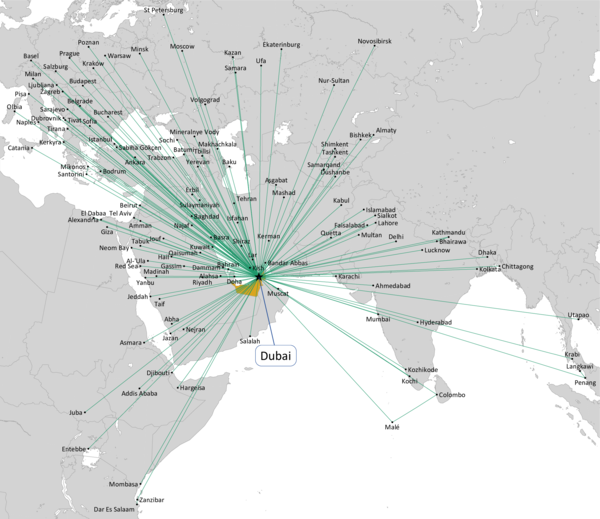
Since emerging from the pandemic years, Flydubai has strongly increased its network. It currently flies to 133 destinations (a quarter of which are also served by Emirates) in 55 countries (see map) within 5,500km of Dubai (the longest route being Dubai to Penang). This is up from 104 destinations served in 2018.
For the year ended December 2022 passenger numbers had just about recovered to the 11 million carried in 2018. In 2023 the airline saw a year-on-year 30% growth in passenger numbers and followed this in 2024 with a further 12% increase to give a full year total of 15.4m.
In February it was able to report the strongest financial results in its 15-year history. Revenues grew by 15% year-on-year to AED12.8bn ($3.5bn) — more than double the revenues achieved in its peak pre-pandemic year — and pretax profits reached AED2.5bn ($674m) — ten times that recorded in its previous best year in 2014.
Neighbours doing well too
For comparison purposes we show the results history of Qatar Airways and Etihad below, and their current route maps on the following pages.
Both have broken into profitability since the pandemic.
Qatar Airways (probably) had not produced a positive operating result in any of the ten years (ending March) preceding 2022. It had additional problems resulting from a diplomatic crisis with the Arab League in 2017: it was prohibited from using Emirati, Saudi and Egyptian airspace. The restriction was lifted in 2021.
For the year ended March 2022 it burst into resounding profitability, mostly thanks to its freighter operations. Although passenger demand remained well below prepandemic levels it transported a record 3m tonnes of cargo (it proudly boasted that it transported 600m doses of Covid-19 vaccines over the course of the pandemic) and cargo revenues accounted for 50% of turnover. It announced an operating profit margin of over 20%.
For FY 2024 it reported figures showing passenger numbers 24% higher than the number carried in 2019-20, revenues 60% higher at QAR80.4bn ($22.0bn) and operating profits of QAR13.4bn ($3.7bn). (It has neglected to provide an update for the six months ending Sep 2024.)
It too claims to be the World’s Best Airline — an accolade bestowed on it once again in the 2024 Skytrax awards. Unlike Emirates it is a member of a Global Branded Alliance. It joined oneworld in 2012 and since then had pursued closer equity and operational involvement with certain members. It has a 25% in IAG, (and the Qatari Investment Authority has a major 20% stake in London’s Heathrow airport) and has a 10% stake in Cathay, 3.4% in China Southern, and 10% in LATAM (even though no longer in oneworld). In 2017, it even attempted to acquire a 10% stake in American.
It has recently been granted approval to acquire a 25% stake in Virgin Australia.
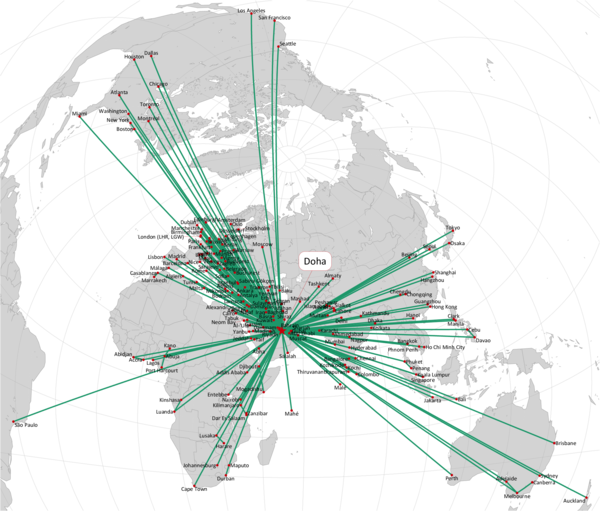
Etihad had also pursued a strategy of airline investments in the 2010s under the “hunter strategy” (invest in a basket-case because it is available) employed by then CEO James Hogan — Air Berlin, Air Serbia, Air Seychelles, Alitalia, and Virgin Australia. He was sacked in 2017 to be replaced by Tony Douglas. In the decade before the onset of the pandemic, Etihad had reported total net losses of $8.6bn, representing an average net margin of negative 17%.
Douglas managed to get the operation under control, and started reorganising it as a mid-sized carrier concentrating on point-to-point services. In 2022 the airline produced its first operating profit in a decade: $343m on revenues of $5bn, a modest 7% margin, even though passenger numbers were still 45% below the pre-pandemic peak.
Douglas left when, in 2022, the Abu Dhabi government transferred ownership of Etihad Aviation Group to the emirate’s sovereign wealth fund, ADQ. The reason given for the change in ownership was that it formed part of its efforts to “transform Abu Dhabi into a global aviation hub”. (Tony Douglas moved across the border to help create Saudi Arabia’s new super-connector, Riyadh Air).
So it was left to his successor, Antonoaldo Neves (formerly CEO at TAP, and previously Azul) to be able present the airline’s strongest annual results in its history for 2024.
Passenger numbers jumped 32% year-on-year to 18.5m — reaching the level last seen in 2017. Revenues grew by 25% to $6.9bn (some 13% higher than the prepandemic peak) and net profits (the airline neglected to mention operating profits) reached $476m compared with $143m in the previous year.
Reuters has reported rumours (using insider sources) that Etihad is planning a $1bn IPO of 20% of its shares on the Abu Dhabi stock exchange this year. Neves has the experience: he led Azul to its IPO on NYSE in 2017 (although left shortly afterwards to join TAP).