Atlantic Recovery
Redux
Jul/Aug 2021

While domestic markets have largely re-opened in the US and, to a lesser extent, Europe, the North Atlantic market remains very restricted. Occasionally It appears that progress towards normalisation is being made, then there are set-backs, the latest being the removal of the US from the EU’s “whitelist” meaning new quarantine rules. The Atlantic re-opening is going to be more complex for airlines than the domestic market restarts; some of the key issues are condensed in some comments on three key graphs.
Firstly, it is worth reemphasising the fact that long-haul, especially the North Atlantic, is much more important financially for network carriers than the passenger volumes might suggest. The US Legacies — United, Delta and American — are usually regarded as being primarily domestic operators, particularly by US-based analysts, 88% of their passenger volume is domestic but this segment represents only 68% of their revenues and profits. The North Atlantic accounted pre-pandemic for 18% of operating profits. The reliance on the North Atlantic is even greater for the European carriers who, unfortunately, are not required to reveal the regional breakdown of revenue or profits.
Overall, the cost structure of European network carriers and to a lesser extent the US majors is based the complex hub systems that feed short-haul traffic to/from the long-haul services where the profits are made (or not).
The second graph underlines the importance of the UK, specifically London, in the North Atlantic market. The top 15 city-pairs account for 30% of the market: seven of these (the red bars) are to/from London. London-New York had, pre-pandemic, over twice the passenger volume of the nearest rival, Paris-New York. Clearly, until Covid-19 restrictions are lifted for UK travel, there is no prospect of a real reopening of the North Atlantic. And any sign of a viral resurgence in New York would be a disaster for the industry.
London-New York is also the dominant business travel route, largely because the two cities are the global financial centres. Airline planners have agonised over the impact of Covid-19 on business travel but the only conclusion is that at some point business travel may recover to pre-Covid levels but it is not going to be soon. Video technology is now universal; corporations will continue to cut travel budgets, and they have realised that they can use air travel to meet their carbon reduction obligations; and super-elite passengers are choosing private jets.
This will be a big problem for the network carriers whose premium passengers have accounted for 30-40% of their revenues. Pre-Covid the ratio of premium to economy fares was about 5:1 as a global average, higher on the Atlantic. That type of ratio will not be achieved in the foreseeable future because to fill Business class cabins premium fares will have to be significantly reduced from pre-Covid levels. Premium leisure is being promoted but is only a partial solution.
For the revenue part of the profitability equation — average RASK — to get close to balancing the cost part — average CASK — economy class fares will have to be raised. In turn, a rise in economy fares might put off a substantial recovery in traffic volumes.
The pre-pandemic structure of the Atlantic market is encapsulated in the third graph.
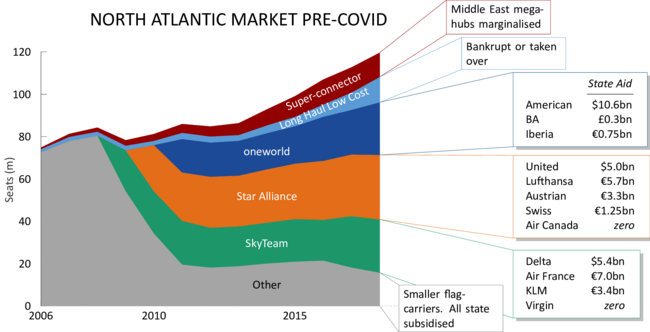
The North Atlantic market had become increasingly consolidated by multinational groups that together controlled about 68% of capacity: the antitrust immunised joint ventures of Air-France-KLM with Delta; Lufthansa Group with United; British Airways, Iberia and Aer Lingus with American. These groups became virtually merged entities, with the US and European partners making joint decisions on fares, schedules and capacity, sharing revenues and costs on a “metal-neutral” basis so that in theory there was no difference as to whose aircraft were operated — a legal oligopoly among privately owned, competitive airlines.
But, with the notable exception of IAG and Virgin Atlantic, these network carriers have absorbed at least $45bn in state aid in grants and loans during the pandemic. And after decades of extricating themselves from their national carriers, the German, French and Dutch governments now find themselves as significant shareholders; under the CARES Act, the US government will have the right to participate in “the gains of the eligible business” — a sort of national control.
The challenges of restoring long-haul services to anything like pre-Covid operations are such that governments may find themselves enmeshed for the long term, in which case it is possible to envisage long-haul international airlines once again assuming the role of national champions or chosen instruments, a transatlantic airline industry a bit like the pre-deregulation world — dominated by a few large airlines, owned or controlled by their governments, subsidised by their states, with little sign as yet of disruptive competitors.
Long-haul low-cost capacity, in various forms, had peaked at about 12% of the North Atlantic total, but Covid-19 killed off these delicate airlines. Norse Atlantic is aiming to replace Norwegian’s 787 operation, and Play is planning a Wow-type low cost hubbing operation at Reykjavik using A321neos. Both presumably will have learnt from the mistakes of the predecessors, but they seem to be niche outfits rather than market disruptors.
The super-connectors — Emirates, Etihad and Qatar Airways — had built up their share of Atlantic to about 9% pre-pandemic but their finances have been damaged, and funnelling passengers to/from 200-plus countries through a few terminals to the US may not be an attractive proposition when the market finally re-opens.
The model offered by JetBlue — operating A321LRneos featuring the MINT premium product — may be the optimal solution, if it is allowed to take over suitable (and currently unused slots). It is based In New York, the prime US gateway on the Atlantic. It has a strong network of routes domestically in the North East of the country to be able to feed routes out of both its home city and Boston. It has the experience of successfully (and profitably) disrupting the erstwhile cosy transcontinental markets between west and east coast (while halving fares on the routes). It will be operating with efficient, new, and relatively small aircraft. And it may be able to afford to treat the Atlantic as an experiment.
