THY: Opportunity emerges from the pandemic
Jul/Aug 2021

THY might just emerge from the pandemic as a stronger player, a super-connector in the cargo business as well as the passenger sector. Its recent financial results show it to be one of the first airlines to achieve a genuine turn-around, but can the recovery be sustained?
Covid-19 vaccination rates in Turkey has progressed fairly well (75% single jab) and the summer months saw an unexpected surge in tourist demand. The Turkish economy appears to be rebounding — the OECD forecasts 5.7% growth in real GDP this year compared to 1.7% in 2020.
On the downside, the traffic recovery depends on Covid infection trends and travel rules imposed by northern European countries, and THY in the second quarter of 2021 was flying just 56% of its 2019 capacity. The country’s economic performance is uneven, heavily reliant on large-scale spending by the state on infrastructure projects, and inflation is threatening to get out of control. The political situation on Turkey’s borders remains volatile (as an aside, THY was the number one commercial airline flying to/from Afghanistan in the first half of this year)
How THY achieved break-even
THY broke even at the net level in the first half of this year, a sharp contrast with the rest of the European industry. THY has not received direct financial support from the Turkish state (although it is 49% owned by the Turkey Wealth Fund, the national investment vehicle, and this link has facilitated access to bank funding and kept down its cost of capital). Remarkably, the 2021 operating profit, $24m, was a much better result than in the equivalent pre-pandemic period of 2019 when it reported a loss of $193m. The turnaround was achieved despite a collapse in RPKs of 59%, a reduction in ASKs of 48% and a decline in average load factor of 11 points to 62.4%. So how did THY do it?
Passenger revenue fell more or less directly in line with the collapse in traffic by $2.9bn (see summary P&Ls), but cargo revenue more than doubled to nearly $1bn, which meant that total revenue fell by a mere $2bn or 33%.
| US$ Millions | 2019 | 2021 | Change | % | |
|---|---|---|---|---|---|
| Pax Revenue | 4,971 | 2,060 | (2,911) | -59% | |
| Cargo Revenue | 799 | 1,765 | 966 | 121% | |
| Other | 179 | 147 | (32) | -18% | |
| Total Revenue | 5,949 | 3,972 | (1,977) | -33% | |
| Fuel | 1,836 | 981 | (855) | -47% | |
| Personnel | 1,041 | 598 | (443) | -43% | |
| Aircraft Ownership | 895 | 944 | 49 | 5% | |
| Airports and Navigation | 548 | 384 | (164) | -30% | |
| Sales and Marketing | 575 | 258 | (317) | -55% | |
| Ground Handling | 391 | 284 | (107) | -27% | |
| Passenger Services | 298 | 97 | (201) | -67% | |
| Maintenance | 384 | 238 | (146) | -38% | |
| Others | 174 | 164 | (10) | -6% | |
| Total Operating Costs | 6,142 | 3,948 | (2,194) | -36% | |
| Operating Result | (193) | 24 | 217 | ||
| Net Finance Costs | (123) | (83) | 10 | ||
| Pretax profit | (316) | (59) | 207 | ||
| Tax | 113 | 58 | (55) | ||
| Net Result | (203) | (1) | 202 |
In the first half of 2021 THY owned a fleet of 18 widebody freighters, wet leased in a further seven units, and also used up to ten passenger widebodies in cargo roles, but the increase in FTKS was fairly modest, up about 18% between the two periods. The real boost to revenues came from an increase of 87% in unit prices, reflecting the global shortage of bellyhold capacity on grounded passenger widebodies and the unprecedented boom in maritime freight rates, in turn caused by a surge in demand for JIT-delivered products combined with logistical disruptions throughout the containership transport system.
Then THY succeeded in cutting operating expenses by $2.2bn or 36% — hence the turnaround to an operating profit of $24m in the first half of this year, $217m better than in 2019. Net financial costs, mostly forex related, of $83m produced a pre-tax loss of -$59m which was a $257m improvement on 2019. Adding in a tax credit of $58m, much less than the 2019 refund, produced the net result of -$1m, $202m better than 2019.
| FY (Jan-Dec) | Jan-Jun | ||||||||
|---|---|---|---|---|---|---|---|---|---|
| US$m | 2016 | 2017 | 2018 | 2019 | 2020 | Total 5 years | 2020 | 2021 | |
| Revenues | 9,792 | 10,958 | 12,855 | 13,229 | 6,734 | 53,568 | 3,434 | 3,972 | |
| Net result | 7 | 223 | 753 | 788 | (836) | 935 | (654) | (1) | |
| Operating Cashflow | 613 | 2,368 | 1,457 | 2,111 | 389 | 6,938 | 100 | 1,516 | |
| Capex | (878) | (848) | (1,242) | (1,068) | (1,153) | (5,189) | (625) | (380) | |
| Other Income (Expenditure) | 622 | 1,664 | (1,161) | 52 | 784 | 1,961 | 441 | 229 | |
| Free Cashflow | 357 | 3,184 | (946) | 1,095 | 20 | 3,710 | (84) | 1,365 | |
| Increase (Decrease) in debt | 209 | (2,759) | 691 | (656) | (284) | (2,799) | (230) | (922) | |
| Total Cashflow | 566 | 425 | (255) | 439 | (264) | 911 | (314) | 443 | |
Looking at the operating costs in more detail, fuel was the biggest cost item, falling by 47% mostly reflecting the reduction in flight hours but also a 10% decline in price per gallon.
Aircraft ownership costs were marginally up. Nearly 80% of THY’s fleet is owned or on financial leases (for which for which the average interest rate is 2% pa) and 90% of this cost element was non-cash depreciation. THY has not had to enter into renegotiations with operating lessors, but the overall fleet plan has been cut back.
In 2019 THY moved its entire passenger operations from the old İstanbul Atatürk airport to the new İstanbul Grand Airport (İGA) which meant that it was based at the most modern, high-tech, unconstrained hub in Europe but it also meant that it was facing some of the highest airport charges in Europe as the pandemic struck. The airport owners, a private Turkish consortium, having paid €22.1bn for the 25-year concession was reluctant to cut charges but did agree a 10% discount on landing fees. The state airport authority, DHMI has cut charges at its airports by 50%, the discounts continuing into 2022, while the other İstanbul airport used by THY, Sabiha Gökçen, made similar concessions. As a result, airport and navigation charges for THY fell by $164m or 30% between 2019 and 2021.
The most dramatic saving came from personnel — expenses were down by $443m or 43% — the result of an agreement reached in September 2020 with the unions which implemented across-the-board salary cuts of 40% in return for no lay-offs. With consumer price inflation in Turkey edging towards 20%, this salary reduction has had to be modified, and 15% salary restorations are being phased in throughout 2021. The agreement is for full salary restoration to take place when, in the words of chairman Mehmet İlker Aycı there is “a reasonable recovery in the profit of THY and recovery in the sector”.
Other significant cost savings were made in sales and marketing, down $317m or 55% and in passenger services, down $201m or 67%. Some of these savings will be permanent; reliance on e-marketing has been accelerated, the airline is downgrading its catering offering, and operations have been transferred to the lower cost brand, Anadolujet.
In the short term the outlook is favourable; THY will still have a strong cargo performance throughout the rest of this year at least while the passenger business continues to recover. HSBC is forecasting a net profit of $484m for 2021, a 4.9% margin in contrast to an -$836m, -12.4%, loss in 2020.
Longer term, there is the possibly that THY’s upturn will be endangered by the normalisation of the air cargo market — with falling cargo revenues negating the recovery in passenger revenues at the same time as cost pressures, especially from labour, are escalating,
Spinning off TC and Anadolujet?
However, THY intends to consolidate recent gains in the cargo sector — it has stated its explicit target of establishing itself as one of the top three cargo airlines in the world, which is ambitious as in 2019 THY was the ninth largest cargo airline, well below FedEx, UPS and Emirates. The implication is that THY will be capable of winning business from Emirates, Qatar Airways and the European network carriers.
The cargo operations are branded separately as Turkish Cargo (TC), and the plan is to spin TC off as a separate identity with its own AOC and to form a joint venture with a major player in the cargo sector. Currently, the company is in the process of setting up IT systems, negotiating legislative issues and planning for some type of capital raise, with a competition date of the end of this year. As for the partner, THY says that there are interested parties but has revealed nothing definitive. Qatar Airways might be a possibility or Lufthansa with whom THY has had a long-standing 50/50 joint venture — the charter airline Sun Express (last year Lufthansa wound up its own subsidiary Sun Express Deutschland and transferred residual operations to Sun Express and Eurowings). A joint venture with one of the internet giants would be an imaginative move — Amazon, perhaps.
| 1 | FedEx | 17.5 |
| 2 | Qatar | 13.0 |
| 3 | UPS | 12.8 |
| 4 | Emirates | 12.1 |
| 5 | Cathay Pacific | 10.9 |
| 6 | Korean | 7.4 |
| 7 | Lufthansa | 7.2 |
| 8 | Cargolux | 7.2 |
| 9 | THY | 7.1 |
| 10 | China Southern | 6.8 |
THY is in the process of moving the entire cargo operation to İGA in the course of this year (the freighter fleet remained temporarily at the old Atatürk airport after passenger operations moved to İGA in 2019). Like the passenger side, the cargo facilities at İGA — called Smart East — are high-tech featuring robotic process automation and augmented reality technology; specialist facilities for the shipment of temperature-sensitive cargo and livestock; and direct connections between the terminal and the freighters. Initial capacity will be 2.8m, rising to 4m tonnes by 2024, by which time İGA expects to be ranked as the fourth biggest cargo hub in the world and the biggest in Europe.
THY has indicated that it may consider spinning off Anadolujet in a similar manner to Turkish Cargo, though details are sparse.
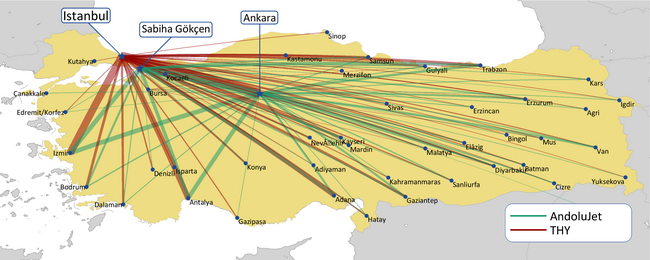
By mid-2021 64 737-800s were operating under the Anadolujet brand on 97 international routes compared to just 30 in 2020, with ASK capacity up 129%. Anadolujet is a classic LCC model: the aircraft are configured to 189 seats and the network is pure point-to-point, separate from the THY hub network. The main bases are Sabiha Gökçen and Ankara Esenboğa, much less expensive airports than İGA, even before the pandemic discounts. The focus is on price-sensitive passengers in Europe and the Middle East
The risk with such LCC subsidiaries is cannibalisation of the mainline traffic and undermining of THY’s hub economics. Although the two markets appear distinct, Anadolujet’s network from İstanbul will increasingly overlap with THY hub operation. New destinations started this year by Anadolujet include Lyons, Milan, Moscow, Zürich, Baku, Dubai, Baghdad and Tehran.
Anadolujet also has the classic LCC-subsidiary role of trying to protect the parent from aggressive competition, in this case from Pegasus, also based at Sabiha Gökçen. Pegasus has proved to be resilient throughout the crisis; according to HSBC’s Turkish analysts, passenger volume will be 20.5m this year, 67% of the 2019 volume, and operating losses will be reduced to -€27m from -€179m in 2020.
THY and ME3
Although THY has in the past used Lufthansa as its benchmark (its longstanding target of bypassing the German carrier in terms of total passengers by 2023 now seems irrelevant given Lufthansa’s post-Covid downsizing), the most important competitors for THY have been the three Middle East super-connectors (ME3).
The pandemic has had the effect of highlighting the importance of having a significant domestic market (or not having any domestic market in the case of the ME3). In 2020 THY carried 13.6m passengers domestically, and 27.7m in total — 37% of the 2019 volume. By contrast, in FY1020/21 Emirates managed only 6.6m passengers, 11% of its 2019/20 volume.
THY’s international network with its focus on secondary as well as primary cities in Europe and its strong presence in Africa is relatively less exposed to competition for connecting traffic. Our pre-pandemic analysis (see Aviation Strategy April 2019) of the overlap among the four super-connector networks revealed that 24% of THY’s international capacity was deployed on routes where there was no direct competition from the other super-connectors whereas the comparable percentages for Qatar Airways was 6%, Emirates 5% and Etihad 1%.
Nevertheless, the overlap between the networks was still substantial. Again based on pre-pandemic numbers, 62% of THY’s capacity operated to the same destinations as Emirates, 65% to the same destinations as Qatar; only 45%s of capacity competed directly with Etihad, a figure that will be significantly reduced following Etihad’s forced downsizing.
Pre-pandemic the super-connector sector was characterised by persistent over-capacity, with each of the carriers having expansionist over-ambitions. All that has changed, each of the ME3 super-connectors has downsized their fleets, attempting to shift to smaller-size equipment, Etihad in particular has had to face up to the consequences of its rapid expansion and absurd airline investment strategy. Although the ME3 can continue to rely on support from their very wealthy owners, even they will be unwilling to add to the billions of dollars that have been pumped into their flag-carriers over the past 18 months.
In this new environment THY, with its non-reliance on direct state funding and its rational turnaround strategy, should be able to enhance its competitive position. It may be significant that THY recovery is being led by the Americas region with business captured from both the ME3 and the European network carriers — ASKs in June this year were 112% of the June 2019 level and load factors had moved back up to near normal levels, 77%.
Resetting growth
Indeed, the pandemic may just have afforded THY the opportunity of resetting the growth strategy. THY used to confidently present detailed long term, 6-year, fleet plans — for instance, back in 2018 it projected a 435 aircraft fleet for the end of 2021, 112 widebodies, 305 narrowbodies and 18 freighters. Today it no longer publishes its firm orderbook and limits itself to a 6-month projection — by the end of 2021 the fleet will be 371 units consisting of 106 widebodies, 245 narrowbodies and 20 freighters.
In late 2020 THY renegotiated with Airbus the delivery schedule for 71 A321 NEOs and 25 A350-900s, moving from a final delivery date of 2023 to 2028. Then in early 2021 THY reached an agreement with Boeing to cancel ten 737 MAXes from its orderbook of 75 units, and to reduce deliveries to an undisclosed lower annual rate (previously THY was to have taken all the ordered MAXes by 2023). This has allowed the airline to postpone the raising of some $5bn in aircraft debt until after 2024,
| Widebody | A330-200/300 | 54 |
| 777-300ER | 33 | |
| A350-900 | 5 | |
| 787-9 | 15 | |
| 107 | ||
| Narrowbody | 737-800/900 | 109 |
| 737-8/9MAX | 16 | |
| A320 Family | 84 | |
| A321 NEO | 30 | |
| 239 | ||
| Freight | A330F | 10 |
| 777F | 8 | |
| Wet Lease | 8 | |
| 26 | ||
| TOTAL | 372 |
Even before the pandemic financiers were getting a little concerned by THY’s capex commitments and balance sheet. The airline has cut back sharply on capex (although it still has over $1.3bn of commitments this year) and has managed to reduce net debt, but the balance sheet as at mid-2021 was still highly leveraged — a debt/equity ratio of 3.6/1. Fitch’s rating for THY debt is only B (which means that “while financial commitments are currently being met; capacity for continued payment is vulnerable to deterioration in the business and economic environment”). However, cash has been built up to a very respectable $2.2bn.
(US$m)
| End June 2021 | |
|---|---|
| Fleet assets | 4,347 |
| Right of Use assets | 15,065 |
| Cash | 2,254 |
| Other assets | 4,664 |
| Total Assets | 26,330 |
| Long term debt | 12,072 |
| Short term debt | 4,291 |
| Other liabilities | 4,282 |
| Total Liabilities | 20,645 |
| Shareholders' Equity | 5,685 |
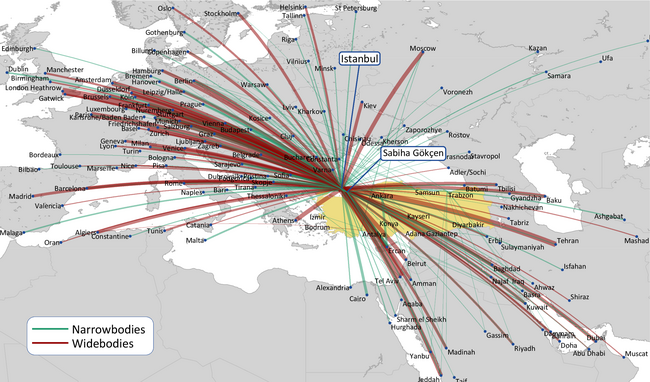
THY’s growth strategy has been essentially to add more cities, add more aircraft so that traffic grew exponentially through the multiplication of city-pairs connected through the İstanbul hub. İstanbul’s geography meant that about 40% of global air traffic was within narrowbody range and by using 737s THY could open up markets that were never going to be served by direct widebody flights. But well before the pandemic it had become clear that growth was not necessarily translating into profits and acceptable ROCEs. For instance, between 2016 and 2019 revenues grew by over 10% pa but net profit margins were in the zero to 6% range.
With the orderbook rescheduling comes the opportunity for THY to adjust its network for profit maximisation rather than market maximisation. The network covers 331 destinations, both domestic and international, of which 249 were being flown as at June 2021. The airline in its latest presentation identified 14 future destinations, including Nantes, La Coruña, Palermo, Abha (Saudi Arabia), Juba (South Sudan), Port Sudan, Atyrau (Kazakhstan) and Sialkot (Pakistan). Even with narrowbody hubbing operations, can such points be commercially viable?
The mega-airport question
Potentially, İGA, İstanbul’s new airport, is THY’s greatest asset. But it is also a a symbol of the extravagant nationalist policies of President Erdoğan.
İGA is located 50km north-west of the city centre on the European side of the Bosphorus. It has a capacity of 90m passengers a year with a single terminal and two sets of parallel runways. Planned expansion will take it to 150m passengers by 2027 with eight runways and a second terminal. Whether this will take place in the post-pandemic world is uncertain, but it is clear that İGA will be Europe’s, and maybe the world’s, biggest airport. Moreover, user reaction to the new airport has generally been very favourable and it has received various awards. For example, it was deemed to be “Europe’s most efficient airport” by the Air Transport Research Association while Skytrax appointed it as a “5-Star Airport" and a “5-Star COVID-19 Airport”.
İGA itself is part of a mega-project promoted by President Erdoğan, which includes Kanal İstanbul, a planned $30bn shipping canal designed to bypass the Bosphorus Strait, plans to build a new city for 2-3 million inhabitants, the North İstanbul Highway, and the proposed third bridge on the Bosphorus.
Critics of the mega-project and President Erdoğan’s other policies, especially the repression of democratic and social rights, and the replacement of Turkey’s secularism with a fundamentalist Islamic ideology, warn that Turkey will suffer both economically and politically. The grandiose spending sprees will provide a temporary boost to the economy but the fall-out will be inflation and recession and political unrest (it was only five years ago that there was an attempted coup in Turkey).
THY as an international hubbing airline is somewhat protected from these developments, but not completely.
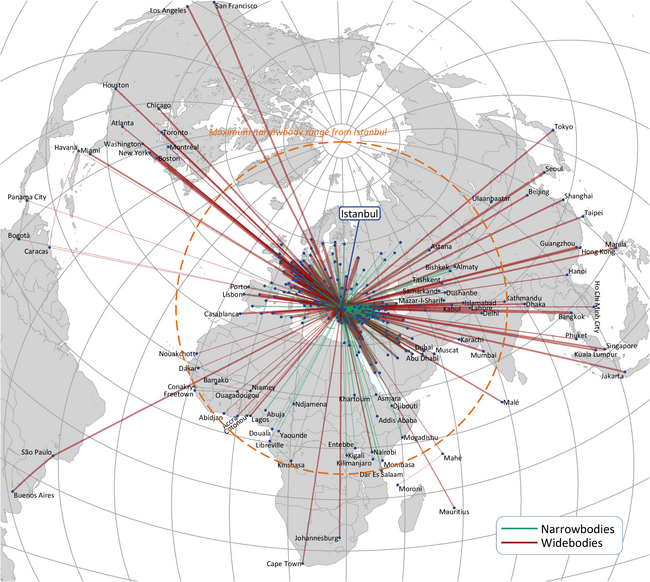
Notes: Equidistant azimuthal projection based on Istanbul: great circle routes appear as straight lines; thickness of lines directly related to annual seat capacity.