Capital A: SuperApp illusions,
AirAsia Realities
June 2022

The airline formerly known as AirAsia is going digital in a big way. It is developing a “Super App” to provide a one-stop online shop that goes well beyond the traditional airline offering of own airline ticket sales, check-in, hotels and car hire. Will it succeed?
In January, AirAsia Group Bhd formally changed its name to Capital A. At the time the company said that the change of name was to reflect the Group’s new core business strategy as “an investment holding company with a portfolio of synergistic travel and lifestyle businesses”.
With the new corporate strategy comes a change in reporting — the portfolio is split into four group divisions: Aviation, Engineering, Digital — which in the accounts is split into three reporting segments: Teleport (logistics), airasia SuperApp and BigPay (financial tech) — and Ventures (ie others).
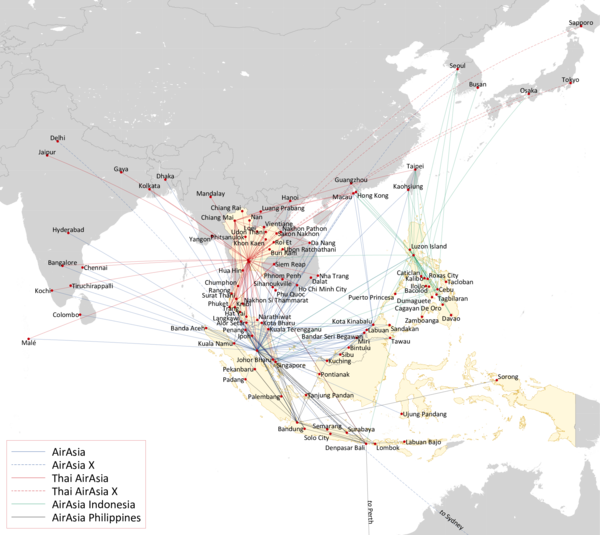
All the surviving AirAsia airlines (Malaysia, Philippines, Indonesia, and Thai) are to be placed in the Aviation Segment along with ground handling (Great Team Red, or GTR) and catering-to-restaurant business Santan. AirAsia Japan ceased operations in October 2020 and was dissolved in June 2022. At the end of 2022, AirAsia sold a 33% stake in AirAsia India to its partners Tata for $37.7m. It seems likely that Tata will take out AirAsia’s remaining 16% minority stake in AirAsia India and merge it into Air India Express. Indonesia AirAsia and Philippines AirAsia are both consolidated. Thai AirAsia, in which AirAsia group had a 45% equity interest is treated as an associate. At the beginning of 2022, Thai AirAsia’s quoted majority parent holding company, Asia Aviation, raised ฿14bn ($386m) in a mixture of private placements, convertible debt and rights issue; and it appears that at the same time AirAsia swapped its 45% stake in Thai AirAsia for a 45% stake in Asia Aviation. There probably was a reason.
AirAsia X, the long haul low cost A330 operator, does not appear in the list. Although effectively controlled and run by Fernandes, bin Meranun and their Tune Group, AirAsia (now Capital A) only has a 13.8% stake. It is described as an “affiliate” and treated as an “investment” in the accounts. For a description of AirAsia X’s current position see the box below.
We present a simplified view of the group’s complex corporate structure in the organogram.
Engineering encompasses the group’s incipient MRO business, suitably named Asia Digital Engineering (ADE) to keep with the hi-tech theme. The aim in the next five years is to build external sales, capture MRO market share (proudly claiming 24-hour operations in Malaysia as a competitive low cost advantage) and establish ADE as a “key player in the ASEAN region”.
In the Digital division the group aims to build its logistics operation Teleport Anywhere to a 10% market share of cargo in South East Asia (primarily driven by belly-hold capacity) and a 9% share of deliveries. It currently delivers to 86 cities in seven countries in the region.
Bigpay, the group’s financial tech offering, offers digital money transfer between 10 countries in Asia/Pacific. It recently lost out in its application for one of five digital banking licence available in Malaysia (but had started offering loan products in the anticipation that it would succeed). The group states it has an aim to build its customer base to 10m monthly active users by 2026 — whatever that really means. At the end of 2021 Bigpay apparently had 1m “carded users”, up by 50% over the year, and more than 2m copies of the app had been downloaded. In the first quarter of 2022 it said its user base had grown by 64% year-on-year. Bigpay has a vision to be the leading digital bank throughout ASEAN with a mission “to empower and improve the financial health of the next generation by improving accessibility to financial services”.
The airasia SuperApp has the modest ambition to be the “superapp of choice in ASEAN” and a mission “to connect our customers with everything, everywhere and to provide our customers with value, togetherness, affordability, accessibility and inclusivity”.
The app has four pillars (known as verticals in the jargon of the industry):
- Travel. It has an online travel agency (OTA) selling airline tickets on 700 airlines worldwide (and claims to be the third largest OTA in ASEAN, based on website traffic). Users can book hotels and there is an inclusive tour product named SNAP selling flights plus hotels. In addition there are mini-apps linking to health tourism and AirAsia’s 60% owned subsidiary Ikhlos that provides “life style solutions” to members of the Muslim faith.
- Delivery: Food, following the acquisition in 2021 of Malaysian company DeliverEat, but also connecting AirAsia’s own Santan franchised restaurant chain (dedicated to providing the fastest Nasi Lemak to the region); Fresh Food using its home grown “airasia grocery” product (seated under the group’s Ventures division) providing B2B and B2C services from farmer to consumer (with the aim to become the Amazon Fresh of ASEAN); Beauty (further undefined); and Rides (a Uber-type ride-hailing service service), following the 2021 acquisition of Gojek’s Thailand ride-hailing operations and Malaysian company Dacsee. In addition, it markets AirAsia Xpress (presumably linked with Teleport Anywhere) to provide on-demand parcel delivery services.
- Money: with links to Bigpay giving payment and money transfer services and access to loans and insurance. In this pillar the company also places its loyalty scheme Big Rewards.
- Media: providing TV and chat services.
Explaining the strategy, CEO Tony Fernandes stated: "We have combined our 20 years of experience as a leading low-cost airline and our vast market base in ASEAN with technological innovations to develop the AirAsia Super App. It seeks to facilitate various daily needs and lifestyle trends by offering a comprehensive range of products and services. This is a very important business for us, and we expect non-flight revenues to account for 50% of our total revenues within five years."
Tony Fernandes is known for putting a positive spin on any news item. But these new ventures are far from profitable while the core airline business is still reeling from the effects of the Covid pandemic. Group revenues in 2021 tanked to RM1.8bn ($422m) from 2019’s RM12bn ($2.7bn) and the group reported losses at the operating level of RM2.8bn ($650m) and RM3.7bn ($850m) at the net. These losses actually represented an improvement over 2020 (see chart).
| 2021 | 2020 | |||||
|---|---|---|---|---|---|---|
| YE Dec RMm | Revenues | EBITDA | margin | Revenues | EBITDA | margin |
| Aviation | 1,573 | (178) | -11% | 3,048 | (2,330) | -76% |
| Asia Digital Engineering | 101 | 13 | 13% | 19 | 0 | 2% |
| SuperApp | 150 | (139) | -93% | 117 | (11) | -9% |
| Teleport Anywhere | 551 | (57) | -10% | 295 | (5) | -2% |
| BigPay | 22 | (118) | -547% | 18 | (83) | -472% |
| Others | 16 | (74) | -475% | 1 | (260) | nm |
| Eliminations | (577) | (472) | (224) | (661) | ||
| Group Total | 1,836 | (1,025) | -56% | 3,274 | (3,349) | -102% |
In 2021, it appears that the group successfully limited the aviation losses (at the EBITDA level) to RM178m down from a RM2.3bn loss in the prior year (see table), but the SuperApp also lost RM139m on RM150m of revenues and Bigpay lost RM188m on RM22m of income. The only division to record a positive EBITDA was the engineering arm ADE, possibly reflecting time-plus margins on work to the (associate) Thai AirAsia fleet and some external customers.
In the first quarter of 2022 the group saw a substantial year on year growth in passenger traffic with the numbers carried up by 66% to 5.2m, although this was still at only 28% of 2019 levels. Group revenues rose by 150% to RM0.8bn, the operating loss worsened by 6% and net loss by 10% to RM (1)bn.
| Pct Change | |||||
|---|---|---|---|---|---|
| Q1 2022 | Q1 2021 | q on q | yr on yr | ||
| Bigpay | Total users (m) | 3.18 | 1.65 | +15% | +93% |
| Carded users (m) | 1.17 | 0.71 | +13% | +64% | |
| Teleport | Tonnage (tonnes) | 25,625 | 19,497 | +4% | +31% |
| Yield (RM/kg) | 5.21 | 4.46 | +16% | +17% | |
| No of deliveries (‘000s) | 945 | 171 | +60% | +451% | |
| airasia SuperApp | Monthly active users (m) | 10.74 | 4.54 | +32% | +137% |
| Gross booking value (RMm) | 871.95 | 441.33 | +2% | +98% | |
Aviation recovery is on its way as borders reopen and travel restrictions ease across ASEAN. Most of the countries in the region opened their borders in May to fully-vaccinated international passengers. China (and Hong Kong) which had pre-pandemic had provided 18% of AirAsia’s traffic, remains effectively closed.
AirAsia has maintained that Southeast Asia’s market of 700 million people is ample to power a reboot for the region’s airlines and it expects a strong rebound in regional travel. AirAsia has a distinct advantage in the forthcoming recovery. Its legacy competitors have been intensively damaged by the crisis. Malaysian Airlines, Thai International and Garuda have all been or are still going through bankruptcy restructuring, the latter two expected to emerge with substantially smaller fleets. AirAsia has orders for 362 A321neos, and Fernandes has suggested that he would look to establish one or two new AirAsia branded airlines in the region (without specifying which countries).
AirAsia currently has 97 of its 202-strong fleet back in the air operating (including one A330 wet-leased from AirAsia X for domestic Malaysian trunk routes), but expects that will rise to 176 by the end of the year. Tony Fernandes had guided that AirAsia will be cash flow positive in the second half of the year and profitable once more in 2023. Aviation revenues could feasibly climb quite quickly back above the RM12bn achieved in 2019.
| In Service | Parked | Total | ||||||
|---|---|---|---|---|---|---|---|---|
| A320 ceo | A320 neo | A321 neo | A330-300 | A330-900 | Total | |||
| AirAsia | ||||||||
| Malaysia | 30 | 15 | 2 | 1* | 48 | 54 | 102 | |
| Thai | 21 | 7 | 1 | 29 | 23 | 52 | ||
| Indonesia | 12 | 12 | 13 | 25 | ||||
| Philippines | 9 | 9 | 14 | 23 | ||||
| Total AirAsia | 72 | 22 | 3 | 1 | 98 | 104 | 202 | |
| On order | 362 | |||||||
| AirAsia X | ||||||||
| Malaysia | 4 | 4 | 8 | 12 | ||||
| Thai | 1 | 1 | 2 | 6 | 8 | |||
| Total AirAsia X | 0 | 0 | 0 | 5 | 1 | 6 | 14 | 20 |
| On Order | 20† | 15‡ | ||||||
The new digital ventures are in their early stage of development and in a high growth phase. But to get the non-aviation revenues to account for half the group total by 2026 turnover would imply a compound annual growth rate of 75% over the period.
Fernandes takes pride in saying that the SuperApp had been confirmed as one of three companies in Malaysia to have been identified as a “unicorn” — a privately held startup tech company with a value of over $1bn — in a research report from Credit Suisse identifying 35 such companies in the ASEAN region.
This is an interesting report highlighting a digital development focus in the region on e-commerce, ed-tech, logistics, deliveries and mobility (mainly ride-hailing), digital healthcare and fintech. It highlights the low overall financial preparedness of the region (particularly in Indonesia) including credit card and bank account penetration, ATM availability among other things, but also the high penetration of smartphones. AirAsia’s SuperApp is the only one mentioned in the report that includes air transport.
AirAsia also notes in its Q1 results’ presentation that its logistics operation Teleport has a “last valuation” of $300m. Simply deducting this $300m figure and the SuperApp valuation of $1bn from Capital A’s current equity market capitalisation of $575m would suggest that its investors, were they to believe the assertion, ascribe a value to the aviation business of a negative $725m.
Moreover, these tech valuations come from two acquisitions: the SuperApp acquired Gojek’s ride-hailing business in Thailand for what was announced to be $40m, but paid for with a 4% minority in the equity in the SuperApp; and, a similar arrangement between Teleport and DeliverEat. The group may soon to be able to assign a “value” to its Bigpay subsidiary: in August last year it took on a $100m loan from South Korean conglomerate, SK Group, to be converted into preference shares within a year subject to regulatory approval.
Unfortunately for Fernandes, there is a high level of competition in the super-trendy Super App space in SE Asia, with a huge amount of capital backing. Singapore-based Grab Holdings (quoted on New York and with a market cap of $9bn) is battling it out with Jakarta-based GoTo Gojeck Tokopedia (valued at $27bn) and Singaporean Sea Ltd with its Shopee e-retailing outfit (quoted in New York with a value of $42bn). They are all heavily loss-making. (For details see box)
ASEAN SUPERAPP COMPETITION
| Revenues | Net Loss | Market Cap | ||||||
|---|---|---|---|---|---|---|---|---|
| US$bn | 2019 | 2020 | 2021 | 2019 | 2020 | 2021 | Current | At Peak |
| Sea Ltd (Shopee) | 2.2 | 4.4 | 10.0 | (1.5) | (1.6) | (2.0) | 42.4 | 197.6 |
| Grab Holdings | (0.8) | 0.5 | 0.7 | (3.7) | (2.6) | (3.4) | 9.1 | 40.0 |
| GoTo Gojek Tokopedia | 0.2 | 0.2 | 0.3 | (1.6) | (1.1) | (1.4) | 26.7 | 31.6 |
Sea Ltd
Founded in 2009 as Garena, a game development and publishing company, it changed its name to Sea in 2017 and functions as a holding company for Garena, e-commerce company Shopee, and fintech SeaMoney. Shopee claims to be the largest e-commerce platform in SE Asia with over 300m monthly visitors. It also has an operation in Brazil and claims that globally it is the top-ranked App in the shopping category in Q1 2022. SeaMoney is its digital payments arm offering mobile wallet services, payment processing, credit offerings and other digital financial services. Sea was one of the successful bidders for a Malaysian digital banking licence in May this year in consortium with Malaysian conglomerate YTL.
Floated on Nasdaq in 2017 in a $0.9bn IPO it raised a further $1.5bn in 2019, $2.6bn in 2020, and $7bn in 2021 through secondary offerings. Its revenues have grown exponentially to $10bn in 2022, but has been losing an average $1.7bn a year. It currently has a market capitalisation of $44bn, somewhat down from the peak last September of nearly $200bn.
Grab Holdings
Founded in 2012 as MyTeksi in Kuala Lumpur as a ride-hailing app, the company moved to Singapore in 2014, having secured a $10m funding from sovereign wealth fund Temasek, and renamed as Grab.
It expanded through the region with a series of mobility apps — GrabTaxi, GrabCar, GrabCoach, GrabBike (motorcycle taxis), GrabWheels (e-scooter rental), GrabFamily (cars with child seats), and even GrabPet (taxis with drivers who like animals) — and in 2018 merged with Uber’s SE Asian operations giving it access to food delivery services, merging UberEats into GrabFood (and getting Uber as a major shareholder). Grab also has a delivery service GrabExpress providing last mile courier operations, and multilingual GrabChat messaging.
Through GrabPay it has a payments and fintech product, and was also one of the successful bidders for a digital banking licence in Malaysia awarded in May (having also successfully acquired a similar Singaporean licence in 2020).
Hailed as ASEAN’s first “decacorn” (The Economist, with a bit more erudition than the financial markets display, recently suggested that unicorns with a value over $10bn should be called gryphons), Grab debuted on the New York stock markets in December 2021 through a SPAC merger raising $4.5bn, valuing the group at $40bn. Nasdaq welcomed the flotation as the largest SPAC combination outside the USA.
Revenues have grown from a negative $0.8bn in 2019 to $0.7bn in 2021 and the group has averaged annual losses of over $3bn in the last three years. The group has a current market capitalisation of merely $9bn, less than a quarter of that at its IPO.
GoTo Gojek Tokopedia
Indonesia-based GoTo is the result of the $18bn merger in 2021 of ride-hailing operator Gojek and e-commerce company Tokopedia in what has been described as the country’s biggest ever business deal. GoTo claims to be responsible for 2% of Indonesia’s GDP with ambitions. CNBC quoted William Tanuwijaya, co-founder and CEO of Tokopedia, as saying “hopefully one day we’ll contribute 5 to 10%”.
Gojek was founded in 2010 as a ride-hailing platform for motorcycle taxis (known as ojek in bahasa Indonesia) and launched its app in 2015 with four services: GoRide, GoSend, GoShop and GoFood — all effectively using a motorcycle to take something from A to B. Additional services were quickly added including Go-Mart (grocery delivery), Go-Clean (housekeeping and cleaning), and even GoMassage (self-explanatory). In 2017 it made a series of fintech acquisitions to add a payments system: 64% of Indonesians have no access to banking services. It had been providing last-mile deliveries for e-commerce platform Tokopedia (founded in Jakarta in 2009) and last year felt that a merger was logical.
Boasting 2.5m drivers, 14m merchants and 55m annual transacting users, the merged group floated on the Indonesian stock exchange in April 2022 raising $1.1bn in its IPO and valuing the company at $32bn. In the last four years gross revenues have grown from 4.3tn rupiah ($0.1bn) to 17tn ($0.3bn). The group has averaged net losses of $1.25bn a year for the past three years.
Weak balance sheet
Unfortunately also, Capital A Group’s balance sheet is not exactly in a healthy position to support the ambitious development. The significant losses during the last two years have more than eliminated shareholders’ funds: equity (after minority interests) stood at a negative RM6.4bn at the end of 2021. By the end of the first quarter the deficit had widened to RM7.35bn (see table).
| RMm | Dec 2019 | Dec 2021 | Mar 2022 |
|---|---|---|---|
| Property | 1,202 | 931 | 910 |
| Right of use assets | 11,216 | 9,751 | 9,397 |
| Aircraft PDP | 252 | 610 | 622 |
| Associates & JV | 703 | 439 | 1,057 |
| Intangible assets | 635 | 833 | 834 |
| Others | 6,294 | 5,015 | 4,358 |
| Fixed Assets | 20,302 | 17,580 | 17,178 |
| Cash | 2,588 | 1,257 | 364 |
| Other current assets | 2,704 | 1,193 | 1,496 |
| Current liabilities | (7,135) | (9,204) | (9,849) |
| LT Debt | (86) | (1,423) | (1,420) |
| Lease liabilities | (10,188) | (10,390) | (9,687) |
| Maintenance provisions | (4,721) | (4,861) | (4,884) |
| Other LT liabilities | (554) | (576) | (549) |
| Total Long Term Liabilities | (15,549) | (17,249) | (16,540) |
| Equity | 2,911 | (6,423) | (7,350) |
In the first quarter of 2021 it completed a private placement of shares representing 14% of the shares in issue which brought in RM331m (and, incidentally, TPG’s David Bonderman as a shareholder among others). In December it completed a RM1bn rights issue of 7-year redeemable convertible unsecured Islamic debt securities, paying an annual “profit” of 8%. A quarter of the amount raised with this hybrid instrument is recognised as equity capital, the remainder as long term debt.
Capital A Group ended 2021 with long term debt of RM1.4bn, having been virtually debt free at the end of 2019. With shareholders’ funds in deficit, the Group is in default of stock exchange listing requirements of Bursa Malaysia. It was granted an 18-month dispensation while the Covid pandemic raged but, in January this year, was officially served with “Practice Note 17” requiring the group within a year to provide a plan to “regularise” its financial position.
| RMm | 2017 | 2018 | 2019 | 2020 | 2021 |
|---|---|---|---|---|---|
| Revenues | 9,710 | 10,604 | 11,965 | 3,274 | 1,836 |
| Net result | 1,592 | 1,711 | (286) | (5,888) | (3,721) |
| Operating cash flow | 2,154 | 353 | 2,081 | (2,168) | (678) |
| Net Capex | (2,128) | 8,643 | 4,493 | 177 | 31 |
| Other investment flows | 544 | 406 | 167 | 313 | 350 |
| Free cash flow | 570 | 9,402 | 6,742 | (1,679) | (297) |
| Net increase in debt | (683) | (6,349) | (4,175) | (412) | 740 |
| Equity raised/(Dividends paid) | 204 | (1,738) | (3,409) | 331 | |
| Total Cash Flow | 91 | 1,316 | (842) | (2,091) | 774 |
Tony Fernandes dismisses the problem suggesting that it is a solvable “accounting” issue, which “doesn’t reflect the fundamentals of the company”. In some sense he may be right (accountancy after all is an art rather than a science). The balance sheet is in effect asset-light: all the aircraft are on operating leases and, because of the peculiarities of lease accounting, their on-balance sheet near RM10bn value is not quite matched by the lease liabilities. Likewise what appears as RM4.9bn maintenance provisions in long term liabilities are nearly matched by RM4bn prepayments on the asset side. Minority interests account for RM3.3bn of the deficit. But to “regularise” the position the Group will need to boost its equity capital and reserves by at least RM6bn ($1.5bn).
In a recent interview in the Financial Times, Tony Fernandes suggested that Captal A is planning New York listings both for the AirAsia airline “sometime next year” and to be followed by the AirAsia SuperApp. It is not entirely clear, but we understand this could mean he would seek to sell minority stakes in both AirAsia Bhd (possibly merged in with the AirAsia Aviation Group) and the digital venture to raise funds that could flow straight into reserves (the binding consideration is that AirAsia Bhd must be substantially owned and controlled by Malaysians to retain its AOC). He is no doubt hoping that the US stock markets can provide a better understanding of valuing ULCC airlines and more of an appetite for unicorns than the Malaysian Bursa. With a fair wind he may even be able to get sufficient funds to restore the balance sheet.
Tony is ever the optimist. “Twenty years ago, when I started this airline, no investor wanted to invest in us. It wasn’t a very convincing story to say you’re going to start up an airline when you’re from the music business, with no money, and go up against Malaysia Airlines, Singapore Airlines and the like,” he told the FT.
“Twenty years later, I now say I’m going to take on these digital unicorns. Probably not a convincing story either from an airline that’s struggling, going through Covid, has a weak balance sheet, etc. But it’s slowly coming.”
With markets in bear territory there are signs than some unicorns will soon become unicorpses.
AirAsia X
AirAsia X, Tony Fernandes’ long haul low cost venture (in which AirAsia has a 14% stake), has had a torrid time through the Covid pandemic. All its operations were international and in May 2020 it effectively had to go into hibernation — or perhaps life support as if in intensive care.
In December 2020 it started proceedings to get court backing for debt restructuring, and extended its financial year by six months to give it some breathing space. The financial results for that 18-month period were eye-wateringly painful: revenues of RM1.2bn ($280m), 70% below that of the year ended December 2019, an underlying operating loss of RM1.4bn ($325m) before impairment charges and a published net loss of RM33.7bn ($7.7bn).
The debt claims presented to the courts totalled RM65bn ($15bn), but was whittled down to RM33bn — a large portion of this relating to AirAsia X’s outstanding orders for 78 A330-900s and 30 A321XLRs.
A settlement was agreed in March 2022, allowing for a 99.5% haircut on the debt and allowing the company to avoid dissolution. There are provisions to allow creditors — excluding Airbus — to enjoy a share of profits equating to 20% of the excess EBITDAR over RM300m from 2023 to 2026. Not that the group has been that profitable in the past: it posted a profit in only four of the years in the decade up to 2019 and lost a total RM1.7bn in the period.
Following the deal, that near $8bn was written back to the profit and loss account in the quarter ending March 2022. Also issued a PN17 by Bursa Malaysia, AirAsia X has until October to “regularise” its financial position: it has been talking about raising new equity of RM150m via private placement and rights issue for over a year. Meanwhile associate company, Thai AirAsia X, in May applied for bankruptcy protection in the Bangkok Courts.
In the recovery strategy formulated last year, AirAsia X stated that it would shift its focus from “market share to that of sustainability, yield and driving profitability”, and that it would “continue its focus on medium to long haul flight operations within the 5 to 8-hour range and defer investment in new or immature routes”.
And now it is firmly in the mood for coming out of hibernation. In the last couple of months it has gradually announced new routes and a resumption of passenger services from July. With a much reduced fleet of 20 A330s (of which six are currently in service) — half the size of pre-pandemic levels — it is restoring services to Delhi, Sydney, Seoul, Tokyo, Sapporo, Osaka and Honolulu (via Osaka), and has also announced plans to serve Dubai, Istanbul and London (which might be seen as a departure from the new strategy).
AirAsia X CEO, Benyamin Ismail stated in June that “I am confident all of our resumed or new services will prove to be very popular and that we will return to pre-COVID capacity on some of our core routes within the next 12 months. Our strategic new model, combining cargo and passengers, enables AirAsia X to fly profitably where other airlines may not be able to, which makes operations to longer-haul routes like Dubai, Istanbul and London, commercially viable and more affordable for our guests at the same time”.
The viability of the long haul low cost model has not yet been proven. But AirAsia X still has 15 A330s and 20 A321XLRs on order.