Alaska: A Caring and
Careful Airline
June 2022


Alaska Airlines is 90 years old but its name is a heritage, reflecting its origins in the 49th state. Alaska Air Group (AAG) — the holding company for the mainline airline and Horizon, the regional airline — has been head-quartered at Seattle since the late 1950s and the vast majority of its operations are based in the Pacific North West and California. Culturally, it is very West Coast: “Care” is its official buzzword, permeating its branding and employee communications. (With David Neeleman’s Breeze proclaiming that it is “nice”, US airlines seem to be on a mission to rescue the industry’s image.)
The care message was central to CEO Ben Minicucci’s presentation to equity analysts and financiers at Alaska’s investor day, held in late March in New York, the first such meeting for three years. Minicucci regaled the analysts with what he himself described as “fluffy stuff”, including the story of how he was inspired by his father, an illiterate Italian who emigrated to the US after WW2. The Wall Street types remained dry-eyed.
Putting cynicism aside, Alaska does have a good ESG record. AAG has just appointed Patricia Bedient as chair of the company’s Board of Directors, making it one of only 20 S&P500 corporations with a female chair. The company has set itself targets linked to bonuses to achieve the same ethnic diversity among senior management as among the overall workforce — roughly a third of Alaska’s employees are BIPOC (Black, Indigenous and People of Color). It has the short-term aim, again tied to bonuses, of becoming the US’s most fuel-efficient airline by 2025.
Note: excludes special items, including CARES Act funding 2020/21.
Alaska also has a good commercial record, consistently outperforming the US industry in terms of pre-tax margins, achieving profit margins of 24% in 2014 and 2015 before its profitability was dented by the costs of integrating Virgin America, which it bought in 2016 for approximately $4bn (cash plus debt assumption).
The airline managed to survive the pandemic with only modest CARES Act loans — $600m in total — though it received $1.6bn in grants through the Payroll Support Program (PSP) during 2020 and 2021. With this support, which was used to offset labour costs, the company lost $0.8bn in total at the net result level, though operating cashflow was positive.
Alaska can claim that it led the recovery of the US industry: its pre-tax margin in the second half of 2021 was 7% compared to 2% at Delta, -1% at Southwest, -5% at JetBlue, -7% at United and -11% at American. It boasts that it was the first US airline to achieve positive operating cashflow excluding PSP funds, as well as the first to regain profitability. And the first to return to pre-pandemic leverage, which it did without issuing new equity, In contrast to four of its five main competitors.
Its balance sheet as at the end of the first quarter 2022 is more or less optimal, according to the airline — debt roughly half of total capitalisation. It does not have to plan for painful deleveraging unlike the three legacy network carriers whose debt to capitalisation ratios range from 90% to 120%
| 2016 | 2017 | 2018 | 2019 | 2020 | 2021 | Mar-22 | |||
|---|---|---|---|---|---|---|---|---|---|
| Revenues | 5.9 | 7.9 | 8.3 | 8.8 | 3.6 | 6.2 | Fleet assets (inc lease rights) | 7.8 | |
| Net result | 0.8 | 1.0 | 0.4 | 0.8 | -1.3 | 0.5 | Intangibles | 2.0 | |
| Operating Cashflow | 1.4 | 1.6 | 1.2 | 1.7 | -0.2 | 1.0 | Cash and short term deposits | 2.9 | |
| Capex & Acquisitions | -2.6 | -1.0 | -1.0 | -0.7 | -0.2 | -0.3 | Other current assets | 1.5 | |
| Other Investment Income (Expenditure) | 0.0 | -0.1 | 0.4 | -0.1 | -0.4 | -0.7 | Total Assets | 14.2 | |
| Free Cashflow | -1.2 | 0.5 | 0.6 | 0.9 | -0.8 | 0.0 | |||
| Net increase (decrease) in debt | 1.8 | -0.4 | -0.5 | -0.5 | 2.1 | -0.9 | Long term debt | 2.1 | |
| Dividends & Share buy-backs | -0.3 | -0.2 | -0.2 | -0.3 | -0.1 | 0.0 | Other long-term liabilities | 3.9 | |
| Total Cashflow | 0.3 | -0.1 | -0.1 | 0.1 | 1.2 | -0.9 | Other current liabilities | 4.6 | |
| Total Liabilities | 6.0 | ||||||||
| Shareholders’ Equity | 8.2 |
Given all this, why, the CFO Shane Tackett, asked plaintively, does Wall Street not treat Alaska better? Its share price has been trading a price/forward earnings ratio of 8.7 compared to, say, 13.4 at Southwest. Taking a long-term view Alaska’s share price has generally underperformed the Arca Airline Index, while tracking almost exactly the same trend as JetBlue.
Part of the reason may be that it is not simple to define Alaska’s market positioning. Like JetBlue, it occupies a position somewhere between the legacy network carriers and the expansionist ULCCs. Its basic strategy is to combine low costs with higher yields. Unit costs on a stage length adjusted basis are about 25% below the average of the three big network carriers but nearly 50% above the Frontier/Spirit level. Unit revenues, measured in terms of passenger revenue per domestic passenger, are about 20% below the legacies’, and 60% above the ULCCs’. Neither is it really comparable to the ultimate LCC — Southwest — whose brand and scale overwhelm Alaska’s.
At the investor day Alaska was gently guiding to a pre-tax margin in the region of 6% this year., though industry-wide cost inflation may have put that in doubt. The longer-term pre-tax margin was declared as 11-13%.
Alaska presents a persuasive narrative with regard to its integrated network/fleet/product strategy, a strategy that is designed to enhance yields at the same time as reducing unit costs, mostly through fleet efficiencies. The management is confident that its post-pandemic commercial initiatives will deliver a net $400m benefit to the airline, equivalent to about 5% of 2019 revenues and 40% of its 2019 pre-tax profit.
ALPA threatens
Unfortunately, pilots with placards outside the investor day meeting cast an ominous shadow, and since then contract negotiations with ALPA have been fraught, with the union threatening strike action and staff shortages causing some summer schedules to be cancelled. Management argues that Alaska is not in a position to increase the total cost of its pilot contract at a time when fuel costs are rising rapidly, and the main way of increasing remuneration has to be through profit sharing. It contends that "ALPA’s proposals would burden Alaska Airlines with the highest-cost pilot contract in the industry by a significant margin”. According to management, its proposed five-year contract would mean that senior Alaska Airlines captains and first officers would have the third-highest pay rate in the industry (behind Southwest and American).
Alaska’s dispute with ALPA is one of several examples of the power that pilots have in the post-pandemic world (reviewed in the first article); as one Alaska executive, admitted, “it’s a very good time to be a pilot”. The regional airline, Horizon, is being impacted as well, with pilots transitioning as soon as they are qualified to positions in mainline operations, at Alaska itself and also other airlines. It is difficult to see how Alaska management can avoid further pay concessions.
Unpacking the $400m
The pandemic had one upside for Alaska — it provided management with time to put together three plans that together are designed to generate the promised $400m incremental revenue benefit.
Alliances and network
Alaska formally joined oneworld in 2021, a move which has increased the number of partner airlines by seven to 23, and given Alaska access to 100 nonstop flights to Europe from the West Coast. Alaska’s entry into oneworld was sponsored by American which is by far the most important partner airline; this specific agreement provides for mutual codeshare marketing as well as mutual FFP participation, lounge access, etc.
The alliance effect accounts for $135m of the total $400m. The management presentation broke this benefit down further: one third would come from oneworld passengers connecting onto the Alaska network, one third would come from Alaska passengers connecting onto oneworld aircraft, one third would come from new corporate accounts using combined Alaska/American services. What wasn’t revealed is how much oneworld membership will cost in terms of participation fees, which are usually charged on a RPK/RPM basis.
The oneworld entry does seem to make sense given its strong position in its Werst Coast bases and its own total concentration on North American services. Seattle Tacoma (52m passengers in total in 2019) is the main base for Alaska and is the largest airline hub operation on the West Coast — Alaska, with 350 daily departures, has pushed its market share up to 60% at which point Alaska expects that it can grow its passenger volumes without diluting yield.
Seattle for some time has been underserved by international connections, which is surprising given the number of giant corporations that are headquartered in the Puget Sound region — for example, Costco, Microsoft, Amazon, Nintendo and Starbucks, plus Boeing which has its manufacturing centres in the city though it recently decided to relocate its headquarters from Chicago to Washington DC, more convenient for political lobbying.
Alaska is establishing the same type of market control at Portland (20m passengers in total in 2019) where it has 110 daily departures and a 50% market share. The other Alaska bases are LAX and SFO in California where it has smaller but growing market shares — 8% and 17% respectively in terms of departures — and Anchorage, its original base, where it has a 65% share.
Capacity expansion is planned to be in the order of 6%pa on average through 2025, and it is going to be very careful expansion. Only 10% if the growth in ASMs will be in new markets while 70% will be through adding frequencies, again appealing to the business sector (the other 20% comes from aircraft size and stage length effects).)
Given that it is surrounded by tech companies, Alaska has a close insight into corporate travel trends in this sector. The pandemic resulted in an obliteration of tech business travel — down 85% from 2019 — but even these executives are turning off zoom and returning to physical travel, according to Alaska — corporate travel was only down about 25% compared to 2019 in the first half of this year.
Loyalty scheme
Given the valuations that have been placed on airline loyalty programmes over the past two years, it is perhaps not surprising that the Alaska Mileage Plan provides the most important element in the $400m incremental revenue total. A $195m benefit is attributed to the programme based largely on a new co-branded credit card agreement with Bank of America, signed earlier this year. Indeed, at the investor day a BoA president also made a presentation, lauding the extent of cooperation and compatibility between Alaska and the Berkshire Hathaway-owned financial giant.
Alaska claims that it already has the most generous loyalty plan in the US, with its members earning at least 30% more miles per dollar spent than its competitors, and this will be greatly enhanced by the BoA alliance. For instance, the Alaska/BoA credit card offers cardholders an Annual Companion Fare (worth $221) two free checked bag ($120), discounts on daily lounge accesses passes, etc.
The strategic benefit for the two corporations lies in the mass of consumer data that can be shared, enabling focused marketing campaigns, early identification of retail trends, low cost penetration into new markets, and so on. This digital strategy is being followed by most airlines in one form or another, but Alaska’s joint venture with BoA does seem more tangible and focused, and Alaska has not — as yet — placed an incredible valuation on Mileage Plan or changed its prosaic name to something trendier.
Fleet upgauge
The third element relates to the fleet and is expected to contribute the remaining $75m of the $400m net benefit. Essentially, the plan will complete by 2023 the rationalisation of the mainline fleet to Boeing 737s, finally discarding the A320s that came with the Virgin America take-over. On the same timescale Horizon will move from having a mixed Embraer/De Havilland fleet to being a single E175 operator, with the Q400s leaving the regional fleet. Details are shown in the table.
| March 2022 | End 2024 | Change | |||
|---|---|---|---|---|---|
| 737 Freighter | 3 | 3 | |||
| 737 NG | 163 | 163 | |||
| 737 MAX 8 | 10 | 10 | |||
| 737 MAX 9 | 19 | 77 | 58 | ||
| 737 MAX 10 | 6 | 6 | |||
| A320 | 30 | -30 | |||
| A321 | 10 | -10 | |||
| Mainline Total | 225 | 259 | 34 | ||
| Q400 | 32 | -32 | |||
| E175 | 66 | 82 | 16 | ||
| Regional Total | 98 | 82 | -16 | ||
| TOTAL | 323 | 341 | 18 |
As Alaska itself notes, this is a standard strategy for LCC-types, generating well-known benefits: single maintenance programme, simplified pilot rostering and training, optimised network planning and seamless equipment swaps. It also deepens the airline’s relationships with its key suppliers — Boeing, CFM and Embraer.
Alaska’s relationship with Boeing is close, the Alaska headquarters being only a few miles from Renton, so executives from both companies have had plenty of opportunities to discuss MAX problems and negotiate contracts.
Alaska placed its original order for 32 737-9s back in 2012, but did not receive its first aircraft until January 2021. It then waited until the end of 2021 to expand its order by adding a further 23 MAXes, which at that difficult time was a major confidence boost for Boeing.
As at the end of Q1 2022 Alaska had firm orders for 67 MAXes for delivery during 2022-24 plus lease commitments for a further seven. Alaska also holds options for a further 52 MAXes, mostly -10s. Horizon has firm orders for 12 E175s plus a further commitment for seven E175s under a capacity share agreement with SkyWest.
Originally planning on a single 737-9 fleet, Alaska revised its order to bring in -8s and -10s. Within the MAX fleet Alaska is going to operate all three variants; the 178-seat 737-9 is the core aircraft, for high demand and long-haul routes, with the longer-term target of having roughly the same number of 189-seat 737-10s and a significantly smaller subfleet of 162-seat 737-8s.
The 737-9 configuration of 178 seats compares to 150 on the A320, which gives a cost reduction of 14% per seat. There are 40 premium seats on the 737-9, 33% more than on the Airbus, which Alaska expects to be a driver of increased yields, though the ratio of premium cabin fare to economy cabin fare at Alaska is only 1.3, about third of the ratio for a legacy network carrier.
The problem with claims on future synergies is that it is very difficult to verify them later, for example tying down the period over which the synergies are realised or extricating the synergy impact from other company or market developments. For instance, the Virgin America takeover was advertised back in 2017 as being worth $300m in annual net synergies, $240m in revenue and $60m in cost. But the revenue enhancement had not been achieved pre-pandemic, and the added costs of the dual fleet turned out to be significant. In its Q1 2022 accounts Alaska was still recording $75m in fleet transition charges relating to the Virgin America takeover.
JetBlue scenarios
Questioned about Alaska’s view of M&A, specifically the Frontier/Spirit/JetBlue situation, Ben Minicucci categorically stated that his airline had no interest in expanding other than organically. He then added that there were no regrets about Alaska’s purchase of Virgin America; it was a deal that would pay dividends
The proposed Frontier/Spirit merger was analysed in some detail in the March 2022 edition of Aviation Strategy, with the general conclusion that there would appear to great compatibility between the two carriers’ operating models and management. But since then Spirit shareholders have put off making a decision because JetBlue seems determined to win Spirit and has raised its bid several times.
JetBlue’s latest and allegedly final offer for Spirit gives an equity value of $3.35bn. The offer is all-cash and is about 40% higher than Frontier’s offer which is mostly in the form of shares. In addition, JetBlue is guaranteeing Spirit shareholders a $400m “Reverse Break-up Fee” payable if the DoT blocks the merger. (JetBlue is already entangled in an antitrust case with the DoJ over its alliance with American in the northeast of the US, which the DoJ contends is leading to market control and higher fares.)
JetBlue’s presentations have concentrated on the financial details of the offer and regulatory aspects, but have provided very little on the future strategy for the JetBlue/Spirit amalgam. In fact, JetBlue complains that it, unlike Frontier, has not been given access to Spirit’s internal information and so has not been unable to conduct proper due diligence.
Spirit shareholders are naturally tempted by JetBlue’s extra cash but Spirit’s management strongly believe that JetBlue/Spirit doesn’t make sense. In contrast to the clear Frontier message — “Creating America’s most competitive ultra-low fare airline” — the rationale for the proposed takeover given by Jet Blue’s CEO, Robin Hayes is “to create a bigger JetBlue”. But does this mean that JetBlue is going to buy the Spirit A320s, network and airport gates, then convert these assets into much higher cost (about 50% higher on an adjusted CASM basis) JetBlue operation? Or operate in effect two different airlines — a superior LCC type and a ULCC type?
There are various possible implications for Alaska.
Under the first scenario the JetBlue/Spirit merger goes ahead. If it is successful, Alaska will probably face more competition on the transcon markets and its expansion prospects may be curtailed. However, if the implementation of the merger proves to a nightmare, Alaska’s competitive position will be greatly enhanced relative to JetBlue, which will also have a greatly increased debt load, and new market opportunities will open up.
Under the scenario whereby the Frontier/Spirit merger is consummated and a powerful new ULCC emerges, Alaska should be aware of a competitive threat. There is a ULCC vacuum at its West Coast bases (see the Frontier Spirit route map in the March edition), which the new Frontier Spirit might well want to move into, especially as Alaska is moving its own model upmarket. Alaska argues that it can fend off ULCC competition because it offers a range of products on its flights — from “Suited up Flyers” to “Dollar Driven”, but it hasn’t yet been fully tested against the ULCCs.
A third scenario is that Frontier/Spirit goes ahead creating a super-ULCC, leaving JetBlue looking for another partner — and who better than Alaska? Speculation about Alaska/JetBlue is not original, but there are some interesting arguments for this combination.
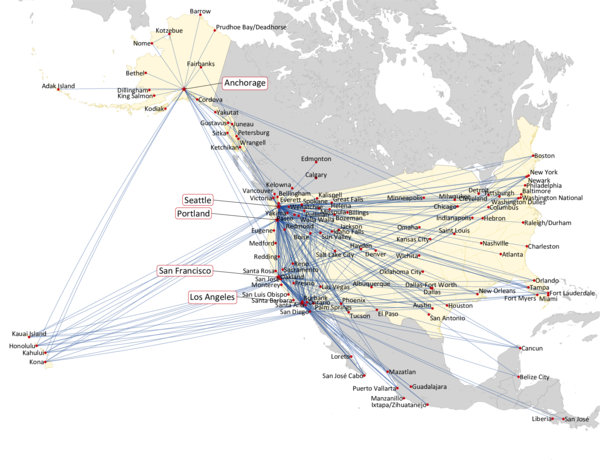
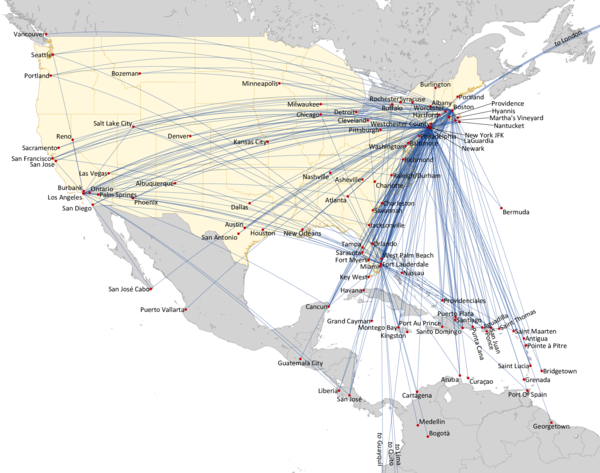
The charts and route maps encapsulate Alaska’s and JetBlue’s strength at the major cities on the West and East coasts respectively. There is little network overlap — with the very important exception of transcon.
The two carriers’ unit costs and revenues are similar, and both have the same type of operating model. They are both orientated towards business travellers and their products seem compatible. Both airlines have important relationships with American, and JetBlue would fit into oneworld if it wished. There is no antagonism between the two sets of management. However, the different fleet types — 737 and A320 — is an issue, especially as Alaska has spent so much effort in fleet rationalisation after the Virgin America takeover.
