TAP Air Portugal: Sustainable Profitability by 2025?
May 2022

Portugal’s national flag carrier, TAP Air Portugal, having had a rough time during the pandemic, is again seeking private capital.
TAP was founded in 1945, privatised in 1953 (albeit with majority state-ownership), and nationalised in 1974 in the wake of the Carnation Revolution that deposed Salazar’s dictatorship of Portugal. Since then it remained state owned but has been up for sale and privatisation on and off for the past 30 years (see Aviation Strategy March 2003, June 2011 and April 2015).
The policy of privatising the airline was almost forced on the Portuguese state as part of the terms of a bailout in 2011 by the ECB and IMF following the fallout from the 2009 global financial crisis. It then took until 2015 before TAP was successfully privatised.
The state sold 61% of the equity (for €10m plus a commitment to inject €350m in new capital) to the Atlantic Gateway consortium. This had been formed by David Neeleman (a fluent Portuguese speaker then running Azul, and also conveniently holding Cypriot citizenship, so able to prove he was European) and Portuguese magnate Humberto Pedrosa, owner of the ground transport operator, the Barraqueiro Group. The state retained a 34% stake (with the intention to sell down further within two years) and the remaining 5% set aside for employees.
The airline’s new owners said at the time that they intended to expand operations to ten more destinations in the US and eight more in Brazil. The consortium also committed to supply TAP Air Portugal with 53 new planes and keep the carrier’s hub in Lisbon for at least 30 years.
In its 2015 accounts, the newly privatised airline laid out a six-point strategic plan to turn the company around (TAP was perennially loss-making having lost a total €380m in the preceding six years):
- renewal and expansion of the fleet;
- evolution of the business model to what was described as a “customer choice model”;
- increase automation and improve customer experience;
- consolidate growth and increase focus on the hub in Lisbon;
- improve operational efficiencies;
- reposition the (loss-making) MRO businesses in Portugal and Brazil.
In 2016 there was a change of government, change of political philosophy, and a change of heart. The state regained a 50% stake of the shares, leaving the consortium with 45% (but 90% of the economic rights). Nevertheless, under the Atlantic Gateway management, the company grew strongly for four years.
The fleet increased by a net 40% from 75 units in 2015 to 105 by the end of 2019 (see fleet table). The regional fleet was completely replaced, new generation A320neos and A330neos brought on board (the latter with help from spare capacity at Azul), and the fleet of four-engined A340s disposed of. Total capacity increased by an annual average 8.5%: services to Brazil hardly changed, but adding handful of new routes to the USA and Canada — prior to 2015 it only operated to Newark from Lisbon and Porto, and Miami from Lisbon — produced a doubling of capacity to North America. The total number of passengers carried had increased by 50% to 17m by 2019, an annual average growth of 10%. Revenues grew by 27% to €3.3bn (a CAGR of 6%).
| 2015 | Δ | 2019 | Δ | 2021 | On Order | Avg Age (years) | |
|---|---|---|---|---|---|---|---|
| A340 | 4 | -4 | |||||
| A330 | 14 | -7 | 7 | -4 | 3 | 14.1 | |
| A330neo | +17 | 17 | +2 | 19 | 3 | 3 | |
| A319 | 21 | -3 | 18 | -11 | 7 | 21.5 | |
| A320 | 19 | 19 | -4 | 15 | 16.4 | ||
| A320neo | +7 | 7 | +4 | 11 | 12 | 2.4 | |
| A321 | 3 | +1 | 4 | -1 | 3 | 20.3 | |
| A321neo | +8 | 8 | +2 | 10 | 9 | 2.4 | |
| A321neoLR | +4 | 4 | +4 | 8 | 5 | ||
| E190 | +9 | 9 | 9 | 10.7 | |||
| E195 | +4 | 4 | 4 | 10.1 | |||
| ATR72 | +8 | 8 | 8 | 6.6 | |||
| F100 | 6 | -6 | |||||
| E145 | 8 | -8 | |||||
| Total | 75 | 30 | 105 | -8 | 97 | 29 | 8.2 |
In 2017 the group registered a reasonable operating profit of €107m (a 4% margin) and managed to produce its first net profit of the decade, of €23m. But it then went on to lose another €160m in the following two years. Unit costs at the airline fell by nearly 15% between 2015 and 2019, mostly through long haul growth, but this did not translate into profitability. The Brazilian MRO business still struggled to make positive returns.
Maybe the strategic plan put in place by the Atlantic Gateway consortium just did not have enough time to produce its full results.
Covid pain
The first two months of 2020 had started well, with a 13% increase in the number of passengers and 18% growth in RPKs. Then the full force of the pandemic and associated travel restrictions left the company with full year traffic and capacity down by two-thirds. Full year results showed revenues down by 70% to €1bn, operating losses of €(1)bn and net losses of €(1.4)bn.
In 2021 there was some recovery. But with the continuing travel restrictions as new variants emerged, while passenger traffic was up by a quarter on prior year levels to 5.8m, this was still only a third of the level in 2019. Revenues came in at €1.4bn, underlying operating losses (before exceptional items) at €(478)m and net losses of €(1.6)bn.
TAP had entered the pandemic with only €426m in cash at the beginning of 2020, equating to 13% of the prior year’s annual revenues. By June 2020, it was close to running out of cash, and turned to the government for help.
However, there seems to have been a disagreement among shareholders over the terms of the €1.2bn six-month emergency loan offered: the State apparently wanted to impose a condition that the loan be converted into equity, which could significantly dilute consortium’s stake.
An agreement was reached. Neeleman bowed out of the Atlantic Gateway consortium, selling his 22.5% stake in TAP Group to the Portuguese Ministry of Finance and waiving conversion rights on his (and Azul’s) outstanding loans.
On the announcement of the agreement the Government outlined the reasons for the effective re-nationalisation, saying: “The importance of tourism as an essential sector for economic activity is now widely accepted as being responsible for over 10% of the national GDP, with the TAP Group taking on a role central in respect to the growth of national tourism… The Government’s mission is to ensure the preservation of the value of the national airline and safeguard its strategic position so as to avoid insolvency of a company crucial for the development of the country…”
The bailout loan was approved by the European Commission on the 10th June on condition that it be repaid within six months of its decision, and could only be extended if the Portuguese State submitted a restructuring plan for the TAP Group before the end of that period. This they duly did (on 10th December 2020, the last possible day) as a draft for discussion and approval. The plan envisages a transformation of TAP’s operations “to ensure economic viability in 2023 and sustainability in 2025”.
Restructuring plan 2021
In December 2021 the Commission gave approval to the plan and the granting of a total €2.55bn restructuring aid (including that emergency loan) along with €640m “Covid damages compensation”. It imposed conditions:
- disposal of 18 daily slot pairs at Lisbon’s congested airport (from the Winter 2022/23 season);
- a cap on fleet size;
- disposal of non-core activities;
- a ban on acquisitions;
- and a ban on using the fact that it was in receipt of state aid in its advertising.
The approval paved the way for the full re-nationalisation of the airline. The state loans having been converted to equity, the Ministry of Finance is now the sole shareholder. TAP has been partially recapitalised showing negative shareholders' funds of €(0.5)bn at the end of 2021 (up from a negative €(1.2)bn in the prior year — see balance sheet table). This compares with total debt (including operating lease liabilities) of €3.6bn, down from the €4.6bn at the end of 2020, but on a par with the level at the end of 2019. TAP is due to receive the final €0.9bn tranche of the total €2.55bn restructuring aid during 2022.
| 2019 | 2020 | 2021 | |
|---|---|---|---|
| Tangible Fixed Assets | 3,026 | 2,944 | 2,955 |
| Other fixed assets | 271 | 272 | 524 |
| Current assets | 1,855 | 1,741 | 1,239 |
| of which cash | 426 | 519 | 813 |
| Current liabilities | (1,735) | (3,024) | (1,745) |
| of which debt and leases | (588) | (2,021) | (632) |
| Long term debt | (1,197) | (993) | (1,285) |
| Operating Lease liabilities | (1,852) | (1,611) | (1,683) |
| Total debt | (3,049) | (2,605) | (2,968) |
| Provisions and other | (234) | (420) | (473) |
| Equity | 135 | (1,154) | (468) |
In June 2021 the government brought in new management under Christine Ourmières-Widener as CEO. Having started her career at Air France, she went on to head up CityJet and Flybe and has a good record of running loss-making airlines (though not necessarily for turning them round). In her presentation on the full year 2021 results she outlined the main elements of the restructuring plan. The core focus will be on the airline, with progressive disposal of maintenance, catering and ground handling. The transformation to achieving a profitable and sustainable aviation business by 2025 is based on five main pillars:
- Customer: enhancing the customer experience, and protecting the hub and slots by network optimisation,
- Revenue: sales, ancillaries and loyalty initiatives to boost revenues; target cargo sales growth balanced with passenger demand (two of the A330-200s have been converted to freighters),
- Costs: renegotiations with lessors and suppliers; reduce third-party costs; fleet strategy focused on flexibility and efficiency, with a simpler aircraft mix, increase use of A321LR on thin Atlantic routes
- People: labour flexibility; modernise collective labour agreements (currently suspended until 2024); implement digital roadmap (whatever that means).
This all sounds good: increase revenues and reduce costs. Many airlines in attempting such a transformation rely on growth. TAP, with an effective restriction on capacity for the next three years, does not have that luxury.
Strengths and weaknesses
TAP is the 16th largest European airline (pre-pandemic and depending on which measures you are used) with passenger traffic in 2019 of 17.1m and a fleet of around 100 aircraft.
It has a niche position in its links with the former Portuguese colonies of Angola, Mozambique, Cape Verde, São Tome y Principe and, most importantly, Brazil. With a small domestic market it is regarded as providing an essential national service in ensuring links to Portugal’s autonomous regions of Madeira and the Azores.
It has a leading position on routes between Europe and Brazil (and Brazil accounts for half the capacity between Europe and South America). Serving ten destinations pre-pandemic (predominantly from Lisbon, although it also served Rio and São Paulo from Porto), it accounted for 27% of the total seat capacity — well ahead of nearest rival Air France-KLM (three destinations and 17% of the market) and LATAM (seven routes to Europe from São Paulo and 14% share). Interestingly the northern Brazilian destinations should be easily reachable with TAP’s new A321LRs.
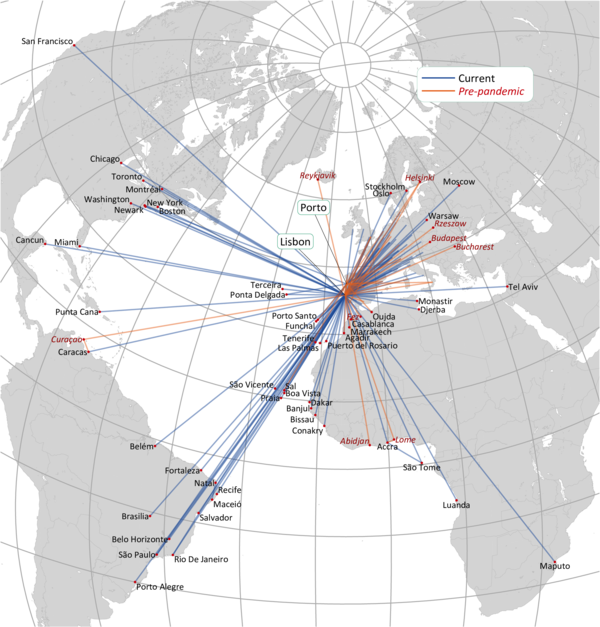
There is natural O&D demand on its extensive network to Brazil, although it may not be particularly high yielding. But to make those routes work, it also needs good feed into its hub in Lisbon. TAP has a commanding position in Lisbon — in normal times continental Europe’s busiest single-runway airport — with 55% of the slots (50% after the required slot disposals).
Portugal is a strong tourist destination with 27m international visitors in 2019 (compared with a population of 10m). Five countries account for one third of tourists arrivals: the UK, Spain, France, Germany and Brazil. Lisbon is the most popular destination, accounting for a third of visitors, but nearly half are heading for holidays in northern Portugal (served by Porto, Portugal’s second largest city) or the Algarve (served by Faro).
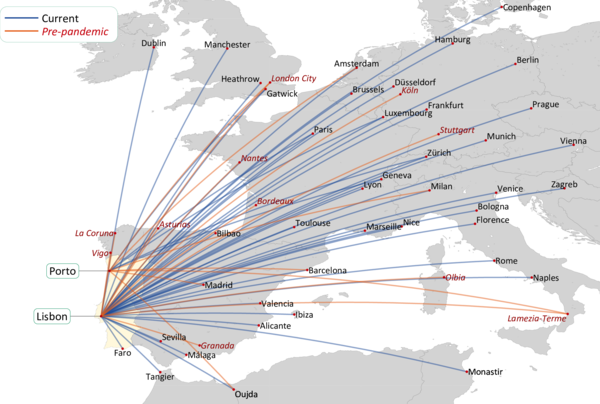
Portugal has been a prime target for LCC incursion. After TAP, the next three largest airlines at Lisbon were Ryanair, easyJet and Vueling, between them accounting for 25% of (pre-pandemic) intra-European seats at the airport. Ryanair, easyJet, Jet2 and Transavia accounted for 70% of capacity in Faro. Ryanair, easyJet and Transavia provided 60% of the seats at Porto.
TAP will be required to surrender 18 daily slots in Lisbon. This is being done through bids to an independent adjudicator who will score the proposals on merits of proposed plans, and among other things will give preference to an airline that offers the largest seat capacity of Lisbon-based aircraft and serve the largest number of destinations from Lisbon until the end of 2025. (Interestingly if there is more than one bidder with the same “score”, TAP will get to choose its competitor). The successful bidder will probably be an LCC, and possibly one that could make life even more difficult for TAP at its home base. A decision is due in June.
Opportunities?
Christine Ourmières-Widener will have her work cut out to get the Portuguese flag-carrier to break-even by 2023, but she appeared to be cautiously optimistic to be able to do so. Whether it can get to a sustainable level of profitability by 2025 is equally questionable. The question of ownership however is unlikely to go away. Portugal is unlikely to be able to inject more funds into its airline — adhering to the one-time-last-time principle of EU state aid. Prime Minister António Costa (who won a surprising majority in January’s national elections) has said that TAP “will be in a position to sell 50% of the capital as soon as possible, and fortunately there are already other companies interesting in acquiring it”.
Who? IAG might be interested in order to give it, through Iberia, a commanding position on the South Atlantic (even with only a 50% shareholding). But that would mean overcoming the traditional Portuguese-Spanish rivalry. Air France-KLM might have been interested, if it weren’t going through its own reformation. Lufthansa could be a contender, strengthening ties with fellow Star Alliance member. Or Portugal could again find its own unique solution.
