Emirates: New Competition, Geopolitics and Innovation
May 2022

Emirates was a great innovator, building a global hub at Dubai capturing traffic from traditional flag-carriers and offering a huge range of new intercontinental connections. It will emerge from the pandemic in good shape but facing a new competitive environment and having to innovate again.
Emirates reported results for FY 2022 (year to March 31st) that showed a marked improvement on the previous year, though it remained in the red. The net loss was AED3.8bn (US$1.1bn) compared to AED 20.3bn ($5.5bn) in FY 2021. Revenue increased by AED28bn to AED58.3bn, mostly due to returning passengers (up by a factor of 6.5 to 19.6m), cargo revenue having surged in the previous year (because of an increase in unit rates rather than volume). The increase in operating costs was kept to AED13.7bn, almost all DOCs like fuel, handling and airport charges related to increased flying, which brought the 2022 total to AED59.6bn. At the EBIT level Emirates lost AED 0.4bn (after accounting for other operating income of AED 0.9bn), AED 15.5bn better than 2021. Net finance costs totalled AED3.4bn, down by AED2.2bn from 2021.
Sir Tim Clark, President of Emirates and the avuncular voice of cautious optimism throughout the pandemic, has predicted a return to profit in FY2023 as traffic returns, with pre-pandemic capacity being restored sometime later this year. But with uncertainty over yields and unit revenues, the airline, according to its FY2022 accounts, is only planning on a recovery to 95% of pre-pandemic revenues, which were AED98bn ($26.5bn) in FY 2019, by FY2025.
Restoring capacity to pre-pandemic levels would imply more than doubling the volume of ASKs from FY2022 levels, through rebuilding frequencies and resurrecting suspended routes. Emirates’ average passenger load factor in FY2022 was only 58.6% compared to a normal level of 78-79%, so the airline would have to be very confident about the resilience of travel demand. There is also the issue of operational efficiency — Emirates Airline cut its workforce from around 48,000 pre-pandemic to about 36,000 last year, and, as various airlines, have found re-establishing optimal staffing levels and retraining employees, can prove very problematic. One of the reasons that only about 70 of Emirates 118 A380 fleet are currently flying, is a shortfall in the 10,000 cockpit and cabin flying crew needed for this operation.
Emirates has always claimed that it can be profitable with oil at $100/barrel, partly because demand for air travel to the Middle East is boosted when the oil market is strong. But the current price is around $120/barrel which has meant increased fares that might threaten the recovery in traffic. Emirates, however, claims that demand is solid despite the fare increases.
Balance sheet unaffected by pandemic
Emirates’ financial management throughout the pandemic was enabled by its 100%-owner, the Emirate of Dubai, but nevertheless has been astute, maintaining the balance sheet at pre-pandemic strength. At the end of March this year Emirates’ balance sheet showed shareholders’ equity of AED20.3bn and total liabilities of AED129.7bn, a debt/equity ratio of 6.4/1. At the end of March 2020, just at the beginning of the pandemic, the balance sheet showed slightly more equity, AED 23.5bn, but significantly more liabilities, AED 148.4bn, a ratio of 6.3/1.
The cashflow table traces what has happened throughout the five-year period to FY2022. Emirates has never been particularly profitable and had one horrendous year during the pandemic, but its operating cashflow (adding back in depreciation, creditor/debtor balances, and other non-cash items) has been generally strong, again apart from the one year. The company has been able to maintain capex through the pandemic. Free cashflow again has been positive except for FY2021.
Remarkably, in each of the five years Emirates has been able to pay down its debt, even during FY2021 and FY2022, but in these years it received cash injections, in the form of additional equity, from the government totalling AED14.9bn ($4.0bn). This is compatible with the sums received by the US and European Legacies and significantly less than, for instance, the state support SIA has needed. Emirates has stated that it intends to pay its owner dividends as soon as it returns to profitability. It has paid the Emirate of Dubai dividends in the past, AED1bn in FY2019 for example, but it is difficult to see how the airline will be able to generate the surplus cash required to make substantial dividend payments in the short/medium term.
Fleet dilemmas
Airbus terminated the A380 production line last December and delivered its final A380 to Emirates at Hamburg. This leaves Emirates with a dilemma — how to manage and gradually replace its ageing A380 fleet, by far the largest in the world. It may be regretting having cancelled in early 2019 its order for 20 units. That year Emirates revealed its A380 retirement plan: gradually retiring aircraft — two have gone so far — and using them for parts for the remaining aircraft until the entire fleet disappears in 2035. A similar programme is being applied to the 777 fleet.
Unfortunately, Emirates is experiencing problems with all the replacement widebody types.
Emirates has firm orders for 115 Boeing 777Xs, plus 61 options (see fleet table), which were originally contracted for delivery from mid-2020, but technical issues and directives from the FAA have delayed Boeing, which has already built some of the aircraft for Emirates. Now it seems that the earliest delivery date will be mid-2025. Sir Tim is clearly not happy, noting that Emirates will in effect be offered second-hand aircraft by Boeing.
The 787 situation is, if anything, even more problematic, with production delays that are unacceptable to Emirates. Sir Tim has indicated that the order for 30 787-9s may be cancelled.
That leaves the A350-900 for which Emirates has a 50-unit order. It might be able to pick up some more A350-1000s if relations between Airbus and Qatar Airways continue to deteriorate, though Emirates has also stated that it would not accept any A350s until the paint peeling issues associated with Qatar’s A350s are solved.
In response to a more price-sensitive business market and an upscaling leisure market, Emirates is putting its faith in Premium Economy and is starting to refit its fleet. An 18-month programme, scheduled to begin at the end of 2022, at Emirates Engineering Centre in Dubai, will see 52 A380s and 53 Boeing 777s fitted with the new cabin class. The 777s will have 24 and the A380s 56 Premium Economy seats laid out in 2-4-2 configuration with a 40-inch pitch.
Network challenges and trends
As the global market re-opens Emirates will face a new set of competitive challenges from expansionist airlines and new hub systems, linked to geopolitics in some cases. It is not at all clear how the global connecting market will evolve — just as it wasn’t clear when Emirates started out in the 2000s — but some of diverse trends might be as follows.
The Middle East super-connector (ME3) system was under pressure long before Covid-19, with state-funded competition in the form of Qatar and then Etihad causing structural over-capacity in the order of 10%, according to our estimates, and this surplus was set to increase as a result of planned net deliveries. The pandemic has at least partly solved this situation.
As the graph indicates, just over 11% of seat capacity has been removed from the ME3 fleets, mostly as the result of Qatar and Etihad ceasing A380 operations. Etihad has been rationalised by about 39%, in effect reversing the years of ill-advised over-expansion; a merger with Emirates might have been the logical solution, but local sensibilities prevented that. With the cutbacks in orders, whether planned or not, the super-connector system is more realistically sized for the post-pandemic word.
But competition from the fourth super-connector is likely to intensify. Largely thanks to its cargo operation and domestic market, THY was able to minimise the financial damage from the pandemic, and has relocated all its hub operations to İGA, Istanbul’s new airport, which has a potential capacity of 200m passengers a year.
And what is happening in Saudi Arabia? At the GACA-sponsored “Future of Aviation Forum”, held in Riyadh in April, the Saudi civil aviation authority announced a strategy to rapidly build global hub infrastructure and airline networks based at the capital. The explicit aim is for Saudi Arabia to transport 330m passengers, to/from more than 250 destinations, plus 4.5m tons of cargo, by 2030.
This $100bn-plus project — which would at least double Middle East connecting capacity — sounds highly improbable. Still it is endorsed by Saudi Arabia’s de facto ruler, Crown Prince Mohammed bin Salman, and, as GACA emphasised, has “the unlimited support that the civil aviation sector in the Kingdom enjoys from the Saudi leadership.”
India has been Emirates’ largest national market, providing the core of its VFR demand as well as being very important for high-yielding business travel to/from Europe. Emirates has stated that it will restore full capacity to the Indian market in this year, but Tata Group’s take-over of Air India and the development of Indigo into a powerful international carrier have changed the competitive dynamics.
The Tata Group has a great deal of restructuring to do, but combining Air India’s historical traffic rights with Vistara’s premium product offering and SIA’s reputation and network economics could create a carrier that would compete with Emirates by capturing increased volumes of long-haul traffic overflying Dubai and the other Middle Eastern hubs. Potentially this new entity could offer premium products comparable to Emirates.
Europe has now reopened but with China and large parts of Southeast Asia still pursuing Covid Zero policies the Europe-Asia connecting market has not been tested fully. The perceived risk for Emirates is that passengers, especially premium passengers, will try to avoid connecting hubs, preferring non-stop services where possible. Dubai International and Dubai World airport management will have had the opportunity to observe the mistakes of Heathrow and other airports in being unprepared for a post-pandemic surge in passengers. If the Dubai airports are able to handle passenger flows smoothly and efficiently, resistance to connecting at such mega-hubs will probably disappear.
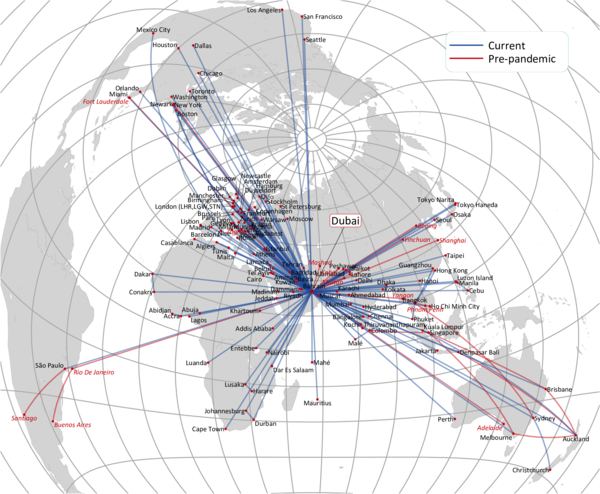
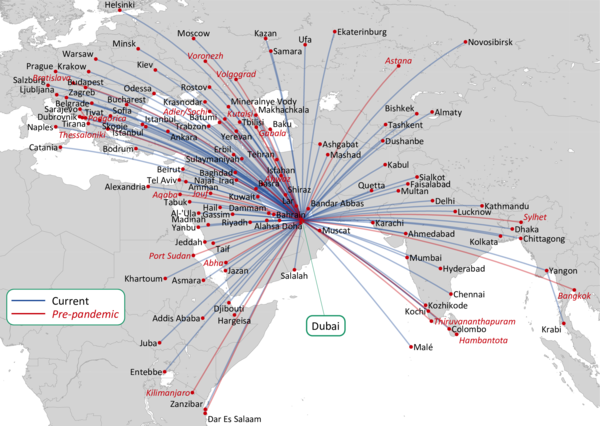
Following the imposition of Western sanctions Dubai has been left as one of the two main gateways to the rest of the world for Russians (the other being Istanbul). Emirates operates twice daily to Moscow (plus there is a daily flydubai flight) and daily to St Petersburg. Moreover, multinational companies have relocated key staff from Moscow to Dubai. One can imagine that yields on these services are very lucrative, though the airline does point out that it is also carrying “humanitarian” supplies (medicines, etc) in its bellyholds.
Emirates has also resumed operations to nearly all its North American points. It is ironic that Covid-19 brought an end to US complaints about the Middle Eastern state aid as US carriers received their own support funds. But there appears to have been no progress on establishing an alliance between Emirates and a US Major, a development which Emirates stated, two years ago, would be a priority post-pandemic.
China was a relatively small market for Emirates pre-pandemic but one that seemed to offer strong potential — for example, connections from China to African cities, supporting the massive Chinese investment in the continent. But Addis Adaba and Ethiopian Airlines have emerged as a competing intercontinental and intracontinental hub operation. Terminal 2 of Bole Airport was completed last year, constructed by China Communications Construction Company and financed by the EXIM Bank of China. This will more than double capacity to 25m passengers a year. Chinese language signage throughout the shiny new facility is a good indication of where the target market is.
LCC incursion and the dual role of flydubai
Over the past ten years the short/medium-haul markets within and to/from the Middle East have been inundated by LCCs. As well as Emirates’ associate LCC, flydubai (not part of the Emirates Group but having the same owner), the innovator Air Arabia is based at Sharjah airport, very close to Dubai, and has diversified into Abu Dhabi in partnership with Etihad. Wizz also flies from Abu Dhabi in a joint venture with ADQ, the state development fund. Flyadeal has emerged as the leading Saudi LCC while Jazeera is expanding from its base in Kuwait. Oman Air has recently launched its own LCC, Salam Air. Then there are the Indian LCCs — Indigo, SpiceJet and the new Tata LCC which may be amalgamated from Air India Express and AirAsia India — plus two potential new ULCCs — Go First and Akasa.
All these airlines are A320 operators (with the exceptions of Akasa and Air India Express) whereas flydubai is a 737-800 and MAX operator, which meant that it suffered from the MAX grounding in 2019 as well as the pandemic.
Flydubai staged a recovery in 2021 carrying 5.6m passengers, up 76% on the previous year and reporting a profit of AED841 million ($229m) on revenues of AED 5.3bn, reversing the loss of AED718m in 2021. (Flydubai’s accounts are not as transparent as Emirates, and it may be that the 2021 result, showing a profit margin of 15.8%, has been inflated by an extraordinary item.)
Its 25 MAXes have been gradually returning to service since April last year, and the fleet now totals 59 aircraft including 34 737-800s, with 20 MAXes scheduled for delivery in the rest of 2022. A further 141 MAXes are on firm order, following an agreement reached with Boeing last year that removed 65 aircraft from the previous backlog.
Flydubai has a heavily modified LCC model, operating all its aircraft with a premium class and offering a full-service connecting facility at Dubai, both for its own network and on most of Emirates’ routes; last year 34% of its passengers were connecting. Emirates’ loyalty programme, Skywards, is applicable on Emirates/flydubai connecting flights, as is lounge access for higher-tier Skywards members flying on the flydubai network.
For Emirates, flydubai has a dual strategic role: providing feed onto its own flights and securing a defence against the influx of LCCs into the Middle East market. Given flydubai’s massive 737MAX orderbook and Emirates’ orderbook frustrations, it seems very likely that more of its shorter-haul flights will be shifted from the mainline carrier to its lower cost associate.
|
|
| In fleet (March 2022) | On Order | Options | |
|---|---|---|---|
| A380-800 | 118 | ||
| 777-200 ER/LR | 134 | ||
| 787-9 | 30 | ||
| 777-X | 115 | 61 | |
| A350-900 | 50 | ||
| Total Passenger | 252 | 195 | 61 |
| 777F | 10 | 2 | |
| Total Freighter | 10 | 2 | 0 |
| TOTAL | 262 | 197 | 61 |
DEPLOYMENT PRE- PANDEMIC
