LATAM: The New Reality
after Chapter 11
September 2021

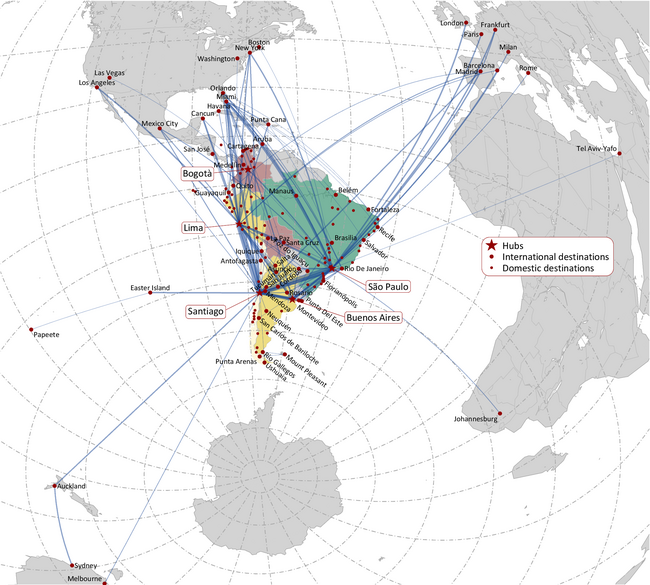
Following the merger between Lan Chile and TAM to form South America’s leading multinational airline group, LATAM underwent a comprehensive (and profitable) transformation between 2015 and 2019. Baulked by Chile’s refusal to allow an immunised JV with American and IAG, it left the oneworld alliance after 20 years' membership to hitch up with Delta and form a JV with its new partner (which would hopefully be acceptable to the competition authorities). In the process Delta made a successful public tender for 20% of LATAM’s equity in December 2019, making it the largest single shareholder; the Cueto Group, former majority shareholder in Lan Chile, and the Amaro Group, former controllers of TAM, adjusted their various holdings to 16% and 6% respectively (Qatar Airways held on to its 10% stake). It was all looking quite exciting (see Aviation Strategy Dec 2019).
What timing!
As the pandemic took hold there was not much support forthcoming from any of the seven countries in which LATAM had AOCs (Chile, Brazil, Peru, Columbia, Ecuador, Paraguay and Argentina). Effectively grounded by travel restrictions from mid March 2020 as South America (and Brazil in particular) became the world’s epicentre of the Covid pandemic, it was burning cash. At the end of March 2020 LATAM had cash resources of $1.8bn, 17% of revenues. It’s prime priority was to maximise the group’s liquidity but it decided to “take advantage of the crisis to transform LATAM group to a new reality”. The group filed for Chapter 11 creditor protection in May in the New York courts.
LATAM tried to act quickly to stem cash haemorrhaging: it cut nearly a third of its workforce — 13,300 jobs went out of a total 41,700 at the beginning of 2020 — and negotiated (or imposed) a 15% across-the-board salary reduction for those remaining. It deferred lease payments, moving some equipment to power-by-the-hour contracts and started “right-sizing” the fleet, planning to remove 43 aircraft from the 342 operated in 2019. It started outsourcing various parts of operations in Brazil, Peru and Ecuador in order to reduce fixed, and increase variable costs. It ceased domestic operations in Argentina. It paid ticket refunds in vouchers.
LATAM had originally expected that it would be able to recover to 50%-70% of its pre-Covid capacity (in ASK terms) by the end of 2020. Its domestic operations saw a recovery: in Brazil back to 59%, and the Spanish Speaking Countries (SSC) to 46% of 2019 capacity by December. International operations, unsurprisingly, remained severely depressed by the year end still 80% down year on year in capacity terms and with load factors of only 50%.
For 2020 as a whole passenger demand (in RPK) was down by 66% and passenger revenues by 70%. Total revenues fell by 58% to $4.3bn, costs by 38%, and operating losses came in at $(1.7)bn. Implementing big bath accounting, the group wrote off $2.5bn goodwill and some intangible slot values to produce a net loss of $(4.5)bn (while also “rejecting” $2bn of aircraft assets and associated lease liabilities from the balance sheet).
In the first half of 2021, operations continued at a similar rate as in the latter half of 2020. Passenger revenues were down by 77% compared with 2019 (mitigated by a 34% jump in cargo revenues which in the period accounted for 40% of total revenues, compared with 10% in normal times), costs were down by 47% and LATAM reported another operating loss of $(0.7)bn with a loss of $(1.2)bn at the net level after charging $0.5bn restructuring costs for the rejection of aircraft among other things. By the end of June the group’s net equity position had fallen to a deficit of $(3.66)bn.
The management appears to have taken some sardonic pleasure from being able to report that the airline had been ranked the world’s most punctual airline in 2021.
At the end of 2020 LATAM received court approval to raise $2.45bn in two tranches (A- and C-tranches) of debtor-in-possession (DIP) funding (in part supplied by shareholders Qatar and Cueto Gorup) with a third tranche (strangely called the B-tranche) envisaged. By the end of June 2021 it had drawn $1.65bn of the funds available and had $1.5bn in cash and equivalents in hand. By the end of July, cash had fallen to $1.1bn (giving available liquidity of $1.9bn) and the group started soliciting interest from potential lenders for the $750m in B-tranche DIP funding.
Recovery plan
In September LATAM released a five-year business plan — preparatory to presenting its reorganisation plan to the courts in October for creditor approval by mid December. In it the Group forecast a return to 2019 profit levels by 2024 with strong further growth thereafter to achieve an operating margin of 11% by 2026. This would be the highest operating margin since 2010, when Lan Chile (under old accounting rules) achieved 14% and TAM 9% — the average since then has been 5.5%.
In recovering from the pandemic LATAM is fortunate to have strong domestic networks. It had a dominant position in Chile and Peru with market shares in 2019 of 54% and 63% respectively. Brazil is the largest domestic market overall on the continent and LATAM’s 38% market share generated 43% of all passengers it transported in 2019. The group also had a meaningful domestic operation in Ecuador (which it shared in roughly equal proportion with Avianca and the now defunct national carrier TAME) and Colombia with a 25% share of the market behind market leader Avianca. In total LATAM’s domestic operations accounted for 78% of total passengers transported pre-Covid (and 41% of total group revenues).
The recovery from the pandemic will be long and difficult, and it is generally assumed that domestic, short-haul VFR and leisure traffic will recover the soonest.
For the seven months to end August this year, LATAM’s domestic traffic (in RPK terms) in Brazil have averaged 40% of the levels seen in 2019, and the SSC domestic markets 50%. But in August traffic levels in Brazil were only 25% below those two years ago, and in the SSC 30%; and the company projected that in September domestic operations would be 80-90% of the 2019 levels, and even 14% above 2019 levels in Colombia.
International traffic on the other hand averaged only 12% of the levels in 2019, and in August were still 80% down on pre-pandemic levels.
The business plan maps out the company’s forecasts of traffic recovery highlighting that domestic traffic is expected to recover to 2019 levels by the fourth quarter of 2022, driven by Brazil and Chile. Regional international traffic, depending on the timing of the removal of travel restrictions, would not do so until the third quarter of 2023. Long haul traffic may not reach pre-Covid levels until the third quarter of 2024 (see chart). The company mentions that it expects that changes in travel and working habits will lead to a structurally permanent reduction in business travel of around 15% but is hopeful that its joint venture with Delta will be able to offset much of this decline on routes to the US.
The business plan’s capacity projections (shown in the chart) suggest that total ASKs are unlikely to exceed pre-pandemic levels until 2025, although load factors could rebound to normal levels in the mid-80s by next year.
Fleet reduction and simplification
LATAM took the opportunity of the Chapter 11 process to force through a fleet restructuring. It rejected 27 aircraft — which the bankruptcy code allows for leased aircraft that are deemed not to be on market terms — retired 15 of its older narrowbodies and got rid of its 13 A350s to enable it to concentrate widebody Brazil operations round the 787 and 777 which at least has pilot commonality (six of these appear to have ended up at Delta, which was part of the framework agreement signed in 2019).
By 2022 it plans to have reduced the total fleet to 286 units from the 342 it had in 2019 — although the business plan mentions that this number includes six 767 aircraft that are available for sale, or have already been sold, and 10 767s scheduled for cargo conversion.
In the hunt for liquidity it also moved a large portion of its fleet onto power-by-the-hour or interest-only contracts — covering 60% of the narrowbody fleet until 2022 and 50% of the widebody fleet until 2023 — which provides it with significant short term flexibility and is said to provide annual cash flow savings of over 40% compared with 2019.
LATAM renegotiated its outstanding commitments with Boeing and Airbus without penalties. It cancelled orders for four 787s and one 777F although will continue to take two 787s around the end of 2021. The last two A350 deliveries were cancelled in light of the decision to retire its entire A350 fleet. It postponed its outstanding A320 narrowbody orders for up to three years, eliminating originally planned 2020 and 2021 deliveries, but increased its commitment by 28 units and now has 70 A320neos on order for delivery up to 2028.
In the latter years of the business plan, LATAM is anticipating rebuilding the narrowbody fleet to the size it had pre-pandemic by 2024/25, but the widebody fleet looks set to be a third smaller (see table).
Compensating for the lack of widebody belly-hold capacity the group is planning nearly to double the number of freighters it operates (no doubt using the 767s earmarked for conversion). The management is eager to point out that its cargo business strategy continues to be “belly-supporting freighter” (in contrast to Avianca’s restructuring plan which seems to hive off cargo into a separate business unit).
To minimise cash drain all aircraft to be acquired from 2022 will be taken on operating leases, and the company suggests that when it exits Chapter 11 protection its fleet debt will consist of $2.2bn in finance leases and $2.3bn in (capitalised) operating leases.
Aggressive cost reductions
LATAM claims that its underlying cost structure was already highly competitive before the onset of the current crisis. Having gone through major restructuring following the merger of Lan Chile and TAM — simplifying its organisational structure to a functional model, getting rid of 13,000 jobs (and 37% of management executives), outsourcing multiple non-core functions — its ex-fuel unit costs of 4.5¢/ASK in 2019 were reasonably on a par with Copa and Azul, 25% below those of Avianca in the region, and nearly half that of the North American majors (see chart).
But the business plan suggests that the crisis has led the company to extract an additional $900m from the cost base through four strategic initiatives:
- Simplifying the business. The largest element of this is the further 33% reduction in manpower since the onset of the pandemic: wage costs in the first half of the current year were running 50% below the levels in 2019 (helped by depreciation of the Chilean peso and Brazilian real), but it states it has also “re-designed benefits for all employees”. The group has also implemented spend Control Towers in all areas of the business. It has accelerated outsourcing of airport operations, particularly in Brazil, Ecuador and Peru, in order to improve efficiency and increase the proportion of variable costs, but also insourced key maintenance work.
- Leveraging digital transformation and IT simplification. The group accelerated its integration of digitisation to increase direct digital sale penetration and to reduce the number of direct customer contact points. In doing so it reduced the number of city ticket offices, removed the requirement to reconfirm domestic flights, introduced automatic check-in (used by 28% of passengers in 2020, the first year of introduction), introduced remote AI powered assistance, biometric boarding checks, and accelerated the roll-out of self-service bag drops.
- Fleet negotiation strategy. As discussed in the fleet section above LATAM concentrated on revising fleet costs and commitments, rejecting aircraft to reflect the new demand reality, achieving reduction in fleet cash costs, reducing cash outflows through negotiated interest only periods. It is also increasing cabin density.
- Other supplier negotiations. Under this heading the management highlight attention on rejecting non-competitive contracts, improving fleet utilisation and increasing crew productivity.
The net effect of these measures, according to the business plan, could result in a possible 25% reduction in ex-fuel unit costs to 3.3¢/ASK by 2024. It would also increase the proportion of variable costs to 80% of total costs while the PBH and interest-only contracts continue into 2023 — thereafter falling to 72% in the latter years of the forecast (in 2019 variable costs accounted for 65% of total costs).
Not that this necessarily means that LATAM would improve its comparative competitive positioning. Avianca, in its own business plan in preparation for exiting Chapter 11, is forecasting a reduction in ex-fuel unit costs of nearly 45% to 3.48¢ by 2023 (from 6.2¢/ASK in 2019). But in their case this excludes cargo operations and its frequent flyer program among other things which it plans to hive off into separate business units (as it will do with its long haul operations).
FFP
It is perhaps relevant that LATAM in its business plan presentation emphasises the need to keep the frequent flyer programme embedded within the airline.
In 2019 the group bought out the 27% minority shareholders in TAM’s Multiplus programme, which had gone through an IPO in 2010, reintegrated it within LATAM Brasil, and consolidated the FFP operations under a single brand — LATAM Pass — to make it what claims to be the fourth largest FFP in the world in terms of members.
The management seem keen to point out that LATAM Pass is not a separate legal entity: the airlines own the FFP liability, which increases when a mile is pre-sold or sold and reduced when redeemed or expired, neither of which represent a cash transaction. (Cash transactions only take place when miles are sold to third parties or non-flight rewards redeemed).
Keeping the programme embedded within the airlines allows the group more easily to enhance revenue management, optimising revenues by balancing revenue and reward tickets; prevents the accumulation of cash within the FFP; and, avoids additional intercompany transactions (with potential tax implications).
Chapter 11 Exit in
December?
LATAM now plans to present its reorganisation plan to the court by 15 October, soliciting creditors' and claimholders' approval by the middle of December. As part of preliminary discussions the group came up with a proposed new capital structure that would include $5bn in equity financing.
When it made the five year business plan public in September, the company announced that in response to requests for proposals it has received “certain non-binding exit financing proposals from its most significant claimholders and its majority shareholders... Each contemplates raising in excess of $5bn through the issuance of new debt and equity in LATAM... which would be backstopped (underwritten?) by the parties making the proposal”. It’s an interesting choice of wording, and the company didn’t enlighten further, but it must be nice to have a choice of exit options.
Roberto Alvo, Group CEO, is quoted as saying: “Despite the dramatic crisis we have faced, we have taken full advantage of our restructuring, not only by becoming substantially more efficient, but also by cementing a better value proposition for customers, all of which has been reaffirmed by the significant interest we have received in providing exit financing. We will emerge from this process as a highly competitive and sustainable group of airlines, with a very efficient cost structure, all the while maintaining the unparalleled network and connectivity that LATAM offers in all the markets it serves."
When LATAM emerges from Chapter 11, existing shareholders will be diluted into insignificance. The new shareholding structure will be interesting. It will no doubt include the Cueto and Amaro groups. It will probably include Qatar. It may also include Delta, despite the apparent restrictions imposed by the US CARES Act.
| 2019 | Δ | 2021 | 2022 | 2023 | 2024 | 2025 | 2026 | ||
|---|---|---|---|---|---|---|---|---|---|
| Narrowbody | A319 | 46 | -11 | 35 | 228 | 236 | 246 | 254 | 254 |
| A320 | 142 | -12 | 130 | ||||||
| A320neo | 13 | -1 | 12 | ||||||
| A321 | 49 | 49 | |||||||
| 250 | -24 | 226 | |||||||
| Widebody | A350 | 13 | -13 | 58 | 51 | 53 | 55 | 57 | |
| 767-300 | 31 | -7 | 24 | ||||||
| 777-300 | 10 | 10 | |||||||
| 787-8 | 10 | 10 | |||||||
| 787-9 | 16 | 2 | 18 | ||||||
| 80 | -18 | 62 | |||||||
| Total passenger fleet | 330 | -42 | 288 | 286 | 287 | 299 | 309 | 311 | |
| 767-300F | 12 | 1 | 13 | 16 | 20 | 20 | 20 | 20 | |
| Total fleet | 342 | -41 | 301† | 302 | 307 | 319 | 329 | 331 |
| US$bn | Jun 2021 | Dec 2019 |
|---|---|---|
| P&E | 9.54 | 12.92 |
| Goodwill | 2.21 | |
| Intangible assets | 1.09 | 1.45 |
| Other fixed assets | 1.30 | 0.49 |
| Cash etc | 1.60 | 1.57 |
| Stock | 0.29 | 0.35 |
| Drs | 0.60 | 1.24 |
| Other | 0.41 | 0.85 |
| Current Assets | 2.91 | 4.02 |
| ST debt | (5.14) | (1.89) |
| Crs | (3.07) | (2.22) |
| Other | (2.78) | (2.85) |
| Current Liabilities | (10.99) | (6.96) |
| Net Current Assets | (8.08) | (2.94) |
| LT & Lease Debt | (5.24) | (8.53) |
| Crs | (0.67) | (0.62) |
| Provisions etc | (1.59) | (1.85) |
| Net Assets | (3.66) | 3.13 |
| Represented by: | ||
| Share capital | 3.15 | 3.15 |
| Retained earnings | (5.39) | 0.35 |
| Reserves et al | (1.40) | (0.37) |
| Shareholders’ funds | (3.65) | 3.13 |
| MI | (0.01) | (0.00) |
| Net Equity | (3.66) | 3.13 |
| Ratios: | ||
| Net debt | 8.78 | 8.84 |
| Net debt/Equity | -240% | 283% |
| Net debt/EBITDA | -16.9x | 4.0x |