IndiGo: Pushing the Limits
of the LCC Model
May/Jun 2025


Pieter Elbers has now been CEO of IndiGo for three years, after 30 years at KLM, eight as CEO.
KLM evolved into the ultimate hub and spoking airline, building waves of connecting flights from its one base at Amsterdam and using an innovative alliance with Northwest to create a global network, despite having a minuscule home market. Its possibly questionable decision was the merger with Air France which was designed to overcome the problems of scale and open up new markets, but which also brought bureaucratic management structures and an unbalanced contribution to profits to KLM’s detriment.
IndiGo has been by far the most successful of the wave of Indian new entrants of the mid noughties, achieving by this year a dominant position in the fast growing, potentially huge domestic market. Essentially a domestic point-to-point LCC, IndiGo has evolved by adding some frills and entering into codesharing alliances. But it now plans to transform into a global airline operating long-haul with A321 XLRs and A350s.
The reason that the decision to order A350s raises concern among some analysts is that no LCC has successfully amalgamated narrowbody and widebody operations. Many of the leading European and US LCCs have considered long-haul widebody ventures but have not taken their plans forward. Air Asia does have Air Asia X but has never been able to meld its A320 and A330 operations, and Air Asia X has been consistently unprofitable.
However, Elbers has pointed out that the A350 decision, with flying due to start in 2027, was the result of long-term planning. He enjoys widespread respect in the industry and appears to have adapted very well to the Indian environment, even trying a few sentences in Hindi at industry events.
India : A global super-power
With a population of 1.44 billion India overtook China as the world’s most populous country in 2023. It looks as if it will also displace China as the main global driver of aviation demand.
The economy is powerful and tech driven, the fourth largest in the world. Annual real GDP growth rates in the 5 to 6% range are confidently predicted for the next five years. (But average annual GDP per capita is only $2,700, a reminder of the wide inequality in the country.)
Some observers have started referring to an Amrit Kaal, roughly translated as “golden age” of strong extended economic and social progress. The parallels are: Germany, 1950-69, Japan 1956-72, USA 1959-66, China 1982-2011.
A large part of growth story relates to demographics. It not just population growth, which is expected to peak around 2060, but the fact that India is youthful; at present 68% of India’s population is in the working age group — and India is now forecast to supply up to 24% of the incremental global workforce over the next ten years. China, by contrast will hit peak population in the next few years and a rapidly diminishing proportion of the population will be of working age, largely because of the one-child policy.
Aviation forecasts are also highly positive. According to IATA, the number of passengers traveling to, from, and within India is expected to grow at an average 5.6% pa over the next 20 years, with the total passenger volume (domestic and international) reaching about 600m by 2044, compared to 174m in 2024. India is already the third-largest air transport country in terms of passengers, behind the US and China.
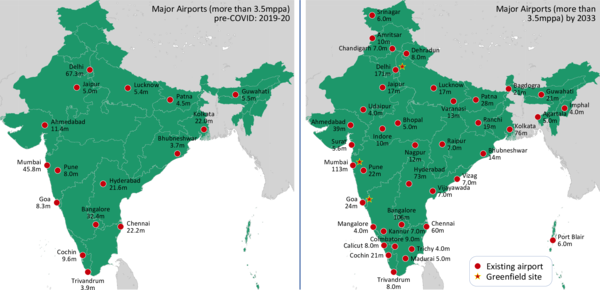
The maps give a concrete illustration of Indian investment in aviation infrastructure. number of operational airports is set to increase from 125 in 2024 to 230 by 2030, with further plans to reach 350-400 by 2047.
Evolving model
IndiGo stared off with a classic LCC model: a point-to-point LCC operation, single A320 family fleet, load factor in the high 80s, excellent dispatch reliability, average aircraft utilisation around 11.5 hours per day, built-in in a capital cost advantage through a series of mega-orders from Airbus, financed using sale and leasebacks, no frills but consistent service.
The specific target market for IndiGo was to divert middle class passengers from the very slow railways to aeroplanes, and then to stimulate new markets. Train passengers still provide major growth potential. Later this decade bullet trains will arrive on the sub-continent, but it still takes a minimum of 15.40 hours to travel from Delhi to Mumbai by train whereas IndiGo’s flight time is 2.15 hours. Incidentally, both cities will open new secondary airports this year — Noida and Navi.
IndiGo has modified the model, in a way that would horrify LCC purists like Ryanair.
Firstly, it has implemented codesharing. Its main partners are: Virgin Atlantic, JAL, BA, Qantas and Air France/KLM/Delta. IndiGo has two types of agreements:
-
Inbound codeshare where the partner airline places its code on IndiGo’s domestic flights, eg Virgin Atlantic connects its London-Bangalore flight with IndiGo’s Bangalore-Goa flight.
-
Outbound codeshare where IndiGo flights connect to other airlines for onward travel, eg IndiGo flies from nine Indian cities to Singapore where passengers can connect onto Qantas services.
Although growing, revenue from codeshare agreements is a single-digit percentage of IndiGo’s overall revenue.
Secondly, IndiGo has a loyalty program is called BluChip. Key features include: no blackout dates and lifetime validity for points, and 50% additional points offered as an incentive to book through direct channels.
Thirdly, IndiGo offers Business Class — branded as IndiGo Stretch — on some international and domestic flights. A321s are typically configured with 12 Stretch seats and 208 economy seats. The Business Class fare is approximately three times that of Economy, and benefits include priority check-in, advance seat selection, and additional baggage allowance.
IndiGo financials
Immediately before the pandemic IndiGo’s financial results were not impressive by LCC standards, or by any airline standards, the result of over-capacity in the Indian domestic market and management disruption caused by a severe falling-out between the two founders of the airline, Rahul Bhatia and Rakesh Gangwal. During the pandemic, FY 2022 and FY2023, the airline accumulated ₹119.8bn (US$1.44bn) of net losses. FY2023 was marginally loss-making but, under new management, there has been a marked return to profitability in the last two years,
In FY 2025 IndiGo Increased its revenues by 17.3% to ₹808bn and achieved a net profit of ₹72.6 billion, a margin of 9%. The net profit was slightly down on the previous year, attributed mostly to exchange rate movements. This is impressive by historic Indian industry standards, and compares well to the leading European LCCs post-pandemic — Ryanair achieved a 11.5% net margin in FY 2025.
IndiGo was able to take advantage of a concentrated domestic market (see below) and push up RASK by 3.7% to ₹4.96, but CASK increased by 6.4% to ₹4.38 despite a fall in fuel costs.
Notably, ex-fuel unit costs rose by 12.5% in FY 2025 compared to the previous year. However, this must be considered in the light of the logistical challenges that IndiGo has met: it has been receiving on average 1.3 additional aircraft every week, which means constant flows of flying, ground and maintenance personnel to recruit and train at the same time as expanding maintenance facilities and establishing new airport bases.
In addition, IndiGo faced Airbus delivery delays and grounding because of the GTF engine issues. This peaked in the middle of 2024 pushing IndiGo to wet lease capacity in and extend existing operating leases. IndiGo has reached a compensation agreement with P&W.
A few years ago, IndiGo’s balance sheet looked strained, in fact it showed negative shareholder equity. That has now been repaired: as of March 2025, IndiGo had ₹1.16trn of assets (40% of which were for “right of use”, capitalising its operating leased fleet) as against ₹1.06trn of liabilities, giving shareholders’ equity of ₹93bn (US$1.1bn). Still, given the scale of its fleet investment plan IndiGo will need to further strengthen its balance sheet.
|
|
The Indian stock market has looked very favourably at IndiGo, quoted under Interglobe Aviation. The share price has tripled since 2023, giving a current market capitalisation of ₹2.3trn (US$28bn). This compares to $31bn for Ryanair. Its PE ratio is about 31/1 compared to Ryanair’s 19/1, which implies full confidence in IndiGo’s rapid expansion plans and/or over- exuberance on the part of Indian investors.
The share price surge has taken place despite, or perhaps because of, a sell-off of shares by the two founders, especially Rakesh Gangwal whose interests now own an estimated 13.5% of the airline compared to 37% three years ago. Rahul Bhatia’s stake in Interglobe Aviation is estimated to be down to 36% from 38% (behind IndiGo is Bhatia’s InterGlobe Enterprises, a conglomerate that is privately controlled and releases little financial information, but which operates across 28 countries with a workforce of 55,000).
Achieving market dominance
The background to this very good financial performance has been a consolidation of the Indian market. This year IndiGo has achieved a domestic market share (measured by passengers) of nearly 70%; three years ago it had just under half of the domestic market. In the international market IndiGo now accounts for 44% of Indian airline traffic compared to 50% for the Air India group.
IndiGo’s domestic and international network has five main bases at Delhi, Mumbai, Bangalore, Hyderabad and Kolkata — the main metropolitan centres of the country (by contrast Air India focuses its international services heavily on Delhi). Although IndiGo operates on point-to-point principles, there is enough connecting traffic at some of these bases, Hyderabad in particular, for them to be described as hubs. With over 90% of the Indian population living close to IndiGo’s 91 airports the carrier has achieved a dense network, including a substantial number of thin monopoly routes.
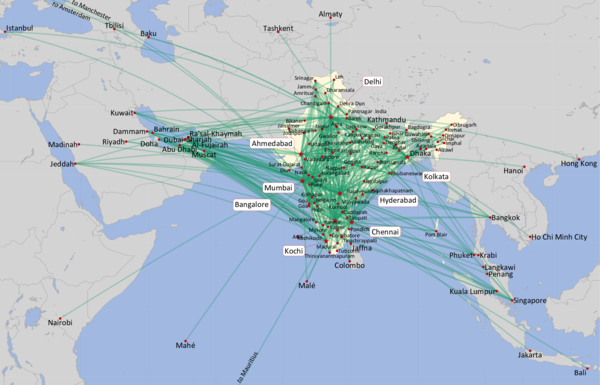
Given India’s economic growth prospects and the planned airport development there would appear to be plenty of potential for further domestic growth. However, IndiGo is focusing on the internationalisation of its network; in the short term it aims to increase its international ASKs to over 30% of its total (from about 27% currently). Its international expansion can be seen in terms of concentric circles around India. The first circle encompasses the Middle East, a natural extension of the domestic market with strong migrant worker flows, an open-skies environment in which IndiGo comes into direct competition with the Super-Connectors and strong Middle Eastern LCCs like flydubai and Air Arabia. The second circle refers to new routes to Southeast Asia where it competes with LCCs like Air Asia and Lion Air as well as network carriers like SIA. The third circle involves start-up routes to Central Asia, Indonesia and Africa; many of these routes require XLR equipment which is due to start arriving this year.
The fourth circle is under development: operating genuine long-haul to Europe. Up to 8-9 hours, the A321 XLR can be used on European services, configured with 195 seats of which 12 are business class. Beyond this stage length and/or for dense roots IndiGo has to switch from narrowbodies to the A350. In order to gain widebody experience IndiGo is damp leasing 787-9s from North Atlantic Airways (Norse provides the cockpit crew, IndiGo the cabin crew). By early 2026 it expects to have six 787-9s in operation to Europe, having recently started up to Manchester and Amsterdam.
Note: 2023 basis, adjusted to 1095km stage length
Fleet investment
IndiGo launched the one of the world’s most ambitious investment programme in 2023, when Elbers announced the largest ever aircraft order (by number of units) — 500 A320neo-family aircraft (125 A320s and 375 A321s, including 90 A321XLR aircraft, with deliveries to begin in 2025). The value of this order is probably around $25-30bn (estimated not list pricing). At June this year IndiGo’s A320/21 family orderbook totalled 884 units, making IndiGo Airbus’ most important customer.
| In Service | Firm Orders | |
|---|---|---|
| A320 ceo | 27 | |
| A320 neo | 186 | 237 |
| A321 ceo | 3 | |
| A321 neo (inc XLRs) | 140 | 648 |
| A350-900 | 60 | |
| 737 MAX | 6 | |
| 777/787 (damp leased) | 3 | |
| ATR 72 | 48 | 30 |
| Total | 413 | 975 |
In 2024 Elbers made another remarkable announcement — an order for 30 A350-900s plus options for a further 70, with deliveries starting in 2027. In June this year 30 of the options were firmed up, doubling IndiGo’s commitment to 60 units valued at about $7bn.
The rationale for the radical decision to invest in the widebodies can be summarised as:
-
With India’s economic prospects, the long-haul market is simply one that IndiGo cannot afford to ignore. The decision to order the A350 was the result of a long-term planning process. And short-term preparation for the A350 operation is currently underway through the operation of damp leased 787s;
-
With its dominance of the domestic market, IndiGo is assured of feed to all its main international bases to/from long-haul flights;
-
IndiGo is well placed to serve the huge and wealthy Indian diaspora which is currently poorly provided for. There is a preference for direct services from Europe to various Indian cities rather than having to connect through Middle Eastern global hubs;
-
IndiGo has been developing its premium product, and it will be able to design an A350 business class specifically suited to Indian long-haul. Although the airline has not yet finalised the seating configuration of the A350, a substantial business class will be necessary for widebody economics to work;
-
IndiGo is confident of maintaining the type of unit cost advantage that he enjoys in the short/medium-haul market in the long-haul sector. While this is certainly the case with regard to Air India and Western flag carriers, it is it is less certain that IndiGo can match the type of unit costs achieved by Emirates and the other super-connectors;
-
IndiGo is a prime customer for Airbus and has a good working relationship with the OEM which will continue into the A350. It expects the same type of relationship with Rolls Royce which will provide the Trent XWB engine for the A350s;
-
The long-haul development is in line with the official policies of Narendra Modi’s government.
Air India’s preoccupations
Air India’s overwhelming preoccupation at the moment is dealing with the consequences of the tragic 787 crash at Ahmedabad. But the likelihood is that Air India, as with other large network airlines or flag- carriers, will be able to emerge from this crisis. As well as traditional political support, Air India has the resources of the all-powerful Tata group behind it.
Just before the crash it was speculated that the airline was on the point of placing an order for 100-plus narrowbodies, adding to its mega-order of 2023 (estimated at $30bn -plus for 470 aircraft). This order reflected Air India’s intent to grow to the same scale as the 600-unit fleets of the main Chinese carriers or to match IndiGo’s ambitions. Currently, the Air India group has 442 narrowbodies (737MAXes and A320/21neos) and 74 widebodies (A350s. 787s and 777Xs) on firm order.
Air India’s financial results are now buried within TATA’s accounts and information is limited. Total revenue was reported to have risen by 14% to ₹610bn ($7.3bn) in FY2025, but there has been no clarification of whether the long run of operating losses under state control has been reversed.
Under CEO Campbell Wilson, Air India has a similar global vision to IndiGo. However, Air India has complex structural issues, specifically the ongoing process of merging two full-service airlines, Air India itself and Vistara, neither of which has been commercially successful, at the same time as finsihing amalgamating two very different LCCs, Air India Express and Air Asia India, into one unit. On the other hand, Air India is now fully owned by the mega conglomerate that is TATA, whose publicly listed companies are valued at over $300bn, and which employs over 700,000 people in, for example, Tata Consultancy Services, Tata Motors, Tata Steel, Tata Chemicals, and Tata Power. Their travel departments will presumably have been instructed or nudged to use Air India wherever possible.
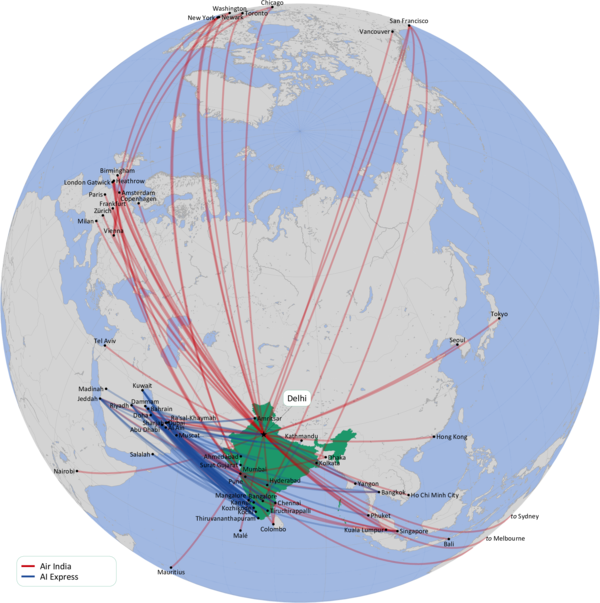
The map opposite Illustrates air India’s long-haul network into primary points in Europe and North America, the same points that IndiGo is likely to target with its new A350s. It is unlikely that Air India will be able to compete on unit costs with IndiGo, but it has many decades of experience in restricting bilaterals in its favour and protecting its slots at global hubs.
LCC competitors’ implosion
IndiGo’s dominance in the domestic market is not just the result of its rapid growth but also a consequence all the self-destruction of its local LCC rivals.
Three years ago, Go Air, which had about 3% of the domestic market, announced its transition to a ULCC by rebranding as Go First. Owned by the powerful Wadia Group it attempted an IPO which failed, then it went into liquidation in 2023.
SpiceJet, the first of the low-cost new entrants back in 2004, had to ground its MAX fleet in 2019 before the pandemic hit. Compensation from Boeing, offering equity to lessors and a strong performance from its cargo unit SpiceXpress rescued the carrier, but its finances deteriorated post-pandemic.
It has been forced to downsize its operations and now has only about 3% of the domestic market compared to 9% three years ago. It does however retain 5% of the international market because of continuing operations to the Middle East. There are tentative signs that its finances may have stabilised — it reported a net profit of ₹5.8bn ($70m) for FY2025 against a net loss of ₹4.1bn the previous year. Total revenue was down by 25% to ₹52.8bn ($635m). By the beginning of this year the fleet was down to 62 units, only half of which were operational. Intriguingly, the airline still maintains that it has 129 737 MAXes on order.
Akasa was a 2022 start-up founded by Rakesh Jhunjhunwala, a well-known investor and stockmarket trader, entering at what he assessed as being the bottom of the market, with the intention of creating India’s first ULCC.
The scale of Akasa’s ambitions is clear; it has an orderbook of 198 MAXes, but its development has been severely hampered by delivery delays, and its current fleet consists of only 30 MAXes. And there is limited financial information, although it is reported that Akasa made a remarkable net loss of ₹19.8bn ($240m) in FY 2025. According to a Akasa spokesman, quoted in the Indian press: “This is neither surprising nor unanticipated. Our robust business plan provides for these losses.”
