Virgin Australia:
A Textbook Restructuring?
May/Jun 2025


Virgin Australia was one of the first airlines to succumb to the effects of the COVID-19 pandemic. Already weakened by years of losses, an intense domestic price war in 2019, and unfortunately-timed corporate activity (buying out the minority shareholder in its FFP), Australia’s second airline ran out of cash in April 2020 and voluntarily submitted to administration.
Five years later, with two years of healthy profits under its belt, it has just had its listing on the Australian Stock Exchange restored through the sale of 30% of its equity (236m existing and one new share at A$2.90 apiece) giving the company a market capitalisation of A$2.3bn.
In late 2020, US-based private investment company Bain Capital bought Virgin Australia from the administrators, Deloitte, for A$3.5bn — A$730m in cash and assuming A$450m in worker entitlements and secured debt of A$2.3bn (out of the total A$4.8bn debt at the time). Trade creditors, and bondholders took a 90% haircut. The then shareholders (which included Richard Branson’s Virgin Group, Singapore Airlines, Etihad, and two chinese carriers Hainan and Qingdao Airlines) lost their entire investment. (After the deal, Branson went on to take a 5% stake, presumably in BC Hart, Bain Capital’s investment vehicle that became the airline’s sole shareholder).
Restructuring needed
Founded in 2000 as LCC Virgin Blue, by the 2010s it had forgotten its original mantra of keeping things simple. It rebranded as Virgin Australia in 2011, moved into long haul international flying using a handful of 777s, added wide bodies and “business” class to its domestic network, and bought LCC Tigerair Australia. It tried to copy all that its main rival Qantas did.
By the end of 2019 the Virgin Australia Group consisted of four main divisions:
- Virgin Australia Domestic (including Virgin Australia Regional), operating to 39 destinations in Australia with a fleet of 96 narrowbody, widebody and turbo prop aircraft;
- Virgin Australia International, flying to 15 destinations across New Zealand, Pacific Islands, North America and Asia with a fleet of 22 widebody aircraft;
- Tigerair Australia, its low cost brand, flying to 12 destinations within Australia using a fleet of 15 A320s and 737s;
- Velocity, its FFP loyalty programme.
The problem was that neither Virgin Australia International nor Tigerair made a profit. In the five years ended 2019 the group had achieved an average underlying operating margin of only 3.4%; but it had lost money at the net level in every year: a total of A$1.7bn over the period.
Mike Murphy, senior partner at Bain Capital, quoted in Forbes, said: “It was sitting on a fleet that was too big, and a business perimeter that was too much. The long-haul international business had never made money. Its low-cost carrier business Tigerair had always struggled since the day they acquired it. It was clear things needed to change, and part of the attraction was just what was possible on the cost and complexity reduction under ownership and throughout the administration process.”
A structural strategic reset was needed.
Under the leadership of new CEO Jayne Hrdlicka (a former Bain Capital consultant, former CEO of Jetstar and Qantas Loyalty), the company pivoted away from the full-service and international direct competition against Qantas to a hybrid business model — a mid-tier “value carrier” focusing on domestic (and, eventually, short-haul international) routes to appeal to leisure and SME business traffic. Free perks (food, luggage) were abandoned to concentrate on an unbundled buy-on-board and ancillary pricing product. The widebodies went and long haul international routes closed. Tigerair Australia was dismantled and its mixed fleet of 15 A320s and 737s returned to lessors.
The mainline fleet was simplified, with the disposal of ATRs and Embraers, to concentrate on the 737 as a single aircraft type. By the end of 2020, it had halved its fleet to 58 737s but since then has rebuilt its strength to 95 units (including eight 737MAXs). It is in the process of further streamlining the 737 fleet with a retrofit seat densification programme to give a standardised 182 seat count.
| 2019 | 2024 | 2025 | 2026 | Orders | ||||
|---|---|---|---|---|---|---|---|---|
| June | Dec | June | Dec | June | Dec | |||
| B777 | 5 | |||||||
| A330 | 6 | |||||||
| 737NG | 85† | 86 | 87 | 85 | 82 | 79 | ||
| 737MAX8 | 8 | 8 | 14 | 20 | 26 | 25 | ||
| A320 | 15∗ | 7 | 5 | 4 | ||||
| F100 | 14 | 3 | 1 | 1 | ||||
| ATR42 | 14 | |||||||
| E1 | 5 | |||||||
| E190-E2 | 3 | 4 | 6 | 4 | ||||
| Total | 144 | 104 | 101 | 107 | 106 | 111 | 29 | |
Notes: †six 737 and ∗nine A320 operated by Tigerair Australia
Following an internal review, the group decided to continue operating Virgin Australia Regional Airlines (VARA). This provides scheduled and charter services focusing on the resource communities in Western Australia — mostly underwritten by long term contracts — that had used a mixture of aged A320s and F100s. The group is in the process of replacing these with new E190-E2s (of which it has four on firm order).
The operational reset gave the group the opportunity for deep cost restructuring: a third of the workforce were laid off, collective agreements renegotiated, and structurally the group reduced the underlying head office staffing levels. It also renegotiated (and exited) over 500 “onerous” contracts delivering annual savings of nearly A$300m. From the accounts it looks as if Bain only had to inject A$247m in new equity.
The restructuring plan paid off. Virgin Australia retained its 35% share of the domestic duopoly (against Qantas Group’s 63%). For the year ended June 2023, Virgin Australia was able to announce its first (underlying) profit in 11 years. It generated an underlying operating profit of A$426m on revenues of A$5.0bn (a margin of 8.5%) and net profits fo A$223m. Further recovery in FY2024 allowed it to report operating profits of A$501m on revenues of A$5.4bn (a near respectable 9.4% margin) and a net result of. And the group is forecasting that its result for FY25 will see revenues almost back to prepandemic levels at A$5.8bn, operating profits up by 28% to A$644m and a net result 28% higher at A$331m.
Bain Capital seems to have been able to apply a textbook case of strategic restructuring, financial discipline, and operational refocusing to effect the turnaround in Virgin Australia’s fortunes. They have also applied the private equity textbook policy of extracting cash returns: in the last two financial years it took A$1.1bn in a return of capital and payment of dividends — with a further A$100m dividend paid out in the six months ended December 2024.
Mike Murphy explains: “For us, as a private equity firm, we’ve always been very explicit that we are five-to-seven-year investors typically. We are now at five years, and I expect us to be investors for at least another couple of years. But at some point for our investors and our business model, we ultimately need to exit. An IPO is a step in that long journey.” The IPO saw Bain disposing of 40% of its shareholding in Virgin Australia. It decided not to use the opportunity to raise new equity to bolster the balance sheet (except for one share — which is there presumably as a quirk of ASX rules). At the end of December the airline still had negative equity of A$840m. Post issue, Bain retains a 40% stake. The next largest shareholder is Qatar Airways with 23%.
|
|
Notes: ∗ Capital return to shareholder; † Dividends
Qatar Airways
Qantas (a member of the oneworld alliance), operates a comprehensive joint venture agreement with superconnector Emirates for services through the Middle East on the kangaroo route. So, maybe it shouldn’t be surprising that Qatar Airways (a member of, and banker to the oneworld alliance) should be interested in some link with Virgin Australia.
In 2023, Qatar had applied almost to double the number of weekly services it is permitted to operate into the four main Australian cities. The bilateral ASA limited them to 28 direct services into Sydney, Brisbane, Perth and Melbourne from Doha (although with no limitation on aircraft gauge), and an additional seven services via, or onto, another point in Australia (such as Adelaide, Canberra, Darwin, Gold Coast). There are no limitation on services that don’t touch the four metropolises. The application was rejected.
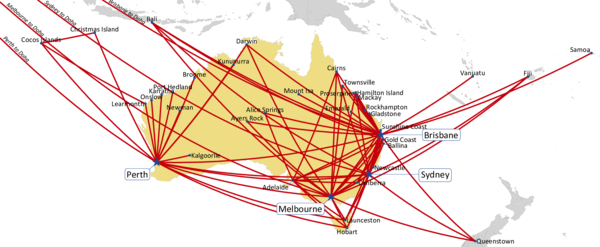
A year later Qatar Airways reached agreement to acquire a 25% stake in Virgin Australia from Bain Capital (for QR1.87bn, or A$785m). This was effected in April 2025 following government approval. With the stake comes an agreement for Virgin Australia to “operate” flights to Doha from Sydney, Brisbane, Perth and Melbourne — taking up reciprocal rights under the bilateral. However, the aircraft will be wet-leased from Qatar Airways.
Virgin Australia this as a “capital-light” method of accessing long-haul international routes, seeing a benefit in offering its customer base with convenient connections to 170 destinations worldwide through Doha; and envisages potential enhanced feed on to its domestic services. It states that the overall impact of the wet lease arrangement and the new services on its level of operating profits is expected to be immaterial.
| FYE June | 2023 | 2024 | 2025F |
|---|---|---|---|
| Airlines | |||
| Passengers carried (m) | 18.9 | 19.2 | 20.8 |
| ASK (m) | 30,030 | 32,374 | 33,630 |
| Load factor (%) | 84.0% | 83.0% | 85.5% |
| RASK (cents per ASK) | 16.2 | 15.9 | 16.5 |
| CASK (cents per ASK) | 15.1 | 14.7 | 15.0 |
| Statutory underlying EBIT margin | 7.4% | 7.6% | 9.4% |
| Velocity | |||
| Member numbers at period end (m) | 11.5 | 12.3 | 13.3 |
| Statutory underlying EBIT margin | 23.4% | 28.2% | 27.6% |
