Qantas Project Sunrise:
Brilliance or Hubris?
Jun/Oct 2026


In October 2027, after seven years in the planning, Qantas is scheduled to inaugurate “Project Sunrise”: nonstop flights initially covering the 17,000km between Sydney and London using a fleet of highly modified A350-1000ULR aircraft in 20-22 hours.
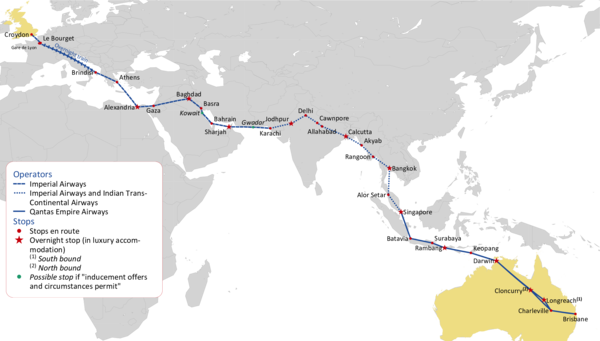
Nearly a hundred years ago, in April 1935, Imperial Airways and Qantas Empire Airways established the original “Kangaroo Route” — a gruelling 12½-day, multi-hop marathon to conquer the “tyranny of distance” for a highly exclusive cadre of the colonial elite (and premium mail). By eliminating intermediate hubs entirely, Project Sunrise is championed as the ultimate evolution of commercial flight. Yet, beneath the two triumphs lies a stark historical echo. Both the 1935 route and its 2027 successor represent an element of hubris, prioritising a low-density, hyper-premium market niche at the expense of systemic structural efficiency. Today, however, this pioneering engineering feat faces a fundamentally different boundary condition than the geopolitical challenges of the 1930s: the unforgiving atmospheric realities of a worsening climate crisis.
Imperial Connections
The original 1935 route must have been an amazing journey. Using a mixture of Armstrong Witworth Atalantas, Handley Page Heracles, and de Havilland Express aircraft (later progressing to Empire flying boats), Imperial Airways and Qantas provided the opportunity for ten wealthy passengers to fly a near 20,000km route from London to Brisbane. Leaving the central London air terminus at 11:45 (on Tuesdays and Saturdays) they would be taken to Croydon Airport, flown to Paris Le Bourget, transported to the Gare de Lyon for an overnight sleeper train to Brindisi in the south of Italy (Mussolini did not allow British aircraft to fly over the country) and then through some 30 destinations to reach the final destination sometime (unspecified) in the evening of the Thursday some twelve or sixteen days later. There was no night flying en route, but luxury accommodation was provided at each overnight stop (that in Sharjah was a desert fort). There was strict etiquette: passengers were required to “dress for dinner”.
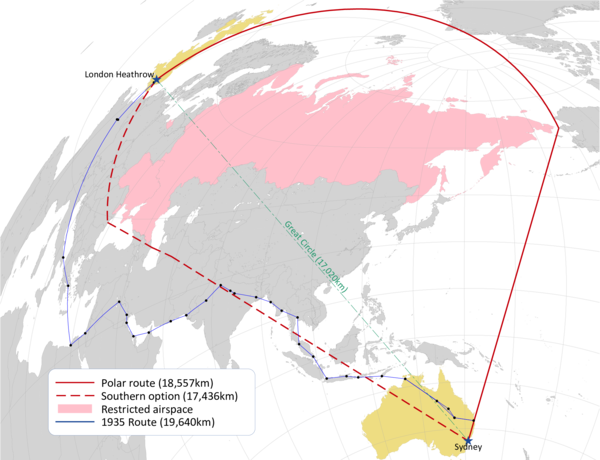
(The Italian restrictions of the 1930s provide a curious parallel to current geopolitical tensions and the restricted airspace over Russia, Ukraine and the Middle East demonstrating how political geography breaks the mathematical purity of the great-circle route.)
The tickets cost £195 one way (subject to exchange rate fluctuations), and £350 return — nearly three times the price of a first class berth on a steamship but saving four weeks travel time. The ticket price included all food, accommodation, tips and transfers, and a 15-25kg free luggage allowance (depending on the weight of the passenger). That sum was equivalent to the average annual salary at the time: so something over £40,000 in today’s money — not exactly a trip for the man on the Clapham omnibus.
Creating the world’s longest route
Project Sunrise was first mentioned in 2017 and touted by Qantas in its 2019 investor day (see Aviation Strategy, Feb 2020). Following the success of trialling a direct route between Perth and London using a low density 787-9, it foresaw the opportunity of ultra-long haul routes from Sydney to London, New York, Manchester, Frankfurt and Paris; and trans-antarctic routes to Jo’burg, Cape Town, and Rio.
A few things got in the way of the plan: not only the pandemic and its aftermath, but finding an aircraft that could actually fly the route with a meaningful payload.
In May 2022 it plumped for an offering from Airbus and ordered 12 A350-1000ULRs.
The first has recently and successfully completed a test round-trip between Tolouse and Sydney (the return took over 24 hours) and will be delivered in April 2027. The inaugural regular route between Sydney and London will commence in November 2027.
Qantas will not be able to fly the direct great circle route of 17,000km. Currently, and for the foreseeable future, there is a lot of restricted airspace on the way. The optimal routing will also depend on the seasonality of prevailing winds and position and strength of jet streams. In the map we show a couple of options: a northbound route over the Pacific and North Pole, skirting the Kamchatka peninsular; a southbound route avoiding Ukraine and manipulating the narrow corridor north of the problems in the Middle East.
The Polar route adds more complexities. The A350 has the highest ETOPS rating in commercial aviation, with a certification of 370 minutes (over six hours) diversion under single engine power. But there would be substantial and costly disruption if a fault made it necessary to land at Longyearbyen on Svaalbard in the midst of northern hemisphere winter.
Qantas is fitting the cabin out with a premium-heavy configuration of 234 seats (compared with the “normal” three class layout of 330-370 seats and maximum single class capacity of 480 seats in the A350-1000) and has gone a long way to provide onboard “well-being” services to assuage passengers’ trepidation of being stuck in a tin can for over 20 hours. The experience from the direct Perth-London route gives it confidence that passengers prefer non-stop flights and are willing to pay a 30-50% premium to save four hours travel time.
The modifications to the base model have been substantial. Airbus integrated a 20,000-litre fuel tank into the rear fuelage structure (giving it a total fuel capacity of nearly 190,000 litres (150 tonnes); re-engineered the fuel system to manage center of gravity and fuel transfer control over prolonged flight times; provided structural reinforcement and redesign of the landing gear to support the increased MTOW and spread the weight more evenly when on on the ground. Rolls tweaked the Trent XWB engines to optimise fuel burn efficiency and endurance over ultra-long distances.
The Payload Penalty: The Non-Linear Physics of Distance
Long haul routes account for 10% of airline passengers, but 50% of fuel used (and CO₂ emissions). There is a “sweet spot”, at a stage length of around 6,000km, where the fuel uplifted is at its most efficient. As stage length increases the relationship between fuel burn and distance becomes sharply non-linear and creates a “fuel-to-carry-fuel penalty”. As the graph shows, at a range of 18,000km the A350 needs 1.1kg of fuel to carry 1kg of payload.
The aircraft will need to take off at its MTOW which requires signiciantly more thrust to climb and cruise. On an 18,000km sector the upgraded A350 will get through around half of its 150t of fuel in the first ten hours: fuel burn drops progressively as the aircraft gets lighter.
As stage length increases the required level of fuel increases as a proportion of total take-off weight, as the graph illustrates: at 18,000km fuel could account for over 40% of the take-off weight. A further complication arises in hot weather. The aircraft’s fuel capacity is volumetrically limited. Energy content of fuel is determined by its mass, but its density changes with ambient temperature. There can be the risk that on a particularly hot day in Sydney or London, the A350-1000ULR could fill its tanks to the brim, but not have enough fuel to reach its destination.
Luckily London and Sydney each are only a few metres above sea level and in temperate climes. At “hot-and-high” airports not only does the fuel volume expand but also engine thrust is reduced.
This massive fuel-load requirement directly steals from the aircraft’s payload capacity and enforces the sub-240 seat restriction.
But with half the seats in premium cabins, it leaves the route exposed to premium-demand fluctuations.
This non-linear spike in fuel consumption exposes the paradox of modern ultra-long-haul: the physics of extreme range requires the aircraft to function primarily as a flying fuel tanker, compromising its economic and environmental efficiency before the wheels leave the tarmac.
But the operation is an engineering feat that others in the industry have also decided to pursue.
The table shows the world’s current top ten longest routes. It is headed by Singapore Airlines’ all premium 160 seat operations to JFK and Newark (both suffering a diversion penalty from airspace restrictions of 11% and 7%).
Qantas accounts for four of these top routes using low density 787-9s.
Qatar and Emirates both restrict cargo payload on their flights to Auckland, and may reduce the seats on sale to enforce the structural zero fuel weight safety constraints. Qatar also switches to a lower capacity 777-200LR when headwinds are particularly strong.
The China Southern route can only operate from Shenzhen to Mexico non-stop: the return has to touch down for refuelling at Tijuana because Mexico City, at an elevation of over 2,200m above sea level, is a classic hot-and-high airport and the A350 will not be able to get off the ground at its MTOW. Even so, while it offers 252 seats on the non-stop segment, capacity is limited to 152 seats for the return.
The airline industry is under extreme pressure to decarbonise. It has its plans to achieve “net-zero” by 2050 — the plans heavily dependent on the production of sustainable aviation fuels (SAF). And this is how former Qantas CEO Alan Joyce justified the project. Some regard SAF as a dubious method — it has the same chemical formula as conventional aviation fuel and burning 1t generates 3.16t of CO₂ even if the SAF had been created from feedstock that was recently alive rather than buried underground for millenia. Moreover, because SAF production is severely scaling constrained, burning it to haul its own weight on a 20-hour flight yields half the putative net life-cycle carbon reduction of using that same tonnage across three short haul flights.
There will be increasing political pressure on enforcing aviation’s payment for its carbon footprint (witness the EU’s plans to extend the remit of the ETS) and this will add to the cost of fuel as more of the vastly more expensive SAF gets blended into aircraft. Flying a heavily laden, low-density aircraft half way round the world should probably be treated as environmentally regressive, generating twice the CO₂ emissions per passenger than a route with an intermediate stop no matter the source of the fuel.
Ninety years after Imperial Airways chased the illusion of ultimate connectivity via the original Kangaroo Route, Project Sunrise stands as a testament to engineering brilliance of conquering distance. But may be it is being deployed against the wrong adversary. In an era defined by climate reality, the ultimate measure of aviation success may no longer be whether we can fly twenty hours non-stop, but why we still convince ourselves we should.
| Distance (km) | |||||||||
|---|---|---|---|---|---|---|---|---|---|
| Route | Eqpmt | Great Circle | Flown | Flight time | Seats | Airline | |||
| 1) | New York | Singapore | A350-900ULR | 15,347 | 16,989 | 18:10 | 161 | SIA | |
| 2) | Newark | Singapore | A350-900ULR | 15,344 | 17,085 | 18:30 | 161 | SIA | |
| 3) | Auckland | Doha | A350-1000/777-200LR | 14,534 | 14,720 | 17:15 | 327/272‡ | Qatar | |
| 4) | Perth | London | 787-9 | 14,499 | 14,769 | 17:15 | 236 | Qantas | |
| 5) | Dallas | Melbourne | 787-9 | 14,472 | 14,761 | 17:40 | 236 | Qantas | |
| 6) | Paris | Perth | 787-9 | 14,264 | 14,873 | 17:20 | 236 | Qantas | |
| 7) | Auckland | New York | 787-9 | 14,207 | 14,689 | 17:30 | 236 | Qantas | |
| Air New Zealand | |||||||||
| 8) | Auckland | Dubai | A380-800 | 14,200 | 14,425 | 17:10 | 484 | Emirates | |
| 9) | Shenzhen | Mexico City | A350-900 | 14,146 | 14,535 | 16:20 | 252/156† | China Southern | |
| 10) | Los Angeles | Singapore | A350-900ULR | 14,113 | 14,528 | 16:20 | 161 | SIA | |
| Range at max payload | Payload at max range | |||||
|---|---|---|---|---|---|---|
| Range(km) | Payload(t) | Payload(t) | Range(km) | MTOW(t) | ||
| 787-9 | 9,800 | 52.5 | 28-30 | 14,010 | 254 | |
| A350-900 | 10,100 | 53.4 | 34-36 | 15,750 | 283 | |
| A350-900ULR | 12,000 | 43.1 | 24 | 18,000 | 280 | |
| A350-1000ULR | 10,200 | 67.5 | 22-24 | 18,500 | 319 | |
POSSIBLE ROUTINGS SYDNEY-LONDON NON-STOP