Allegiant: Sunseeker out,
Sun Country in
Jun/Oct 2026


Almost by default, Allegiant has emerged as the best performing company among the US low cost airlines, the others having self-destructed to various degrees. Back in 2022 a proposed merger between Frontier and Spirit promised to create a new ULCC force in the US but that merger fell apart when JetBlue intervened with a financially generous but strategically dubious bid for Frontier, which was scuppered by the US regulatory authorities. Both JetBlue and Frontier have struggled in find new directions in a market characterised by high fuel prices and more effective competition from the Networks. Spirit went from being the most profitable airline ten years ago to Chapter 11 then to Chapter 7 bankruptcy in May this year. Southwest, now under the control of private equity firm Elliot Investment Management, is converting to a full-service type, closer to the Networks than to LCCs.
Allegiant Travel Company, the airline’s parent, has a current capitalisation of $2.05bn, less than half its 2021 peak, but it is valued more highly than JetBlue, $1.40bn, or Frontier, $1.35bn. The US LCC sector is now eclipsed by the Network carriers; Delta’s market capitalisation is $53bn, by contrast.
Allegiant, founded in 1997, went through various iterations and a Chapter 11 bankruptcy before finding a successful and unique strategy under CEO and major investor Maurice Gallagher, who previously led the ULCC Valujet. Gallagher now holds the chairmanship of Allegiant and is still the second largest individual shareholder, with 7.5% (Blackrock is the largest with about 13%). Since 2024 Greg Anderson, a long-time Allegiant executive, has been the CEO, charged with the immediate task of sorting out the Sunseeker fiasco.
Just before the pandemic Allegiant decided to diversify away from its core low cost travel business by developing a luxury holiday resort — Sunseeker — at Charlotte Harbor in Florida, which opened in 2023. The commercial logic was: Allegiant had unparalleled access to a mass market of affluent leisure travellers (21 million in its loyalty programme) in Middle America, so it had unique opportunity to provide them with leisure accommodation. Allegiant set out to build Sunseeker, a facility that would offer everything an American vacationer could want — luxury hotel rooms, restaurants, bars, golf courses, tennis courts, shows, etc. Sunseeker was located on the coast of the Gulf of America (previously Gulf of Mexico) very close to Allegiant’s underutilised base airport of Punta Gorda.
But real estate development proved to be a very different business from airline management. Allegiant executives failed to cope with construction delays, cost overruns and the aftermath of a hurricane. The development is estimated to have cost $720m but didn’t attract anything like enough vacationers; occupancy rates were rarely above 50%. With losses mounting, Allegiant was forced to sell the resort to Blackstone Real Estate for $200m in 2024, with Hilton taking over the hotel operation, booking an impairment charge of $322m, which explains the $240m total net loss for that year, followed by another $100m-plus of write-offs in 2025/26.
Allegiant’s airline operations actually did well in 2025, with total passengers up by 10.5% to 18.5m, though scheduled load factor dipped slightly to 82.0%, which is low by LCC standards. Airline revenues totalled $2.54bn, up 3.7%, and generated an operating profit of $144m. Unfortunately, Sunseeker, with revenues of $60m, produced an operating loss of $(107m). So, an overall operating profit of $37m, which translated into a net loss of $(45m).
|
|
The balance sheet as at mid-2026, after the Sun Country merger (see) looks reasonable, with total assets of $6.44bn (including cash of $1.1bn) and total liabilities of $4.67bn, giving shareholders’ equity of $1.77bn. Fitch classifies Allegiant as just below investment grade, with a BB+ rating for the $500m secured debt it issued this summer.
Unusual network and operating model
As the map indicates, Allegiant has an unusual network. It covers most of the US serving small, underserved communities, connecting them to major leisure destinations. In the first half of this year it operated to/from 126 cities on 578 routes, with another 40 routes being added throughout this year. Over half the routes serve five major leisure destinations in the Sun Belt: Orlando (MCO and SFB), Tampa/St. Petersburg, Las Vegas, Punta Gorda (Sunseeker) and Phoenix (AZA and PHX). Most of its routes are too thin and/or seasonal for traditional Network or LCC operation; Allegiant claims that 75% of its network has no nonstop competition.
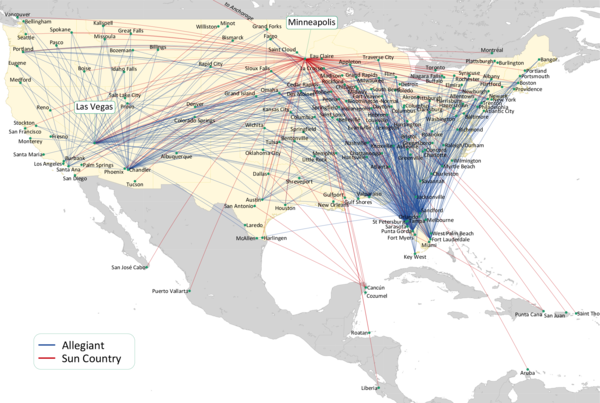
The defining aspect of Allegiant’s operating plan is that, in contrast to the classic LCC strategy, it does not attempt to maximise aircraft utilisation. Rather it matches aircraft utilisation to demand, daily, weekly and seasonally, parking aircraft when demand is low, on Tuesdays for example. Also, the fleet is dispersed among 22 Origin bases in addition to the Destination bases, allowing capacity is shifted between these points in response to demand changes.
The monthly variation in aircraft utilisation is shown in the chart below, compiled from Skailark data. Over this 15-month period aircraft utilisation varied from 4.1 to 8.0 block hours per day, with an overall average of 6.8 hours, roughly half the ULCC standard.
Such a strategy works when there is a high proportion of variable flight operating costs compared to fixed aircraft ownership costs. In 2025 Allegiant’s fuel expense, the all-important variable, was 25% of total costs, compared to 6% for interest (aircraft and other debt), 1% for leases and 9% for depreciation. Station costs at 10% will contain some minor element of flight variable costs but en route charges in the domestic US, unlike Europe, are not a variable cost for the airline as they are paid to the FAA via a passenger tax added to tickets. Salary costs at Allegiant account for 31% and, at least in the short term, there is no variable element.
Allegiant’s core fleet, as at mid-year, comprised 103 A319s and A320s, on average 17 years old, fully depreciated aircraft and, by contemporary standards, fuel-inefficient. Up to the pandemic Allegiant was able to grow its A320-family fleet through a series of opportunistic transactions, picking up second-hand-units mostly for cash. But these opportunities have inevitably dried up, meaning that Allegiant had to change direction by ordering new types from Boeing.
One of the questions that has hovered over Allegiant is whether its model is truly scalable; what are its limits to growth? (In Europe Volotea, an airline with a similar operating model — see Aviation Strategy, February 2025 — has failed to grow into profitability, and its airline investor, Aegean, is having to make some hard decisions about its future.)
Allegiant management is confident that the market will support growth. In a recent presentation, it stated that over 1,400 potential new routes, 75% of which have no direct service, have been identified. But while these routes might be viable with elderly, cheap A319s and A320s, using expensive, new MAXs might be a different proposition, although management emphasise the 20% operating cost improvement that the MAXs have over the older generation types.
In 2022 Allegiant ordered 50 737 MAX 7 and 8s, with options for a further 50 — a firm commitment of about $3bn, after discounts. By September this year 21 were in service, with a further four to be delivered by year end. Consequently, the airline’s capital expenditure has escalated. Management indicates that in 2026 there will be $640-$660m in aircraft-related capex.
| In service | Avg age | On Order | |
|---|---|---|---|
| A319 | 27 | 21.1 | -- |
| A320 | 76 | 15.2 | -- |
| 737-800 | 43 | 17.6 | -- |
| 737-800BCF∗ | 22 | 23.5 | -- |
| 737-900 | 3 | 11.5 | -- |
| 737MAX8 | 21 | 1.4 | 29 |
| Total | 192 | 16.0 | 29 |
Notes: ∗ Operated for Amazon Prime Air
Allegiant has not specified its longer-term fleet plan but it will revolve round a changing mix of MAXs and A320s (and 737-800s from Sun County). The company will seek to maximise MAX block hours by allocating them to the denser markets or by imaginative aircraft scheduling between thin markets, the aim being to get their average utilisation up to 12-plus hours a day. The A320 family will presumably continue to be operated in the traditional Allegiant fashion, flying when there is demand, parked when there is not. All this adds complexity to the Allegiant operating model.
Allegiant is having to deal with other cost pressures. In August, Allegiant finally reached, after two years of negotiation, a collective agreement with its pilots’ union. Pilots are in a very strong position in the US at present, and at Allegian they have achieved salary increases of up to 54% from existing levels, effective January 2027. Various bonuses, estimated at $300m, that had been retained by the company will now be released as a result of the agreement. Finally, Allegiant will make a major improvement to pension and disability schemes. In return, the pilots have committed to greater flexibility in rostering and scheduling.
Allegiant is also in the process of modifying its product — more free drinks and snacks on board — and is introducing a premium class, Allegiant First, from Spring next year. Allegiant First will comprise a separate cabin of eight seats in a 2x2 configuration at the front of some aircraft (which previously had an all-Economy configuration) plus perks like priority check-in and boarding, generous baggage allowance. This innovation reflects a general trend in the US whereby travellers seem to be rejecting no frills and opting for some degree of service, but it is also adding cost to Allegiant’s model.
Sun Country and the
Amazon challenge
After all the speculation and intrigue the only LCC merger that was actually completed in the US was Allegiant’s purchase of Sun Country, finalised in May. The transaction was valued at $1.5bn, including $400m of Sun Country net debt, and comprised a mixture of cash and shares. Sun Country shareholders received a premium of 20% above the pre-bid stockmarket price.
Sun Country is a leisure passenger/fast freight airline based at Minneapolis/St. Paul (MSP) operating a fleet of 43 elderly 737-800s, 3 737-900ERs and 20 737-800BCFs. It has been consistently profitable, apart from the Covid years, in 2025 achieving a turnover of $1.1bn, an operating profit of $100m and a net profit of $53m.
The rationale given by Allegiant for the takeover, apart from Sun Country being available, was fairly predictable: additional scale, cost synergies, revenue diversification, enhanced loyalty programme and access to an international network to Mexico and the Caribbean. Equally predictable was the promise of future synergies, $140m annually but not until three years out and mostly comprising revenue rather than cost efficiencies.
There is no doubt that the merger brings together two strong leisure brands but there are some execution issues to be resolved. Although the two brands are to remain separate for the time being, Allegiant executives have taken over at the top of Sun Country, with the former CEO, Joe Bricker, acting as integration advisor on the board of the joint airline.
The Sun Country network is the obverse of Allegiant’s, concentrating operations at the traffic origin base of Minneapolis and flying Minnesotans to a wide range of destinations in Florida, California, the Southwest, the East Coast, Mexico and the Caribbean, whereas Allegiant flies from small origin bases to major leisure bases. Allegiant states that this will provide aircraft scheduling opportunities.
MSP is Delta’s second hub where it controls 71% of the capacity against 12% for Sun Country. Allegiant will be facing a substantial direct competition from a Network carrier for the first time. However, the immediate problem is competition for personnel: Sun Country is rapidly losing pilots to Delta.
The integration of the Sun Country 737NGs adds further complexity of the Allegiant fleet, though again the airline claims that this will aid aircraft scheduling.
Finally, Allegiant will again be entering a new business with new risks — managing logistics contracts with an Tech Giant. Sun Country has a cargo agreement with Amazon that runs until 2030 and has been concentrating its efforts on this while downsizing its passenger operations. In the fourth quarter of 2025, Sun Country’s passenger block hours were down 8.5% on an annual basis while cargo hours were up 51%. By the end of this year they will be operating 22 737 BCFs, developing a new cargo hub at Cincinnati and will be the second most important carrier in the Amazon Air virtual airline (after ATI, a 767F operator).
