China Airlines, EVA and Starlux:
Interesting Times in Taiwan
Jul/Aug 2025

The three Taiwanese network airlines — China Airlines, EVA Air and Starlux — live in interesting times, in the words of the apocryphal Chinese curse, buffeted by the volatile policies of Presidents Xi and Trump.
Taiwan is dwarfed by mainland China, with a population of just 23 million compared to 1.4 billion. But it is an economic powerhouse, the centre of the global semiconductor industry, with a GDP per capita of about US40,000 (recently overtaking South Korea) compared to just $13,000 for China.
China Airlines and EVA (14.4m and 13.5m passengers respectively in 2024 including subsidiaries) plus newcomer Starlux (4.1m passengers), play a critical role, both economically and politically in connecting Taiwan with the rest of the world, part of which does not recognise the country’s existence. The two main carriers fly beyond Asia to North America and Europe; Starlux’s network already includes the USA and it has ambitions to start up to Europe in 2026. (Brief profiles of the three airlines appear later in this article.)
The two Chinas
The pandemic raised the profile of China Airlines, which was heavily involved in the transport of PPE and other medical equipment to North America and Europe, but also highlighted confusion as to its national status; in the West it was widely assumed that it was a mainland carrier and frequently confused with the PRC’s Air China. Consequently, there was a move by the airline’s management to rebrand the flag-carrier, possibly as Taiwan Airlines, which engendered vehement political opposition, and the name change was eventually dropped. In a way, this episode encapsulated the identity issues between the two Chinas.
At the end of WW2, Taiwan, part of the Japanese empire for over 50 years, was transferred to China, which was in the throes of a civil war between the communists under Mao Tse Tung and the nationalists (the Kuomintang or KMT). The communists prevailed on the mainland, establishing the People’s Republic of China (PRC) while the nationalists set up a provisional government in Taiwan, which was renamed the Republic of China (ROC).
Since then, relations between the two Chinas have been complex and fractious with both the PRC and the ROC claiming legitimacy. The ROC has lived in a state of constant alert over an attack from the mainland; tension has escalated after Russia’s invasion of Ukraine and the ambivalent reaction of the USA. In his 2025 new year address President Xi stated that Taiwan would inevitably be reunited with mainland China. President Trump has appeared to be not too focused on the PRC-ROC political situation, being preoccupied by what he regards as the unfair trade imbalance between Taiwan and the USA. He has, however, remarked that President Xi had reassured him that the PRC would not invade while he (Trump) was in power.
It is possible that commercial considerations will prevail, as they have done in the past. The PRC is rapidly expanding its zone of influence beyond Southeast Asia to countries, such as India, Nigeria, Ethiopia and Brazil, partly because of US tariffs, and it probably won’t want to disturb this geopolitical and geoeconomic progress. Moreover, Taiwan could respond to a PRC attack by destroying its electronics manufacturing plants, apparently a policy suggested by the Pentagon. This would have dire consequences for the PRC’s own electronics industry, which relies heavily of Taiwanese chips, and for the global economy.
Meanwhile, China Airlines and EVA operate quite extensive networks between the ROC and the PRC. This is despite the fact that there is no official ASA between the two Chinas. Direct regular flights between the ROC and the PRC have been allowed since 2003 but these are still officially charters. Before then all flights had to been routed through Hong Kong or Macau.
Even today PRC-ROC traffic volumes are relatively modest. For instance, in 2024 China airlines carried 1.1 million passengers to/ from the mainland and a further 1.0m to/from Hong Kong/Macao, together about 13% of its total traffic. EVA generates only 7% of its passenger revenue from the PRC and Hong King.
Flight routeings between the two Chinas are often circuitous because of M503. This is a north –south flight path down the Taiwan Straits imposed by the PRC in 2015. It connects Nanjing and Shanghai in the north with Guangzhou and Hong Kong in the south, which means that Taiwanese airlines have to negotiate narrow crossing corridors en route to mainland destinations, while avoiding various air defence zones controlled by the two national airforces.
Semi-conductors and the Phoenix phenomenon
The USA is a key market for the Taiwanese airlines — accounting for about 20% of China Airlines’ passenger revenue and, perhaps more significantly, 64% of its cargo revenue. EVA has a higher passenger exposure, about 40%, and in the first quarter of 2025, when exporters were rushing to beat the Trumpian tariffs, the USA accounted for 71% of EVA’s cargo revenues.
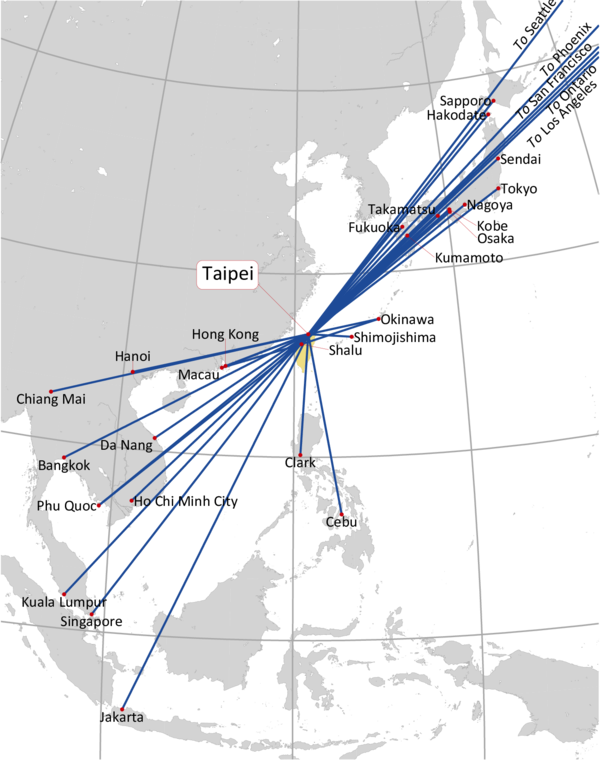
As the maps show, all three carriers operate to the principal gateways — New York, Chicago, San Francisco, Los Angeles, etc — but there is a slightly unusual city on China Airlines’ and Starlux’s network — Phoenix, Arizona. Because of developments in the semi-conductor industry, building air service to Phoenix from Taipei has become vitally important, as has the forming of alliances with the two main US airlines based at Phoenix — Southwest and American.
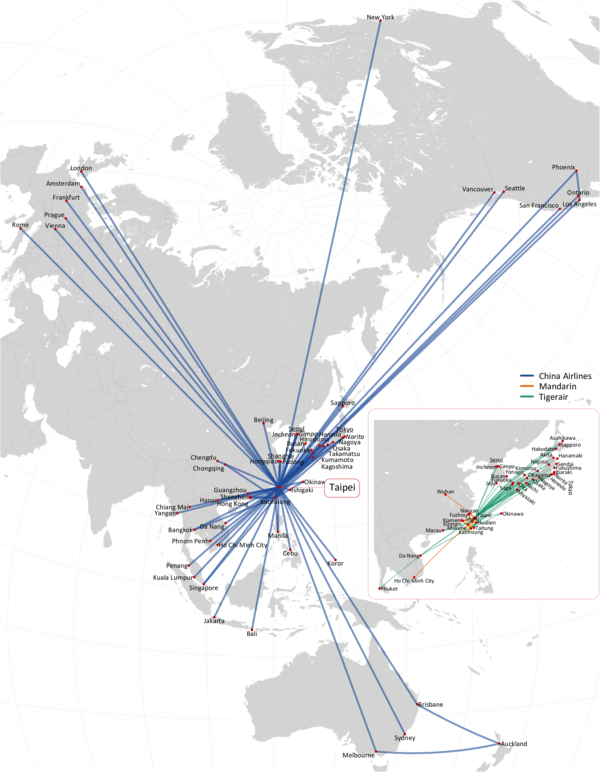
Great circle routes from the origin appear as straight lines.
China Airlines will inaugurate its Taipei-Phoenix non-stop service in December 2025, and has announced an extensive codeshare agreement with Southwest. Starlux’s direct service is due to start in January 2026, and it has signed a codeshare alliance with American. EVA does not (yet) operate to Phoenix, but it has also entered into another substantial codeshare agreement with Southwest.
The connection is TSMC, all three airlines’ most important corporate client. Taipei-based TSMC (Taiwan Semiconductor Manufacturing Company) is the world’s largest independent semi-conductor foundry, manufacturing integrated circuits for high-tech companies such as Nvidia, AMD, Alphabet, Amazon, Apple and Microsoft — in short, the modern US economy. According to The Economist, TSMC produces two-thirds of all chips made by foundries, and in the most advanced segment, including processors for smartphones, laptops and data centres, the company’s share exceeds 90%. The AI revolution depends on TSMC.
In the cargo sector, TSMC uses a combination of bellyhold and dedicated freighter capacity (the three carriers operate 27 747F and 777F freighters in total with a further 10 A350Fs on order), though in fact a majority of the semi-conductor exports go by sea, which is particularly beneficial for EVA with its Evergreen parentage. TSMC integrates the airline capacity into its supply chains, which includes operating smart warehouses and real-time information platforms.
It is interesting to note that the share of cargo in total revenue is about 30% for the three Taiwanese carriers as against around 12% globally, according to IATA. In 2024 China Airlines carried 839,000 tonnes, EVA 713,000 and Starlux 44,000). It is also interesting that the combined stockmarket valuation of the three Taiwanese airlines, $13.5bn, is about 1% that of TSMC.
MARKET CAPITALISATIONS (US$bn)
On the back of rapidly rising revenues ($88bn in 2024) and net profits ($34bn) TSMC’s stockmarket value has hit $1.3tr this year, soaring above its South Korean rival Samsung and dwarfing the one-time global leader Intel (the US government has just had to buy 10% of its stock) — see chart.
TSMC is in the process of transforming from being heavily concentrated in Taiwan to expanding into a global manufacturer, not entirely voluntarily. By far the most important expansion has been into Arizona where TMCS has committed to invest $165bn, maybe much more. President Trump started to complain about over-reliance on Taiwan-manufactured chips during his first Presidency, then President Biden’s Administration passed the CHIPS Act in 2022, essentially subsidising US semi-conductor manufacturing. Returning to power, President Trump raised the stakes hugely, threatening Taiwan with various tariffs — 40% at one point, though the current level is 20% — and demanding that TSMC shift production to the USA (at the same time as blocking American IT investment in mainland China and imposing maga-tariffs of up to 145%). Faced with an economic catastrophe, the Taiwanese complied; indeed, earlier this year the Taiwanese government suggested that it could invest $400bn in the USA. TSMC’s firm plans are for six very high-tech Fabs (fabrication units) in Arizona, potentially operating a third of TSMC’s advanced semi-conductor capability.
This new type of globalisation is also spreading to Europe where the EU has passed its own CHIPS Act. However, in this case the emphasis is on government support for new semi-conductor investment, designed to double Europe’s share of the global industry from 10% to 20%. TSMC has started constructing a Fab in Germany, and is also investing heavily in Japan.
The impact on the airline sector is a little unclear. In the short-term, cargo volumes will probably be boosted as equipment and parts are shipped to the US to build up the Fabs; in the longer-term, there will probably be a depressing effect on cargo volumes as semi-conductor production is moved from Taiwan to consuming countries.
However, the new geo-economic structure should support growth in business travel. For example, in an attempt to transfer Taiwanese levels of efficiency to the USA about 1,000 Taiwanese technicians are being relocated to Phoenix (assuming that they don’t have to pay the $100,000 visa fee proposed by the Trump Administration) and a similar number of Americans are moving to Taipei to attend year-long training programmes.
Domestic politics
and powerful entrepreneurs
Measured as share of total Taiwanese carrier revenue, the positions are China Airlines, 44%, EVA 48%, Starlux 8%. The obvious question is: can the Taiwanese market sustain three full-service network carriers? There is only JAL and ANA in the much larger Japanese market. In South Korea, Korean Air and Asiana have merged into one carrier, but there is a substantial LCC presence in that country. Independent LCCs have been unable to establish a foothold in the Taiwanese market; the last LCC, U-Land, went out of business decades ago, despite its reassuring name.
Any consolidation, however, is complicated by domestic politics and relationships among the island’s leading entrepreneurs.
China Airlines is not simply Taiwan’s flag-carrier, it is the KMT’s national airline. The KMT founded the airline back in 1959, and throughout its history top managerial appointments have usually had close KMT connections. Its pilots were usually also ex-military or air force reserves, which was alleged to have created an autocratic culture and a poor safety record. The safety issues have now been solved.
The KMT is no longer in power (since last September 2025, the Democratic Progressive Party has held the Presidency and a majority in parliament), but it remains the single largest political party, with widespread influence. The China/Taiwan name-change controversy is indicative of continuing national sensitivities regarding the flag-carrier.
The Taiwanese state owns approximately 60% of China Airlines through the China Aviation Development Foundation and other state bodies, with about 40% floated on the Taipei stock exchange.
The China Airlines group includes Mandarin, which used to be the brand used to operate to countries that did not recognise the ROC, but is now an ATR72 regional operator, and Tigerair Taiwan, formerly a joint venture between China Airlines and Singaporean Tiger Airways but now a fully owned lower-cost subsidiary, flying A320s.
EVA Airways started operations in 1991, launched by the Evergreen Group, the main part of which is Evergreen Marine Corp, a containerline which generated NT$463bn of revenues in 2024, twice that of the airline. Evergreen Marine grew from a one-ship operation in the 1960s to the world’s seventh largest containerline today under the leadership of Chang Yung-fa, chairman until his death in 2017. His son-in-law, Cheng Shen-chi, is the current chairman.
About 30% of EVA is owned by Evergreen companies, the rest of the shares traded on the Taipei stock exchange. EVA Air (including its regional ATR operator UNI Air) bypassed China Airlines as Taiwan’s largest airline in 2023 (measured by revenue) and has been clearly outperforming its main rival on the stock market over the past four years.
Starlux was set up in 2019 by Chang Kuo-wei, a son of Chang Yung-fa and chairman of EVA Air until 2016 when his half-siblings staged a coup and dismissed him. The dispute apparently was over inheritance, which he received from Chang Yung-fa and they didn’t. Starlux competes directly with EVA and China Airlines, with a strategy of providing high-quality service and building a global hub at Taipei — the “Emirates of Taiwan”.
Indicating that it is more than a vendetta airline, Starlux carried out a successful IPO in October 2024, listing on the stock exchange and raising about $300m for about 20% of the stock. In addition, Chang Kuo-wei is reported to have invested $200m of his own funds in the project.
In 2024 the recovery from the pandemic showed up in the financial results of the two main carriers, but EVA outperformed China Airlines. While EVA’s total revenues increased by 10.5% to NT$221bn (US$6.6bn) and China Airlines’ revenues grew by 10.3% to NT$203bn, EVA reported a net profit of NT$30.4bn, representing a margin of 13.7%, while China Airlines net result was NT$15.5bn, equivalent to a 7.6% margin.
EVA has the stronger balance sheet, with shareholders’ equity of NT$135.3bn against long term debt and liabilities of NT$126.7. China Airlines’ balance sheet shows shareholders’ equity of NT$94.4bn against long-term debt and liabilities of NT$147.4bn.
The recovery has continued in 2025 with EVA reporting a 2.8% increase in revenues and China Airlines a 5.4% increase for the first six months. But the results presentations more than anything reflected deep concerns about the impact of US tariffs, both directly on exports and indirectly on the global economy.
Starlux broke even for the first time in 2023 and last year was able to report a net profit of NT$1.3bn on revenues of NT$35.5bn, a net margin of 3.7%. After growing revenues by 55% in 2004 Starlux has continued its rapid expansion, with a 34% increase in revenues for January-June 2025.
| China Airlines | EVA Air | STARLUX | |||||||||
|---|---|---|---|---|---|---|---|---|---|---|---|
| Fleet | In service | Avg age | Orders | In service | Avg age | Orders | In service | Avg age | Orders | ||
| Widebodies | |||||||||||
| 777 | 10 | 10.4 | 14 | 33 | 12.3 | ||||||
| 787 | 24 | 20 | 4.3 | 10 | |||||||
| A350 | 15 | 8.0 | 10 | 24 | 10 | 1.6 | 18 | ||||
| A330 | 14 | 17.4 | 8 | 10.1 | 5 | 3.0 | 3 | ||||
| 39 | 12.0 | 48 | 61 | 9.4 | 34 | 15 | 2.1 | 21 | |||
| Narrowbodies | |||||||||||
| 737 | 10 | 10.0 | |||||||||
| A320ceo | 9 | 9.7 | |||||||||
| A320neo | 8 | 2.5 | |||||||||
| A321ceo | 17 | 10.2 | |||||||||
| A321neo | 17 | 2.4 | 8 | 18 | 13 | 4.1 | |||||
| 44 | 5.6 | 8 | 17 | 10.2 | 18 | 13 | 4.1 | ||||
| Regional | |||||||||||
| ATR42/72 | 11 | 5.2 | 14 | 11.4 | |||||||
| Freighter | |||||||||||
| 747F | 8 | 20.0 | |||||||||
| 777F | 10 | 2.8 | 9 | 5.4 | |||||||
| A350F | 10 | ||||||||||
| 18 | 1.1 | 9 | 0.4 | 10 | |||||||
| Total | 112 | 7.2 | 56 | 101 | 9.0 | 52 | 28 | 3.0 | 31 | ||
By 2026 Starlux’s revenues are likely to be close to 10% of those of the total Taiwanese airline industry, making it a serious player. However, despite the funds raised by the IPO Its balance sheet will be stretched by its ambitious fleet expansion programme — see table. EVA and China Airlines may well feel threatened by Starlux’s investment in widebodies at the same time as the two main carriers are going through a major re-fleeting exercises. And Starlux has signalled its intentions in the cargo sector, which is currently dominated by EVA and China Airlines, by ordering 10 A350Fs.
All this suggests intensified competition in increasingly difficult markets. Maybe it is time for the Chang siblings to have a reconciliatory meeting.
|
|
|
|
Notes: ∗ Dividends paid
|
|
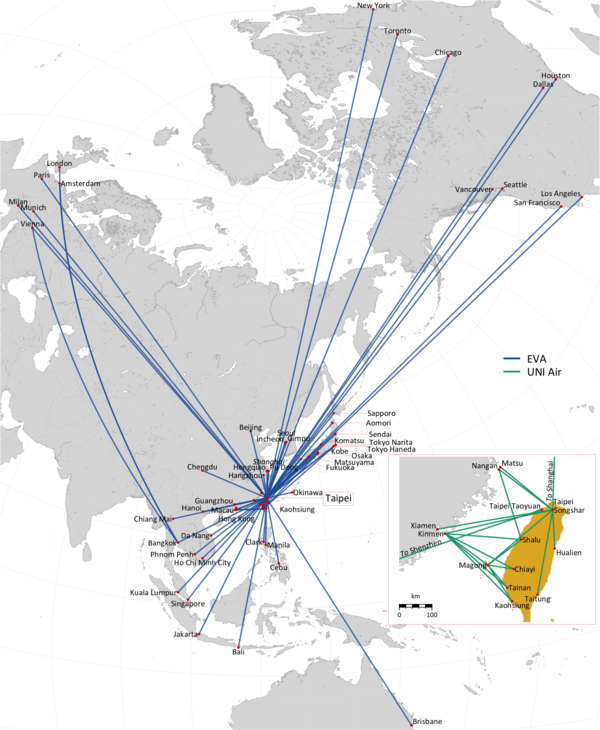
Great circle routes from the origin appear as straight lines.