Norwegian Reborn:
Another Chance
Sep/Oct 2023


Norwegian Air Shuttle was severely financially challenged even before the onset of the Covid-19 pandemic. The crisis pushed it into bankruptcy in late 2020 which allowed it to completely restructure its fleet, network and balance sheet, and redesign its operating model and strategy. It has emerged as a leaner and simpler airline. In a recent research report, Barclays' veteran analyst, Andrew Lobbenberg, highlighted the attractive position posed by its reincarnation.
The old Norwegian: downed by high growth, long haul and complexity
Norwegian Air Shuttle (NAS) was originally founded as a regional airline in 1993, in part acting as a feeder to Braathens SAFE. Following SAS’s acquisition of Braathens in 2001, it reinvented itself as a low cost airline in direct competition with the incumbent Scandinavian flag-carrier and expanded strongly (helped by its 2007 acquisition of Finnair’s Swedish LCC FlyNordic) to end the noughties as Europe’s third largest LCC behind Ryanair and easyJet, with a fleet of 57 737s.
In the following decade it embarked on a period of aggressive growth. In 2012 it announced the hitherto largest single aircraft order from a European airline: 22 737-800, 100 737-MAX8s (plus 100 options) and 100 A320neos (with another 50 options) — its first foray into the Airbus camp.
It also threw itself into long haul expansion, launching a long haul low cost service with a fleet of 787 Dreamliners.
At its peak in 2018, Norwegian operated a total fleet of 164 aircraft: 114 737NGs, 18 737MAX8s and 32 787s. Half of the fleet was leased.
Its growth ambitions were far too aggressive. Having made hefty market share gains in its home markets against legacy incumbent SAS, it had to find places to put the monthly deliveries of new aircraft. It pushed narrowbody aircraft into European markets beyond its natural Nordic base (where its brand was well regarded).
It established an operating base at London Gatwick, competing against the established (and lower cost) low cost UK airlines on the traditional sun, sea and sand routes to the Mediterranean; it opened a domestic Argentine airline, and set up an operation in the Caribbean making use of the freedoms in the US-EU Open Skies agreement to fly from Martinique and Guadeloupe to the US — by a strange quirk of colonial history, both islands are départements of France and therefore in the EU.
At the 2018 peak, Norwegian’s long haul operations featured routes from the Nordic capitals (as well as Bergen), London, Paris, Rome, Madrid and Barcelona to some fifteen destinations in the USA as well as Bangkok, Singapore, Dubai, Rio and Buenos Aires. It had built up a meaningful 6% share of the seats on the Atlantic — and briefly became the largest non-US airline serving New York. The airline was also a pioneer in using new generation narrowbody aircraft on the Atlantic, flying to small airports like Hartford CT, Providence RI and New York Stewart.
The management pushed the operating model further away from the KISS principle, creating an excessively complex business (for an LCC). It held multiple AOCs — in Norway, Sweden, Ireland, the UK and Argentina — (and even a Bangkok crew base) partially initially designed as an attempt to mitigate the high cost of employment under Norwegian regulations (and in the UK’s case to access route rights otherwise denied following Brexit).
But this reduced its flexibility to switch aircraft and crew between the separate operations with a negative impact on productivity. Its innovative employment strategies also engendered regulatory, competitor and union opposition when it attempted to expand operations into the US.
Until Norwegian started on this aggressive growth strategy the airline had been reasonably profitable: in the decade up to 2013 it had generated kr2.3bn in operating profits representing a 15% margin. But in the following five years to end 2019 it lost kr4.2bn at the operating level and kr4.5bn after tax while revenues more than doubled to kr43.5bn.
Norwegian’s incursion on the Atlantic, and especially from its base in Gatwick, even led IAG (aka British Airways) to consider acquiring it. IAG built up a near 5% stake in the company in 2018, but its offers of a takeover were rebuffed.
The airline had tried to change its growth strategy from the end of 2018 in order to return to sustainable profits and at the beginning of 2019 announced some restructuring efforts to help it to do so.
But then it was hit by the grounding of its 737MAX fleet in March 2019 following the Ethiopian and Lion Air crashes; it also suffered from reliability issues of the Rolls Royce engines on the 787s.
In July 2019, CEO Bjørn Kjos — the luminary behind Norwegian’s development and growth — bowed out of the group he had fostered.
The group had tried to shore up its liquidity — during 2018-19 it raised a total of kr5.4bn in new equity. But it ended 2019 with only kr3bn in cash — less than one month’s normal operating cash burn — and kr52bn in debt and lease liabilities: totally unprepared for the crisis of the Covid-19 pandemic.
Bankruptcy and Restructuring
When the pandemic hit, Norwegian furloughed 7,650 positions (80% of its staff), cancelled crew agreements covering 4,700 pilots and cabin staff, and parked all but seven of its aircraft — only 200 employees remained in operations. It slashed its monthly operating cash burn from kr3bn to around kr200m (excluding finance costs).
It was granted kr3bn state guaranteed loans, under condition of putting its finances in order. To do so, in May 2020, it reached agreement with lessors and bond holders owed a collective kr38bn (this included a kr3.3bn bond secured against its then valueless slots at Gatwick, but excluded kr22bn liabilities on its owned aircraft) for a debt for equity swap. The net impact of this along with a small public equity offering was to increase book equity by kr15bn, dilute existing shareholders by 95%, and boost cash to kr4bn. The company nevertheless reported a kr5.4bn loss for the first half of 2020 (and went on to register a kr24bn loss for the full year).
In November, with no further state aid forthcoming from Oslo, the group filed for bankruptcy protection, examinership and reconstruction in Ireland and Norway. It emerged some six months later with net debt of kr500m, kr6bn new equity, a much smaller fleet of 51 737s, the entire outstanding order book cancelled, and ownership costs on its remaining aircraft reduced by an average 35%.
New Norwegian — Back to KISS
Norwegian’s new business plan is a return to its origins in the noughties: a short haul low-cost airline concentrating on short- to medium-haul point-to-point, fast turnaround, high utilisation services within the Nordic countries and from there to sun, sea and sand destinations in the Mediterranean and Canaries, and city-break destinations across Europe.
The complexities of multiple AOCs have been abandoned — it retains two: one in Norway (in EFTA, but non-EU), one in Sweden (in the EU). with the fleet split between them. The tortuous outsourced methods of employing flight and cabin crew under the old business plan — originally designed to reduce the need to employ staff under onerous Norwegian and Swedish rules — have been brought back in-house (as has maintenance) and most of the staff are on Scandinavian contracts; although the company retains three bases in Spain (Alicante, Málaga and Barcelona) sharing a handful of aircraft to take advantage of lower labour costs of Spanish-domiciled crews. In 2024 it plans to open new bases in Palma de Mallorca and Riga.
One of the strengths of the original business model was the very home country: Norway is a very dynamic air travel market. The absolute population of around 5.5m may be low in relative terms, but there is a very high standard of living (income of $78,000 GDP per capita in purchasing power parity terms), the terrain is difficult and distances between population centres great. This creates a high propensity to travel by air: over five trips per head of population. Two of the trunk routes (Oslo to Bergen and Oslo to Trondheim, covering distances of 325km and 365km respectively) were the busiest routes in Europe in 2022.
Since emerging from examinership (the Irish version of administration) in 2021, the airline has rebuilt its fleet to a strength of 82 737s (including 17 MAX8s), and has negotiated a new order for 50 737MAXs for delivery from 2025. Given that the order was negotiated in the depths of the downturn, Norwegian probably got a very good price. The company is planning modest growth to 90 aircraft by 2024 and 110 by the end of the decade.
Strong Nordic market position
The new Norwegian is the market leader in Norway (see charts) with 32% of the capacity within, into and out of the country in 2022, well ahead of SAS’s 27%, and regional player Widerøe’s 13%. The position has since improved: Flyr, founded in June 2021 in an attempt to take advantage of Norwegian’s difficulties, didn’t last the course and filed for bankruptcy in January 2023.
In Sweden (twice the population and two thirds the number of seats) and in Denmark (5.8m population and two thirds the number of seats) it trails SAS’s 26-27% market share in second place with 14% and 16% — but still ahead of Europe’s largest airline Ryanair.
Fortunately for Norwegian its main Nordic competitors are particularly challenged. Its main rival, SAS, filed for bankruptcy in July 2022 in the US and is currently in the process of securing the equity to emerge from protection by the year end. It has struck a deal with a consortium led by Castlelake, the aircraft lessor and investor, to provide US$1.2bn in new equity, convertible debt and DIP refinancing: as members of the consortium the Danish State will have 26%, and Air France-KLM 20% of the new equity. SAS is focusing restructuring on reducing the size of its fleet, renegotiating employment contracts and aircraft leases. For SAS, the airline economic environment is far tighter now than it was when Norwegian went through its restructuring mid-pandemic: shortage of staff is adding wage pressures, and global shortage of aircraft, exacerbated by P&W engine problems, is pushing up lease rates. Both make it a challenging time for negotiations.
In Finland, Norwegian has a relatively small operation but with a 9% share is second behind Finnair. The Helsinki-based flag-carrier is particularly challenged by geopolitics. Its pre-pandemic strategy was to operate a hub in Helsinki connecting traffic flows from Western Europe to North East Asia and China — providing the most direct routes and shortest flights. But the closure of Russian airspace has removed any advantage it had, and it is being forced to shrink back.
Consolidating Norway
In July Norwegian announced an agreed takeover of domestic competitor Widerøe for kr1.1bn. Based in Bodø, and originally founded in 1934, Widerøe is Europe’s largest regional airline.
It has a fleet of 45 Dash-8s — ranging in size from the 39-seat 1/200s (optimal for steep approach and short runways), 50-seat 300, to the 78-seat 400 — and three 110-seat Embraer 190s for longer domestic and select international routes from secondary airports. In 2022 it generated revenues of kr5.7bn carrying 3.3m passengers and recorded an operating profit of kr80m. It appears that it has been consistently profitable, with operating profits in 14 of the past 15 years (it suffered a small operating loss of kr57m, -1.4% or revenues, in 2020) and average margins of 4.5% over that period.
The route network is largely complementary; Norwegian and Widerøe overlap on only 13 routes. Half of Widerøe’s flights, accounting for a third of its passengers, are on government-subsidised public service obligation (PSO) routes — largely covering tiny markets, and some with harsh and complex flight conditions, in north and northwest Norway. Its core business is a selection of commercial regional scheduled and charter services within the country — in total it has a 20% domestic market share.
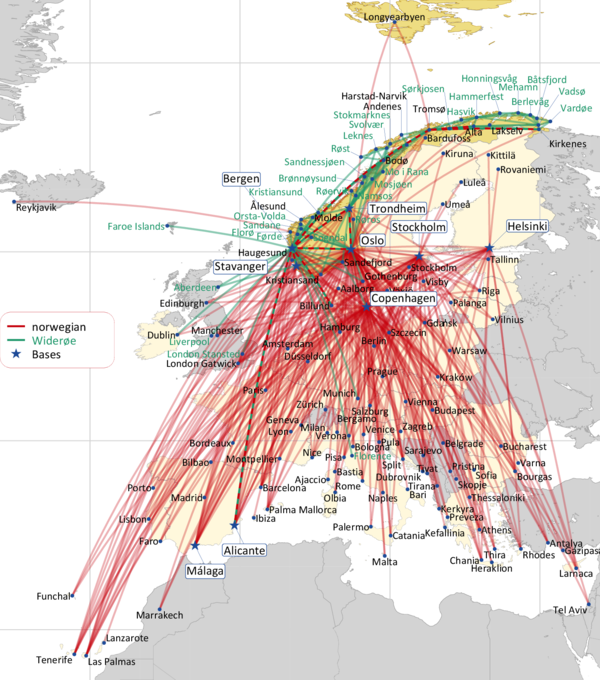
The regional carrier also has a ground-handling operation — the largest in Norway — located at 40 airports, serving 100 airline customers that in 2022 handled 14.5m pax and 330,000 flights.
Intriguingly, Widerøe set up what it calls an “air mobility business incubator”, Widerøe Zero, to look at electric aircraft — for which many of its routes should be suitable. It signed an MoU with Embraer’s Eve at the COP26 meeting in Glasgow, “to develop a new concept of operation where passengers will experience the future of electric transportation and a new model of sustainable mobility, connecting people living in a sparsely populated region and challenging geography”.
The plan for the acquisition is to keep the brands and operations separate. This appears sensible as the two airlines have completely different operating models, although Norwegian suggests that there will be opportunities for synergies. Among other things the management note that Widerøe’s operations have much lower seasonal variation; it has good business traffic; that there is the potential for “seamlessly connecting” regional Norway to feed onto Norwegian’s international flights from Oslo (76 destinations), Bergen (20) or Trondheim (10). The deal is subject to regulatory approval: and the regulator has asked for more time to consider the implications.
For the full year 2022 NAS reported an operating profit of kr1.5bn — but as more than kr2bn of this related to exceptional writebacks, it still suffered an underlying loss of kr604m. So far in 2023 the group reported underlying Q1 operating losses of kr886m little changed on the prior year, but Q2 saw profits of kr676m reversing losses in the same period of 2022. For the third, peak quarter, NAS reported a record quarterly revenue in its 21 year history, and the second highest level of profits (after Q3 2019) with an EBIT of kr2.2bn, more than double the prior year and showing a 25% margin. The company is guiding to a full year operating profit of up to kr2bn, which would allow it to publish its first annual profit since 2016.
It is possible that the newly rejuvenated Norwegian this time has a viable business model.
| bn kr | 2018 | 2019 | 2020 | 2021 | 2022 | @ end | Jun 2023 | Dec 2019 | |
|---|---|---|---|---|---|---|---|---|---|
| Revenues | 40.27 | 43.52 | 9.10 | 5.07 | 18.87 | Fleet and other fixed assets | 16.45 | 70.73 | |
| Net result | (1.45) | (1.61) | (23.04) | 1.87 | 1.01 | Current Assets | 4.52 | 11.51 | |
| Cash and equivalents | 9.35 | 3.10 | |||||||
| Operating cashflow | 0.46 | 3.04 | (1.39) | 0.14 | 2.43 | Total Assets | 30.32 | 85.34 | |
| Capex and investments | (8.56) | 8.33 | 2.66 | 0.22 | (0.80) | ||||
| Free cash flow | (8.10) | 11.37 | 1.27 | 0.36 | 1.62 | Debt and lease liabilities | (11.18) | (52.22) | |
| Net change in debt | 6.03 | (10.81) | (0.07) | (0.46) | (1.11) | Other liabilities | (2.86) | (4.97) | |
| Other financial flows | (1.50) | (3.35) | (1.96) | (0.74) | (0.45) | Current liabilities | (12.57) | (24.03) | |
| Equity raised | 1.46 | 3.96 | 0.33 | 5.86 | Total Liabilities | (26.61) | (81.22) | ||
| Change in cash | (2.12) | 1.17 | (0.43) | 5.03 | 0.06 | Shareholders’ funds | 3.71 | 4.13 |
| In service | Parked | Total | Δ v 2019 | Avg Age | On Order | |
|---|---|---|---|---|---|---|
| 787 | ↓37 | |||||
| 737-800 | 67 | 1 | 68 | ↓34 | 10.0 | |
| 737MAX | 17 | 17 | ↓1 | 1.8 | 50 | |
| 84 | 1 | 85 | ↓72 | 8.4 | 50 |
| In service | Parked | Total | Δ v 2019 | avg age | |
|---|---|---|---|---|---|
| DHC-8-100 | 20 | 3 | 23 | ↑1 | 29.1 |
| DHC-8-200 | 3 | 3 | 27.4 | ||
| DHC-8-300 | 3 | 3 | ↓4 | 24.9 | |
| DHC-8-400 | 13 | 3 | 16 | ↑6 | 14.9 |
| E190-E2 | 3 | 3 | 5.5 | ||
| 42 | 6 | 48 | ↑3 | 22.5 |
