Pegasus:
A Winged Wonder
Sep/Oct 2023


Pegasus claims to have transformed Turkish aviation. In the process it has established itself as Europe’s third ULCC and reported the highest level of profitability in Europe.
The specific elements of Pegasus’s low-cost model are:
-
A fleet of mostly A320-family aircraft, with growth plans of totally focused on the A321neo.
-
CASK was €¢3.36 (€¢2.13 ex-fuel) this year on an average stage length of 1,574km, compatible with Wizz.
-
Total traffic is expected to be around 33m passengers this year, about half of Wizz’s total and just 18% of Ryanair’s.
-
Its main hub is at Istanbul Sabiha Gökçen, and it is a genuine hub airport: unusually for a LCC, 25% of its traffic is connecting, half of this international-domestic and half international-international.
-
Other bases are at Adana, Ankara, Antalya and Izmir in Turkey, plus Ercan in Northern Cyprus.
-
The network consists of 95 international destinations and 36 domestic.
-
The sales message concentrates on low fares, in much the same way as Ryanair. There are no frills apart from a FFP (“BolBol” — abundantly, in English). All of Pegasus’s aircraft have a one-class configuration.
-
The airline is 57% owned by ESAS, a private Turkish investment conglomerate, which is believed to have assets of at least €30bn; in this respect it is similar to IndiGo and its Interglobe parent.
Pegasus’s CEO is Güliz Öztürk, one of the few female chief executives in the airline business (seven of the top 100 according to FlightGlobal) but currently one of the most high profile, a regular speaker at conferences and recipient of industry awards. She has been in aviation since 1999, firstly at THY, then joining Pegasus in 2005 when Aer Lingus sold its 49% stake to ESAS Holding, the private conglomerate owned by the (late) entrepreneur Şevket Sabancı and his family. In 2022 she replaced Mehmet Nane who moved to vice-chairmanship of the carrier.
Under Öztürk’s leadership the airline has emphasised its diversity and sustainability credentials. It has met its initial target for 25% female board membership and is working to improve its current 30% female participation in its workforce — the “Harmony” project. It has committed to Net Zero and has received accolades for sustainability financing initiatives and carbon emission disclosure. And all this on top of a globally leading financial performance.
Finances, inflation
and depreciation
Pegasus’s 2022 results were truly remarkable. It reported a net profit of €430.8m on revenues of €2.44bn, a margin of 17.8%; for comparison Ryanair’s net margin was 12.0%. This was twice the profit level of pre-pandemic 2019, and at the EBITDA level it achieved a 34% margin, which Pegasus claimed to be the best globally.
Pegasus attributed its success to the rapid recovery in traffic to Turkey (inbound tourism doubled in 2022 from 2021 to 45m visitors, back to the same level as in 2019), a very strong revenue environment and capacity shortages. In fact, unit revenue, measured in terms of total revenue per passenger averaged €90.90 in 2022, 61% up on 2019’s €56.60. Other European LCCs also experienced a post-pandemic surge in yields but not on anything like the same scale — Ryanair, for instance, saw a 14% increase in unit revenue.
Expressed in Lira per passenger, Pegasus’s unit revenue increase was even more more spectacular — 342% between 2019 and 2022. This hints at a problem for all companies that operate in Turkey’s extremely high inflation (over 80% in 2022) and rapid currency depreciation environment: distortion of accounts. Pegasus explains that its “functional” currency is the Euro because the Euro represents a significant proportion of its revenues and costs, and budgeting in carried out in Euros. However, the Lira is the “representational” currency under the legal framework. Translation between the Lira and the Euro and to/from the US Dollar and other currencies is made under various rules determined by the Central Bank, which we do not have the space to cover in this article (and even if we did have the space it’s very doubtful that we could explain them adequately).
Overall though, Pegasus emphasises the fact that the Lira has become less important in its operating cost structure, This change reflects Pegasus’s focus on growing its international services while allowing its domestic market share to slip.
In 2019, 71% of its revenues were in Euros or US Dollars (Pegasus attempts to peg its fares to the Dollar) and 26% in Lira; by 2023 the proportion had changed to 80% and 17% (3% others). Similarly, cash operating costs were 70% Dollar or Euro and 27% Lira in 2019; this year the split is 78% and 25%.
Turkey in recent years has been afflicted by a monetary crisis that threatened to derail the entire economy, undermining the progress made over the past 20 years. Under President Erdoğan real GDP growth had been strong, averaging about 5.5% pa, with the growth largely built on an infrastructure building boom fuelled by massive credit expansion. The most prominent project is the new İstanbul airport, İGA, which, with planned capacity for 150m passengers by 2027 and with eight runways, will be Europe’s, and maybe the world’s, biggest airport.
But when that economic expansion started to produce excessive price inflation Erdoğan overruled his central bankers, insisting on a policy of low interest rates plus various populist measures like boosting public sector salaries. The result was consumer price inflation almost becoming hyper, hitting annual rates of 80%-plus. Consequently, the Lira depreciated by 70% against the Dollar over the past three years while foreign capital fled the country. The depreciation might have been steeper had Erdoğan not implemented major, and sometimes covert, support for the Lira, as well as relying on new regulations designed to penalise companies for holding foreign currencies.
However, faced with a very serious balance of payments crisis, it appears that in September Erdoğan signalled a change in policy. Under a new head of the central bank, Hafize Erkan, incidentally also female, has started the process of rationalising Turkey’s monetary policy, implementing an increase in base interest rates from 8.5% to 30%. Whether she can maintain the new programme, which aims to reduce inflation to 8.5% by 2026, is of course uncertain.
This was the difficult politico-economic background for Pegasus as it managed to report record profitability and maximise its foreign currency holdings. The Borsa İstanbul appears to have appreciated Pegasus’s recent financial performance, though not quite as much as that of THY, which itself reported record net profits of US$2.7bn, a 14.7% margin, in 2022. At the end of October, the stock exchange was valuing Pegasus at the equivalent of €2.4bn, which compares to Wizz’s €2.1bn market cap on the UK stockmarket.
Meanwhile, the depreciation of the Lira continues to benefit the tourism sector by reducing the cost of Turkish holidays relative to the rest of the Mediterranean, resulting in a 20 % rise in foreign visitors in the first half of 2023. Pegasus recorded a similar, 21%, increase in passengers while unit revenue slipped back to €77 per passenger. The airline describes the market as “normalizing” after the 2022 surge, allowing it to reinstall its “habitual strategic focus”, which means concentrating on international rather than domestic growth; pushing up the load factor, which increased from 79.6% in the first half of 2022 to 82.7% this year, still low by European LCC standards; and driving ancillary revenues, up by 34% to €26.2 per passenger this year.
The balance sheet as at mid-year looks fairly solid, with shareholders’ equity of €953m against long-term debt of €2.95bn, almost all of which is in Euros or Dollars. Cash and equivalents stood at €908m, of which only 12% was in Lira.
| Jan-Jun | |||||||||
|---|---|---|---|---|---|---|---|---|---|
| FY (Jan-Dec) | 2019 | 2020 | 2021 | 2022 | 2022 | 2023 | @end June | 2023 | |
| Revenues | 1,739.5 | 629.9 | 1,024.6 | 2,449.4 | 774.1 | 1,099.7 | Fleet/other fixed assets | 3,819.6 | |
| Net result | 211.6 | (753.2) | (150.2) | 430.8 | (100.8) | 68.5 | Current Assets | 470.1 | |
| Cash and equivalents | 907.7 | ||||||||
| Operating Cashflow | 552.8 | 49.4 | 392.1 | 906.2 | 385.3 | 338.2 | Total Assets | 5,197.4 | |
| Capex and Investments | (88.4) | (42.8) | (291.7) | (332.3) | (83.7) | (84.6) | |||
| Free Cashflow | 464.4 | 6.6 | 100.4 | 573.9 | 301.6 | 253.6 | LT debt/lease liabilities | (2,946.0) | |
| Increase/(Decrease) in Debt | (291.5) | (170.0) | 83.2 | (523.5) | (245.7) | (216.7) | Current liabilities | (1,298.7) | |
| Currency Translation Effect | 2.0 | (65.9) | (108.7) | 3.9 | 23.8 | (1.3) | Total Liabilities | 4,244.7 | |
| Total Change in Cash | 174.9 | (229.3) | 74.9 | 54.3 | 79.7 | 35.6 | Shareholders' Equity | 952.7 | |
Fleet planning
and projected growth
Pegasus’s fleet planning is based on a long-term commitment to the A320 family. The original order was placed in 2012 and amended on several occasions, the last time in August this year when 36 A321 NEOs were added. Pegasus is the launch customer for the CFM-Leap engine, so it has avoided the problems associated with P&W’s GTF engines.
The fleet currently comprises 101 aircraft with 239-seat 78 A321neos on firm order. The schedule is for 16 neos to be delivered on average each year up to 2029, with the 737-800s and early A320 eos exiting. The official target is for a fleet of 151 A320/21neos by 2029, with an average seat capacity for the whole fleet of 223 against 191 in 2021.
| In Service | On Order | |
|---|---|---|
| 737-800 | 16 | |
| A320ceo | 8 | |
| A320neo | 46 | |
| A321neo | 31 | 78 |
| Total | 101 | 78 |
Although this equates to a seat capacity CAGR of about 11.5%, it is a relatively modest plan given the relatively low traffic base, and will probably be upsized. Öztürk has referred to 170 units by the end of the decade which would imply a 2029 traffic volume of around 65m passengers.
Still, a comparison (see chart) with Ryanair and, in particular, Wizz, shows Pegasus lagging well behind in terms of projected traffic volume.
Moreover, THY is expected to announce a mega-order, apparently delayed because of the various issues with new engines, for up to 600 aircraft — 400 narrowbodies and 200 widebodies. THY, through its lower cost unit, Anadolujet, is Pegasus’s single biggest competitor directly at Sabiha Gökçen, and indirectly at IGA, its global hub. THY plans to spin off Anadolujet as an independent LCC in 2024, having boosted its fleet of A320 family and 737-880s and MAXs to 88 from 70 currently.
Pegasus has almost no direct competition with the European ULCCs — Ryanair and Wizz — though it does to a limited extent with easyJet. Its main international competitors are the charter carriers, notably Sun Express, based at Antalya, Sabiha Gökçen and Adana, which is jointly owned by THY and Lufthansa, operating a fleet of 66 aircraft, mostly 737-800s and MAXs. The other important charter competitor is Corendon, also based at Antalya, operating a fleet of 737-800s and MAXs mostly to/from Germany.
The chart is a snapshot of estimated seat deployment in 2022 — roughly two-thirds international, one-third domestic. The largest single international market is Germany, 22%, unsurprising considering the huge Turkish diaspora in that country plus the predilection of Germans for vacationing on the Turkish Riviera or in the TurkAegean, as these resorts are now marketed, while Turkey itself is being progressively renamed Türkiye. Other Western European tourist-generating countries, the UK and Austria in particular, accounted for another 31% of Pegasus’s capacity. These traffic flows have proved to be very resilient but they have been affected by, for example, the attempted coup in Turkey in 2016 and the earthquake that hit Turkey and Syria this year.
(32m Seats, 2022)
Other significant markets include Israel, both for tourist flows and connecting traffic to Western Europe, but air connections between the two countries have been suspended following the Hamas massacre and Israel’s military response in Gaza. Turkey offers a transit possibility for Russians, and this has been a significant source of business for Pegasus.
Some 10% of Pegasus’ capacity is allocated to the Middle East and Central Asia, the most important markets being Egypt, the UAE, Iran, Azerbaijan and Kyrgyzstan. According to recent interviews with Öztürk, Pegasus plans to build up markets to the east of Turkey, partly to develop connecting flows from Europe, partly to exploit cultural and economic links in Central Asia, but in this the airline is restricted by traditional Air Service Agreements.
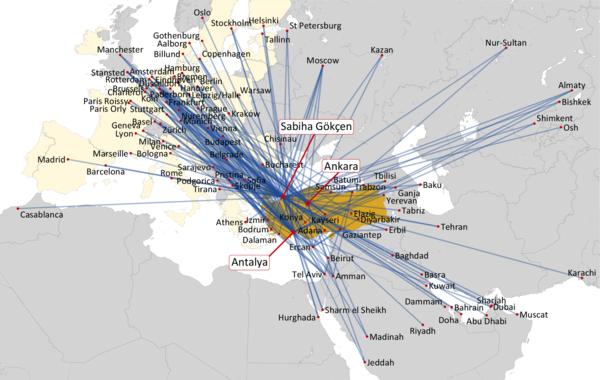
A solution might lie in establishing subsidiary or associate companies with separate AOCs in the Asian countries and in Eastern Europe. Poland, the Czech Republic and Romania have been suggested, which could provide Pegasus with the opportunity of operating intra-Europe (and competing directly against Ryanair and Wizz).
Pegasus has some experience in this field. In 2012 Pegasus bought 49% of Air Manas, an airline based in Bishkek, Kyrgyzstan, that operated 737-800s on a network between two domestic Kyrgyzstan cities and nine international destinations in India, Russia, Turkey and China. Unfortunately, Air Manas did not survive the pandemic and ceased operations in May 2022.
Much of the strength of Pegasus’ network derives from its hub at Sabiha Gökçen (named after Turkey’s first female fighter pilot — there is a theme here.) It is located 35km southeast of central İstanbul on the city’s Asian side and is operated by Malaysian Airports. This year throughput will be around the 35m mark, equally split between international and domestic passengers, which is right at the capacity limit. In November, a second runway was completed which in theory will double capacity, but the one terminal at the airport is close to its capacity limit. A new terminal is in the planning stage but will not open until late 2025 at the earliest.
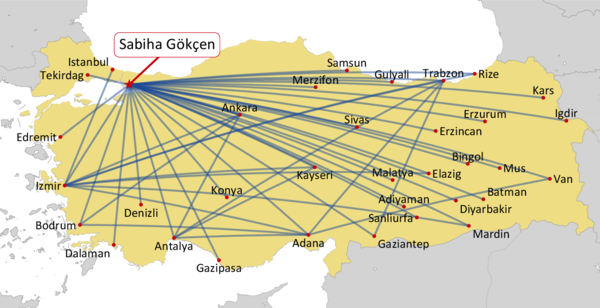
Pegasus’s position as the dominant force at Sabiha Gökçen has been reinforced as since 2019 as THY has focused on İGA, having moved its entire passenger operations from the old İstanbul Atatürk, leaving Sabiha Gökçen as a pure LCC/Charter airport, albeit with an important connecting role. Pegasus should be able to deal with the threat from the new Anadolujet as LCC spin-offs from full-service carriers are rarely effective. The charging structure at Sabiha Gökçen also favours Pegasus, in comparison to İGA which has some of the highest airport charges in Europe.
Pegasus also has the option of developing international services from its other bases. For example, in 2023 it has started up flights from Ankara to Moscow, Warsaw and Kraków, and from Antalya to St. Petersburg and Symkent (Kazakhstan).
Overall, the key strategic question for Pegasus is how it might expand beyond the Turkish market without jeopardising its powerful niche position.
