Wizz Air: Where now
for its bold plan?
Sep/Oct 2022

At the beginning of the pandemic we observed that Wizz Air had a bold plan: it would pursue growth aggressively, build its A321neo fleet rapidly and enter new markets where the incumbents were weak. It looked as if this could be a successful, that Wizz Air would emerge as a triumphant disruptor (see Aviation Strategy, May 2020), But when it published its Q1 results FY2023 (April-June 2022), the picture had changed for the worse.
Wizz Air was directly exposed to the repercussions from Putin’s invasion of Ukraine. Demand in central and Eastern Europe (CEE) Europe, Wizz Air’s home market, fell sharply, pushing RASK down by about 10% compared to pre-pandemic operations. In 2021 Wizz Air management made a decision to go to a policy of no hedging on fuel and currency, because it had lost out on its previous hedging positions. This proved disastrous when fuel prices surged and the euro weakened against the dollar. CASK rose about 40% compared to pre-pandemic.
In hindsight, no hedging looks reckless, but it should be remembered that in the past airlines like Ryanair and Southwest have taken major hits as the result of oil prices declining and exposing fully hedged positions. Wizz Air resumed hedging this summer using collar and cap derivatives — $982-$1130, compared to IATA’s estimate of the current spot price of $1140, but a concern is that Wizz Air has restarted fuel hedging at what may be the high point in the present oil price cycle.
The fall-out from the Ukrainian war and no hedging for Wizz Air was a net loss in Q1 (April-June) of €452m, 56% of revenues, albeit that €140m of this was a non-cash foreign exchange loss on capitalised leases. So it appeared that Wizz Air had gone from being a genuine ULCC threat to Ryanair to being another financially troubled airline.
However, Wizz Air has a very experienced CEO in József Váradi and is now supported by Robert Carey who has the title of President and is in charge of the network, revenue, ancillaries, digital and marketing teams. Mr Carey joined the airline in June 2021, after three years as CCO at easyJet and before that was a partner at McKinsey’s airline practice, where he no doubt gained experience of aggressive expansion strategies.
The carrier at least partly recovered the situation in the summer in that the reported loss for H1 was €384m, of which €285m was classified as unrealised forex losses. Passengers carried more than doubled to 26.5m compared to 2021, RASK was up 32% to €c4.48, partly reflecting increased fuel prices, and ex-fuel CASK was reduced by 5% to €c2.62.
Wizz Air divides the equity analysts, with target prices for its shares, which are quoted on the LSE and stood at around £20.9 at the end of October, ranging from £12.5 to £50.0. Or, in terms of market capitalisation, from today’s value of £2.15bn (€2.4bn) the airline could potentially be worth anywhere between £1.3bn and £5.1bn.
The bearish view focuses on Wizz Air’s balance sheet which at the end of September showed a negative net asset value of -€260m, a figure that is likely to have risen to around -€500m by the end of the current FY2023. With €4.7bn of long-term debt and lease liabilities on the balance sheet plus a heavy fleet delivery schedule, investors have shown some concern over Wizz Air having to raise fresh capital through an equity rights issue or a bond placement at a high interest rate.
| Year ending March 31 | 2019 | 2020 | 2021 | 2022 | 2023 H1 | at end | Sep-22 | |
|---|---|---|---|---|---|---|---|---|
| Revenues | 2.32 | 2.76 | 0.74 | 1.66 | 1.18 | Fleet assets (inc lease rights) | 4.47 | |
| Net result | 0.13 | 0.28 | (0.58) | (0.64) | (0.38) | Intangibles | 0.08 | |
| Operating Cashflow | 0.74 | 0.77 | (0.22) | (0.07) | 0.47 | Cash and short term deposits | 1.57 | |
| Capex & Acquisitions | (0.20) | (0.45) | (0.25) | 0.34 | (0.09) | Other current assets | 0.36 | |
| Other Investment Income (Expenditure) | 0.14 | (0.23) | 0.10 | (0.28) | 0.27 | Total Assets | 6.48 | |
| Free Cashflow | 0.68 | 0.09 | (0.37) | (0.01) | 0.65 | Long term debt | 4.58 | |
| Net increase (decrease) in debt | (0.34) | (0.10) | 0.62 | (0.32) | (0.24) | Other long-term liabilities | 0.10 | |
| Share Issues | -- | -- | -- | -- | -- | Other current liabilities | 2.06 | |
| Dividends & Share buy-backs | -- | -- | -- | -- | -- | Total Liabilities | 6.74 | |
| Total Change in Cash | 0.34 | (0.01) | 0.25 | (0.33) | 0.41 | Shareholders' Equity | (0.26) |
Wizz Air management at the H1 results presentation vigorously refuted the possibility of a rights issue: they could restore the balance sheet through post-pandemic profits. Moreover, liquidity was strong — €1.6bn in cash and near-cash at the end of September — and operating cashflow was positive — €470m in the first half of FY 2023 (see table). The company is one of the few airlines to enjoy an investment grade credit rating, affirmed earlier this year by Fitch, which a rights issue might jeopardise. And it could use the delivery programme as a source of cash (presumably because the total PDPs, which are calculated on the list price of new aircraft, would be in surplus when the airline took delivery at the discounted unit price Indigo Partners had been able to negotiate).
The virtuous growth story
Wizz Air is all about growth. Building on the mega-order placed by Indigo Partners in 2017, Wizz Air this year exercised options of 75 A321neos for delivery in 2028-29 as part of its plan to be a 500 aircraft company by 2030 (for comparison its fleet at the end of this year will be 173 A320 family aircraft while Ryanair currently operates 483 737s). Of the 304 firm orders 257 are A321 neos and 47 are for the XLR version.
With 239-seat A321neos replacing 180-seat A320ceos seat capacity will triple between 2023 and 2030 with an expected increase in passengers from 2019’s 40m to around 200m, which was Ryanair’s pre-pandemic target for 2025.
Wizz Air contends that the stream of new neos will continuously improve its unit costs. through the A321 neo’s fuel efficiency (16% better than the ceo) and through the increase in seats (59 more than the ceo). In terms of CASK Wizz Air currently estimates that it is a little below Ryanair; Ryanair measures competitiveness on ex-fuel operating costs per passenger and states that it is 30% below Wizz Air. Such is Wizz Air’s confidence in its growth that it has complained strongly about Airbus’s delays in delivering nine scheduled aircraft this year; given the scale of its losses the reduced deliveries might have been regarded as a relief.
The success of the growth strategy depends on Wizz Air getting on a virtuous circle: increased capacity, increased cost competitiveness, increased penetration into and stimulation of new markets, exploiting the fact that it has a guaranteed stream of new capacity whereas its biggest rival, Ryanair, has a potential orderbook problem (Aviation Strategy, August 2022). However, there are two issues.
The first goes back to the negative equity: can Wizz Air implement such an ambitious strategy with an apparently weak balance sheet? The capitalisation issue goes beyond liquidity. In Western Europe Wizz Air will be increasingly competing against very well capitalised competitors in Ryanair and easyJet and the state-supported Legacies.
If or when things go wrong will it be able to find additional finance at competitive terms? Wizz Air’s position is further complicated by the fact that its fleet is not owned, having been financed through sale and leasebacks, which have also generated working capital for the airline as the sale price from the lessor has generally been higher than the discounted purchase price from Airbus. Wizz Air is starting to rebalance its fleet financing through the use of instruments like JOLCOs (Japanese operating leases with a purchase option) but this is relatively small scale as yet.
The limits to opportunism
The second issue relates to Wizz Air’s network expansion into new markets in Western Europe and the Middle East.
Wizz Air divides its fleet into two segments to implement its strategy of what it describes as “choiceful expansion” :
-
The core fleet which is deployed in the established markets, mostly Central and Eastern Europe but also UK regional, which totalled 99 units at the end of October, just 4 aircraft more than in 2019.
-
The expansion fleet which accounted for 50 units in October, 39 units up from 2019. Approximately 15 of these additional aircraft have been deployed (not necessarily based) in the Italian market, 12 in Albania and other Balkan countries, 6 in London Gatwick, 4 in the UAE and 2 in Cyprus.
Wizz Air saw the pandemic as an opportunity to expand opportunistically, picking up slots at London Gatwick, penetrating the Italian market as Alitalia retreated into ITA, and replacing defunct carriers like Blue Air in Romania, a 737NG operator which carried over 5m passengers in 2019.
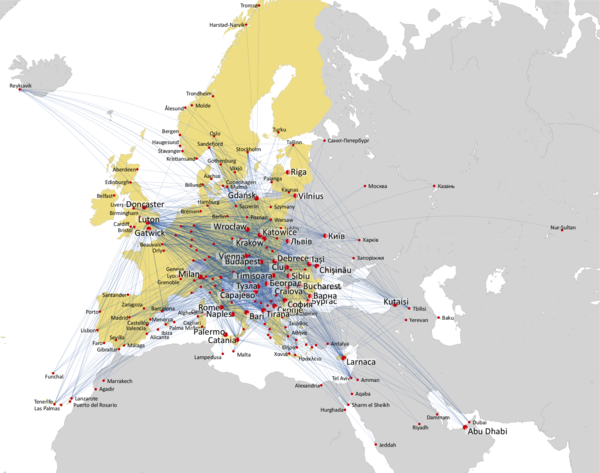
This opportunistic approach, which meant entering new markets with uncertain demand and, in many cases, offering low frequencies, soon found its limits, causing the airline to close some of its new bases in Italy and the Balkans. In an insightful interview with Simpleflying, Wizz Air President Robert Carey admitted that it had entered the Italian domestic market with a "fairly typical Wizz-type philosophy … to spread across many different markets and see what would work [but] last winter, there was a pivot towards focusing on a meaningful domestic presence rather than covering as many markets as possible.
“If you’ve got Ryanair and easyJet flying three times a day, and we’re operating four times a week, it just doesn’t compute. And so we [reviewed] the whole network last winter and basically said, ‘Look, we’re going to really focus on the markets where recently which we think can work, let’s get meaningful products’. So, a daily or multiple daily product in those markets. And we didn’t have more planes to just throw into it."
Putting the blame on Airbus is understandable but not totally convincing. How exactly can it achieve the critical mass in markets dominated by Ryanair and easyJet? Low costs don’t necessarily solve the problem, and Wizz Air seems already to have switched from a Ryanair-type yield-neutral management system to one that attempts to maximise revenue rather than load factor.
Arabian dreams
Longer term, the plan is to divide its ultimate 500-unit fleet as follows: 250 in its CEE home market, 125 in Western Europe and 125 in the Middle East.
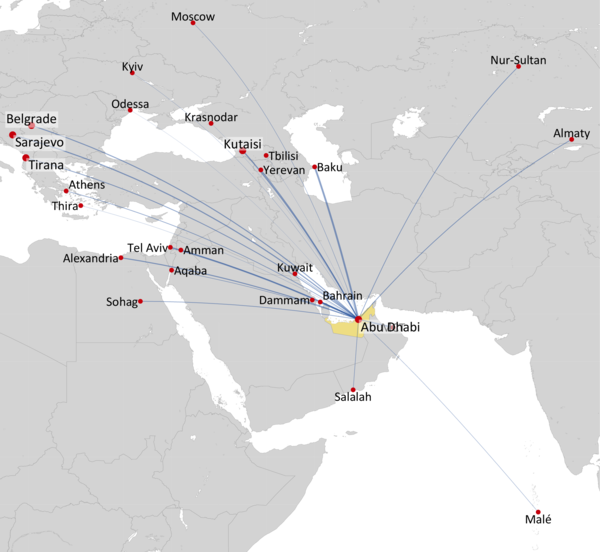
At present only the equivalent of four or five aircraft are allocated to Wizz Air Abu Dhabi. Wizz Air’s joint venture with the Abu Dhabi Developmental Holding Company (ADQ) was set up in 2020, and now flies to the Middle East (including Israel), Eastern Europe and Central Asia. The logic is a market of five billion within an 8-hour radius of Abu Dhabi and counter-seasonality — UAE travel tends to peak in the winter season. The potential is a fleet of 50-100 aircraft according to József Váradi. The reality is the politics of Middle Eastern aviation.
For example, this summer Wizz Air Abu Dhabi seemed to have found a golden route — Abu Dhabi-Moscow — one of the few gateways for Russians escaping Western embargos. Inevitably, there was an outcry in Europe and the service was cancelled, leaving Air Arabia Abu Dhabi — the joint venture between Air Arabia, the very effective Sharjah-based LCC, and Etihad — to take up the route with a daily service.
Abu Dhabi
Now Wizz Air’s great expectation is a similar joint venture in Saudi Arabia as part of that country’s hugely ambitious Vision 2030 strategy (see box). Saudi Arabia looks promising but is full of pitfalls.
Overall, the growth strategy may well still work out but success may also depend on structural changes — ie, mergers and acquisitions — in the European industry.
