Air India’s Karmic Re-birth
within Tata Airlines
Oct/Nov 2021


India is emerging from the pandemic with a partly restructured airline industry, but it is an industry with its finances in a precarious state and with many competitive issues to be resolved.
To provide an Idea of how hard India has been hit by Covid 19: official statistics, however questionable, for the two Asian super-powers show India to have reported nearly 35m cases and around 500,000 recorded deaths while China, officially, experienced only 100,000 cases and 5,000 deaths.
The Indian government responded by placing draconian restrictions on international travel and restricting domestic flights, closing down the entire industry for two months in 2020. Domestic traffic is gradually recovering — latest monthly figures (September 2021) show traffic to be up 75% on 2020 though still down 40% on 2019. International is still very depressed with travel only permitted in certain bubbles; the India-Singapore bubble has just been established.
No industry-specific financial support has been provided by the government. Instead, it reverted to bureaucratic type, imposing capacity limits on the airlines, which have just been lifted.
It also imposed a complicated series of fares rules, setting minimum price caps in order to ensure fair competition and maximum price caps to protect consumers, applicable to advertised fares over a 30 day period. This period had now been reduced to 15 days and should be abolished altogether by the end of the year.
The chart summarises the impact on the main airlines in the domestic market. Passenger volumes in the first nine months of this year were half those of 2019, with Go Air and SpiceJet being particularly badly impacted while IndiGo and Vistara appear relatively resilient.
The ownership structure of the industry has changed radically. Following Tata’s take-over in October of the national flag-carriers, the Tata group of diverse airlines — Air India, Air India Express (and Alliance, a small turboprop subsidiary), Air Asia India, and Vistara — has about in total 24% of the domestic market while IndiGo has reinforced its dominant position, with its share now estimated at 56%. The other two LCCs — SpiceJet and Go First (formerly Go Air) have 11% and 8% respectively. Other airlines, notably Jet Airways and Kingfisher, have largely disappeared, though new carriers — Akasa, an ULCC, and maybe a resurrected Jet — plan to enter the market.
The pie charts might seem to indicate a neat consolidation of the Indian airline industry. The reality is messier.
Tata reclaims Air India
The painful process of privatising Air India — the first attempt was in 2010 — concluded in October when the Tata Group’s bid for the flag-carrier was accepted ahead of SpiceJet’s, though the transaction will not be formalised until January next year, which leaves a slight possibility that the deal could still unravel. This means that Air India will return to the conglomerate that founded the airline back in the 1930s and whose Executive Chairman was the legendary industrialist, J.R.D. Tata until 1978.
The details of the transaction are that the Tata bid totalled ₹180bn ($2.4bn) for Air India and Air India Express plus 50% of the ground handling company jointly owned by Air India and Singapore Airport Terminal Services (SATS). ₹27bn of the purchase price is in cash, the remaining ₹150bn is the assumption of debt.
One of Air India’s many problems has been its bloated and sometimes intransigent workforce, although the government has made some progress in recent years in rationalising it. Tata will be obliged to take on 9,500 permanent employees and retain them for one year before offering voluntary redundancies; it also has to assume pension and medical liabilities for current and previous employees.
So what exactly has Tata bought? (In theory, it could have got Air France-KLM for the same price).
Air India’s financials pre-pandemic were distressed (and there are serious suspicions that its losses were understated). In the financial year to March 2020 Air India reported a net loss of ₹79.8bn ($1.0bn) on revenues of ₹285.2bn; its balance sheet showed negative equity of ₹374.6bn ($4.9bn).
The Air India fleet (not including Air India Express) comprises 125 units (of which 23 parked): 49 widebodies, including ageing 747s and 777s, and 76 narrowbodies, including 40 A319/320ceos. It has zero aircraft on order. Assuming that the aim is to merge Air India into a full-service operator with Vistara (see below), a substantial capital expenditure programme looks necessary, considering that Vistara itself has only four 787s and 24 A320s on order.
There is of course the brand, which is always worth more in the minds of politicians than its real market value, and the domestic and international slots, only a few of which have a monetisable value. The attraction of Air India to Tata probably lies in its long-haul network.
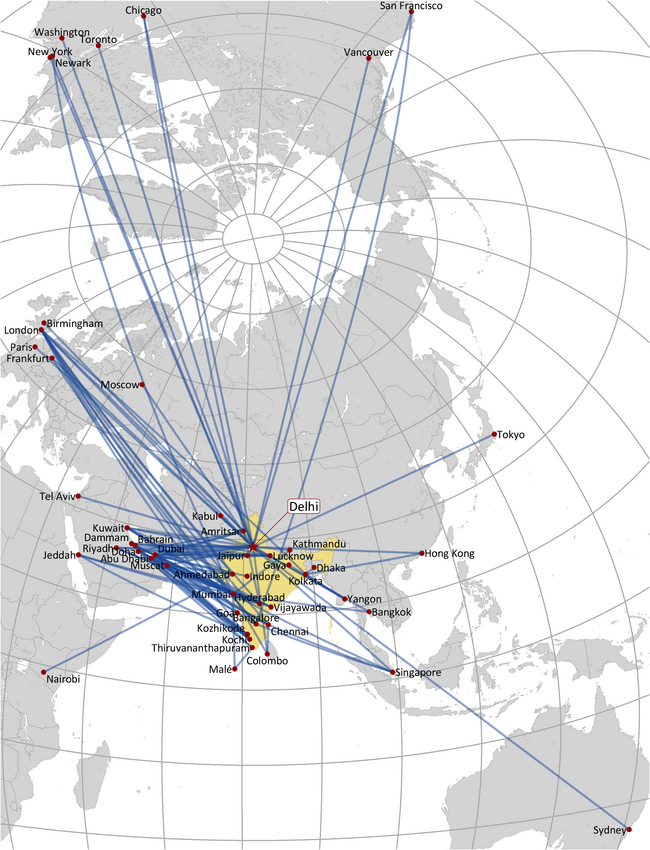
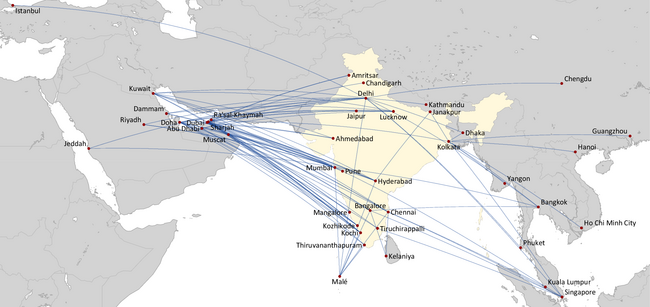
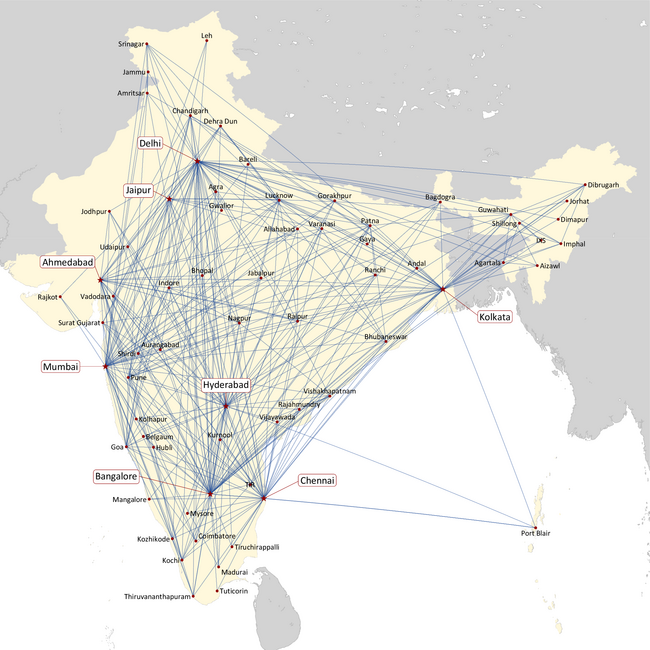
Looking at the map there are two parts to Air India’s international network — the dense medium-haul operation mainly to the Arabian Gulf and the long-haul network to the major cities of North America and Europe. The medium-haul operation is characterised by intense competition from the super-connectors and, increasingly, the A321neo/ 737MAX operations of the Indian LCCs — IndiGo, and SpiceJet — and the Arabian LCCs — Air Arabia, Flydubai, Jazeera, flyadeal, Wizz Abu Dhabi, etc. The longer-haul operation, with good proportions of high yielding business traffic and scarce slots at congested hubs, could offer Tata prestige and profitability in the post-pandemic world.
Air India failed to find an effective response to the rise of the super-connectors which accounted for the large majority of the increase in international traffic to/from India in the 2010s.
Disturbingly the Comptroller and Auditor General (CAG) in a damning 2018 review of the national carrier’s performance during 2012-16, when business conditions were relatively benign, revealed that nearly 70% of Air India’s losses were in the international sector rather than in the liberalised domestic market. All international segments were loss-making, the worst being North America.
Traditionally restrictive ASAs between India, European countries and the US, designed to protect the flag-carrier, played into the superconnectors’ hands enabling them to build up connecting traffic flows and channel them through their Middle Eastern hubs to Indian cities under comparatively liberal ASAs, signed before the likes of the UAE or Qatar had any aviation presence.
The pandemic may well have given a boost to long-haul point-to-point model relative to the connecting model, but to exploit the opportunity Tata faces some huge challenges.
Firstly, it has to radically change the corporate culture, ridding Air India of malign political, military and union influences. It may find that it has bought Air India in order to demolish it.
Then, it has to determine whether the Vistara model is the optimal replacement. In the process, Tata has probably got to build an IAG-type structure, accommodating a full-service airline (Vistara/Air India) and an LCC operation (Air India Express/Air Asia India).
Vistara: retro model
Vistara is a joint venture between Tata, with 51%, and SIA, with 49%, which started up in 2015, and is based at Delhi. The name is Sanskrit, apparently translating as “expansion without limits”.
Tata and SIA’s discussions on a joint venture date back at least 20 years and involved both countries’ prime ministers. Vistara emerged as a full-service airline, essentially replicating SIA’s product, but on a mostly domestic network. Despite the fact that the average stage length domestically is just 970km, Vistara offers a three-class product on all its flights: for example, the A321 is configured with 12 Business Class seats, 24 Premium Economy and 152 Economy. It promotes a quality brand, with fares to match, and emphasises its loyalty programme.
Its fleet size remains fairly modest, 48 units, mostly A320/21neos, with another 28 on order. Pre-pandemic the fleet plan was to reach 70 units by the end of 2023. International expansion was meant to be central to its strategy, but Covid restrictions have meant that its two 787-9s have been mostly limited to Singapore and, since last year, London. So far this year 97% of its passengers have been domestic.
Vistara seems like a throw-back to a previous travel era. Today no European or American Legacy carrier would offer three cabins throughout its domestic or intra-regional networks. The pricing strategy also seems retro — Vistara promotes full fares far in advance of departure dates and discounts at the last minute, the opposite of a typical LCC booking profile. Its 2019 average load factor was 83% compared to, for example, 93% at SpiceJet; for the first nine months of 2021 it achieved 64% against SpiceJet’s 75%.
Financial results for FY2021 (year to March) were very severely depressed by the pandemic — a reported net loss of ₹16bn ($208m) or 73% on its revenues of ₹22bn. But even in the previous, year, mostly untouched by Covid, Vistara lost ₹18bn, 38% of its revenues. Indeed the airline has been consistently loss-making since inception, necessitating equity injections from its parents, despite which its debt/equity ratio stood at 10:1 as at March 2020.
The pandemic frustrated Vistara’s plan of replacing Jet Airways on international routes when Etihad’s investment went bankrupt in 2019. Its full-service product would probably have worked on some of those routes, but persisting with it on short-haul seems odd.
So, it is difficult to see how potential synergies can be achieved by Vistara and Air India as the two airlines stand at present. Both require fundamental structural reform. And the attitude of SIA towards the Vistara/Air India amalgam is uncertain; SIA has been profoundly impacted by the pandemic and may be forced to rationalise its investment portfolio
What of synergies within the Tata Group? The Tata group is a microcosm of India — huge, sprawling, dynastic, dynamic, bureaucratic and ungraspable. Founded in 1868, it encompasses industries as diverse as steel making, motor manufacturing, IT, hotels and finance in India and globally (the organogram is a highly simplified picture).
Although still largely controlled by family trusts, there are 29 stockmarket-quoted Tata companies with a combined equity market valuation of around $250bn (about 30 times greater than IAG’s, for comparison). Each unit operates independently but the new Vistara/Air India could conceivably benefit from synergies from the hotel business and IT; and the financial muscle that Tata could exercise in negotiations with OEMs would be formidable.
There is also the potential to direct Tata customers to Tata airlines. HSBC in a recent research note highlighted Tata’s plan to launch a “super-app” which would enable customers throughout the empire to build up- air-mile points for use on Tata airlines. Further, such loyalty programmes are eminently monetisable in the current market.
Tata Low Cost
The take-over of the Air India Group has left Tata with two airlines — Air India Express and Air Asia India which it apparently intends to merge to form an LCC unit to operate beside the full service Vistara/Air India.
At first sight this seems to be logical link-up: in 2019 Air India Express and Air Asia India carried just 14m passengers between them, nowhere near the scale of the leading LCC IndiGo which carried 75m.
Because of the new joint ownership the integration process is projected to be smooth, according to Tata management who have brought in management consultants to manage the merger.
The problem is that the two Tata LCCs are niche operators with contrasting fortunes.
Air India Express is an almost purely international airline based at Cochin in the state of Kerala. Remarkably for a state-owned company, it has found a specialist role — transporting Indian workers to/from Kerala and the Arabian Gulf — and was consistently profitable in the years immediately before the pandemic. Its FY2020 results showed a net profit of ₹4.1bn ($53m) on revenues of ₹52.3bn. Its future depends on how quickly business in the Gulf recovers from the pandemic.
By contrast, Air Asia India was set up in 2013 as a joint venture between Tata (51%) and Air Asia (49%), the idea being to import the Malaysian LCC’s expertise into the Indian domestic market, but the JV has been consistently loss-making. It recorded a net loss of ₹8bn ($104m) in FY2020. For FY2021 (year to March), the airline is reported to have lost ₹15bn, somewhat more than its revenues of ₹14bn. Tata increased its stake in the airline to 84% in December 2020 and is in the process of buying out the remaining 16%. With its main base at Bangalore, the global IT hub, Air Asia India has just not achieved the scale to compete with the much larger LCCs, IndiGo and SpiceJet.
One of the issues facing Tata is that Air India Express is a 737-800 operator, with 24 units, while Air Asia India is a A320 operator, with 35 units. Neither carrier has aircraft on order, so, as with Vistara/Air India, if it is to the achieve the scale needed for a domestic LCC, Tata will have to place an order for new equipment. The alternative might be to buy one of the other Indian LCCs.
IndiGo: Purist LCC
IndiGo has firmly established itself as the sub-continent’s dominant airline, but it too is being severely stressed by the Covid recession. The main concern is over whether it has over-expanded.
IndiGo was established in 2005 by Rahul Bhatia, head of the InterGlobe tourism, air transport and technology conglomerate, and Rakesh Gangwal, who, among other achievements, was CEO of USAirways. Both have shares of about 37% in the airline. Despite rapid growth over many years, consistent profitability and a generous dividend policy, these two ageing, extremely rich gentlemen have fallen out and are engaged in a nasty court battle (which we frankly do not understand).
Traffic in 2019 was 75.0m, 91% in the domestic market, which put IndiGo in the top rang of global LCCs, but the net result was just above breakeven. Losses escalated to ₹58.1bn ($754m) in FY 2021, followed by ₹40.4bn in the April-September period of this year, pushing negative equity to Rp 44.6 on the balance sheet.
The CEO Ronojoy Dutta (appointed 2019, ex Air Canada and United) is unperturbed, pointing to the carrier’s management of cashflow and soundness of the business model. Indeed, IndiGo has adhered to a classic LCC model:
-
Single A320 fleet with high utilisation and maximum seating in all variants;
-
Point-to-point network but with tactical interlining alliances, the latest being with American;
-
No frills, but consistent service and high on-time performance;
-
Yield management through optimising the mix of demand-driven buckets on the assumption that the airline itself has no pricing power;
-
Building in a capital cost advantage through mega-orders.
IndiGo is one of Airbus’ most important customers; its orderbook stands at 559 A320/21neos, over twice the current fleet, and accounts for two thirds if the total Indian backlog.
indigo justifies the scale of its order book and scheduled deliveries by, firstly, emphasising its strategy of replacing CEOs with NEOs, so that by the end of 2022 it will be operating a exclusively NEO fleet. This implies returning 80 A320 CEOs to lessors or putting them up for sale, which seems ambitious in today’s fragile second-hand market.
Secondly, once borders are reopened IndiGo is poised for rapid international expansion, the target being to have 40% of its capacity on international routes by 2025. IndiGo will focus solely on operations of a maximum of 6-7 hours, attacking in particular traffic that flows over the Middle East hubs by offering direct A321 flights. Tata, it will leave to the longer-haul full-service markets.
| FY (end March 31) | 2019 | 2020 | 2021 | Apr-Sept 2021 | At End Sept | 2021 | ||
|---|---|---|---|---|---|---|---|---|
| Revenues | 298.2 | 372.9 | 156.8 | 41.7 | Fleet and other fixed assets | 233.0 | ||
| Net result | 1.6 | -2.3 | -58.1 | -40.4 | Current Assets | 116.1 | ||
| Operating Cashflow | 31.6 | 69.7 | -16.1 | -9.2 | Cash and equivalents | 68.0 | ||
| Capex and Investments | -25.4 | -45.7 | 32.0 | 34.2 | Total Assets | 417.1 | ||
| Free Cashflow | 6.2 | 24.0 | 15.9 | 25.0 | Long term debt and lease liabilities | 257.3 | ||
| Financing Activities | -5.9 | -24.1 | -17.7 | -16.2 | Current liabilities | 204.4 | ||
| Total Cashflow | 0.3 | -0.1 | -1.8 | 8.8 | Total Liabilities | 461.7 | ||
| Shareholders' Equity | -44.6 |
SpiceJet and SpiceXpress
SpiceJet suffered the double-whammy of being a 737 MAX operator and having to ground its fleet in 2019 before the pandemic struck.
It reported substantial losses through FY2019-21, but the situation really deteriorated this year. In the April-September period it lost ₹12.9bn ($168m), 46% of its ₹28bn turnover, which resulted in negative equity on its balance sheet ballooning to ₹38.6bn. Liquidity has become very problematic.
SpiceJet was the first of the low-cost new entrants back in 2004 but it has never been tightly focused on the LCC model as IndiGo. The main shareholder and CEO through most of its history has been Ajay Singh, an entrepreneur in various businesses including television, sport and PR.
He has had to use all his PR skills in negotiating with SpiceJet’s lessors where his airline has defaulted on payments, arguing that liquidity problems will be alleviated when compensation for the MAX grounding comes through from Boeing where it holds a firm backlog of 155 MAXes. Reports in November suggested that the compensation deal had been completed, just after the MAX was recertified in India. Curiously though, the compensation package from Boeing appears to include two 777-300ERs which SpiceJet intends to use on starting up a new long-haul operation, probably to the US.
The other element of SpiceJet’s liquidity raising involves the spin-off of its logistical and cargo operation, SpiceXpress. SpiceJet grew its cargo business by a factor of six in FY2021 compared to the previous year, wet-leasing in capacity to supplement its fleet of five 737SFs. Cargo revenues in FY2021 were ₹11.2bn ($146m) as against ₹40.5bn for passengers services, but cargo produced a net profit of ₹1.3bn ($17m) in contrast to the passenger loss of ₹11.4bn.
The idea is to transfer SpiceXpress to a new company that will be ring-fenced from SpiceJet’s liabilities, and raise new funding from existing and new shareholders. The value proposed by SpiceJet for the new SpiceXpress entity is ₹25bn ($325m). The problem is that lessors and other creditors are objecting to the transfer of certain assets to the new company.
| FY (end March 31) | 2019 | 2020 | 2021 | Apr-Sept 2021 | At End Sept | 2021 | ||
|---|---|---|---|---|---|---|---|---|
| Revenues | 92.6 | 132.1 | 61.2 | 28.0 | Fleet and other fixed assets | 80.2 | ||
| Net result | -3.2 | -9.3 | -10.0 | -12.9 | Current Assets | 28.8 | ||
| Operating Cashflow | 4.6 | 18.2 | 3.8 | 0.2 | Cash and equivalents | 3.1 | ||
| Capex and Investments | -1.5 | -1.6 | 2.1 | 0.0 | Total Assets | 112.1 | ||
| Free Cashflow | 3.1 | 16.6 | 5.9 | 0.2 | Long term debt and lease liabilities | 57.5 | ||
| Financing Activities | -3.6 | -17.0 | -5.9 | -0.1 | Current liabilities | 93.2 | ||
| Total Cashflow | -0.5 | -0.4 | 0.0 | 0.1 | Total Liabilities | 150.7 | ||
| Shareholders' Equity | -38.6 | |||||||
A wave of ULCCs?
The pandemic may have created another wave of new entrants — ULCCs.
Go Air announced its transition to the ULCC model by rebranding as Go First. It was the smallest of the 2005 wave of LCCs that entered the Indian market around 2005, but never found the scale of IndiGo or SpiceJet, and has generally struggled to break-even. It is, however, owned by the Wadia Group — smaller version of Tata, with equity of only about ₹540bn ($7bn), but it was founded earlier, in 1736
Go First has not yet revealed its F2021 results but in FY2020 it reported a net loss of ₹12.8bn ($166m) on revenues of ₹72bn. The balance sheet showed negative equity of ₹15bn.
Now the plan is to restructure as a ULCC and raise funds of ₹36bn ($470m) through an IPO, originally scheduled for the end of this year. Details are scarce on how Go First will effect the transition, given the barriers raised by Indian taxes on fuel and aircraft imports, and the lack of secondary airport infrastructure.
Akasa is a proposed ULCC start up founded by Rakesh Jhunjhunwala, an investor and stockmarket trader, reputed to be the Indian equivalent of Warren Buffett. Entering at what he assesses as being the bottom of the market, he announced an order at the Dubai Air Show for 72 737MAXes, with deliveries starting early next year and operational start-up scheduled for the summer of 2022.
Indian aviation is never dull.
| Widebodies | Narrowbodies | Turboprops | TOTAL | |||||||||||
|---|---|---|---|---|---|---|---|---|---|---|---|---|---|---|
| 747 | 777 | 787 | Total | 737NG | 737MAX | A319 | A320ceo | A320neo | A321ceo | A321neo | Total | |||
| Air India | 4 | 18 | 27 | 49 | 20 | 9 | 27 | 20 | 76 | 125 | ||||
| Air India Express | 24 | 24 | 24 | |||||||||||
| AirAsia India | 30 | 5 | 35 | 35 | ||||||||||
| Alliance Air | 19 | 19 | ||||||||||||
| Vistara | 2 | 2 | 6 | 7 | 30 | 3 | 46 | 48 | ||||||
| IndiGo | 80 | 128 | 43 | 251 | 31 | 282 | ||||||||
| SpiceJet | 51 | 13 | 64 | 32 | 96 | |||||||||
| Go First | 8 | 49 | 57 | 57 | ||||||||||
| Total | 4 | 18 | 29 | 51 | 81 | 13 | 20 | 134 | 239 | 20 | 46 | 553 | 82 | 686 |
| TATA Airlines | 4 | 18 | 29 | 51 | 30 | 20 | 46 | 62 | 20 | 3 | 181 | 19 | 251 | |
| Other LCCs | 51 | 13 | 88 | 177 | 43 | 372 | 63 | 435 | ||||||
| Widebodies | Narrowbodies | Turboprops | TOTAL | |||||||||||
|---|---|---|---|---|---|---|---|---|---|---|---|---|---|---|
| 747 | 777 | 787 | Total | 737NG | 737MAX | A319 | A320ceo | A320neo | A321ceo | A321neo | Total | |||
| Vistara | 4 | 4 | 21 | 3 | 24 | 28 | ||||||||
| Indigo | 204 | 355 | 559 | 19 | 578 | |||||||||
| SpiceJet | 155 | 155 | 155 | |||||||||||
| Go First | 95 | 95 | 95 | |||||||||||
| Total | 4 | 4 | 155 | 320 | 3 | 355 | 833 | 19 | 856 | |||||
| TATA Airlines | 4 | 4 | 21 | 3 | 24 | 28 | ||||||||
| Other LCCs | 155 | 299 | 355 | 809 | 19 | 828 | ||||||||