The Sudden Spotlight on Greenland
and its Flag-carrier
Nov/Dec 2025

Greenland is a fascinating country. It was discovered by Erik the Red, a fugitive from Iceland, in c985AD and given the soubriquet “Green”, an early example of positive deterministic branding.
It is the largest non-continental island in the world with a surface area of 2.2m km². It has a population of only 57,000, giving it a population density of 1 person per 36km² (if that ratio applied to New York City, there would only be 243 people living in the metropolitan area).
But it also has an ice sheet that forms the second largest body of ice in the world (behind Antarctica) and which covers 80% of the island. 3km deep at its thickest, it is 2,900km long and 1,100km broad at its widest, and is estimated to contain 2.9m cubic kilometres of ice (2.7 million billion tonnes).
If the whole ice sheet were to melt, it is estimated that global sea levels would rise by over 4 metres. Largely stable for thousands of years, the ice cap started shrinking noticeably from 1995. In 2025 it is estimated to have shrunk by a further 120bn tonnes.
The capital city, Nuuk, is home to a third of the population; the remainder live in around 70 small towns and settlements, mostly on the south and south west coasts. There are no roads connecting towns and settlements — except for the 5km between Ivittuut (an abandoned mining town near Cape Desolation) and Kangilinnguit (a former Danish military base, population 3); and, currently under construction, a 6km stretch connecting Qaqortoq to its new airport, both due to open in April 2026. There is a subsidised ferry service (just one ship) plying connections between settlements along the south west coast from April to December.
Air transport is essential
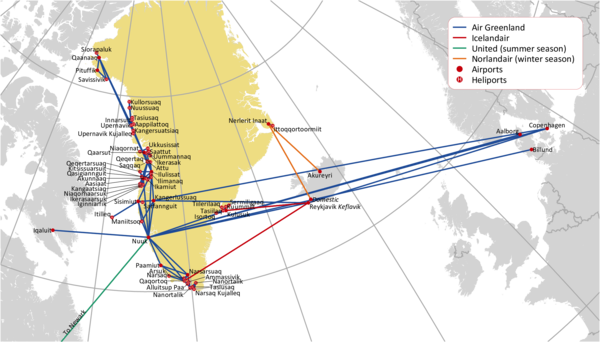
The country has 13 airports and 45 heliports. Some airports have no road connections to the population they serve and require helicopter transfers.
One such is Nerlerit Inaat (Constable Point) which provides access to Ittoqqortoormiit 40km away (population 325), the only settlement on the east coast Scoresby Sound. Described as one of the remotest villages on earth — the nearest neighbouring settlement in Greenland is Kulusuk (pop. 241) over 800km away — it nevertheless has a small guest house for adventurous tourists who want to experience the whales, seals, walruses, narwhals and arctic foxes (and the increasingly aggressive polar bears). Air Greenland provides the Helicopter link, but the only flights from Nerlerit Inaat are to Akeyruri and Reykjavik in Iceland. There are no domestic air connections: it is seemingly totally isolated in Greenland.
For many years the main international airport was at Kangerlussuaq (pop. 399), some 300km north of the capital Nuuk. Originally built by the US Air Force in the 1940s (and operated as Søndre Strømfjord air base) it is one of the few airports on the island that could handle widebody jets and became the hub of operations for Air Greenland.
Pressure to improve access for the capital city led to a decision in 2016 to substantially rebuild the airport at Nuuk. Originally constructed as a STOLport in 1979, the runway was extended to 2.2km (from 950 metres) and a new terminal building built. Air Greenland moved its hub of operations to Nuuk in November 2024.
There are two other new airports currently under construction and due to open in 2026. Ilulissat (pop. 5,000), a popular tourist destination 560km north of Nuuk, is getting a new terminal and 2.2km runway allowing it to operate as a new international airport (and converting the old 900 metre runway into an access road) that is scheduled to open in October. Qaqortoq (pop. 3,055), the largest city in South Greenland is getting a new regional airport planned to open in April, with a new 1,500 metre runway to replace its heliport and the airport at Narsarsuaq (pop. 150), a former US air base that had previously acted as its gateway. There are also plans to provide Ittoqqortoormiit with its own new airport, removing the need for the helicopter shuttle.
Tourism trends
Greenland’s tourism industry is relatively small by world standards, but growing. In 2024, Visit Greenland (the government agency responsible for promoting inbound sustainable tourism) estimates that there were c150,000 foreign tourist visitors, and that the tourist industry contributes nearly 5% of GDP, and employs 6% of the working population. It has an ambitious plan to double tourist arrivals over the next ten years, targeting the adventurous and eco-conscious traveller, extolling the unspoilt natural beauty of the country, Aurora Borealis displays in winter, midnight sun in summer, dog-sled hikes and arctic fauna.
Two thirds of tourists came on cruise ships. This sector has ballooned post-pandemic: the 95,000 welcomed in 2024 were 24% higher than the numbers for the previous year and more than double the previous peak of 47,000 in 2019. The agency’s report for 2023 show that passengers from the USA dominated representing 44% of the total, closely followed by visitors from Germany, the UK, Canada and Australia. Roughly half of the 183 cruise sailings in 2023 were on relatively small ships with capacity of less than 250pax. Visit Greenland noted that on the occasion that two or more cruises docked at a settlement the town could be overwhelmed: eg on one day in Aug 2023 Ittoqqortoormiit (pop. 334) saw three ships dock to disgorge 522 passengers; Qaqortoq (pop. 3,055) received two with a total capacity of 4,377 passengers.
Air travel accounted for the other third of visitors. Two thirds of the foreign visitors in overnight accommodation came from Denmark; the next largest cohorts coming from the USA, Germany, the UK and Iceland.
The opening of the new international airport in Nuuk, and of those in Ilulissat and Qaqortoq will help. United initiated a twice-weekly flight from New York to Nuuk for the Summer of 2025; SAS and Icelandair provide connections from Copenhagen and Reykjavik. There have been some press comments suggesting that Trump’s second term has ironically led to a further strong boost to inbound tourism in 2025.
Air Greenland
Founded in 1960 (as Grønlandsfly) by SAS to serve the American air bases, Air Greenland is the country’s flag carrier (and only airline). Up to 2019 ownership was shared between the Greenlandic Government (37,5%), SAS (37.5%) and Denmark (25%). In that year the Government of Greenland bought out its co-shareholders to take full control, considering ownership of the company to be of critical importance for “coherent air transport in, to and from Greenland”.
In addition to scheduled flights to Denmark (Copenhagen, Billund and Aalborg), Iceland (Keflavik) and Canada (Iqaluit), it operates a route network to Greenland’s 13 airports and 45 heliports.
It also handles extensive chartered special tasks including long line helicopter slings, heli-skiing operations, air ambulance services (medevac), SAR (search and rescue) ad hoc and on long-term contracts.
Air Greenland also owns a 39% stake in the Icelandic charter carrier Norlandair, based at Akureyri and operating a fleet of three 19-seat DHC Twin Otters and three nine-seat Beechcraft B200s. It is said to be profitable, producing a 6% operating margin on revenues of DKK125m in 2024.
In addition it owns Ilulissat-based Arctic Hospitality Corporation which operates Arctic Hotel (Greenland’s only four-star “Superior” hotel, with its unique “Northern Lights Cabins”, as well as a five-star conference centre) and World of Greenland (an in-bound tour operator that aims to deliver the customer’s “reason-to-go”). The latter is primarily focused on the sale, operation and development of the company’s lodges — Glacier Lodge, Igloo Lodge (giving guests the opportunity to experience the Greenlandic winter “in the best way”), and Ilimanaq Lodge (which combines an authentic Inuit experience with gastronomic pampering).
The many different operational tasks result in a complicated organisation, fleet and sets of regulations. The company describes itself as having the most complex AOC in Europe. It does not help that flight operation conditions in Greenland can be extremely hazardous: sudden, severe weather shifts, intense winds, foehns, blizzards, fogs, intense cold (record low for the northern hemisphere of -69.6°C recorded in 1991) and aircraft icing, let alone turbulence from the mountainous icy terrain.
It has a small fleet of ten fixed-wing aircraft and 18 helicopters. Since 2019 it has replaced its 25 year old A330 with a brand new A330-800, upgraded its Beechcraft air ambulance, and replaced its entire helicopter fleet with new Airbus H155s for domestic passenger services, H255s for search and rescue operations and H125s for charter, medical and survey work.
| Seats | In service | Avg age (y) | Future | |
| Fixed wing | ||||
| A320 | tba | 1∗ | ||
| A330-800 | 305 | 1 | 3.2 | |
| Dash 8 | 37 | 8 | 28.7 | |
| Beechcraft B250GT† | 8 | 1 | 6.5 | |
| 10 | 23.9 | |||
| Helicopters | ||||
| Airbus H155 | 12 | 7 | ||
| Airbus H225‡ | 6§ | 2 | ||
| Airbus H125 | 5 | 9 | ||
| 18 |
Notes: ∗ Due end 2026; † Air ambulance on permanent lease to health service; ‡ Search and rescue; § Can carry 19 pax, normally configured for six stretchers
The backbone of the domestic fixed wing fleet are the eight aged Dash 8s — for which there is no realistic replacement. But to take advantage of the opening of the new airport in Ilulissat the company will be taking delivery of a new A320neo for services thence to Copenhagen in 2027.
Perhaps surprisingly, Air Greenland has been profitable — and even during the COVID-19 crisis years. In the first year of the pandemic, passenger traffic dropped by 30% year on year, revenues dipped by 20% and profits fell by 60%: but the company remained profitable. By 2023 passenger traffic was 25% higher than the previous 2019 peak. Indeed the results for 2021 showed its highest level of profitability in nominal terms and ratios: a 13% operating margin and 10% at the net level net. In 2022 and 2023, operating margins turned out a more normal 5-6%.
2024 proved a little more challenging. Revenues increased, but profits slumped by 23%. Firstly there was the costly disruption of moving its operations to the new airport in Nuuk. Secondly, it encountered a higher level of weather related disruption to flights than normal (Air Greenland prides itself on covering food, hotel and rebooking costs for all its passengers): it noted “irregularity” costs exceeded DKK100m. In its annual report the company was hopeful that these irregularity costs woule come down in 2025 “provided that Nuuk Airport can be kept open and is not affected by slippery runways and that the morning fog in the summer does not disrupt flights”.
And then both of its H225 search and rescue helicopters developed engine problems requiring unexpected and heavy maintenance costs. Airbus and Safran apparently claimed that the “special sand conditions” around Kangerlussuaq (where they were based) “destroyed the engines”. Air Greenland plans to move the helicopter base to Ilulissat when its new airport and runway open.
Air Greenland’s problems continued into 2025. For the first half of the year revenue was up 3% mostly driven by international passenger traffic, but operating losses increased to DKK (76)m from DKK (14)m in the prior year period. Poor runway conditions and adverse weather significantly disrupted operations: it had to cancel 59 jet flights compared with three in the first half of 2024; the fixed wing completion rate fell to 72% from 84%; on time performance was a mere 46% down from 71%. Direct “irregularity costs” rose to DKK71m from DKK37m.
Possibly the greatest disruption arose from the teething problems related to the move to Nuuk Airport. Passenger and feeder flights between Nuuk and the old hub at Kangerlussuaq are no longer needed, reducing the number of international transfer passengers by half. The remaining passengers on the network are flying 50% further, primarily those connecting from Northern Greenland having longer flights to Nuuk than to Kangerlussuaq previously. The company states that these longer flights have not fully been reflected in ticket prices. When it published the half year figures, the group expected that it would post a full year pre-tax loss of DKK (30)m.
Since then further teething problems emerged at Nuuk airport. Persistent staff absence in passenger security (blamed by some on the deer hunting season) caused some annoyance and cancellations in the late Summer. But then in September, under instruction from the Danish Transport Authority, Greenland Airports introduced restrictions on movements in the airspace surrounding Nuuk.
Currently the upper airspace (above 6,000 metres) is controlled by ATC centres in Canada and Iceland handling international flights between North America and Europe. The lower airspace under that flight level had been uncontrolled — meaning that pilots were responsible for maintaining safe separation from other aircraft, based on information from the Danish Flight Information Center Naviair.
Greenland Airports in December announced that it is finally getting around to introducing a terminal control area (TMA) in the lower airspace around Nuuk, where air traffic controllers manage traffic before aircraft are handed over to the airport’s flight information service closer to the airport. It expects the TMA to be operational by summer 2026.
In the meantime, the airport is limited to a maximum of four movements an hour on a “2-4-4” model: a maximum of two arrivals, four departures and four operations in total. In addition there has to be at least five minutes separation between aircraft movements, and 20 minutes between two arrivals, and no more than one helicopter operating within 20km of the airport. (Search and rescue and air ambulance services are exempted.)
This regime severely upsets Air Greenland’s domestic and feeder network. Before the restrictions its Dash-8 aircraft could depart early from their home bases, arrive collectively in Nuuk, and create coordinated connections to transatlantic flights and regional destinations: it had been operating eight flight operations an hour in connection with its flights to and from Denmark.
It looks as if 2026 is also going to be an unprofitable year. But that will hardly matter if President Trump follows through on his threat/promise to spend hundreds of billions of dollars to purchase the island.
