Southwest and Elliott:
Brutal Activism
May/Jun 2024


For the CEO of a publicly quoted company, it’s an unpleasant experience to find out that an activist investor has taken a substantial stake in your company. When the activist investor turns out to be Paul Singer’s Elliott Management, their day is really ruined.
This is what has happened on June 14 to Southwest’s CEO, Bob Jordan, who received a letter from Elliott stating that his airline had developed an “insular culture” and delivered “unacceptable financial and operational performance quarter after quarter”. Elliott had built up a holding of about $1.9bn in Southwest, equivalent to 11% of the airline’s market capitalisation of just over $17bn. Elliott claimed in the letter that the share price of a radically reformed Southwest, with a new top management team, would increase by 80% within the next year, bringing the market capitalisation up to about $31bn.
Elliott’s 11% makes it the single biggest shareholder in Southwest, but so far Elliott has received support only from Artisan Partners, owner of about 2% of the stock, out of the other institutional investors (see table). Interestingly, Berkshire Hathaway owned 14% of Southwest in 2019 before the pandemic made Warren Buffett change his mind again about the investability of US airlines and sell off his stake.
| The Vanguard Group | 11.0% |
| Capital Research & Management | 10.3% |
| PRIMECAP Management Co. | 8.4% |
| SSgA Funds Management | 6.7% |
| BlackRock Fund Advisors | 4.7% |
| T. Rowe Price Associates | 3.8% |
| Putnam Investment Management | 2.3% |
| Geode Capital Management | 2.2% |
| T. Rowe Price Investment Management | 1.9% |
| Artisan Partners | 1.8% |
| Total Above | 53.0% |
|---|
Employees own some 6-7% of Southwest through their long-established ESOP. Elliott has made an attempt to appeal to them, but they will be difficult to persuade given the contrast in the cultures of Southwest and Elliott.
Who is Elliott?
Founded in 1977 by Paul Singer, a New York lawyer, Elliott has grown into one of the largest activist funds in the world with an estimated $71bn of assets under management from its Florida headquarters. It has a well-deserved reputation for ruthlessness, even by the standards of this sector.
The 15-year Argentinian bond saga vividly illustrates the Elliott ethos. Back in 2002 Elliott held Argentinian distressed sovereign debt with a face value of $630m which it had bought at a deep discount (the price paid has been estimated as just $117m). Elliott refused the Argentinian government’s offer of 30 cents on the dollar and pursued the Argentinian government in courts in the US, Argentina and the UK, attempting to freeze government funds held overseas. Notoriously, it arranged for the seizure of an Argentinian naval sailing ship crewed by cadets in Ghanaian waters. The hapless sailors spent months marooned off the Ghanaian coast until a court liberated the ship. In 2012 Elliott won a New York legal case, with the court ruling that Elliott and others were owed $1.6bn. Elliott continued to pursue the Argentina government for this sum plus penalties, which caused the Argentinian government international finance markets to seize up. The bond payment became a major political issue, helping to bring down President Cristina de Kirchner. Her successor Mauricio Macri finally conceded to Elliott in 2017, after 15 years of dispute, paying the investment fund a reported $2.4bn. Recent Elliott raids have been less dramatic but have involved high-profile names: Samsung, SoftBank, Twitter, AC Milan football club, for instance.
Elliott’s criteria
Within the Elliott partnership, portfolio managers have to fulfil three criteria in order to start building a position in a target company:
-
The target company’s share price must clearly be undervalued, based on a financial and strategic analysis.
-
There has to be a pathway to releasing that value — for example, a break-up, a change in operating model, a new management team.
-
There has to be a strong case, an argument that will convince and bring in other investors and/or industry partners.
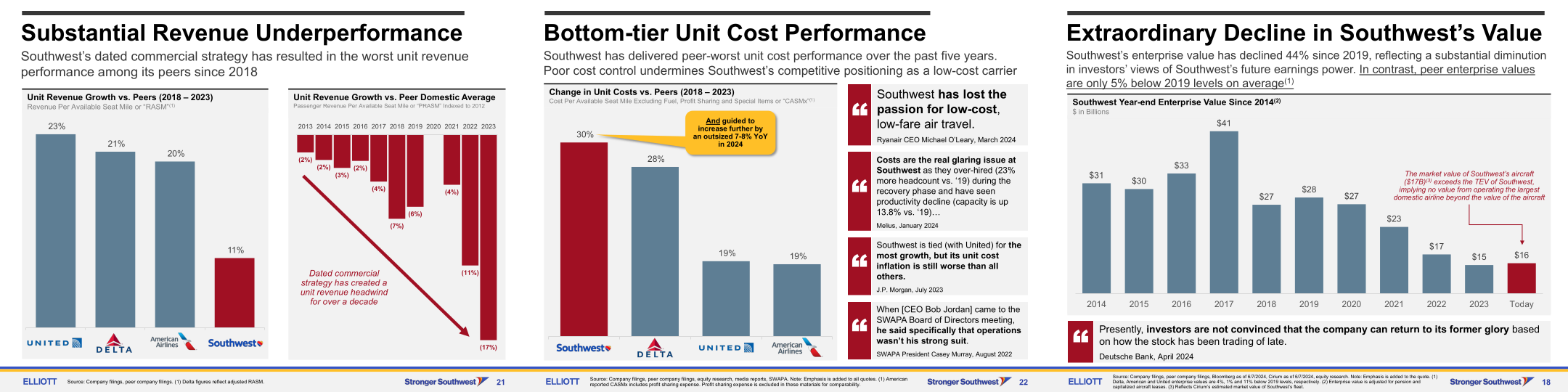
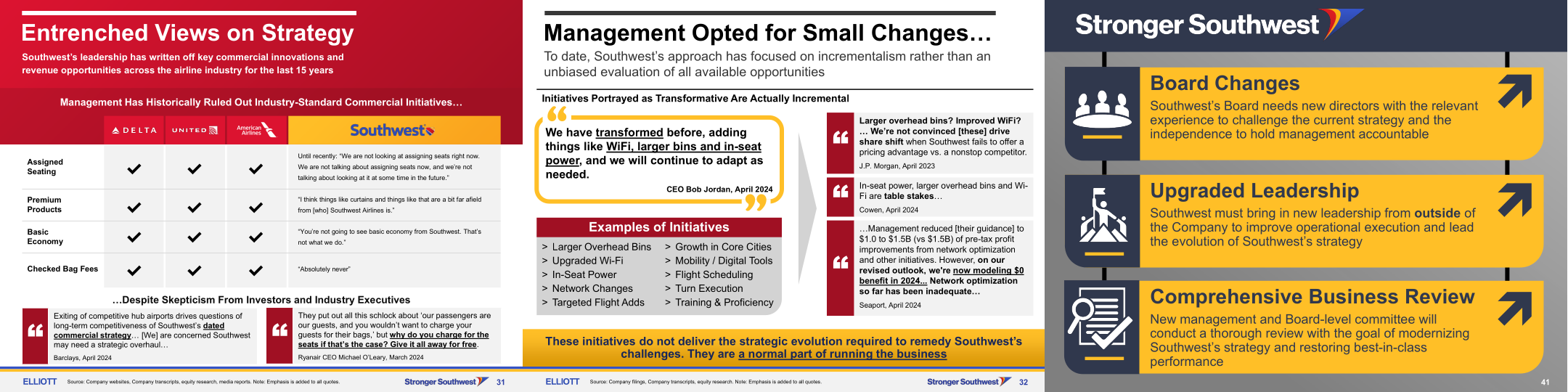
Elliott communicates via PowerPoint in the style of McKinsey. It has put together a slick deck titled “Stronger Southwest” (download here) which has a superficially compelling narrative: a once great airline which has completely lost its way, underperformed the rest of the industry and is severely undervalued; the solution is to sack the C-suite and the Board and bring in a new team to implement a new strategy.
Elliott’s basic interest is in making a profit through pushing up the share price, either through the success of changes it forces or through the defensive response of the incumbent management.
Southwest has an attractive balance sheet with a net asset value of $10.2bn as at the end of Q1 2024, and, critically, it also has $10.5bn in cash, which could be used for share buy-backs.
| FY (Jan-Dec) | 2019 | 2020 | 2021 | 2022 | 2023 | end March | 2024 | |
|---|---|---|---|---|---|---|---|---|
| Revenues | 22.48 | 9.05 | 15.79 | 23.81 | 26.09 | Fleet and Other Equipment | 19.56 | |
| Net result | 2.30 | (3.07) | 0.98 | 0.54 | 0.46 | Current Assets | 2.78 | |
| Operating Cashflow | 3.99 | (1.13) | 2.32 | 3.79 | 3.16 | Cash and equivalents | 10.52 | |
| Capex and Investments | (0.63) | (0.09) | (0.50) | (3.94) | (3.52) | Right of Use and Others | 3.16 | |
| Free Cashflow | 3.36 | (1.22) | 1.82 | (0.15) | (0.36) | Total Assets | 36.02 | |
| Financing * | (0.29) | 10.37 | (0.40) | (2.83) | 0.59 | Long term debt and leases | 9.96 | |
| Dividends/share buy backs | (2.37) | (0.64) | (0.43) | Current liabilities | 12.23 | |||
| Total Change in Cash | 0.70 | 8.51 | 1.42 | (2.98) | (0.20) | Taxes etc | 3.63 | |
| Total Liabilities | 25.82 | |||||||
| Shareholders' Equity | 10.20 |
The Southwest Board, having failed at being nice to Elliott, have now decided on a “poison pill” defence: if Elliott’s stake exceeds 12.5%, the other shareholders will have the right to purchase new shares at a discounted price. The Board are in effect relying on the other institutional investors to support its strategy against Elliott’s proposition by putting more cash into the airline. There is no guarantee of success; the investors might decide not to protect an underperforming management team or they might anticipate that Elliott will respond by offering an increased price for Southwest shares.
Certainly, Elliott has picked up on disaffection among the equity analysts who follow Southwest. For instance, Jamie Baker of JP Morgan Chase characterised the management’s tone at the Q1 2024 results presentation as “grim”, a description refuted by Bob Jordan.
Elliott quotes Deutsche Bank’s comment that “investors are not convinced that the company can return to its former glory”. Specifically, Elliott refers to the decline in the airline’s Enterprise Value (stockmarket capitalisation plus net debt), which it calculates as being currently $16bn (less that the market capitalisation, Southwest having negative net debt) as against $41bn in 2017. Elliott then compares this $16bn figure to a theoretical value of the fleet of $17bn (Cirium data) and reaches the questionable conclusion that the airline creates no net value from operating the largest domestic fleet in the US.
Elliott presents Southwest as markedly lagging its competition in terms of recent unit revenue and unit cost trends. But the comparisons it makes are with the Legacies — Delta, United and American — which have all benefited from the re-opening of the intercontinental markets post Covid as well as more benign competitive environment following the airline consolidation process. Elliott curiously ignores the competitive impact of the ULCCs on Southwest.
While Elliott focuses on the 20% decline in the share price over the past year, the two charts give a more nuanced picture of Southwest’s share price trends relative to pre-pandemic 2019. Compared to the Legacies, Southwest is somewhere in the middle, only clearly outperformed by Delta. Compared to the ULCCs — Frontier, Spirit and Allegiant — Southwest’s decline has been less severe. The other LCC, JetBlue, entangled itself in the failed attempt to take over Spirit, with the result that its share price has collapsed.
Long gone are the days when Southwest regularly produced industry-leading net margins of 20%-plus. In pre-pandemic 2019, despite the MAX problems, Southwest produced a net profit of $2.30bn, which represented a margin on revenue of 10.2% (better than the three main Legacies). But post-pandemic 2023 was disappointing — a net profit of $0.46bn, a 1.8% margin (worse than Delta and United, slightly better than American). With capex resuming, Southwest’s free cashflow was negative to the tune of $(0.36bn) which meant that the restored dividend of $0.43bn had in effect to be financed through borrowing.
The 2024 outlook is unpromising. Southwest has guided to a RASM annual decline of 4-4.5% for Q2, compared to 1.5-3.5% previously, while CASM could be up by about 7%, compared to zero change previously. Elliott jumped in with more criticism: “yet another example of the fundamental leadership change urgently needed at Southwest”.
The MAX situation
Nowhere in the presentation does Elliott examine the main external issue impacting Southwest since 2019 — the 737 MAX crisis.
A central tenet of Southwest’s operating model has been adherence since the beginning to a single aircraft type — the 737 — bringing economies in terms of crewing, training and maintenance, simplifying scheduling and route development decisions, and obtaining very favourable pricing and conditions from the manufacturer in return for exclusivity. However, as former CEO, now Executive Chairman, Gary Kelly put it when the extent of the MAX problems started to emerge in 2019: “This … illustrates the risk of having all your eggs in one basket”.
As of Q2 2024 Southwest had 495 MAXes on firm order, plus 199 options. At the beginning of this year, it had 85 deliveries scheduled 2024, but the current expectation is for just 46 units. The MAX 7, for which Southwest is the launch customer, will not be delivered until 2025/26. Consequently, the carrier has been forced to reduce the number of 737NG retirements this year from a planned 49 to 25 units.
This impacts directly Southwest’s ability to reduce its unit costs through increased fuel efficiency, lower maintenance charges and higher seat capacity. It has also damaged southwest’s marketing, partly because of the travelling public’s unease about this aircraft.
(As at end April 2024)
| MAX -7 | MAX -8 | Total | Options | |
|---|---|---|---|---|
| 2024 | 27 | 58 | 85 | 0 |
| 2025 | 40 | 19 | 59 | 14 |
| 2026 | 59 | 0 | 59 | 27 |
| 2027 | 19 | 46 | 65 | 25 |
| 2028 | 15 | 50 | 65 | 25 |
| 2029 | 38 | 34 | 72 | 18 |
| 2030 | 45 | 0 | 45 | 45 |
| 2031 | 45 | 0 | 45 | 45 |
| Total | 288 | 207 | 495 | 199 |
Culture: Luv lost?
Elliott are highly critical of Southwest’s “outdated” strategy, lambasting the top management for having no experience outside Southwest while at the same claiming that they have damaged the brand.
Southwest’s greatest asset has probably been its culture — efficient, friendly service at reasonable prices delivered by a dedicated, well-trained workforce — the LUV ethos that was established by the first two CEOs, Lamar Muse and Herb Kelleher. There is little doubt that that culture has become diluted since the 1970 and 80s perhaps because subsequent CEOs didn’t have the same charisma, nor focus on the fundamentals, as the originals. The Elliott presentation quotes Michael O’Leary as saying that Southwest has lost its passion for low cost.
Yet it is difficult to see how the Southwest culture could be improved by this opportunistic attack. Elliott strongly recommends new top management, but from where? Their analysis suggests that executives from full-service carriers are needed (assuming that MOL isn’t a candidate for CEO), but they are unlikely to have a deep understanding of the LCC model. Spreading content among workforces at target companies is not exactly an Elliott strength.
And despite the criticism, Southwest, the largest domestic US airline by passengers carried (172m in 2023) still has many admirers. In the standard airline consumer survey carried out this year by JD Power Southwest was placed top in the Economy/Basic Economy category, clearly ahead of the Delta, the best of the Legacies.
| Economy/Basic Economy | Score (Out of 1,000) |
|---|---|
| Southwest Airlines | 685 |
| Delta Air Lines | 651 |
| Allegiant Air | 633 |
| Alaska Airlines | 630 |
| JetBlue Airways | 630 |
| American Airlines | 611 |
| WestJet | 591 |
| United Airlines | 585 |
| Air Canada | 542 |
| Spirit Airlines | 507 |
| Frontier Airlines | 472 |
| Segment Average | 613 |
Strategies and Tactics
Elliott presentation tails off when it comes to the solutions (the “pathway” and “case” parts of its methodology). There are multiple references to assigned seating, baggage fees, premium products, items normally associated with Legacy or Network carriers. But there is no vision for a radically changed “Stronger Southwest” (unless Elliott is hiding its masterplan). Engineering a merger with another LCC or ULCC to create a new force in the US market was a remote possibility, but such a development is now impossible following the JetBlue/Spirit anticompetitive ruling (Aviation Strategy, March/April 2024).
So Elliott seems to be suggesting that Southwest should model itself on the three Legacies. But for Southwest to emulate these carriers, it would have to abandon its LCC operating model. Southwest has adhered to its point-to-point model throughout its evolution, characterised by using secondary airports wherever possible, rapid aircraft turns of 20 minutes or so, and intense rapid build-up of frequencies once it starts up a route.
The point-to-point model achieves economies through efficient rostering of flying and ground crew, and through superior aircraft utilisation — Southwest pre-pandemic generally achieved 1-2 hours more flying per aircraft per day out of its 737s over the narrowbody fleets of the Networks.
Yet a significant portion of its traffic, about 23%, is now connecting. This is particularly the case at its centrally located airports — notably Chicago Midway and Denver. Southwest manages to capture these traffic flows without compromising its operating model. Whereas Network carriers design waves of flights arriving and departing within narrow time periods, with inactivity in between, Southwest schedules for maximum aircraft utilisation, with the passenger self-connecting.
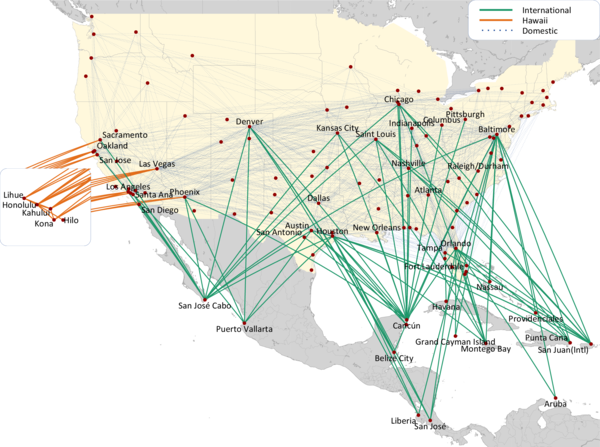
Southwest has a limited international network focused on the Caribbean, accounting for less than 4% of its total capacity. It could not build global intercontinental hubs like the three Legacies.
Without a radical new strategy, Southwest management continue to work on what are essential tactical questions — the culling of unprofitable routes (four cities have been closed this year and operations downsized at Atlanta and Chicago O’Hare); the possible introduction of some baggage fees; whether designating seating and marketing premium products is viable; how to reduce turnround times by five minutes. This involves detailed operational analysis, quantifying the pro and cons, then careful implementation to improve profitability (maybe accepting that the historic margins are no longer achievable).
Elliott’s intervention might help by shaking up complacent managers, but the activist investor’s only real interest is in the share price.
