Breeze: Creating the World's Nicest Airline
May 2022

Crises in the aviation industry can create opportunities for new airline start-ups and new business models. Breeze Airways, the latest offering from serial airline entrepreneur David Neeleman, started operations a year ago in the midst of the pandemic, with the differentiating aim of being “The World’s Nicest Airline”. Where is it now?
Neeleman’s plans for a new startup predate the pandemic, and were forged in 2018 for the creation of an airline initially called Moxy. (The name had to be abandoned in favour of Breeze apparently because of trademark issues, although Breeze retains the IATA code of MX and a MOXY call-sign).
The rationale was based on analysis of the domestic US market over the preceding ten years. As the major airlines consolidated, they concentrated their efforts at their fortress hubs, removing non-stop connectivity from smaller airports; Neeleman observed that “entire segments of the country have seen their air travel options diminish — reachable only through connections and the corresponding increase in travel times”.
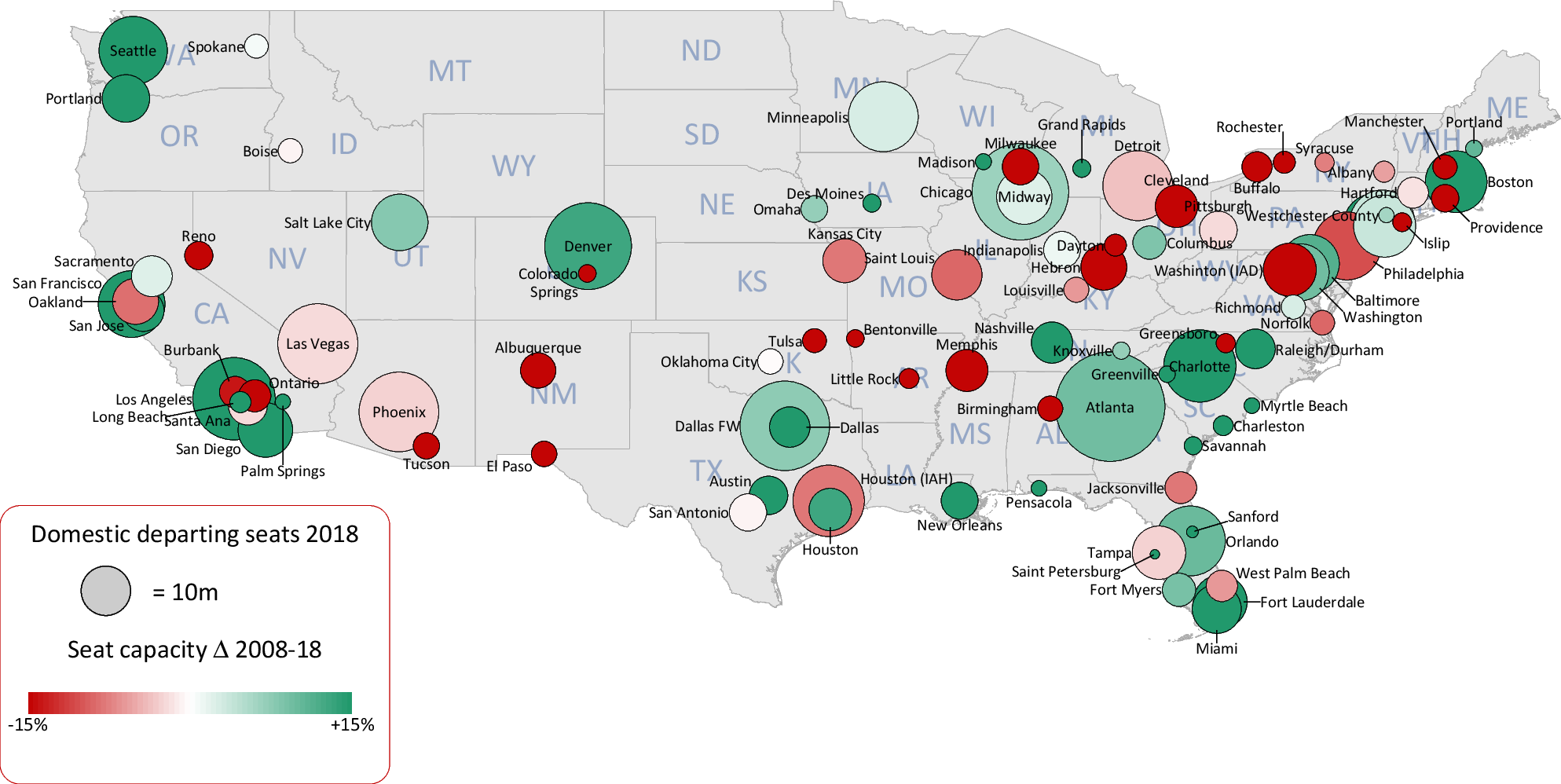
The map shows the impact on the top 100 airports in the US. Between 2008 and 2018, total domestic departing seats from these airports increased by 7.25%, or a compound average growth rate of 0.7%. For those that had been the top ten in 2008, including the mega hubs of Atlanta, Chicago, and DFW the growth had been 9.2% (an annual rate of 0.9%), although this masks declines at former hubs and bases such as Houston Intl, Phoenix and Las Vegas. The top 30 — those with over 9m domestic departing seats in 2008 — experienced overall growth of over 10% (a 1% CAGR), while the following 70 airports displayed no growth as a whole. Out of the top 100 airports, 21 saw total domestic departing seats decline by more than 15% over the period.
In its application to the DoT in 2020, Breeze set out that it would bring low-cost, non-stop services to mid-size markets “abandoned by our current air transportation network” and would do so by flying smaller aircraft with correspondingly low trip costs. Many of its initial target markets it described as secondary leisure markets that have “favourable costs for value conscious travellers or second-home owners” and ones that would “support once a day services or service a select few days of the week”.
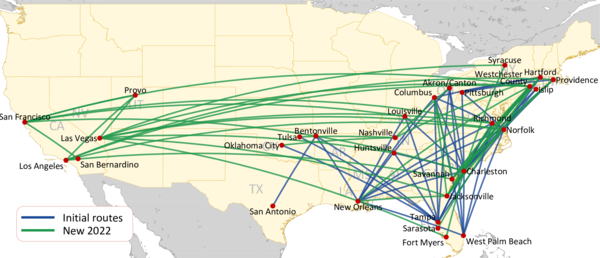
Breeze started operations in May 2021 with a fleet of 13 E190/195 aircraft (leased from Azul, another of Neeleman’s successful creations) operating between four airports: Tampa (FL), New Orleans (LA), Charleston (SC), and Norfolk (VA). It expanded relatively quickly to operate 42 routes between 18 destinations mostly east of the Mississippi on a north-south focus (see the routes marked in blue on the map).
The next phase of development is the introduction of A220s into the fleet. At the beginning of 2019 the company confirmed an order of 60 aircraft of the type from Airbus with 60 options (and has since confirmed conversion of 20 of the options to firm orders). The first A220 was delivered in December 2021, with deliveries averaging one a month up to 2028. In the spring of this year the company generated a slew of announcements of new routes to showcase the arrival of the longer range aircraft — including transcon services to Los Angeles, San Francisco and Las Vegas — to be gradually introduced throughout 2022 as the fleet grows.
As the chart shows, the majority of the destinations Breeze has chosen fit well into a description of small neglected markets.
Breeze inaugurated A220 services on the 25th May, just before celebrating its first year of operations, with a flight from Richmond (VA) to San Francisco.
Neeleman describes Breeze as “low-cost”. But like Neeleman’s two previous creations — Azul and Jet Blue — Breeze is a hybrid between a low-cost carrier and a traditional airline. It has a mixture of fleet types.
The offerings include some common LCC features, such as a point-to-point route network and fees for additional services. Its aircraft do not have in-flight entertainment screens in the seats, but instead, offer streaming content to personal electronic devices. It does not offer connecting flights, but does market “one-stop”. For example, a passenger buying a ticket from Provo (Salt Lake City) to San Bernardino (a route on offer later this year) would fly via San Francisco and stay on the aircraft on the ground during the turnaround.
It also operates multiple cabin classes. The E190s are configured with 108 seats: 60 at the back of the bus with 29″ seat pitch and 48 “extra leg-room” seats with a seat pitch of 33-39 inches. The E195s have 118 seats with 96 standard and 22 extra leg-room. Both Embraers are laid out on a 2x2 basis, which allowed the airline to advertise “no middle seat”.
It similarly markets two fare classes. The “nice” fare — which gives the passenger a standard seat and space to put a handbag under the seat, all other service options sold as add-on ancillaries — and the “nicer” fare — pricing in an extra leg-room seat, carry-on luggage and priority boarding.
With the A220s the company is adding a third class: a “first class” cabin of seats with 39″ pitch, and is adding a third fare category the “nicest” fare (which adds that seat and among other things two checked-in bags). It is currently establishing two configurations. The 126-seat version has 80 standard seats configured 2x3 at a 30″ pitch, 10 extra leg-room seats at a 33″ pitch and 36 first class seats laid out 2x2. The larger 137-seat version has only 12 first class, but 45 extra leg-room and 80 standard seats.
Neeleman explains that he regards the configuration of the aircraft as dynamic depending on seasonality and route. It seems that he regards the front cabin as a “playland” for experimentation, mentioning that he might one day introduce lie-flat premium seats (of which it could fit in 12). Breeze is also adding quick change functionality, helped by its decision not to provide IFE with the miles of associated cabling. He said: "In front of the [over wing] exit row, we have total flexibility. In a matter of days, we can go from 36 first class seats to no first class seats to domestic-style first class seats. We can have 36, 12 or zero premium seats in that cabin."
Breeze has only been operating for a year, and there is little public detail of the progress of the operation. Neeleman at the beginning of the year stated that the company had carried 330,000 passengers since launch. The DoT traffic filings suggest figures consistent with his comment but on load factors only in the mid-60s. The Form 41 financial filings only show Q4 2021 results with revenues of $19m and operating losses of $20m.
The model he is pursuing with Breeze seems similar to that of Allegiant, or another new entrant Avelo, in going after low frequency, and under-served leisure markets. But the big difference is his choice of the A220: a small capacity aircraft with good economics and a range that can cover the US and even be turned onto the Atlantic. David Neeleman is an aviation innovator, and in his career has created four successful airlines — Morris Air, WestJet, JetBlue and Azul — with his definition of success being broader than quarterly financial profits. It would be surprising if he were to fail with Breeze.