Lufthansa: Transforming from Sprawling Conglomerate to ... ?
June 2021

Despite having one of the healthier balance sheets as it entered the pandemic crisis, Lufthansa, Europe’s largest airline group, was laid low by Covid-19. It could easily have been terminal had it not been for a massive €9bn government support package — which gave the German State 20% of the equity making it the group’s largest shareholder.
Through the crisis Lufthansa took early action. Cash drain, at €1m an hour (c€780m a month) was more than halved (with a run rate in the first quarter of 2021 of €232m a month); capital expenditure was reduced by two thirds; and fixed cash costs reduced by 35% (helped by kurzarbeit aid of around €1bn). The group ended 2020 with revenues down by 63%, operating losses of €5.4bn (before deducting aircraft and other asset impairment writedowns of €1.8bn and charges for fuel overhedging of €0.8bn) and net losses of €6.7bn. There was another €1bn loss in the first quarter of 2021.
Total cash outflow since the beginning of 2020 has been €4.6bn, funded almost entirely by debt. As the chart shows, net debt increased from €6.6bn at the beginning of 2020 to €10.8bn at the end of March 2021. Total balance sheet debt grew from €10bn to €16bn, excluding pension liabilities of a further €8bn. Shareholders' equity was decimated, standing at €2bn at the end of the first quarter.
It did not seek recourse to the equity markets (the small €300m increase in equity in 2020 was part of the German Government’s rescue package). This is about to change: the group’s virtual AGM in April gave authorisation for a capital increase of up to €5.5bn, and Lufthansa seems set to try to raise €2-3bn in a rights issue.
The fundamental focus over the next few years will be to pay back the significant debt the group has had to raise to survive the pandemic, and especially the funds made available by the German, Austrian, Swiss and Belgian governments: all of these funds came with restrictive conditions, including on the ability to transfer funds between group companies.
The agreed “Stabilisation Package” provided a €9bn source of liquidity to ensure the group did not fail. The German State provided the lion’s share: its Economic Stabilisation Fund (WSF) took 20% of the equity for €300m, becoming Lufthansa’s largest shareholder, and provided the facility for up to €5.5bn in two stille Einlagen (or “silent contributions” — an idiosyncratically German debt and equity hybrid instrument); national bank KFW provided a €1bn syndicated loan; and there were facilities for up to €2bn in state-guaranteed loans (half provided by Switzerland, Austria and Belgium).
Lufthansa had drawn €3.3bn of the available funding by the end of December (in February it raised €1.6bn in in a straight bond to repay, among other things, the whole of the syndicated KFW loan) and still has €5.7bn to call on if necessary before the end of 2021.
To be able to cover repayment of the debt, Lufthansa will need to see recovery in traffic and profits to levels that will enable it to generate healthy free cash flow from operations of €2-3bn a year. That recovery is likely to take time. As the chart shows, Lufthansa currently anticipates that its VFR based traffic will recover fastest followed by leisure tourist traffic: both should have recovered to pre-pandemic levels by 2024. But Lufthansa is strongly dependent on corporate and business travel which it expects by 2025 will still be 10% below the levels seen in 2019. This suggests that it will be an uphill struggle to achieve the right mix of yields to achieve reasonable profitability without other measures.
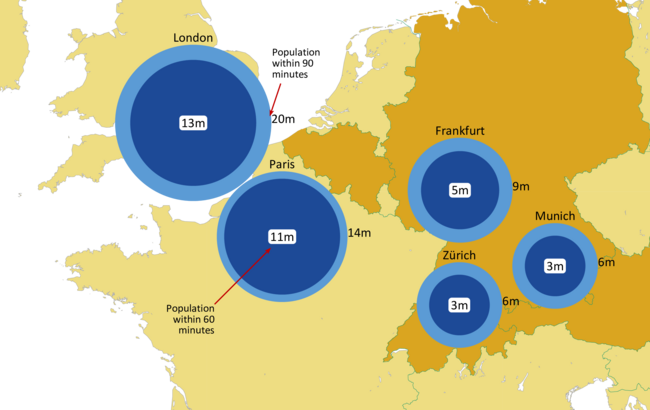
Lufthansa is also heavily dependent on feeding traffic. Its three main hubs at Frankfurt, Munich and Zürich have relatively small catchment areas and O&D markets (in comparison with London and Paris — see chart). 70% of Lufthansa’s traffic transferred at Frankfurt compared with about 50% for Air France at Paris and 30% for British Airways at Heathrow.
Lufthansa sees itself as well-positioned to benefit from recovery in the long haul sectors when that comes. It has joint venture agreements — providing joint distribution, revenue sharing, mutual market access, joint capacity management and joint pricing) on the North Atlantic (with United and Air Canada), to Japan (with ANA), to China (with China Southern), and to South East Asia (with SIA). In pre-pandemic times the joint ventures accounted for 70% of long-haul revenues.
But the group will also need a drastic change in management philosophy: in the past it has not been good at concentrating on Free Cash Flow generation. In the past cycle (see chart) it spent heavily and net capex rose from €2.1bn in 2016 to an average of €3.7bn in each of 2018 and 2019. In those years, when it should have been benefitting from the demise of domestic competitor Air Berlin, it achieved free cash flow averaging €400m a year.
Creating opportunity
out of a crisis
In one sense the pandemic has presented a unique opportunity for Lufthansa to impose a deep restructuring of the business. CEO, Carsten Spohr describes it as a journey to a “new normal” that involves a modernised fleet, a focused portfolio of businesses, and a lean and cost efficient organisation:
- Resize the organisation: get leaner and faster;
- Focus the group on its core airline business;
- Integrate sustainability into everything it does;
- Create value by restoring profitability and balance sheet, ensuring efficient capital use.
The group is targeting cost reductions (from 2019 levels) of €3.5bn by 2024 (equivalent to 10% of total costs in 2019). It has pursued various cost saving programmes in the past, but none as intense as this (for comparison the savings planned are three times the size (inflation adjusted) of the programme “Climb 2011” introduced in 2009 and twice the size of the SCORE programme of 2012/13). The main elements of the cost savings come from fleet modernisation and standardisation, personnel cost reductions, and simplifying operations (and reducing overheads).
The fleet will be smaller for some time to come. In 2020, Lufthansa had already phased out 115 aircraft. It anticipates that by summer 2023 it will have disposed of a total of 230 from the 800-strong fleet it had been operating in summer 2019. After allowing for new deliveries of around 60 short-haul and 20 long haul aircraft, it will be operating a fleet of 650 units in 2023, from which modest future growth could be anticipated.
In the fleet restructuring it plans to reduce the number of types and complexity, and increase the size of subfleets to drive productivity. In the widebody passenger fleet it is disposing of its A380s, 747-400s, A340s, 767s, A330-200s and 777-200s — reducing the number of types operated from 12 to six (747-8i, 777-900, 777-300, A350-900, 787-900, and A330-300). In the cargo operation it is disposing of its 22-year old MD11Fs to concentrate on an all-777F fleet.
In this process, the overall seating configurations will densify (the long haul aircraft disposed of in 2020 accounted for a third of the group’s premium seat capacity) and the group will end up with 30% fewer first and business class seats.
Lufthansa has already cut headcount by 26,000 jobs (24,000 full time equivalent positions) or 20% of pre-pandemic levels: the total workforce had fallen to 117,000 (93,500FTE) at the end of March 2021 down from 137,000 (117,500FTE) at the end of March 2020. Two thirds of the reduction was accounted for by the catering operations at LSG (including 6,500 positions as a result of the divestment of LSG Europe last year to Gategroup). It states it has achieved a structural annualised saving of €0.9bn, but is targeting twice this amount.
Two thirds of the total job reductions were outside Germany, on target with plans. Within Germany employment fell by 8,000 positions (13%) to 52,200, but Lufthansa says it needs to achieve a further 10,000 job cuts (or corresponding costs).
This it states will need to be based on a combination of union agreements, voluntary and compulsory redundancies. The group has not always had brilliant relations with its unions, and may find negotiations tough. There is probably not much it can do until the kurzarbeit provisions come to an end in December. It has a long term collective agreement with the cabin-crew union UFO, agreed after its 2019 strike, that lasts to the end of 2023. The current agreements with VC, the pilot’s union, and ver.di, who look after the ground staff, both come to and end in the first quarter of 2022.
On the matter of operational streamlining, Lufthansa has made some progress. It closed operations at Germanwings and SunExpress Deutschland, and cut 30% of office space in use. It consolidated Eurowings — the group’s point-to-point “low cost” operator — under a single AOC in Germany, and has streamlined the fleet around the A320-family of aircraft, dropping long haul leisure ambitions. By 2023 it is expected that Eurowings will be operating a fleet of 75 aircraft, down from 130 in 2019, and even slightly smaller than it was in 2014 before the Air Berlin acquisition.
However, to add a little complexity back, Lufthansa has established a separate “Eurowings Discover” to serve premium long haul leisure markets (similar to the model adopted by Swiss subsidiary Eidelweiss). Based at Frankfurt with an initial fleet of A330s it will be integrated in Lufthansa feeder and global sales platforms, focusing on German outbound leisure demand.
A prime element of the transformation plan is to recognise the core business as an airline group rather than an aviation-based conglomerate. Consequently it has taken the decision to dispose of a handful of businesses within its sprawling portfolio:
- AirPlus is a travel-oriented and B2B credit-card issuer with revenues of around €300m, 92m transactions and transaction value of €19m in 2019. It may be the easiest to dispose of though unlikely to attract a value of much more than a few hundred million euros.
- LSG (having sold the loss-making European operations) is a market leader in airline catering with brands including LSG SkyChefs and Retail inMotion. With sales of over €2bn and estimated operating profits approaching €200m in 2019, serving 300 airlines with operations in 46 countries round the world, in normal times it might attract a reasonable value in the billions. Lufthansa will not want to dispose of it at fire sale prices.
- The group has also identified the possibility of the sale of a minority stake in Lufthansa Technik (it had already discussed such plans before the pandemic struck). The world’s leading MRO operation, it generated €6.9bn in sales (one third of which were to customers outside the group) and operating profits of €0.5bn in 2019.
Transformation
One of the more fascinating aspects of the transformation plan relates to corporate structure. The old conglomerate was an integrated Aviation Group with Lufthansa German Airlines controlling the group functions and owning the subsidiaries (Swiss, Austrian, Brussels, Eurowings, LH Cargo, LH Technik etc).
Spohr’s new vision is of an Airline Group running the group functions and holding all the branded airlines as its subsidiaries (including LH German Airlines). The business units would have full P&L responsibility, while the Group management board would be focused on strategy, capital allocation and driving improved capital returns.
This is the structure set up by IAG on the merger between BA and Iberia in 2011 (having learnt from the mistakes of Air France-KLM and Lufthansa itself). The holding company has to be agnostic to the requirements of individual subsidiaries: each has to fight for the right to capital.
The structure as proposed gives hope that Lufthansa Group will indeed be able to achieve targets of 8% operating margins and a 10% return on capital by 2024.
It should also look like a very different beast from what it is today.