Qantas: Flying Kangaroo
Bounces Back
Jan/Feb 2023


In the three years to the end of June 2022, covering the depths of the Covid pandemic, Australian flag-carrier Qantas reported total net statutory losses of A$4.5bn (US$3bn), somewhat more than the sum of profits reported in the previous five (profitable) years.
And then, this month, it was able to report underlying pretax profits for the six months ended December 2022 of A$1.4bn — its highest ever level of first half profits.
Indeed the group achieved statutory net profits for the period of A$1bn, almost as much as it reported for the whole of the year ended June 2016 — hitherto its peak year of profitability.
This record performance was seen in all its main brand operating segments (Domestic, International and Loyalty) and was achieved on a still heavily reduced level of activity in comparison with pre-pandemic levels.
Overall capacity (in ASK) in the half year was still 28% below the comparable period in 2019. Domestic operations were nearly “back to normal” at 94% of pre-pandemic levels, but international operations remained heavily curtailed by the continuing border controls flying only 58% of pre-crisis capacity. Demand (in RPK) was 27% down, unit costs up by a hefty 32% (much to do with fuel costs), but unit revenues were up by an extraordinary 46%.
Qantas’s recovery trend shows a lot of similarities with the recovery in financial fortunes of airlines in Europe and North America.
This was the first downturn in the airline industry which was entirely supply-led: passengers did not fly, not because they could not afford or want to, but because they were not allowed to. Rebuilding operations as travel restrictions eased could not keep pace with the underlying level of pent-up demand, squeezing the supply-demand equation. But for Qantas this squeeze appears abnormally huge.
Part of the reason may be the unique structure of the Australian market.
Australia and aviation
Australia has just 26m inhabitants but a huge land mass of 7.7m km², with one of the lowest population densities in the world at three people per square kilometre. There is a lot of empty space.
It is one of the most urbanised countries in the world with nearly 90% of the population living in cities — and nearly two thirds of the population inhabit the five largest: Sydney, Melbourne, Brisbane, Perth and Adelaide. Distances between the main urban centres are large, with limited realistic transport alternatives to air travel.
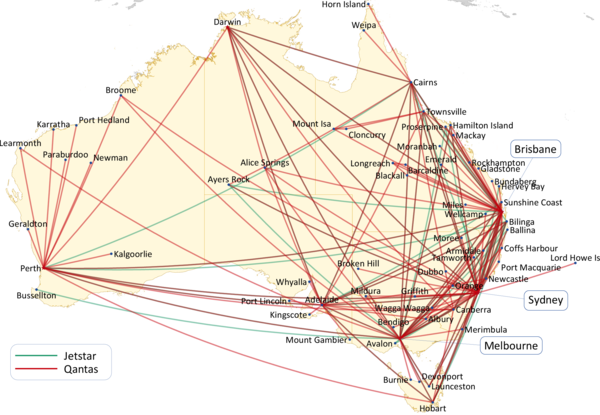
The domestic air system is characterised by a “golden triangle” of routes between Melbourne, Sydney and Brisbane — between them they account for a quarter of all domestic seats. Indeed the 700km route connecting Sydney and Melbourne in 2019 was the second largest route in the world (behind that linking Seoul and Jeju) in terms of the number of flights, and the fourth largest in terms of the number of seats. It regained that accolade in 2022.
Domestically Australia is effectively a two airline market, and has been for decades even after the dismantling of the official Two Airline Policy when the market was deregulated in 1990. Qantas and its low cost subsidiary Jetstar in 2019 held 56% of the domestic seat capacity; Virgin Australia and its (now defunct) LCC subsidiary Tigerair Australia had 37%. Since then the Qantas group has taken some advantage from Virgin’s restructuring out of bankruptcy in 2020 as a “mid-service” airline and pushed up its share of the market to 60% (see charts).
Australia is also a very long way from anywhere.
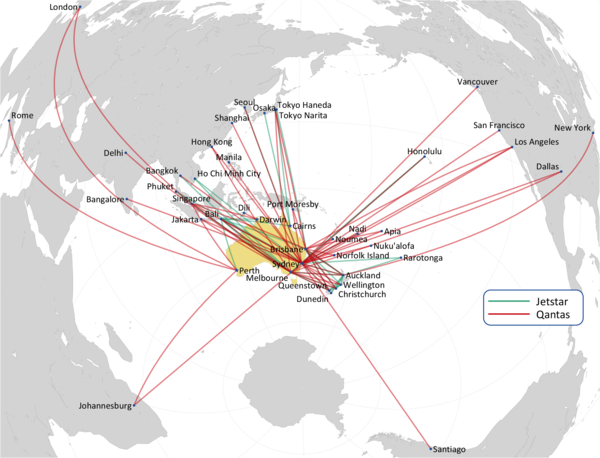
A quarter of tourists (see pie charts) come from or travel to North America and Europe, and flights to Europe, generally too long to be operated economically as non-stop flights, have a multitude of way points to offer transit or transfer flights. Qantas has maintained a 25% share of the market, but both Singapore Airlines and Emirates, providing one-stop connections through Changi or Dubai, are major players (and Qatar, Emirates' rival super-connector has strongly increased its relative presence in 2022, providing flights via Doha). As part of the Virgin Australia restructuring in 2020, its rival got rid of its widebody aircraft leaving Qantas International as the only Australian long haul carrier.
But the majority of international trips are closer to home. New Zealand, only 2,000km from Sydney, naturally accounts for 13%-15% of tourist trips — it is after all the closest English-speaking country with similar colonial ties. Indonesia, the closest ASEAN country accounted for 11% of outbound tourism. But China, effectively closed for the past three years, in 2019 accounted for 15% of inbound travel.
Survival of the fittest
Qantas had entered 2020 in reasonable financial health. It had just completed an acceptable half year performance with an underlying operating margin of 9.5%, and was able to boast a return on invested capital (ROIC) of 19.6%. It had ended December 2019 with A$1.7bn in cash and another A$1bn in undrawn facilities. In February at the publication of the half year results it was encouraged enough to declare an interim dividend of 13.5¢ per share and announce an additional off-market share buy-back of up to A$150m (having paid out A$643m in dividends and buy-backs during the previous six months).
| FY end June A$m | 2018 | 2019 | 2020 | 2021 | 2022 | 2023 H1 | at end | Jun 19 | Jun 22 | Dec 22 | |
|---|---|---|---|---|---|---|---|---|---|---|---|
| Revenue | 17,128 | 17,966 | 14,257 | 5,934 | 9,108 | 9,909 | Fixed Assets | 12,977 | 11,181 | 11,363 | |
| Net income | 953 | 891 | (1,964) | (1,728) | (860) | 1,001 | Other non-current assets | 2,207 | 2,839 | 2,396 | |
| Current Assets | 4,193 | 5,633 | 6,121 | ||||||||
| Operating cash flow | 3,413 | 2,807 | 1,083 | (386) | 2,670 | 2,811 | of which cash | 2,157 | 3,343 | 4,145 | |
| Net capex | (2,201) | (1,651) | (1,571) | (722) | (240) | (717) | Current Liabilities | (8,576) | (10,558) | (11,486) | |
| Net inc in debt | (134) | 393 | 1,163 | (239) | (1,307) | (893) | Debt | (4,589) | (6,179) | (5,331) | |
| Equity | 1,337 | 58 | Other non-current liabilities | (2,776) | (3,106) | (3,047) | |||||
| Dividends/buy back | (1,162) | (1,098) | (647) | (3) | (403) | ||||||
| Net increase in cash | (84) | 451 | 1,365 | (1,289) | 1,120 | 798 | Equity | 3,436 | (190) | 16 |
Only a matter of weeks later the novel coronavirus outbreak in Wuhan had been characterised as a pandemic. Qantas acted quickly. It cancelled the dividend and share buy-back (half way through the process). It raised A$1.4bn in new equity from shareholders and another A$1bn in debt to shore up liquidity. It put in place a three year “restructuring” plan to remove A$1bn from its annual cost base — including getting rid of 6,000 employees, 20% of its 29,000 workforce (subsequently raised to 9,800 through outsourcing) — restore the balance sheet and generate sustainable positive net free cash flow.
Elsewhere in the world some airlines were banging on government doors for help: help which when it came had stringent restrictions. The Australian Government did provide the domestic industry with “Job Keeper” furlough schemes, subsidies on fees and fares to ensure provision of essential air services, freight and repatriation flights, but resisted calls from Virgin Australia for a A$1.4bn bailout. Had it done so Qantas may have felt the need to demand equal treatment.
But Virgin Australia was already financially challenged — with heavy net losses in each of the previous eight years, and negative free cash flow in all but one of the previous ten years (see Aviation Strategy, Dec 2019).
Qantas CEO, Alan Joyce, was brutal: “Governments are not there to pick winners and losers and governments are definitely not there to support companies that have been badly managed for 10 years. A government is definitely not there to support a company that is owned by Singaporeans, Chinese, Abu Dhabi and a British billionaire”.
And for Qantas, strategically, it was better to let its rival fail.
Virgin Australia ran out of cash, filed for voluntary administration and was sold to Bain Capital, a US private equity firm. The “British billionaire” put in funds for a 5% stake.
Segment Results
Qantas Domestic produced astounding results in the six months to end December, despite operational difficulties connected with the ramp up of capacity. Overall capacity was close to prepandemic levels, only 7% below that offered in the same period in 2019, and load factors were back to a normal 80% (30 percentage points higher than in the prior year period). The company ascribes its performance not just to its leading position in corporate and SME markets, but more specifically to a strong growth in premium leisure revenues.
Unit revenues in the period were 25% higher than they had been in the same (pre-pandemic) period in 2019 and the business reported a record level of underlying operating profits at A$785m — higher even than the peak level of (pre IFRS 16) operating profits recorded for the whole of FY 2018 — and a record 22% operating margin, seven points higher than normal times.
According to the figures from the Australian Bureau of Infrastructure and Transport Research Economics (BITRE) Qantas achieved an on-time performance of only 65% in the six months to end December — not exactly something of which to be proud, and it shows the difficulty of restoring operations. The company however takes pride in saying that on this measure it outperformed its main rival (Virgin) in five out of the six months.
Qantas International, mothballed through most of the previous two years, only operated 58% of the capacity it had flown in 2019. It achieved a healthy 88% load factor and strong revenue performance (comparisons here with “normal” times are complicated by turbulence in the freight markets, but total revenues per ASK in the period were 60% higher than they had been in 2019). The division also generated record operating margins of over 12%, and underlying operating profits of A$464m.
The company notes that one of the prime reasons for the strong performance was ongoing capacity constraints across key routes as international carriers gradually restarted operations.
Qantas had progressively restored six of its A380 fleet back into passenger service during 2022 (two of its pre-pandemic fleet of 12 had been sent to the knackers' yard), and with them comes a reconfiguration to boost premium cabin offerings — a project started at the tail end of calendar 2019. The company stated that these results reflect the success of that configuration with a five percentage point improvement in cabin mix compared with 2019.
Qantas had originally planned to have the remaining A380s back in service by the end of 2023. However, because of slot constraints at maintenance facilities (and a lot of work is needed to get these behemoths back in service) it now suggests that this may not happen until early 2025. The group is suggesting that its international capacity will only have recovered to 76% of prepandemic capacty in the second half of the current financial year, and will still be 11% below 2019 levels in the following six months.
Jetstar, the Group’s LCC subsidiary, had a good but not record-breaking six months. It achieved operating profits of A$177m on revenues of A$2.1bn giving an 8.4% operating margin. Total capacity offered was three-quarters of the level in 2019 (almost fully restored on domestic operations but internationally only two-thirds) and load factors a respectable 87%.
On domestic services, unit revenues also were strong, being 16% higher than prepandemic levels, while ancilliary sales per passenger were 39% higher. The company cites particularly strong demand on core leisure routes (eg Melbourne to Sunshine Coast and Gold Coast respectively 23% and 10% higher than 2019).
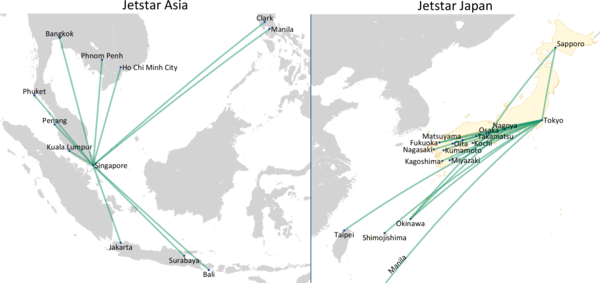
Its international network was profitable with an underlying operating profit of A$72m having relaunched services to Japan and Korea. Singapore-based Jetstar Asia (49% owned) was described as “delivering strong profitability”, even though it is much smaller than it had been, operating only seven aircraft on 11 routes. Pre-pandemic it had a fleet of 18 A320s and a network of 29 routes — including eight destinations in Greater China.
These numbers exclude its A$25m share of losses at Jetstar Japan, where it was challenged by “demand weakness and excess capacity”. Japan did not fully open its borders until October 2022. The 33%-owned associate with a fleet of 19 A320s and 2 A321LR aircraft restarted international services (to Taipei and Manila) in December.
Jetstar sold its stake in Jetstar Pacific to Vietnam Airlines in 2020.
Qantas is one of the few airline groups that (legitimately) treats its frequent flier programme as a stand-alone profit center. Qantas Loyalty indeed was the only part of the business to register profits during the covid crisis.
Profits are generated from three sources: spread, the difference between the reward and redemption values of points; float, the interest earned between earn and burn; and breakage, the proportion of awarded points that expire. Qantas Loyalty does not recognise profits on transaction between itself and Qantas Group airlines. (For a detailed analysis of the finances of airline frequent flier programmes see Aviation Strategy Jul/Aug 2020). Its strength is that it has, through its Qantas branded credit cards, 35% of total Australian credit card spend.
Loyalty also produced a record half year profit of A$220m, up by 73% year on year, on revenues more than double the prior year period. It gained 1m new members in the past twelve months. Credit card spending was 10% above pre-covid levels. There was a doubling in airline redemption activity and a doubling in revenues from OTA TripAdeal (in which Qantas acquired a 51% stake in May 2022).
The management is expecting a full year profit from this segment of up to A$450m — 20% higher than its previous peak in the year ended June 2019.
Fleet renewal
| Qantas | Jetstar | Total | Avg Age | Δ v 2019 | On order | |
|---|---|---|---|---|---|---|
| 747-400 | -6 | |||||
| A380 | 10 | 10 | 13.5 | -2 | ||
| 787 | 11 | 11 | 22 | 6.5 | 3 | |
| A350 | 12 | |||||
| A330 | 26 | 26 | 16.2 | -2 | ||
| 717 | 20 | 20 | 21.0 | |||
| 737-800 | 75 | 75 | 15.9 | |||
| A220 | 29 | |||||
| A320 | 11 | 82 | 93 | 12.3 | -22 | 45 |
| A321 | 3 | 13 | 16 | 9.0 | +8 | 80 |
| ERJ-190 | 14 | 14 | 15.1 | |||
| F70/100 | 19 | 19 | 29.5 | +2 | ||
| Dash 8 | 50 | 50 | 16.6 | +1 | ||
| Total | 192 | 95 | 287 | 18.1 | -11 | 154 |
As part of the measures to mitigate the crisis caused by the pandemic, Qantas accelerated the disposal of its six remaining 747s, disposed of two of its A380s (putting the remaining 10 into hibernation) and deferred delivery of three 787s. The latter are supposedly due for delivery during 2023. On a net basis the group fleet is now 11 units smaller than it had been in 2019 with 287 aircraft (see table).
Encouraged by the apparent success of its restructuring plan, in May 2022 Qantas announced a major aircraft order — the largest order in Australian aviation history. To replace its aging 717 and 737 fleet it ordered 20 A220s and 20 A321XLRs for delivery starting in calendar 2023. The new generation aircraft will be configured to produce an increase in gauge and fuel efficiency to help Qantas fulfill its zero-carbon aims: 25% more seats and 28% better fuel efficiency per seat for the A220 compared with the 717s; and a 15% increase in seats and a17% lower fuel burn for the A321XLR against the 737NGs they will replace. They also come with ranges (nominally respectively 6,000km and 8,700km) that open up more than just domestic Australian routes.
The order included options for an additional 94 aircraft for delivery to at least 2034. It has been combined with Jetstar’s existing then order for 109 A320s (plus options) into a single Qantas Group narrowbody order for 299 aircraft (half of which are options) with the flexibility to draw down on that order by choosing any variant from the A320 and A220 families. (The Group subsequently converted nine of the options to firm A220 orders).
| FY end June | 2023 | 2024 | 2025 | 2026 | ... | 2029 | |
|---|---|---|---|---|---|---|---|
| Qantas | 787-9 | 3 | 3 | ||||
| A350-1000ULR | 3 | 12 | |||||
| A220-300 | 5 | 9 | 10 | 29 | |||
| A321F | 3 | 2 | 3 | 9 | |||
| A321XLR | 3 | 9 | 20 | ||||
| Jetstar | A320neo | 5 | 7 | ||||
| A321LR | 8 | 6 | 8 | 1 | 23 | ||
| A321XLR | 3 | 15 | |||||
| 11 | 14 | 27 | 29 | 118 |
In addition Qantas finally took the decision to go ahead with “Project Sunrise” (see Aviation Strategy, Jan/Feb 2020) ordering 12 A350 ultra long range aircraft for delivery 2025-28. These will be configured “premium heavy” with a mere 238 seats (compared with the more normal 335) and, with luck, will enable Qantas to fulfill its dream of non-stop services on the 17,000km (20 hour) route between Sydney and London. That is always assuming that Russian airspace will have reopened by then.
Qantas avers, with some unfathomable confidence, that Project Sunrise “will be carbon neutral from day one”.
Unfortunately neither party to the aircraft order took account of the current severe supply chain issues suffered by the OEMs, and the delivery schedule has slipped: the A320XLRs will not now be available until 2024-25 and the first A350 us now expected at the end of calendar 2025. It’s a heavy schedule: Qantas on average will be taking delivery of one new aircraft every three weeks for the next three years.
A bonza year
Qantas seems set for a record year of profitability.
The same may be said for the whole of the Australian airline industry: even the reborn Virgin Australia is suggesting it will be profitable in the current year to end June and is considering a return to the Australian stock exchange “at the earliest opportunity”.
Qantas also appears optimistic that it will achieve its 2024 targets set out at its 2019 investor day: a 15-18% operating margin on domestic operations; an 8-10% margin for international; and an underlying operating profit of A$500-600m for Qantas Loyalty.
All its planning is deeply focused on a solid financial framework: minimise the cost of capital by targeting a net debt range of 2-2.5x EBITDA where ROIC is 10%; deliver returns on capital greater than the weighted average cost of capital (ie in excess of 10%); grow invested capital with disciplined investment, and return surplus capital to shareholders.
In the five years pre-covid Qantas provided shareholders with regular distributions in a mixture of dividends and share buy-backs totalling A$4.3bn (and a third of originally outstanding shares).
The A$900m buy-back announced for FY2023 (equivalent to 65% of the emergency money raised in 2020) has locally been criticised as “reckless” for being done in the face of government support during the pandemic, staff redundancies and customer dissatisfaction at operational shortcomings.
But the strategy may help explain how Qantas' share price is back to where it was at the beginning of 2020 and has outperformed the Arca global airline index by 80% since the start of the pandemic (see chart).
Arguments for share buy-backs are dubious at the best of times and at the moment one might think that the group would need the equity: the balance sheet is shot to pieces (see table). Net assets at the end of December while back in positive territory stood at a paltry A$16m. Presumably, it is relying on future retained earnings to restore net shareholder funds.