Aeroflot
Sanctioned
Jan/Feb 2022

Before the collapse of the Soviet Union Aeroflot was, or claimed to be, the world’s largest airline in terms of passengers carried. Following Putin’s invasion of Ukraine Aeroflot is likely to cease to exist, at least in its current form.
The state agency Rosimushchestvo owns 51.2% of Aeroflot and Rostec, a state conglomerate, has a further 3.3%. There is a free float of about 41% of the shareholding, but the reality is that strategic decisions are centrally planned, notably the state-ordered takeover of Russia’s second largest carrier, Transaero, in 2017. The Aeroflot Group also contains Saint Petersburg-based Russiya and the lower-cost subsidiary Pobeda, which in total carried about 42% of total Russian airline traffic in 2021, down from 46% in 2019.
The EU, the UK, the US and Canada have all closed their airspace to Russian registered or owned aircraft, closing off the company’s main source of foreign exchange. The international market has been critical for Aeroflot, accounting for about 40% of its traffic and 60% of total scheduled passenger revenue.
Russia has retaliated by closing off its airspace to Western airlines, a move which mainly impacts Finnair’s Europe-NE Asia hub system, but it will have only a minor direct impact on IAG, Air France and Lufthansa, which can take more southernly routings, adding on average two hours on a flight to Beijing, according to Eurocontrol.
It also kills off Aeroflot’s international-international transfer operation at Moscow Sheremetyevo. Selling that routeing was always challenging and was only made marginally viable through Aeroflot’s membership of SkyTeam. Delta has cancelled its codeshare agreement with Aeroflot as has KLM and Air France. It is only a matter of time before Aeroflot is ejected from the BGA. In addition, Sabre and Amadeus have removed Aeroflot from their distribution systems.
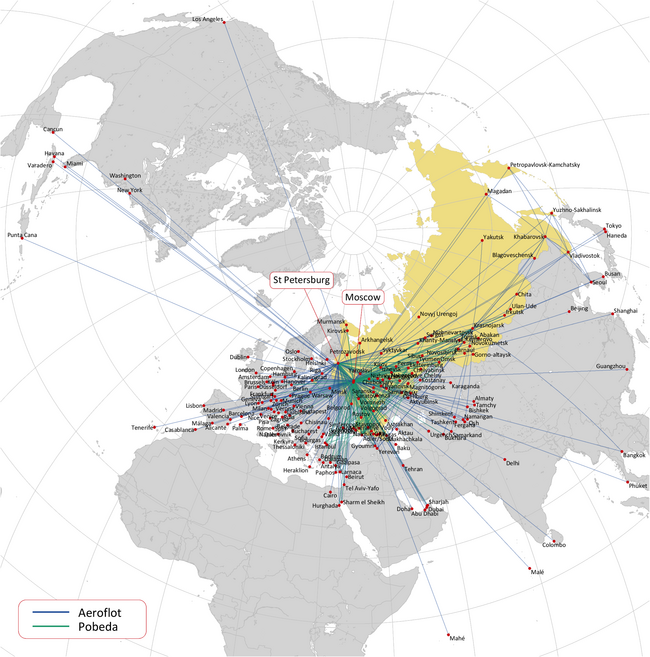
As with any state-controlled flag-carrier, the route map offers some insights into where the country’s politico-economic interests lie. (The map was the constructed from Aeroflot’s schedules just prior to the Ukrainian invasion).
-
Geographically, the domestic market is huge, with a dense network linking provincial cities to two of Moscow’s three civilian airports; there are also extensive connections to former USSR states in the east like Kazakhstan and Uzbekistan.
-
All the major Western European cities are covered but only four points in the USA.
-
Chinese links are, perhaps surprisingly, limited to three routes to Beijing, Shanghai and Guangzhou.
-
Cuba remains because of its historic relationship but there are no scheduled routes to Africa (apart from Cairo).
-
Most of the holiday destinations favoured by newly affluent Russians — London, Miami, Palma, Nice, Cyprus, Sharm el Sheik and (probably) Turkey — are now blocked. But that still leaves places like the Maldives and the Seychelles for the oligarchs.
Aeroflot has suffered financially during the pandemic. In 2020 it reported, under IFRS, a net loss of ₽123.2bn (US$ 1.7bn at then year exchange rates) equivalent to 41% of total revenues of ₽302.2bn. In 2021 there had been a recovery — the net loss was reported as ₽34.5bn, or 8% of revenues of ₽491.8bn.
The balance sheet as at the end of last year showed assets of just over ₽1.1tn ($14.8bn at year end exchange rates) including ₽94bn of cash ($1.26bn) but ₽1.3tn of total liabilities giving a negative equity value of ₽146bn ($2.0bn). These numbers seem irrelevant now; the key metric is Aeroflot’s share price, quoted on the Moscow stock exchange, which plummeted by 40% in rouble terms and by 57% in dollar terms before the market was closed. Its last quoted equity market capitalisation was US$840m but that presumably has now dropped to about zero. Ten years ago, Aeroflot was planning a secondary listing on the London stock exchange.
| ₽bn | Dec 2021 |
|---|---|
| Fleet including right of use assets | 719.4 |
| Other long term assets | 199.7 |
| Current Assets | 190.3 |
| of which Cash | 93.8 |
| Total Assets | 1,109.5 |
| Long term debt and lease liabilities | 672.4 |
| Other long term liabilities | 301.9 |
| Current liabilities | 272.6 |
| Total liabilities | 1,258.9 |
| Shareholders’ equity | (146.4) |
The Aeroflot Group fleet consisted of 371 aircraft at the end of last year of which 47% were Airbus (or Bombardier) equipment, 43% Boeing and 20% Sukhoi. Both the Western OEMs have announced that they have halted to supply of all parts and maintenance support services to all Russian airlines, which will mean that Aeroflot and the other carriers may be unable to operate even domestically after a couple of months, depending on the levels of parts inventories. Increased utilisation of the Sukhoi SuperJets may not be feasible because of the reliability problems encountered by users of this type (like Interjet, see article).
| In Service | On order | |
|---|---|---|
| Dash 8 | 9 | |
| SSJ100 | 76 | |
| MC-21 | 27 | |
| A319 | 28 | |
| A320 | 69 | |
| A321 | 36 | |
| 737-800 | 93 | |
| A330-200 | 12 | |
| A350 | 7 | 15 |
| 777 | 32 | |
| 747-400 | 9 | |
| Total | 371 | 42 |
Airbus will probably cancel Aeroflot’s order for 15 A350s. Boeing has no aircraft on order from Aeroflot, but it does have firm orders for 43 737MAXs from two Siberian airlines, Utair and S7.
Further, the UK government is preparing legislation that will close off insurance services to Russia. The large majority of the Russian fleet is insured through the Lloyd’s of London market.
Looking at the ownership structure about 90% of Aeroflot Group’s fleet by number is on operating lease. Over half the leasing companies are Russia-based — VTB, GTLK, Sberbank and VEB — with Western and Chinese lessors making up the other half. The other Russian airlines have more aircraft, over 500, on operating lease, with a higher proportion from non-Russina leasing companies. For the Russian financial institutions, continuing to finance Russian aircraft, given the targeted sanctions on Russian banks and the severe constraints on the supply of dollars, is going to prove extremely difficult.
The European Union has issued a directive to the effect that leasing companies have to terminate their contracts with Russian airlines by the end of March. This presumably will directly affect all European, mostly Dublin head-quartered, lessors, regardless of ultimate ownership. Moreover, all lessors worldwide must already be facing defaults on their rentals as aircraft are being grounded by sanctions, and international bank settlement systems like SWIFT have been frozen. AerCap, including GECAS, has the greatest exposure of the non-Russia lessors, followed by SMBC and BOC.
How or if aircraft will be repossessed from Russia is just not clear. One suggestion from the Russian side is that the aircraft could be nationalised, which is a semi-polite way of saying expropriated without compensation.
There will be collateral damage to Western leasing companies and to airlines. But what is happening to Aeroflot is a microcosm of what is happening to the Russian economy — destruction through sanctions.
