Mexico and the success of
the globalised ULCC model
Jan/Feb 2022

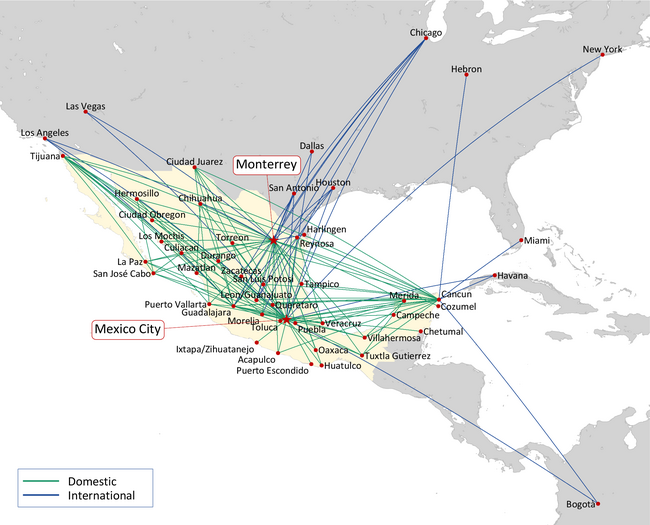
The pandemic has rationalised the Mexican airline industry, leaving it with two dynamic ULCCs — Volaris and Viva Aerobus — and one full-service carrier about to emerge from Chapter 11 bankruptcy — Aeroméxico.
Mexico shut down most of its domestic capacity in April 2020 in response to the first Covid-19 wave, the US imposed severe restrictions on travel between the two countries, and other important trading partners like Argentina, Brazil, Colombia, Chile, and Canada completely closed their borders to international travel. Overall, 2020 domestic traffic was 50% down on 2019, international traffic by almost 60%. But markets have been reopening since the spring of 2021, and last year traffic rebounded by 60% domestically and 76% internationally, By the end of the year traffic volumes were strongly up not just on 2020 but also 2019.
The Mexican government provided no direct state support to the airline industry during the pandemic. As a result the structure of the Mexican industry has been radically changed. The two ULCCs have increased their share of the domestic market from 51% in 2019 to 71% by the end of 2021. Aeroméxico marginally increased its share to 26% but only because of the exit of smaller airlines from the market. Internationally, the two ULCCs now have 15% of the market (Mexican and foreign carriers) against 8% in 2019, surpassing Aeroméxico whose share has fallen from 16% to 11%.
Interjet, which was almost as large as Volaris in 2017, went out of business in early 2021. The pandemic was the immediate cause of its bankruptcy, but the airline had been in difficulties for some time, its LCC-model being squeezed by the ULCCs. Moreover, Interjet’s investment in Sukhoi SuperJets proved to be a false economy. The unit prices were apparently very low but by mid-2019 15 of Interjet’s 22 SSJs were out of service, with Sukhoi unwilling or unable to pay for repairs to the PowerJet engines and provide a regular supply of parts — a Soviet-era characteristic.
The three remaining Mexican carriers are emerging from the crisis with various expansionist strategies but in an uncertain economic climate; 2020 was dire, with real GDP plummeting by 8.3% but there was a rebound of around 6% in 2021 and the OECD forecasts continuing growth of over 3% pa in 2022 and 2023. The president since 2018, Andrés Manuel López Obrador (known by his initials AMLO), continues to pursue a strong anti-corruption stance, but has come under increased criticism for his handling of the economy. One of his policies is to always fly in Economy class.
His major intervention in the aviation sphere was to cancel the new six-runway Mexico City airport initiated by his predecessor, which was about one third constructed and was going to cost $13bn. Instead, a former military airport at Santa Lucia has been converted to commercial use specifically for low-cost operations and is due to open this spring, complementing the congested Benito Juárez International Airport.
Aeroméxico’s transformation hopes
Aeroméxico entered 2020 in a weak state, just about breaking even at EBIT level. After two months of Covid-19 the airline had burnt through almost all its cash reserves and its net asset value was negative to the tune of -$1bn. Delta, which owned 49% of the carrier, was unable to support its Mexican partner, having itself received sate aid under the CARES Act. Aeroméxico declared Chapter 11 in June 2020, with CEO Andrés Conesa claiming that the Chapter 11 process would be used to re-invent the airline, cutting its cost base, terminating leases and switching to Power by the Hour contracts, and rationalising its fleet from 122 aircraft to 86 units.
Aeroméxico attracted a Debtor-in-Possession (DIP) investor — the New York-based private equity giant, Apollo Global Management, which has agreed a loan of $1.1bn to be delivered in tranches of $100m. Then in November 2020 Delta purchased from Apollo part of the DIP debt in a deal whereby Delta and Apollo and acquired the right for the two entities to convert debt into equity in the reorganised Aeroméxico.
In 2021 Aeroméxico reported a net loss equivalent to US$940m (over half of which was accounted for by “restructuring costs”) on revenues of $2.3bn, leaving the balance sheet with negative equity of $(2.7)bn. The Chapter 11 reorganisation plan, approved by US and Mexican courts at the end of January, envisages Aeroméxico emerging from Chapter 11 with a cleaned-up balance sheet due to conversion of the DIP debt to equity, renegotiated lease obligations and a new equity raise. The end-2022 balance sheet is projected to show positive equity of $156m. Delta is expected to have about 20% of Aeroméxico’s equity, down from 49% pre-Chapter 11, and Apollo would hold about 22%.
Details on the airline’s post-Chapter 11 strategy are skimpy, apart from differentiating itself from the lower-cost competitors. The reorganisation plan stated, somewhat unimaginatively: “Aeroméxico expects to be the airline of choice for business and leisure customers by offering a best-in-class customer experience on the ground and in the air”.
The outline operating plan and financial projections were published in November last year and show Aeroméxico nearly doubling his passenger volume from 17m in 2021 to 32m in 2025 alongside growth in the fleet (including Aeroméxico Connect) to 154 units from 133 today. Break-even at EBIT level is forecast for this year, with margins rising to around 14% in 2024/25. All this depends on an increase in average yield while unit costs are held more or less steady.
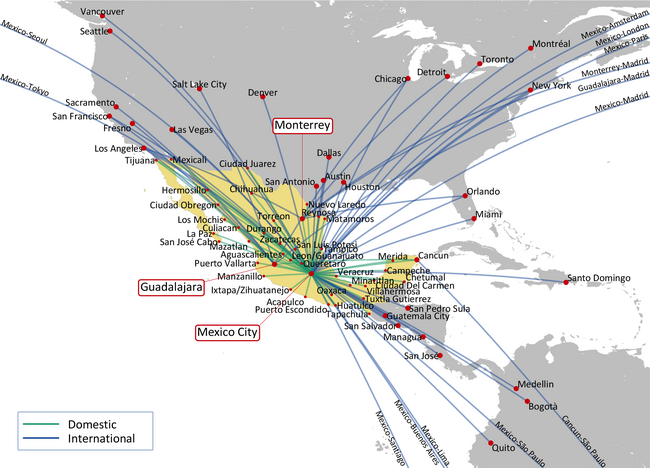
The achievements of Volaris and Viva Aerobus
Volaris has been listed on the Mexican Stock Exchange and the NYSE since its IPO in 2013, with Indigo Partners, the founding entity, retaining a minority stake. It is perhaps surprising that it is probably the highest rated airline stock in North America. Of the 11 US analysts that follow Volaris, eight have “buy” recommendations and three “hold”. Veteran US airline analyst Michael Derchin, in his independent newsletter, puts Volaris at the top of the list of his ten worldwide stockmarket-listed airlines.
Volaris’ 2021 financial performance was impressive compared to pre-pandemic 2019. Total revenues were up 29% to the equivalent of US$2.2bn while adjusted net profit rose to $194m (the adjustment refers to the exclusion of a $88m non-cash loss related to the winding down of a derivatives position; Volaris has announced that in future it will account in US dollars rather than Pesos, partly to avoid such adjustments.) The adjusted net profit margin of 8.7% for the year is claimed by the company to be one of the highest in the global airline industry, and was achieved through a combination of 13% increase in unit revenue (TRASM) and a zero change in unit costs (CASM).
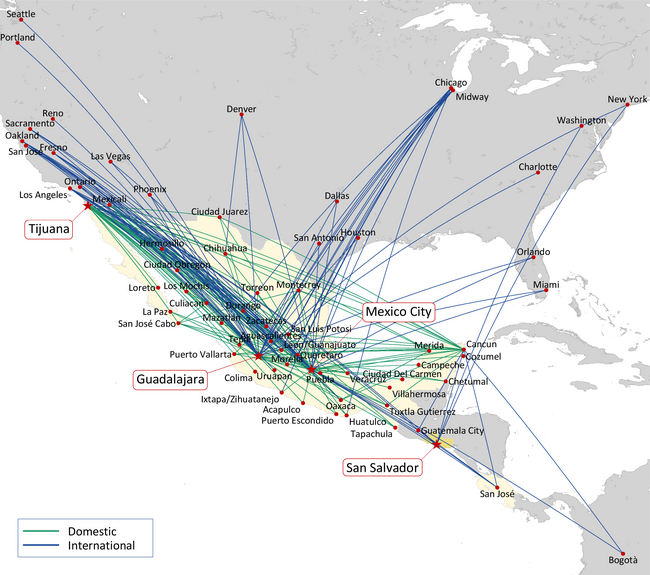
Viva Aerobus’s results for 2021 look even better (both airlines’ financials are unaudited at this stage). It achieved a 10.0% net margin. Total revenues at US$985m were 56% up on 2019 while net profit at $99m was 320% better than 2019’s results. Revenue and cost trends, comparing 2021 with 2019, were very similar to Volaris’: a 11% increase in unit revenue (TRASM) and a -2% change in unit costs (CASM).
Grupo Viva Aerobus is privately owned by IAMSA, Mexico’s largest bus company, with the joint founder Irelandia, the ULCC investment fund, having sold its 49% stake in 2016. Last year it was reported that Viva Aerobus was planning an IPO on the Mexican and New York exchanges, probably in 2022, but market conditions may now have moved against this offering.
The reasons behind Volaris’ and Viva Aerobus’ recent financial achievements and their bright prospects are:
-
Both airlines have embraced all the key elements of Ryanair’s ULCC model — yield-driven demand, flexible asset location, high productivity, rigorous cost control, clear decision-making processes, concentration on VFR and Leisure segments, etc. Perhaps more importantly, there are stable, long-established management teams — under CEO Enrique Beltranena at Volaris and Juan Carlos Zuazua at Viva Aerobus — who know how to implement ULCC strategies.
-
Volaris’ CASM ex-fuel is US¢4.0, while Viva Aerobus’ is a little lower at US¢3.8. These compare to US¢5.6 for the US ULCC Frontier, US¢7.5 for the US LCCs as a group, US¢7.5 for Latin American network carriers and US¢10.2 for US Legacies — so an operating cost advantage of 30-60% against the main rivals
-
Low base fares are sustainable in rapid growth mode because ancillary revenue is strong. Ancillaries account for 42% of total revenue at Volaris and 45% at Viva Aerobus.
-
The two fleets are exclusively A320 Family, so Volaris and Viva Aerobus have avoided the 737 MAX crisis. Average aircraft age is 5.1 years at Viva, 5.6 at Volaris, and average daily utilisation is over 13 hours at both airlines. Expansion plans are increasingly focused on the A321neos, configured with 230 seats and very probably the most efficient type for low-cost operations. Volaris, in particular, has built in a cost advantage due to the unit pricing achieved by Indigo Partners when it placed its A320 mega-order (see below).
-
The airline supply/demand balance is in an unusually favourable alignment because of the exit of InterJet and the downsizing of Aeroméxico. Volaris reckons that the equivalent of 60 narrowbodies have been taken out of the market.
-
Domestically, the two ULCCs are growing by diverting passengers from the buses. Mexico’s extensive bus network expanded rapidly in the 2000s, boosted, ironically, by the duopoly that Aeroméxico and Mexicana then held over domestic air travel. Mexican buses are not the boneshakers that foreign tourists might imagine; Executive Class buses, for instance, offer roomy reclining seats, air conditioning, on-board drinks and snacks and entertainment systems. On Volaris’ network, 41% of routes compete only with buses. The marketing message is that the airline’s cheapest fares, for example, on Cancun-Mexico City are half those of the bus and the travel time saving is 26 hours. Viva Aerobus’s strategy involves selling more bus/airline connections, reflecting its ownership by IAMSA.
-
Internationally, the US-Mexico open skies agreement completed in 2016 should provide growth opportunities for both ULCCs now that slot constraints at Mexico City should be alleviated by the new Santa Lucia airport and cross border alliances are developed (see below). Firstly however, the FAA has to restore Mexico’s Category 1 status which was suspended last year over concerns about regulatory oversight. This means that schedule expansion is limited for all Mexican carriers. Viva Aerobus has stated that it is confident that Category 1 will be restored in the first quarter of 2022. Expansion of Mexico-South America routes is also a prospect — Volaris notes that ULCC penetration in its “reachable markets” in this sector is only about 10%.
ULCC evolution
Mexican ULCCs are playing an important role in a global evolution of ULCC networks, driven in particular by Indigo Partners airlines (see Aviation Strategy, February 2018, “Airline Incubation”). Volaris has benefitted from Indigo’s purchasing power taking about 80 of the investment fund’s mega-order for 430 A320-family aircraft placed in 2017; the other Indigo-backed airlines were Wizz Air, Frontier and JetSMART (Chile).
Volaris has a strong link into Frontier through a codeshare agreement, claimed to be the first between ULCCs. That agreement has assumed greater significance following the proposed takeover of Spirit by Frontier, a $6.6bn deal announced in February. This will create the fifth largest airline in the US, one with adjusted CASM about 25% below that of Southwest and over 40% below that of the three Legacies. Bill Franke, chairman of Frontier and managing partner of Indigo Partners, Frontier’s majority shareholder, will be Chairman of the Board of the combined company.
There is also speculation about Wizz’s transatlantic intentions. Wizz has only applied for a cargo licence to operate its sole A330F, but US airlines and unions are concerned and objecting strongly, perhaps fearing future incursions into the transatlantic passenger market by a ULCC deploying some of the 47 A321XLRs it has scheduled for delivery from 2023. Wizz has previously stated that they will be deployed on eastern routes, but following the Ukraine war that now seems improbable.
Viva Aerobus’ origins were with the other ULCC incubator, Irelandia, established by ex-Ryanair directors, Although Irelandia disposed of its stake in Viva Aerobus, the airline has developed an extensive codeshare alliance with another Irelandia-owned airline, Viva Air of Columbia
In December last year Viva Aerobus announced what it describes as being “a first-of-its-kind, fully integrated” alliance with Allegiant. The two ULCCs have submitted a joint application to the US DoT, requesting anti-trust immunity for the joint operation.
ATI legalises full commercial cooperation between airlines, removing the risk of collusion charges; it is something that is well established for network carriers on intercontinental services but which has never been remotely associated with short/medium haul ULCCs.
Allegiant will also make a small investment of $50m in Viva Aerobus, and its CEO, Maurice Gallagher, whose ULCC investing activity goes back to ValuJet, will be a Viva board director. Start-up date for the joint operation is the first quarter of 2023.
As Allegiant does not currently serve Mexico, the networks would appear to be complementary, potentially offering new non-stop service on US-Mexico routes, capturing traffic from US hub networks. Allegiant will be able to expand its leisure-based network to destinations such as Cancun, Los Cabos and Puerto Vallarta, while Viva Aerobus will have full access to Allegiant’s Las Vegas-based network in the west and centre of the US and its Tampa Bay/Orlando-based network in the east. The aim is to achieve full coordination across all areas of airline operations — codesharing, scheduling, marketing, information systems and loyalty programs. The one peculiarity is fleet — last year Allegiant ordered 50 737 MAXes, having previously been a sole A320 operator.
These ULCC network developments may be the big innovation that comes out of the aviation recession. The alliances have yet to be tested in practice, but the starting point is probably easier than for network carriers because the operating models and corporate cultures are compatible.
| At end Dec 2021 ($m) | Aeroméxico | Viva Aerobus | Volaris |
|---|---|---|---|
| Fleet (inc Right of Use) Assets | 3,025 | 1,022 | 2,372 |
| Current Assets | 315 | 531 | 875 |
| Cash | 1,000 | 452 | 741 |
| Total Assets | 4,340 | 2,005 | 3,988 |
| Long term debt and lease liabilities | 2,100 | 1,215 | 2,128 |
| Current liabilities | 4,970 | 659 | 1,543 |
| Total Liabilities | 7,070 | 1,874 | 3,671 |
| Shareholders' Equity | (2,730) | 131 | 317 |
| End 2021 Fleet | Firm Orders | |
|---|---|---|
| 737-700/800 | 41 | |
| 737 MAX 8/9 | 27 | 56 |
| Narrowbodies | 68 | 56 |
| 787 | 18 | 4 |
| Widebodies | 18 | 4 |
| Total Fleet* | 86 | 60 |
| End 2021 Fleet | Firm Orders | |
|---|---|---|
| A319 | 4 | |
| A320ceo | 40 | |
| A320neo | 40 | 33 |
| A321ceo | 10 | |
| A321neo | 8 | 91 |
| Total | 102 | 124 |
| End 2021 Fleet | Firm Orders | |
|---|---|---|
| A320ceo | 21 | |
| A320neo | 20 | 15 |
| A321ceo | 7 | |
| A321neo | 7 | 38 |
| Total | 55 | 53 |
