A couple of new entrants,
so far
Jan/Feb 2021

Previous aviation crises have accelerated the entry of new carriers with new operating models into new markets. That hasn’t happened with the Covid catastrophe — yet.
The key elements for start-ups are in place:
-
Second-hand values and lease rates at least 40% below pre-pandemic levels.
-
Deals to be done with the OEMs and lessors, especially for latest-technology types like the A321 and the 737 MAX, with early delivery possibilities.
-
A large pool of unemployed pilots and engineers.
-
Slots potentially available at congested airports.
-
Willingness or desperation of airports to strike favourable deals.
-
Incumbents severely weakened and over-laden with debt.
On the other hand:
-
No clear outlook on the timing of demand recovery; in previous crises, global and regional traffic only turned slightly negative for relatively short periods of time.
-
Willingness of governments to subsidise their national airlines.
-
Erratic, below-cost pricing by incumbents.
-
Existence of liquid, efficient and aggressive LCCs in all major regional markets (Ryanair, Spirit, Azul, Volaris, Air Arabia, Indigo, Air Asia, Lionair, etc), the exception being Africa.
There is no apparent business model that could improve on the best of the LCCs, though we suspect that the second wave of LHLCCs, when or if it materialises, will be much more effective than Norwegian or Air Asia X. And many niche low-cost airline projects are in the planning or ruminative stage. The two that are close to launch are Breeze Airways and Flyr.
Breeze
As Breeze Airways is David Neeleman’s latest venture, it has raised high expectations because of Neeleman’s serial success with Morris Air, WestJet, JetBlue and Azul (but not TAP). Breeze has just received authority to fly from the US DoT, though the start-up date for the Salt Lake City-headquartered airline is unclear. Latest reports suggest late 2021/early 2022 is likely.
In fact, little detail about the new airline has been revealed, and the US DoT licence application was heavily redacted. However, it looks like being a US version of Volotea, a surprise success in the European market; the closest US competitor would be Allegiant. It will start with Emb195s, probably leased from Azul, quickly converting to A220s, having placed an order of 60 units back in 2018. Neeleman has publicly stated that he expects A220 trip costs to be 15-20% below those of the A319, which is operated by Allegiant.
Breeze will focus on underserved routes between medium-sized cities, having identified 500 potential city-pairs. Beyond that,the airline says it will be “nice”, which is nice, and will be at the cutting edge of technology.
An interesting insight into the economics of starting an airline is provided by two balance sheets incorporated in the DoT docket (see table). Some $103m of equity funding is initially being put into the airline, of which $39m or 38% comes from Neeleman himself. After 12 months of operating losses and start-up expenses, this equity will have been more than halved to $45m, while debt used to build the owned A220 fleet will have soared to $257m. Cash will have drained from $83m to practically zero, so hopefully a new round of funding will have been put in place.
Flyr
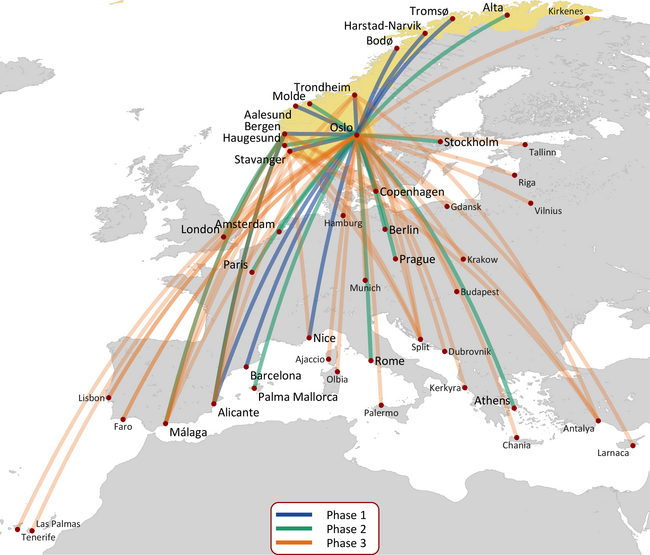
In Norway, start-up airline Flyr has successfully raised NOK600m ($72m) through a private placement, aiming to start operations in the summer this year. Backed by Erik Braathen (who had been CEO of Braathens SAFE in the 1980s and chairman of Norwegian Air Shuttle in the 2000s, and is conveniently currently on the board of BBAM-managed Fly Leasing) and with the support of Maurice Mason (ex-GPA and Irelandia, serial start-up investor with Tigerair, Allegiant and Viva Aerobus on his CV), the team of ex-Norwegian and former SAS officers comes with good credentials.
The plan appears fairly modest: starting with a fleet of eight aircraft to build gradually to operating 28 units by its fifth year by which time it anticipates carrying over nine million passengers, and the plan suggests breaking even at the EBITDAR level in year two.
The founders readily admit that Norway is not the best choice of countries to establish a low-cost carrier (because of employment costs) but starting with a blank virtual sheet of paper, concentrating on an efficient flat organisational structure with a high degree of digital and automated processes which in turn will support data-driven decision making, they believe that they will be able to achieve unit costs on a stage adjusted basis similar to Ryanair and Wizzair.
Key to achieving the target is crew productivity and minimising the total number of employees per aircraft. The management team states that it will have stringent planning principles to maximise crew utilisation: a simple route structure with production mainly in and out of crew bases; a hard maximum of two crews per day per aircraft, with changeover, at the base, at mid-day; optimising flight block hours and turn-around times during peak/non-peak hours. Overall, Flyr is targeting flight hours from the crew close to maximum at 850 hours a year and total full time employees of 36 per aircraft — even below that of Ryanair.
In Norway Flyr, has a unique opportunity. Because of the geography there are many routes with unviable transport alternatives. Norway has a wealthy population and one of the highest propensities to fly, with an average 10.2 trips per head in 2019. It also has a terminally sick pair of competitors in Norwegian and SAS.
Flyr contends that it has a sustainable business model. The traditional LCC model it states was focused on constant growth: constantly increasing fleet size, network and passenger figures, artificially inducing demand by offering extremely low fares. This model, Flyr claims, is not adapted to the “new normal” post Covid-19. It says that it will adapt and optimise scale and production to demand from day one; will not fly at times and to destinations where demand needs to be generated by low prices; will not fly on routes where there are adequate connections by more environmentally friendly means of transport.
| PRE-START-UP | AFTER 12 MONTHS | |
|---|---|---|
| Cash | 83.2 | 0.6 |
| Receivables/Pre-paid | 0 | 47.1 |
| Aircraft | 0 | 293.2 |
| Deposits and PDPs | 13.7 | 46.7 |
| Other Fixed Assets | 2.5 | 12.1 |
| Others | 0.6 | 0.6 |
| TOTAL ASSETS | 100.0 | 400.3 |
| Current Liabilities | 2.9 | 98.1 |
| Long term Debt | 6.9 | 256.8 |
| TOTAL LIABILITIES | 9.8 | 354.9 |
| OWNERS' EQUITY | 102.8 | 102.8 |
| RETAINED EARNINGS | -12.6 | -57.3 |
| TOTAL EQUITY | 90.2 | 45.5 |
| LIABILITIES & EQUITY | 100.0 | 400.3 |