GOL Linhas Aéreas Inteligentes:
Mirroring Avianca
Nov/Dec 2024

Brazil’s third largest airline, GOL, was heading towards sustained profitability out of the country’s 2014-16 recession and political turmoil (and its own restructuring) when the covid pandemic hit.
The following three years were as torrid for the carrier as any other airline worldwide: but the collapse of traffic and revenues (with minimal government support) were exacerbated by a 30% devaluation of the Real to the US Dollar. Over 2020-21 GOL lost a total of R$13bn ($2.5bn).
Note: trailing 12 month total
The majority of its operations are domestic, so it benefited from the early recovery in the large domestic market: revenues in 2022 exceeded those it had achieved in 2019, and by 2023 it was able to report an operating margin of 17.8% — its best since 2006.
However, it ended 2023 in a very weak financial position: its total debt including lease liabilities had ballooned to R$17bn ($3.5bn) from R$4bn ($960m) at the end of 2019, and cash stood at a mere R$639m — 3% of revenues. Total liabilities exceeded assets and the group had a net shareholders' deficit of R$23bn.
At the beginning of 2024 it filed for Chapter 11 protection and restructuring in New York, benefiting from the experience of its friends at Avianca.
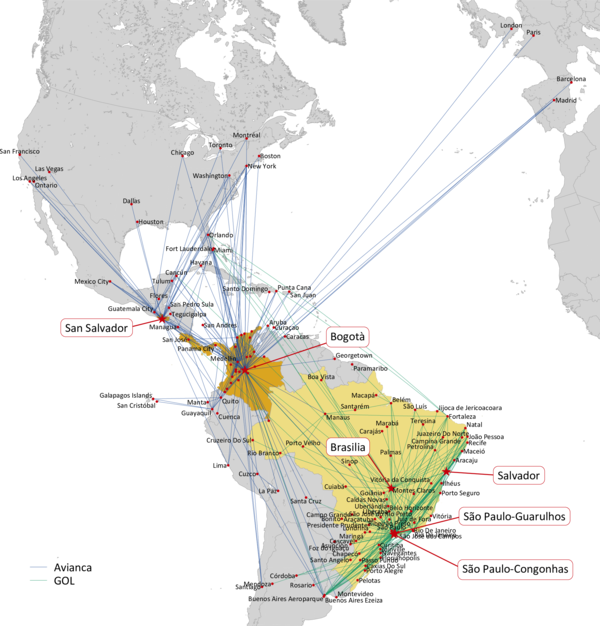
Avianca had filed for Chapter 11 in May 2020, emerging in December 2021 a much leaner, and possibly low cost carrier, with the new holding company (bizarrely) registered in the UK. In 2022 Avianca and GOL announced the intention to combine forces in a new Abra Group Ltd (also registered in England). The major shareholdings of the billionaire controllers in each respective airline — Roberto Kriete and his family of Avianca and the Constantino family who had set up GOL — were placed in Abra. Constantino de Oliveira took on the chairmanship of the new company; Adrian Neuhauser, who had been CEO of Avianca through the bankruptcy process, went in as CEO. The two carriers, it was said, would retain their brand identities.
GOL’s restructuring 5-year business plan, published in May 2024, bears an uncanny resemblance to the plan that Avianca itself had produced in 2020. By 2029 it illustrates a return to the 20%+ operating margins it enjoyed in the early 2000s.
The GOL plan is “underpinned by a robust engine investment program to return aircraft to revenue service, a steady stream of new 737 MAX aircraft, a strategic expansion of its network, and the pursuit of a cR$1 billion profit improvement program”.
Part of the plan requires restructuring commitments to lessors. They hope to achieve some R$5.9bn from renegotiating end-of-lease obligations, reduction in rents, and getting new money financing from Lessors to address engine heavy maintenance as well as sourcing sale and leaseback financing on new 737MAX deliveries (of which it has 93 on order). It aims to apply re-amortisation of lessor-secured obligations, and suggests that future 737MAX deliveries would be funded through sale and leaseback transactions.
The plan as it is set out sees GOL increasing its fleet of 137 737s by 20% over the next six years (see figure). It appears to be planning the introduction of 80 new routes by 2029, “leveraging its significant market position in Brazil’s principal cities to build up its network”. Aircraft utilisation is projected to increase by 10% to 12.8 hours a day over the period and capacity in ASK terms is expected to grow strongly by around 15% a year between 2024 and 2027 before settling to an annual growth of 5% (see figure). A large part of the growth in the short run is expected to be international: the group does not expect its domestic offering to reach pre-pandemic levels until 2026.
The company states that it and its lessors are investing in its older 737NG fleet to repair engines and restore optimal capacity, which would unlock additional growth both domestically and internationally with a focus on maximising profits.
Without any real details it says that it will implement a “R$1 billion annual run rate profit-improvement program” in order to “further improve the airline’s industry leading unit cost levels”.
|
|
GOL received $1bn debtor-in-possession financing (which explains why the Q3 balance sheet snapshot in the table looks so dire) and announced in November last year an agreement reached with Abra Group for a further support agreement including $950m secured debt convertible into new GOL equity in collaboration with GOL’s unsecured creditors committee. The agreement suggested that financial restructuring would reduce GOL’s obligations by around $2.5bn and allow for an exit facility of up to $1.85bn equity.
The details are far from clear, but it is likely that many of the financial concerns that supported Avianca in its restructuring (such as activist hedge fund manager Elliott) have been brought on board to support GOL in its efforts.
The wording of the public announcements are possibly obfuscated by design. The details of the new Abra Group are also particularly obscure. Its latest accounts filed with the UK’s Companies' House (for the year ended 2022) were done on a “micro-entity” basis: no revenues, no employees and an equity deficit. The group has so far failed to file accounts due for 2023 (no worry: the fine for so doing is only £150). When founded, it was hawked as furthering consolidation in Latin America to create a group to rival LATAM. Avianca’s attempt to acquire Viva Air was effectively blocked, but that pushed Viva into liquidation, creating the desired effect. It has apparently acquired an interest in Spanish ACMI operator Wamos Air. And now Abra has signed a non-binding MoU with GOL’s domestic competitor Azul to combine the Brazilian operations (while retaining the brands). This could give Abra Group airlines 60% of the domestic market.
GOL expects to be able to exit Chapter 11 in May 2025, a leaner, fitter and more financially secure airline. Abra Group will probably look to raise funds through an IPO. Then we might find out more about this enigmatic new airline group.