Pearl of the Orient:
A focus on The Philippines
Jul/Aug 2023

Between 117° and 127° East of Greenwich and 4°-21° North of the equator, lies the archipelagic state of The Philippines.
Stretching 1,850km north to south It comprises an estimated 7,641 islands, has a land area of 300,000km² and a coastline measuring over 36,000km (and hosts 24 active volcanoes).
It is the world’s 12th largest country by population, with over 110m inhabitants — 54% of whom are urbanised: the area around the capital city Manila is the 5th most populous urban area in the world with nearly 25m residents. Manila itself is the most densely populated city in the world with over 40,000 residents per km².
The population is relatively young: 30% are under the age of 15 and only 6% over the age of 65. There is also a huge Filipino diaspora — estimated to amount to over 10m people, or nearly 10% of the population — that has spread to many countries round the world (the largest being the USA, Canada, Saudi Arabia, UAE and Japan). It is estimated that a fifth of these are designated Overseas Filipino Workers (OFW). In 2019 the Philippines' Bangko Sentral estimated the OFWs remitted over $33bn “back home”, having a material positive impact on c8% of GNP.
The predominant religion — unusual for the region — is Christianity: 90% of households claim affiliation (and 80% to Roman Catholicism) while only 5% adhere to Islam. The Philippines can lay claim to having the third largest Roman Catholic population in the world behind Brazil and Mexico.
But the Philippines has not been immune from religious discontent. In the southernmost island of Mindanao, the indigenous Moro (the word used by the colonial Spanish government to refer to Muslim people) have been waging a war of independence for most of the past 400 years. In recent decades there have been bouts of terrorist activity and armed conflict between the government and the insurgent Mindanao National Liberation Front (MNLF) and its break-off group the Mindanao Islamic Liberation Front (MILF). The latest settlement has been the 2019 creation of the Bangsamoro (“Moro Land”) Autonomous Region in Muslim Mindanao (BARMM). The hope is that this settlement will provide lasting peace.
This newly industrialising country is one of the poorer nations in the world. Average GDP per capita is a mere $3,900 in nominal, and $11,420 in purchasing power parity terms (2022). But it is growing strongly: the economy averaged real GDP growth of 6.5% in the decade to 2019, and the IMF is forecasting growth of nearly 6.2% over the next five years. As far as air travel is concerned, The Philippines is on the steep part of the S-curve of its development (see chart), and has the potential to see the propensity to travel by air double in the next five years.
Burgeoning Tourist Destination
The country is an enticing tourist destination boasting tropical beaches, rainforests, diving, eco-tourism, heritage towns, golf courses and (important perhaps for the Chinese markets) casinos.
Pre-pandemic, tourism accounted for over 10% of exports and in the ten years leading up to 2019, the numbers of inbound tourist visitors had grown strongly from 3.0m to 8.3m, a compound average annual growth rate of 10.6%.
In absolute terms among ASEAN member nations this is relatively small: a quarter of the annual visitors to the region’s favourite tourist destination, Thailand (see chart), a third of those to Malaysia, a half of the numbers visiting Indonesia. But the compound growth rate had been above the average of 8.4%pa for ASEAN as a whole.
South Korea has been the largest source of inbound tourists for most of the last decade and in 2019 accounted for 24% of the total having increased at an annual average 12% since 2010. But, in common with other tourist destinations in the region, the highest rate of demand growth has come from China: in 2010 Chinese visitors accounted for 5%, grew at an average annual rate of 28%, and ended 2019 accounting for 21% of the total.
High growth in air traffic
Air traffic demand to, from and within the Philippines has been growing well above the world average. Between 2001 and 2019, the total number of passengers carried grew at an average annual rate of 8.6% to peak at 60.1m. Roughly half the demand is carried on domestic routes and has grown at a slightly higher rate of 9.1% over the period. International passenger traffic had grown by 8% a year, but In the five years leading up to the pandemic, that international growth rate had accelerated to approach 10%pa.
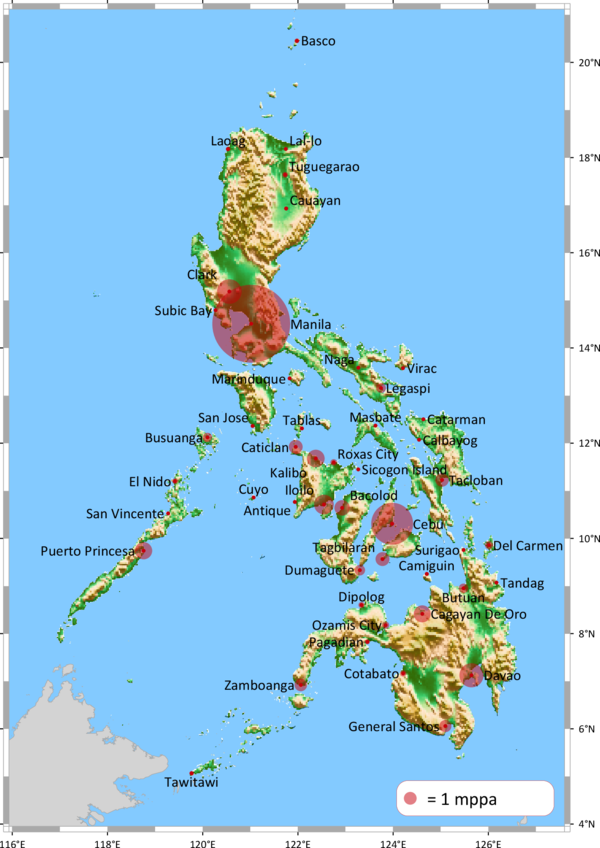
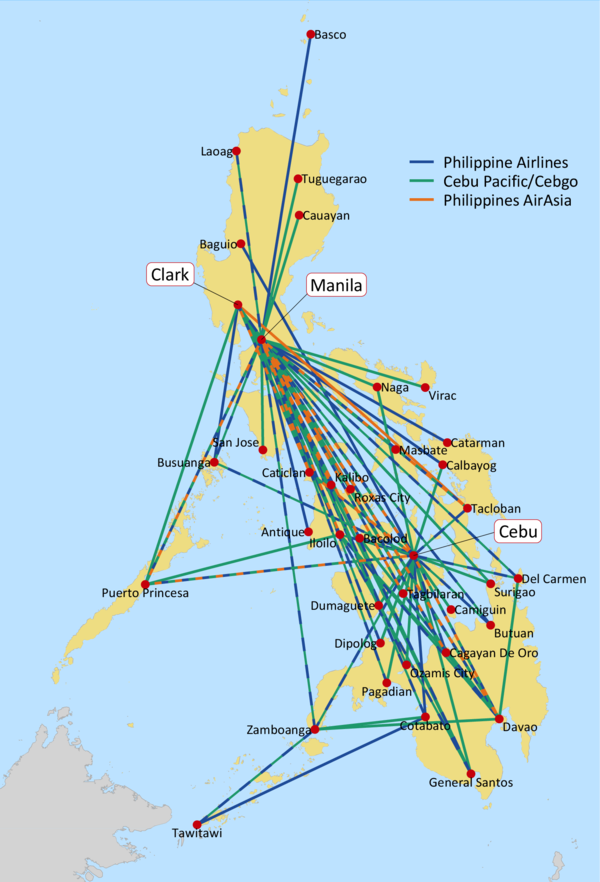
The country has a dense airport network with nearly fifty operational scheduled airports: 15 of these deal with over a million terminal passengers a year (and another five more than 200,000 mppa). But domestic traffic is heavily centralised with over 80% of seat supply on routes to or from the Greater Capital Region (GCR): the three densest routes being from Manila to and from Cebu, Davao and Iloilo, each (in normal times) serving more than 2m pax a year.
Domestic traffic, after the devastation of the pandemic in 2020 and 2021, recovered strongly in 2022 to end only 14% below 2019 levels. Indications suggest that there is almost a full recovery to pre-pandemic levels in the current year.
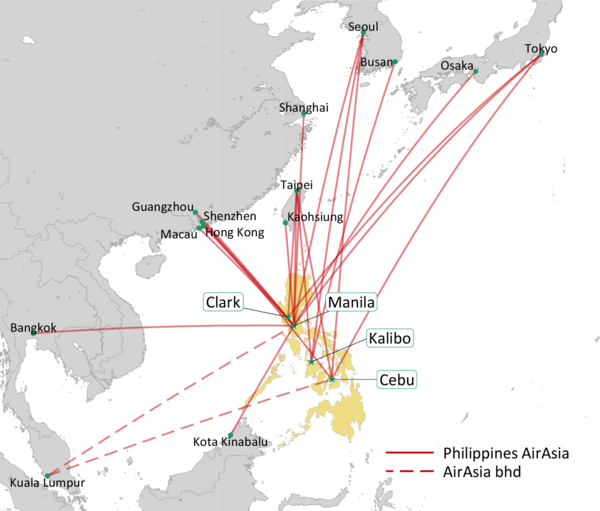
International traffic is heavily focused on Manila — the GCR airports account for 83% of international capacity. Nearly three quarters of traffic is on routes to other ASEAN countries; but the densest routes are to destinations in Korea, Hong Kong, Macau, Japan, China, Singapore, Taiwan and the UAE — all with more than 2m seats annually.
With draconian border restrictions during the pandemic, international demand tanked in 2020 and 2021. Borders slowly re-opened in 2022, and China only started abandoning its zero-Covid policy towards the end of the year — and only recently fully restored its list of approved destinations for outbound tours. Figures from AAPA suggest that passenger numbers on international routes have been gradually recovering, but in July this year were still 20% below 2019 levels.
v same month in 2019
Capacity constraints in Manila
Manila’s Ninoy Aquino International Airport (NAIA) is the country’s largest, and accounts for three quarters of the nation’s international arrivals. It has been operating well over its design terminal capacity (of 32mppa) for many years — in 2019 it had 48m terminal pax — and operates an estimated 10% above the designed capacity of its two runways and apron structure. Within the GCR it is supplemented by the former US Air Force base at Clark International Airport (4m pax in 2019), some 90km north of metropolitan Manila, often used as a diversion when congestion gets too much.
The much-needed expansion and refurbishment of NAIA — to increase capacity to 65mppa — has been mired in controversy over the last six years. Various consortia have made unsolicited proposals under president Rodrigo Duterte’s 2017 infrastructure development initiative (entitled Build! Build! Build!). In July this year, current president Bongbong Marcos rejected the latest unsolicited proposal from a consortium of local conglomerates for a 25-year ₱267bn (US$4.8bn) concession. The government will apparently now be inviting competing bids for a 15-year ₱170bn PPP BOT project.
In 2016 local billionaire Henry Sy came up with the idea of using facilities at Sangley Point, a single runway Air Force base some 9km due west of NAIA (but 28km by road), for low cost carriers and general aviation “while waiting for a new airport”. In 2019, then-president Rodrigo Duterte ordered the transfer of domestic and general aviation operations to Sangley Point — ignoring the lack of terminal, control tower, hangars, lighting and a need to asphalt the runway — and he officially inaugurated the new airport in February 2020. It doesn’t yet have any scheduled passenger service.
In 2017, the country’s San Miguel Corp put in an unsolicited bid to build the New Manila International Airport (NMIA) along with an adjacent airport city at Bacalan, some 35km north of Manila. Awarded the ₱735bn (US$12bn) 50-year BOT concession in 2019, ground works were initiated in 2020 and construction started in 2022. The plans are for an initial two runways (with potential for six) and an ultimate capacity of 100mppa. It is expected to be operational in 2027.
Three Airline Oligopoly
The domestic industry is consolidated: three airlines provide substantially all of the capacity.
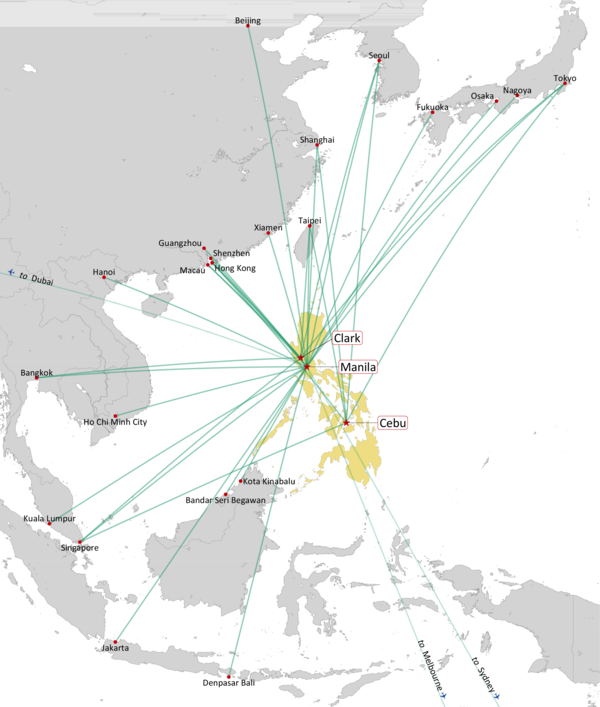
- Market leader with a 50% share is LCC Cebu Pacific (with its regional subsidiary Cebgo). On the 20% of services that avoid the GCR airports of NAIA and Clark, Cebu has an estimated share closer to 60%.
- Flag carrier Philippine Airlines (and its “lower” cost subsidiary PAL Express, that had been designed to counter Cebu’s incursion) have 30% of the market.
- LCC Philippines AirAsia (previously known as Zest AirAsia), a subsidiary of Kuala Lumpur-based Capital A Group (the conglomerate formerly known as an airline called the AirAsia Group) trails with an 18% share.
In the following sections we briefly explore how they have survived the pandemic.
Cebu Pacific
Cebu Pacific Air was established as a legal entity back in 1988, but didn’t launch operations until 1996, a year after it was bought by JG Summit Holdings, a giant Filipino conglomerate that has interests in everything from banks and hotels to property and utilities. Its founder was John Gokongwei — of Filipino-Chinese extract and one of the wealthiest entrepreneurs in Asia — and today his only son Lance is president and CEO of Cebu.
Based at Manila’s NAIA, Cebu was a pioneer of the standard LCC business model in Asia, though today it has multiple aircraft models, an FFP called GetGo and a regional turboprop operator Cebgo. It was launched initially as a domestic-only carrier before expanding onto international routes from 2001, and has built up a domestic market share of 50% and one of 19% on international routes, which in turn account for 30% of its overall capacity. But it had been growing its international presence: in the decade up to 2019, its international capacity had grown at a compound rate of 12.5% a year.
Cebu has been consistently profitable. Between 2012 and 2019 it achieved an average operating margin of 12% (peaking at 20% in 2016) and net margins have averaged 8% a year. Revenues over that period grew at an average of 8% a year.
Over the three years of the pandemic and its immediate aftermath, Cebu lost a total of ₱60bn ($1.05bn), 50% more than the profits it had made in the previous seven years. It had entered the crisis with a strong balance sheet and a reasonable cash balance of ₱18bn (just over 20% of annual revenues). By the end of 2020 this had fallen to ₱4bn and the group successfully raised ₱12.5bn ($260m) through a rights issue.
In the first half of 2023, the group bounced back into profit: a modest ₱3.8bn operating profit representing a margin of 8% on total revenues only 3% below 2019 levels. This was sufficient to restore the equity position into positive territory. Total seat capacity in the period was still 9%, and the number of passengers 8%, below levels in 2019. Average fares were on a par with pre-pandemic levels but ancillary yields were 27% higher: ancillary revenues accounted for 26% of income in the period.
Despite this performance, Cebu has been hit with operational instability particularly in the second quarter. On-time performance plummeted to 58% in May and June, partly because of issues with the Pratt and Whitney engines on its A320neo fleet (the company mentions that engine maintenance currently takes around 220 days compared with a more normal 90 days, and that there is a resulting scarcity of slots in the workshops).
It has also this year been impacted by weather issues: longer and more frequent “lightning red alerts” where it has to stop all flight and ground operations. Each such event can last up to three hours and cause significant disruption; and it mentioned that there were 72 incidents recorded in the rainy season of the second quarter.
| In Service | Parked | Total | Δ v 2019 | Avg Age | Orders | |
|---|---|---|---|---|---|---|
| ATR 72 | 15 | 2 | 17 | ↓4 | 7.2 | |
| A320-200 | 17 | 4 | 25 | ↓5 | 9.9 | |
| A320neo | 9 | 5 | 10 | ↑6 | 2.1 | 10 |
| A321-200 | 7 | 7 | — | 5.2 | ||
| A321neo | 11 | 11 | ↑6 | 3.0 | 20 | |
| A330-300 | 1 | 1 | ↓7 | 6.4 | ||
| A330-900 | 5 | 5 | ↑5 | 2.0 | 11 | |
| Total | 64 | 12 | 76 | ↑1 | 5.9 | 41 |
Cebu has a fleet of 76 aircraft (one unit more than in 2019) with an average age of only 5.9 years. Over the past three years it has taken delivery of 12 A320/321neos and five widebody A330s. It looks as if most have been done on sale and leaseback deals. It has outstanding orders for 41 aircraft.
From 2024 it expects to take delivery of 43 new aircraft and dispose of 33 leaving it at the end of 2028 with a fleet of 88 aircraft: 16 widebodies, 56 narrowbodies — all new generation — and 16 turboprops.
PAL Holdings Inc
Philippine Airlines is one of the oldest airlines in Asia, having been established in 1941 as the de facto flag carrier for The Philippines. It fell into bankruptcy in the aftermath of the 1997 Asian financial crisis.
Lucio C. Tan, another billionaire sino-filipino tycoon and majority owner of local conglomerate LT Group, used PAL Holdings Inc. to acquire the airline out of insolvency in 2006. For a brief spell he relinquished management control to San Miguel Corp and its magnate Ramon Ang, selling him a 49% stake in 2012 for $500m. They obviously fell out and he bought it back two years later for $1bn.
89-year old Tan remains Chairman and CEO, his wife Carmen Tan deputy Chairman, while his grandson Lucio C. Tan III is President, and son-in-law Stanley K. Ng Chief Operating Officer. His daughter, Sheila Pascual is also on the board. Needless to say, the underlying ownership structure is somewhat opaque: the shares are quoted on the Philippine Stock Exchange with a tiny free float. (The company doesn’t need to bother with investor presentations.) In 2019, ANA Holdings (owner of All Nippon Airways) acquired, with remarkable timing, a 9.5% stake for $95m.
Apart from the two years following San Miguel’s exit, PAL Holdings has been notably unprofitable, having lost a total of ₱7.7bn in the six years to end 2019. Its peak operating profit was achieved in 2016 with ₱9.6bn, reflecting an 8% margin.
With a weak balance sheet — over $3bn of debt supporting $85m in net assets and cash of $265m equating to less than 10% of revenues — PAL entered the pandemic unprepared.
Tan shored up Philippine Airlines' finances with a cash injection of $295m in 2020, and then in late 2021 decided to go for a court approved capital restructuring. Astutely, he put Philippine Airlines (but not PAL Express) through Chapter 11 bankruptcy proceedings in the US courts, emerging (after only four months) at the beginning of 2022 with a $2bn reduction in debt and a 20% reduction in the fleet size. The 13 A321s on order were rescheduled for delivery beyond 2026. The quid pro quo was an issue of 20% of the equity in Philippine Airlines to creditors and DIP funders; and a reduction in PAL Holding’s stake in the airline to 79.5% (from 98.9%). Lucio Tan also injected some $500m new equity into the holding company.
| In Service | Parked | Total | Δ v 2019 | Avg Age | On Order | |
|---|---|---|---|---|---|---|
| A320ceo | 13 | 13 | — | 14.0 | ||
| A321ceo | 19 | 3 | 22 | ↓2 | 8.7 | |
| A321neo | 4 | 4 | 8 | — | 4.7 | 13 |
| A330-300 | 8 | 2 | 9 | ↓6 | 9.5 | |
| A350-900 | 2 | 2 | ↓4 | 4.8 | ||
| A350-1000 | — | 9 | ||||
| 777-300ER | 8 | 1 | 9 | ↓1 | 9.9 | |
| Dash 8-400 | 10 | 1 | 11 | — | 6.9 | |
| Total | 64 | 11 | 75 | ↓13 | 9.1 | 22 |
Because of the accounting behind the restructuring, PAL’s published profitability measures for 2020 and 2021 are somewhat meaningless. In 2020 it posted a net loss of ₱73bn ($1.3bn) only to recognise a gain on the condonation of debts in 2021 and post a net profit of ₱61bn ($1.1bn).
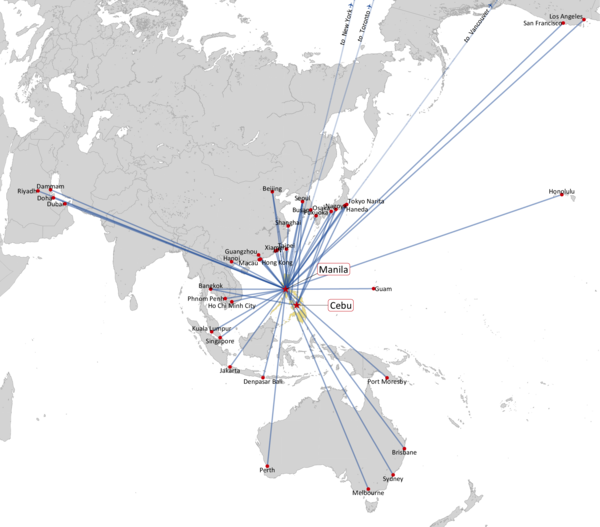
PAL too has bounced back to profitability. It has a higher level of international service than competitor Cebu — in 2019 accounting for 47% of total capacity — so it has not quite reached the same level of recovery in traffic or capacity terms to pre-pandemic levels as its main competitor.
Surprisingly it was profitable in 2022, probably because of the restructuring. It published revenues of ₱139.2bn, only 10% below 2019 levels, but generated its highest ever operating profit of ₱17.3bn — a margin of 15%. The first half results for 2023 are somewhat lacking in operational details, but revenues of ₱87.4bn were 7.6% higher than in the corresponding period of 2019, operating margins touched 20%, and net profits reached a record half-year ₱13.8bn, an extraordinary 15% margin (in 2019 they reported a loss).
This has given the group the confidence to confirm an order with Airbus for nine A350-1000s, in part to replace its aging 777-300s.
Philippines AirAsia
The country’s third largest player is the result of plans by Malaysia-based LCC AirAsia Group to expand its brand footprint throughout ASEAN and the region. Formed in 2010 it merged with local carrier Zest Airways in a complicated series of share swaps and cross-holdings that gave AirAsia effective management control while ensuring that the arrangement did not fall foul of a law capping foreign ownership of utilities (which included airlines) at 40% (and allowed it to consolidate the results in its accounts).
The deal also provided Philippines AirAsia with precious landing slots at NAIA.
Since inception it has grown strongly with an annual increase in capacity of nearly 20%. But it has not been particularly profitable: it achieved a modest operating profit margin of 6% in 2019, but had lost ₱10bn in the previous five years (and ₱14bn at the net level).
The parent company AirAsia Group raised MYR1.3bn ($300m) new equity in 2021 to provide liquidity to survive the pandemic but ended the year with negative net assets of MYR6.4bn ($1.4bn). Its problems were compounded in the crisis by having major stakes in subsidiaries in foreign jurisdictions where there was not a clear ability to transfer cash.
It was (and remains) under pressure from Bursa Malaysia to “regularise” its financial position with details of restructuring. After various extensions, it now has a deadline to comply of the beginning of October 2023.
But then the AirAsia Group changed its name to Capital A at the beginning of 2022 to highlight that it was no longer an unfashionable airline but a more trendy “super-app” and then a super-trendy unicorn (see Aviation Strategy, June 2022).
Capital A no longer provides details on the profit performance of its individual airlines. But in the Q2 results for 2023 the group seemed to show that Philippines AirAsia was currently operating at around 75% of 2019 levels. Early in 2022 Duterte removed the categorisation of airlines as “utilities” in law, and the ownership restrictions were voided earlier this year. As a result Capital A increased its effective stake in the airline to 100%.
The Capital A results show that the airline division’s revenues are only 5% below levels of 2019 on capacity as a whole still 26% down. It also points to very strong ancillary sales, with ancillary yields per passenger 37% higher than pre-Covid times. On an underlying basis however the group as a while remains loss making. The negative equity on the balance sheet had increased to RM10.2bn (US$2.2bn).
The airline has a fleet of 25 A320ceos (12 currently parked) with an average age over 15 years, and none on order. But it could have access to the parent group’s outstanding order for 362 A320-family neos.
| In Service | Parked | Total | Δ v 2019 | Avg Age | On Order | |
|---|---|---|---|---|---|---|
| A320ceo | 13 | 12 | 25 | ↑1 | 15.3 | 362‡ |