IndiGo: An LCC with
no limits?
Jul/Aug 2023

IndiGo is in an enviable situation. The leading Indian airline, operating in the world’s fastest growing economy with a strong technological bent (highlighted by the recent lunar landing), IndiGo has an established LCC model, a dominant market share and inherent advantages over the local competition. It is Airbus’s most valuable customer having just placed an order for 500 A320/21 neos.
IndiGo’s roots can be traced back to 2005 when the Indian regulators started to ease their grip on the domestic market and began to understand that protecting Air India was not in the best interests of the country. At that time Rahul Bhatia, head of the InterGlobe tourism, air transport and technology conglomerate, was part of a consortium aiming to launch India’s first LCC, using the AOC of a grounded carrier (Royal Airways). The consortium (by the way, advised by members of Aviation Strategy who developed a detailed operational and financial plan) succeeded, establishing India’s first LCC, SpiceJet, in 2005. But by then Rahul Bhatia had split away with a very similar plan for IndiGo which started up the following year.
IndiGo has been clearly more successful than SpiceJet, largely because Bhatia persuaded Rakesh Gangwal, who, among many other achievements, had been CEO of USAirways to join as CEO and major shareholder. Gangwal understood the Indian market and the LCC model, despite having worked mostly at Legacy carriers. Like Ryanair and easyJet in Europe, he laid the foundation for Indigo’s growth with an early 100-unit mega-order for A320s. SpiceJet’s initial top personnel choices were traditional and wrong, bringing in recycled Western executives, who didn’t really understand the Indian market nor the LCC model; and over time its management, led by multi-sector entrepreneur Ajay Singh, has never seemed to focus totally on realising the potential of an LCC in the Indian market. SpiceJet entered the pandemic in a weak financial state and has not been able to reverse its decline — recently it has had to pay its lessors with equity in the airline.
Not that IndiGo’s management has been without controversy. When the company launched an IPO in 2015 its balance sheet showed negative equity, largely because Bhatia and Gangwal had extracted about $530m of dividends, for a modest initial investment in the start-up. Still, the IPO succeeded, and some years of strong financial results followed.
But by 2018 serious tensions had developed between the two founders, and they ended up in the courts. The argument seems to have started with a divergence on growth strategy — Gangwal wanted to go for a major growth surge, increasing capacity by over 50% to take full advantage of the weakness of Air India and the other competitors. Bhatia was more circumspect (and correct in retrospect because of the pandemic) but he also reportedly wanted to expand into widebodies, a strategy that was anathema to Gangwal.
Then Gangwal, who owned 37% of the equity against Bhatia’s 38%, tried to change certain articles in the company’s constitution which he said favoured Bhatia, and, when blocked, complained about the airline’s governance to, inter alia, the Finance Minister, citing IndiGo’s various contracts with other InterGlobe companies owned by Bhatia. This painful clash between two ageing and extremely wealthy egos ended with Gangwal’s exit at the end of 2021. Since then, Gangwal and his family have been unloading substantial amounts of IndiGo shares, a process which he has said he will continue for the next five years.
The model
IndiGo’s LCC model has these elements:
-
Essentially a point-to-point LCC operation, current serving 78 domestic points and 22 international destinations.
-
Building in a capital cost advantage through a series of mega-orders from Airbus, the latest being for 500 A320/321s, financed using sale and leasebacks.
-
Load factor is 89%, dispatch reliability is a remarkable 99.9% and on time performance is 89%.
-
Average aircraft utilisation is around 11.5 hours per day for the A320-family fleet which has an average age of 3.6 years, so reducing maintenance costs.
-
Like most other LCCs, it is increasing the average size of its fleet, shifting from 180-seat A320s to 222-seat A321s.
-
No frills but consistent service, regularly awarded the “Best Low Cost Airline in India and Central Asia” title by Skytrax.
-
The original target for IndiGo was to divert middle class passengers from the very slow railways to aeroplanes, and then to stimulate new markets. In FY 2024 (year to March 31) IndiGo expects to carry 100m passengers, roughly ten times the total domestic air traffic volume of 2005.
-
Post-pandemic, 10-15% annual traffic growth is again feasible — Indigo’s new target is 200m passengers by 2030. IndiGo now aims to achieve this volume by increasing international traffic at a faster rate than domestic.
-
The international network is concentrated on the Middle East but the introduction of XLRs will bring European cities into the network.
-
It has an extensive list of codeshare partners: THY, Qatar Airways, Qantas, KLM, American, Virgin Atlantic and Air France, but does not provide traditional passenger or baggage interlining facilities.
Financials
In the immediate pre-pandemic years IndiGo’s financial results were not impressive by LCC standards, or by any airline standards. In FY 2019 and 2020 it just about broke even at the net level, and then in FY 2022 and FY2013 accumulated ₹119.8bn (US$1.44bn) of net losses. FY2023 was marginally loss-making although there was a marked recovery in operating cashflow.
| FY (end March 31) | 2019 | 2020 | 2021 | 2022 | 2023 | At end March | 2023 | |
|---|---|---|---|---|---|---|---|---|
| Revenues | 298.2 | 372.9 | 156.8 | 266.5 | 558.8 | Fleet and other fixed assets | 330.2 | |
| Net result | 1.6 | (2.3) | (58.1) | (61.7) | (3.0) | Current Assets | 132.7 | |
| Cash and equivalents | 128.8 | |||||||
| Operating Cashflow | 31.6 | 69.7 | (16.1) | 20.9 | 127.3 | Total Assets | 591.7 | |
| Capex and Investments | (25.4) | (45.7) | 32.0 | 15.0 | (40.6) | Long term debt and lease liabilities | 415.7 | |
| Free Cashflow | 6.2 | 24.0 | 15.9 | 35.9 | 86.7 | Current liabilities | 238.5 | |
| Increase/(Decrease) in Debt | (5.9) | (24.1) | (17.7) | (30.8) | (84.3) | Total Liabilities | 654.2 | |
| Total Change in Cash | 0.3 | (0.1) | (1.8) | 5.1 | 2.4 | Shareholders' Equity | (62.5) |
As a consequence, and despite all its apparent competitive advantages, IndiGo’s balance sheet as at March 2023 showed ₹62.5bn ($750m) of negative equity — a startling contrast to, for example, Ryanair which has about $6bn in shareholders’ funds. However, the state of the balance sheet does not appear to be of concern to investors — the stockmarket valuation of the company is around ₹950bn ($11.4bn) compared to $19.7bn for Ryanair. (About one third of IndiGo’s shares are in free float on the Delhi stock exchange, a proportion that will rise as Gangwal unloads his holdings.) And behind IndiGo is Bhatia’s InterGlobe, a conglomerate that is privately controlled and releases little financial information, but which operates across 28 countries with a workforce of 55,000.
In 2022 Pieter Elbers was brought in from KLM to be the new CEO. Although KLM is the ultimate hub-and-pure spoking airline and IndiGo is a point-to-point LCC, Elbers is highly respected throughout the industry for his operational and strategic expertise. His timing was good as IndiGo has rebounded this year — the first quarter FY 2024 (April to June) saw an annual increase in revenue of 30% to ₹166.8bn ($2bn) and a return to net profit, ₹30.9bn against a loss of ₹10.6bn for the same period lats year.
At the Paris Air Show in June Elbers announced the largest ever aircraft order (by number of units) — 500 Airbus A320neo-family aircraft (125 A320s and 375 A321s, including an unspecified but substantial number of XLRs) to be delivered in 2030-35. For the period up to 2030 IndiGo has outstanding orders totalling 466 units.
The value of the latest order is probably around $25bn (estimated not list pricing), making IndiGo Airbus’ most important customer. Over its lifetime IndiGo has ordered 1,330 A320 family aircraft; the next biggest airline client is Air Asia with 592.
Commenting on the order Elbers said, “it speaks to the potential of Indian aviation … one of the fastest-growing in the world.” Certainly, the outlook for Indian air traffic is very positive, with India leading global GDP growth rates, 7.2% estimated for this year, but the detailed economic and political picture is more complex — see “India — A Golden Age?”, Aviation Strategy March 2023.
| In Service | On Order | |
|---|---|---|
| A320 ceo | 20 | |
| A320 neo | 166 | 300 |
| A321 neo (inc XLRs) | 87 | 666 |
| A321F | 2 | |
| 777 (damp leased) | 2 | |
| ATRs | 39 | |
| Total | 316 | 966 |
The competition
In 2022 IndiGo had just under half the domestic market in terms of passengers carried, and its share had risen to an estimated 56% by mid-2023. This is in part due to the weakness of some of the competition.
Go First and SpiceJet, which between them accounted for 18% of the domestic market in 2022, have both had to suspend operations. SpiceJet has struggled to raise additional funding after borrowing $500m from the government’s Emergency Credit Line Guarantee Scheme (ECLGS), and is currently operating a reduced schedule under "enhanced surveillance” from the DGCA.
First Go declared voluntary liquidation in March blaming its situation on problems with its P&W engines. It is still not clear whether Go First will cease operating or restructure (it is owned by the very wealthy Wadia Group), but its problems go beyond the P&W issue. The smallest of the first wave of LCCs, Go Air (as it was then) never found the scale of IndiGo nor achieved genuine LCC operational performance.
SpiceJet has orders for 129 737 MAXs and First Go 88 A320neos, aircraft theoretically scheduled for delivery before 2030. This puts another perspective on the 466 A320/21s IndiGo is expecting to receive before that date, and makes its target of doubling its passenger volumes to 200m passengers by 2030 appear even more attainable. (Also, Jet Airways, which has not managed to restart despite being awarded an AOC in 2022, officially has an order backlog of 135 MAXs.)
There is of course the threat posed by the new Air India Group, now controlled by TATA and still the favoured instrument of the Indian government. It signalled its intentions with a 470-unit mega-order and is attempting to effect deep changes throughout its operations (see Aviation Strategy, March 2023). However, the new entity is immersed in a complex dual merger between two loss-making, full-service carriers — Air India and Vistara — and between two fundamentally different low-cost airlines — Air India Express and Air Asia India. As well as merger implementation, TATA is faced with multi-type fleet planning, bilateral liberalisation, brand re-launch, LCC versus full-service network balance, and the need for severe cost reduction.
By comparison, IndiGo’s challenges, although substantial, mostly relate to the overall Indian economy and the airframe and engine suppliers, and appear manageable. They include:
-
Cost pressures on fuel, associated with the depreciation of the Rupee. Also, government-owned fuel suppliers dominate the market, and sales and excise taxes are applied in an unpredictable manner.
-
IndiGo’s fleet is financed through sale and leasebacks, and lease rates are being impacted by increased dollar interest rate rises as well as the Rupee depreciation.
-
Dealing with Indian bureaucrats and regulators can still be very difficult, although deregulatory momentum is now entrenched.
-
Capacity constraints and outdated infrastructure, though this is being rapidly addressed through various main airport investment projects, as well as the planned construction of 80 new regional airports.
-
Problems with the PW1100G durability engines, leading to the grounding at times up to 40 A320s.
-
Lingering uncertainty over the reliability of Airbus’ production schedules, and whether 80-100 new aircraft a year will actually be delivered to IndiGo.
Cost advantage
The chart, complied by the DGCA, shows stage length-adjusted unit costs (2021/22) for the Indian airlines. IndiGo comes out at the equivalent of $US¢4/ASK, which is above the Ryanair benchmark but is significantly below the main competition: about 50% below the mainline Air India level and 25% below that of Air India’s lower cost unit.
Note: 2022 basis, adjusted to 1,555km stage length
Could a genuine ULCC undercut IndiGo? This is the model that Akasa clams it is bringing to the Indian market. Akasa was founded by Rakesh Jhunjhunwala, a high-profile investor, and Vinay Dube, ex-CEO of Jet Airways, starting up in August 2022 at what was assessed as being the bottom of the aeromanufacturing market. It currently operates 20 737 MAXs and plans to expand rapidly with a further 55 units on order. But the background of the ex-Jet top management raises questions over whether a true ULCC can be developed. Moreover, Akasa has announced plans for international services which do not appear to fit in the ULCC model, at least at this stage of development.
Long-haul strategy
This year IndiGo will allocate about 30% of its capacity to international routes, up from 20% pre-pandemic. Operations to the Arabian Gulf are back to close to pre-pandemic levels and key services to Singapore and Hong Kong have been restored.
New underserved markets are being opened up like Mumbai-Nairobi and Mumbai-Jakarta, which should have strong expat demand, and from Delhi to central Asian points like Baku, Almaty, Tashkent and Tbilisi, perhaps reflecting India’s growing politico-economic influence in that region.
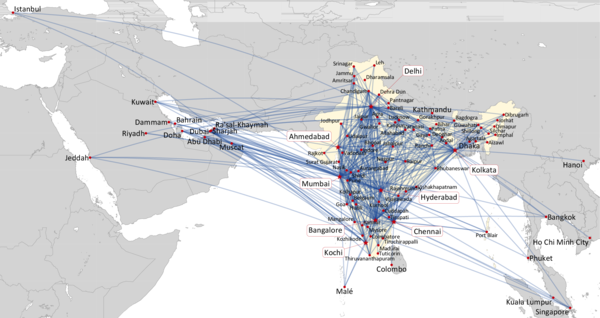
For longer-hauls IndiGo relies on its codesharing partners, buying capacity on their flights and selling its own seats to the partner airline for domestic itineraries. The most important alliance agreement is with THY which codeshares with IndiGo on 33 European routes with flights from India connecting at its Istanbul hub. This summer the US was brought into the joint network, with THY offering connections from IndiGo flights onto New York, Boston, Chicago and Washington. To solve a temporary capacity problem IndiGo also entered into a 12-month damp-leasing agreement early this year for two of THY’s 777-300s (the flying crew are from THY).
The next international expansion phase is linked to the A321neo XLR. IndiGo had scheduled deliveries for 70 XLRs before the Paris mega-order which will probably add another 100-150 units. In theory the XLR could have sufficient range to cover all of Europe, including London and most of Asia north of Australia. Immediate plans are more modest, adding points like Athens and Rome plus Seoul in Korea.
The strategic question for IndiGo is: to what extent does the airline want to be a major a major long-haul player.
On the one hand, it would be loath to cede prestigious long-haul routes and premium traffic to Air India/Vistara.
On the other, long-haul brings it in into direct competition with the European and global long-haul, business travel-orientated specialists as well as the very efficient Middle East super-connectors. Would its alliance with THY survive a sustained move into long-haul? What are the risks to moving too far away from the proven short/medium-haul LCC model? Would the XLRs be suitable to operate all the new network, or would IndiGo have to, as rumoured, place orders for A350s or 787s?
Unfortunately, the only real precedent for an LCC moving into long-haul operation is Air Asia/Air Asia X, which is not too encouraging.
