SAS: Will
Chapter 11 work?
Jul/Aug 2022

SAS, Europe’s sixth largest airline, has had as torrid a time as any over the past two years. Traffic plummeted through the various lock-downs: in each of 2020 and 2021 it carried less than 9m passengers, only 30% of the 28.5m it saw in 2019. In the two years to the end of October 2022 (SAS is unique in choosing October as its financial year end) it lost a cumulative total of SEK15bn ($1.4bn) at both the operating and net level on revenues of SEK34bn — a negative margin of (46)%. Finally in July, spurred by a pilots' strike, the group voluntarily filed for Chapter 11 bankruptcy protection in the US courts.
SAS was the original multinational air carrier. It was formed in 1946 as Scandinavian Airlines System, a consortium of the national airlines of Sweden, Denmark and Norway. Ownership was split three sevenths to Swedish SILA and two sevenths' each to Danish DDL and the Norwegian DNL. The holding company airlines were each 50% state-owned and each had were quoted on the local stock exchanges. In 2001 the group restructured its capital structure to create a holding company with a single share type. 50% was in public ownership.
Norway’s government decided in 2011 to sell down its holding and disposed of its remaining 10% in 2018 (for SEK17.25 a share) noting “that the days when state authorities set airline routes and even staffing requirements for nationally controlled airlines are over”. At the onset of the pandemic, the Swedish and Danish states each retained a 14.8% stake.
The group was not well prepared for Coronavirus crisis. It ended January 2020 (its first quarter for its financial year to Oct 2020) with SEK6.5bn in cash, representing only 14% of annual revenues. Three months later it had burned through a third of it. In June 2020 it started the process for a major recapitalisation to raise SEK12bn in new funds and “restore the equity position” (in the interim helped by a government backed revolving credit facility). This restructuring involved:
- The issue of SEK5bn in hybrid notes split equally between the “major shareholders” (the Swedish and Danish governments and the Wallenberg Foundation), and a further SEK1bn to the Danish government alone.
- The conversion of SEK2.2bn of outstanding bonds (due 2022) to equity or quasi-equity (another hybrid bond) — half the bond holders went for the share option.
- Conversion of SEK1.5bn existing hybrid notes to common shares (at 90% of par value, and at the demand of the two governments).
- The private placement of SEK2bn in new common shares to the major shareholders.
- A SEK4bn rights issue (underwritten by the major shareholders).
The new hybrid bonds carry an initial premium of 3.9% over six month STIBOR, with stepped increases to a punitive 10.4% premium by year eight.
The complicated operation was completed in October 2020, and resulted in the Danish and Swedish states increasing their stakes in the airline to 21.8% each but, with the total number of common shares in issue rising from 382m to 7.3bn, a 95% dilution for existing shareholders.
| ye October | 2019 | 2020 | 2021 | Q1-Q3 2022 | @ end | Jan 2020 | Jul 2022 | |
|---|---|---|---|---|---|---|---|---|
| Revenues | 46,736 | 20,513 | 13,958 | 8,196 | Tangible Fixed Assets | 35,045 | 36,558 | |
| Net income | 621 | (9,232) | (6,523) | (5,810) | Other fixed assets | 6,850 | 11,897 | |
| Operating cash flow | 3,318 | (5,176) | (4,756) | 1,353 | Current assets | 9,874 | 11,242 | |
| Net capex | (4,580) | (7,187) | (1,537) | 1,735 | of which cash | 6,599 | 6,148 | |
| Free cash flow | (1,262) | (12,363) | (6,293) | 3,088 | Current liabilities | (18,957) | (20,061) | |
| Debt | 3,766 | 17,210 | 5,319 | 143 | Debt | (24,592) | (33,524) | |
| Equity raised | (1,138) | 5,910 | Other liabilities | (4,292) | (4,747) | |||
| Total cashflow | 1,366 | 10,757 | (974) | 3,231 | Equity† | 3,928 | 1,365 |
The operating environment hardly improved in FY20/21 and the airline burned through another SEK6.3bn despite a severe cut in capital expenditure (see table) and the dismissal OR temporary lay-offs of nearly half its workforce.
The current financial year has seen some traffic recovery (to c70% of pre-pandemic levels, see graph) at least until the 15-day pilots' strike in July, but the group still managed to lose another SEK5.8bn in the nine months to April (similar to the losses in the prior year period).
Notwithstanding the capital restructuring in 2020, total debt (including operating lease liabilities) has grown by a third to SEK33.5bn, while equity has slumped by two-thirds to SEK1.4bn. But the on-balance sheet equity includes SEK7.6bn in those hybrid bonds.
The hybrid bonds are perpetual, and SAS controls the payment of interest and principal. Consequently the bonds are classified as equity instruments in their entirety according to the accounting standards — with transaction costs and interest attributable recognised directly in shareholders' equity.
Were the hybrid loans to be treated as debt shareholders' funds would be a negative SEK6.2bn.
Transformation plan
On the publication of the Q1 FY22 results (for the three months ended January), SAS CEO Anko van der Werff prefaced the report with the comment that: “For many years, SAS has been burdened by an uncompetitive cost structure that prevents the company from reaching its full potential… SAS is now, more than ever, in need of a new start”. He used the opportunity to launch a comprehensive new transformation plan, dubbed “SAS FORWARD”, to “implement measures aimed at securing long-term competitiveness”.
The key elements of the plan involve:
- Cutting annual costs by SEK7.5bn over the next five years (this would be equivalent to 25% of annual pre-pandemic non-fuel costs);
- Redesigning the fleet, network and product offering;
- Digital transformation, with an aim to improve the customer experience and increase ancillary revenues;
- Positioning SAS as the leader in sustainable aviation, renewing the fleet with new fuel-efficient aircraft, investing in SAF and sustainable products with “incentivised customer behaviour change”;
- Operating platform acceleration to improve flexibility and efficiency, and to adapt to changing market demand and competition;
- Strengthen the balance sheet by de-gearing and raising new capital.
The company notes that it will pursue cost reductions with a “far more comprehensive burden sharing across all major stakeholders and creditor groups” (ie unions, OEMs and lessors) within five years. The timing seems to lack urgency, although a large portion of the target could be front-loaded.
Negotiations with pilots did not go exactly easily. But the 15-day strike in July (estimated to have cost SAS SEK1.4bn) ended with a new 5.5 year collective bargaining agreement with the Scandinavian pilots' union.
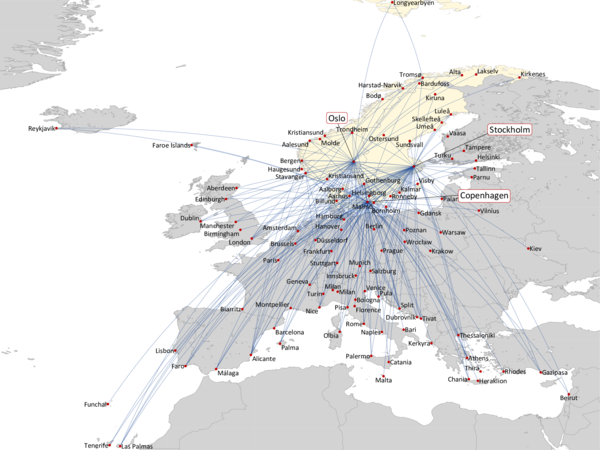
SAS emphasised that there are some structural changes involved and the company needed to adopt to those changes quickly. The management used the example of an anticipated leisure-based demand recovery, which should precede the recovery in corporate travel. To adapt, management has said the focus will be on network planning for leisure traffic. Historically SAS has concentrated operations on the three capitals — Stockholm, Copenhagen and Oslo — which has led to significant LCC incursion on routes for outbound leisure from smaller airports. The company said it will be adding more domestic bases, will strengthen its regional presence, and increase frequencies (and presumably utilisation).
The fleet renewal plan is a continuation of previous strategy (see table). SAS, pre-pandemic, had already planned the disposal of its four-engined A340s in 2020, replacing them with 6 new A350s (for which it has another two on firm order). It is throwing some of these back to lessors as surplus to requirements.
| Firm orders | |||||||
|---|---|---|---|---|---|---|---|
| Fleet | Avg Age | 2022 | 2023 | 2024 | 2025 | Total | |
| A330 | 8 | 11.1 | |||||
| A350 | 6 | 2.2 | 2 | 2 | |||
| A319 | 4 | 15.5 | |||||
| A320ceo‡ | 11 | 15.6 | |||||
| A320neo | 52 | 3.3 | 5 | 13 | 7 | 4 | 29 |
| A321ceo | 6 | 20.5 | |||||
| A321neo | 3 | 1.3 | |||||
| 737NG | 11 | 16.2 | |||||
| A220† | 4 | 3.2 | |||||
| E195 | 3 | 14.5 | 3 | 3 | |||
| CRJ† | 25 | 7.9 | |||||
| ATR72† | 6 | 8.8 | |||||
| Total | 139 | 8.0 | 8 | 13 | 9 | 4 | 34 |
There are 30 A320neos on order designed to replace the older A320ceos and 737NGs in the fleet. The stated aim is to operate a single type narrowbody aircraft fleet by 2023. Note that all the regional aircraft in the fleet are wet-leased or operated for SAS by other carriers.
Positioning the group as a “leader in sustainable aviation” is a requirement for any airline, but perhaps more so than usual for SAS considering that Sweden is home to the flygskam movement.
The required balance sheet restructuring under the plan is ambitious. The group plans to convert SEK20bn of debt and hybrid loans into common equity and to raise at least SEK9.5bn in new equity. This suggests a further heavy dilution for existing shareholders.
SAS received support from the three national governments for the plan to convert SAS’s debt and hybrid bonds to equity. But Sweden stated that it would not invest new capital into the carrier and that it does not aim to be a long-term shareholder. Only Denmark intimated that it might participate in investing new capital (subject to all stakeholders' participation in the SAS FORWARD programme).
SAS clearly did not have any success in negotiating with all its stakeholders, and voluntarily filed for Chapter 11 to accelerate the restructuring process.
In August it secured $700m (cSEK7bn) in Debtor-in-Possession (DiP) funding from Apollo Global Management (which had also helped Aéromexico and LATAM, among others, in their respective bankruptcy filing DiP requirements in the last two years). This very funding may mean that in the end SAS will need to raise even more capital.
That support should see the group through the bankruptcy process over the next twelve months: the aim being to launch a capital increase and rights issue in the first half of 2023.
Future prospects
What will SAS look like when it emerges from court protection?
The US Chapter 11 procedure is designed for companies operating in the US or South American economic environment. It gives protection from creditors, allowing a company to abrogate commercial agreements (such as for debt or leases) while it pursues radical restructuring — notably including employee terms of engagement. But in a European, and especially a Scandinavian context, there is a lot of protection for workers against any company trying to implement radical restructuring against social norms.
When it emerges it may be leaner, could be more flexible, but the competitive dynamics may not be much different.
Scandinavia is outside the central European population belt and its extent tends to be ignored: traditional maps of Europe rarely show much north of Stockholm. The three countries (Sweden, Denmark and Norway) have relatively low populations at 10.7m, 5.9m and 5.4m respectively. But distances are large, and physical geographical barriers can favour air travel. Personal incomes are high (with GDP per head of $58,000, $68,000 and $99,000 respectively estimated for 2022). Norway in particular portrays the highest propensity to travel by air of all nations — with an average number (in normal times) of seven air trips per head of population per year.
Unlike many of their neighbours none of the Scandinavian countries took part in the European colonial trends of the 18th and 19th centuries that provide a current good source of long haul travel demand for the likes of BA, Air France, Iberia, KLM, Sabena and even Lufthansa: the Swedish Empire collapsed in 1721 without expanding outside the Baltic region. (However, there are strong cultural links with the USA, the largest destination of the Scandinavian diaspora — where the census indicates 1.5m identify as Danes, 3.5m as Swedes, and 4.5m as Norwegian.)
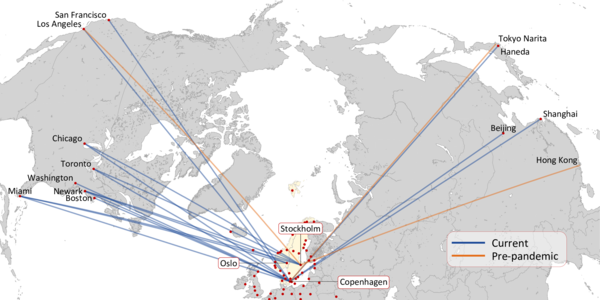
SAS had for many years enjoyed the (relatively) protected market of a niche local market. As the charts show (pre-pandemic) it enjoyed an overall 35% share of the market. Over the years it has tried to expand out of the core “natural” market — and in the good times has targeted long-haul route expansion (through its network hub at Copenhagen), leisure oriented growth, acquisitions and partnerships — but in each cyclical set-back the company has had to refocus back to the core intra-Scandinavian domestic and intra-European business oriented routes.
The difference in the forthcoming recovery may be a need to focus on point-to-point leisure markets, an area where LCCs are traditional winners. On short haul routes, Norwegian Air Shuttle (itself having gone through bankruptcy restructuring) is starting to ramp up the competitive pressure, while Wizz and Ryanair have taken the opportunity of the crisis to expand in the region. On long haul, Finnair experimented with transatlantic flights from Stockholm this summer, while start-up airline Norse Atlantic (norwegian long-haul reborn) launched its inaugural route from Oslo to New York.
Emerging from bankruptcy with a 25% reduction in costs, SAS will still find the competitive landscape demanding.