Air France-KLM: The transformational journey continues
Jul/Aug 2021

In the aftermath of the 2008 Global Financial Crisis, Air France-KLM had been lumbered with an almost insurmountable €6.8bn mountain of debt and searing operational losses. It embarked on a process to restore profitability and financial health, and has spent the past decade deleveraging the balance sheet mostly from internally generated cashflow. By 2019 it had reduced its net debt/EBITDA ratio to an almost investment grade level of 1.5x (see chart), but over the decade had underperformed its European peers in terms of profits and returns on equity.
A new management team in late 2018, led by the group’s first non-French (and non-énarque) CEO, Ben Smith, was all set to take the group on a transformational journey: seriously trying to turn Air France round, narrowing the gap between the French airline (on a sub-2% operating margin at the peak of the cycle) and the well-run KLM (on a respectable 10%); and targeting group “mid-cycle” operating margins of 7-8%.
And then the pandemic struck.
A hunt for liquidity
In comparison to the other two major European network carriers, IAG and Lufthansa, Air France-KLM still had a relatively weak balance sheet at the end of 2019. Its net debt of €6.7bn (albeit including €3.1bn lease debt) was three times shareholders' funds of €2.4bn (before considering €1.5bn in goodwill and intangibles). It had cash in hand of €4.5bn (16% of annual revenues) but short term debt liabilities of €1.8bn and advance ticket sales of €4.1bn.
As the crisis took hold it tried to react quickly, and by the end of the first quarter had available liquidity of €6.7bn and had announced cuts to its capex budget of €700m. But with an estimated monthly €400m cash outflow this was not going to be enough to survive the crisis and went cap-in-hand to its governments for help.
The group’s position was complicated by having two governments to call — both of which view “their” respective national airline as an essential part of national infrastructure.
Accessing the payroll support programmes was the easy bit. Air France and its French subsidiaries implemented short time working under the French Activité Partielle rules while KLM was able to access a similar NOW programme in the Netherlands (the acronym from the Dutch Tijdelijke Noodmaatregel Overbrugging voor Werkbehoud). These programmes provided 70%-85% of furloughed employee costs and saved the group €2.1bn in 2020 (the total wage bill was down by 35% at €5.3bn for 2020).
Although Air France and KLM were the pioneers in cross-border flag-carrier mergers in Europe when they teamed up in 2004, the Internal relationships between the French and Dutch parts of the resulting group have on many occasions been strained.
This tension spread to the Governmental level when The Hague in February 2019 surprised the Elysée by announcing that it had acquired a 12% stake in the Air France-KLM Group with plans to build this to match the then French national holding of 14%. (France may aim to be egalitarian, but under its Loi Florange some shareholders are more equal than others: the French state had 21% of the theoretical voting rights, and the Dutch would have had to wait another two years to achieve parity).
Negotiations for the division of government aid between the two governments in the Covid crisis were not easy but in total the group received financial packages totalling €10.4bn (equivalent to just around a third of 2019 group revenues).
The French Government provided €7bn:
- a €4bn loan, 90% state-guaranteed, with an extendable initial 12-month maturity and a coupon rising from EURIBOR+75bp to EURIBOR+275bp in year three; and
- a €3bn four-year extendable subordinated shareholder loan at a rate of 7% over the base rate (rising to +7.75% in year six). The coupon would increase further by an additional 5.5% (to EURIBOR+12.5-13.25% — what a hefty stick!) if Air France-KLM did not get the loan incorporated into the Group’s shareholder equity, raised new equity without state approval, or if anyone other than the French State acquired a 20% stake.
The group agreed not to pay any dividends (it last did so in 2008) until the loans were repaid in full. There were other soft “conditions”, not necessarily worded in the agreement. According to the Financial Times, the French Finance ministry stated that the loans were “intended solely for the needs of the subsidiary Air France”, while Bruno Le Maire, French finance minister, is quoted as saying that the loans came with conditions including that “Air France must become the most environmentally friendly airline on the planet”. In the wake of the Flygskam movement in 2019, France had been considering banning domestic flights where there was a train alternative of less than 2½ hours duration.
The Dutch put up €3.4bn:
- a revolving credit facility of €2.4bn, 90% guaranteed by the state at a rate of EURIBOR+1.35%
- a direct loan of €1bn with a maturity of 5½ years and a coupon of EURIBOR+6.25% rising to +7.75% by the fourth year. Both the revolving credit facility and the direct loan are drawn simultaneously on a pro rata basis.
These too came with conditions. KLM agreed not to make dividend payments to its shareholders (ie the Air France-KLM Group) until the loans had been repaid. In addition the direct state loan is linked to “manageable cost improvements, the airline becoming more sustainable, and the restored performance and competitiveness of KLM including a comprehensive restructuring plan and contributions made by employees”.
At the time of the agreement Dutch Finance minister, Wopke Hoekstra, seemed to show that tensions continued between the two governments saying: “Air France is not the same size or the same level of profitability as KLM. The Dutch government will therefore support the group and KLM at a level proportionally equivalent to that of the French government for Air France.”
By the end of 2020 Air France-KLM had drawn the full €7bn made available by France, and KLM just €942m of the €3.4bn offered by The Netherlands.
Full year 2020 results from operations were disastrous. Traffic for the group was down by 70% on a 55% reduction in capacity, operating losses exceeded €4.5bn, net losses topped €7bn, and the group suffered a net cash outflow of €5.7bn pushing net debt up to €11bn by the end of December.
The first half of 2021 has seen some faint signs of recovery. Air France in the current environment has some network strengths in comparison with its peers: it has a relatively low exposure to the Atlantic, Asia and the Far East, relatively low dependence on high yield corporate business traffic, a moderately large domestic market boosted by its quasi-domestic routes to the DomTom (Dominions et Territoires Outre-mer) destinations in the Caribbean and Indian Ocean, and strong essential links to francophone Africa. Overall capacity is running at around half the “normal” level of 2019 and was building further into the third quarter.
Cash outflow in the first half was reduced to €1.1bn, and was positive in the second quarter helped by a €1.2bn increase in working capital from advanced ticket sales.
In April, Air France-KLM, avoiding the threat of punitive interest rates on its shareholder’s loans, raised €1bn from a sale of new shares (had it been a rights issue it would have been on the basis of 1 for 2) and transferred the bailout loan into “equity” as “super-subordinated notes”. This had to go through approval from the EU Commission as permissible state aid: the price was to relinquish 18 slots at the congested Orly airport, agree not to pay dividends and limit executive pay.
The French State took over half of the new equity issued, pushing its stake up to 28% of the total. China Eastern subscribed for a further 11%. Delta could not partake, under the rules of the CARES Act, and the Dutch Government forebore. As a result of the issue the group ended June with net debt of a mere €8.3bn strengthening (still negative) shareholders' funds by €4bn to €(3.6)bn. The group has extended the €4bn government guaranteed debt into 2023 and is renegotiating the repayment schedules. It also successfully launched an €800m corporate bond in June — its first foray into the capital markets since January 2020. It had €9.4bn available liquidity at the end of the quarter.
| % of capital | % of theoretical | ||
|---|---|---|---|
| Dec 2020 | Jun 2021 | voting rights | |
| French State | 14.3% | 28.6% | 28.5% |
| China Eastern | 8.8% | 9.6% | 11.5% |
| Dutch State | 14.0% | 9.3% | 13.9% |
| Delta Airlines | 8.8% | 5.8% | 8.7% |
| Employees | 3.7% | 2.5% | 3.7% |
| Treasury stock | 0.3% | 0.2% | 0.3% |
| Others | 50.1% | 44.0% | 33.4% |
The Dutch Government meanwhile wants to be able to do something similar to support the financial structure at KLM. To that end it has been in discussions with the European Commission. But it may be a bit more awkward to talk about converting government debt into the equity of a subsidiary of a French registered group. The EC will probably also want to impose slot disposals by KLM at the (normally) overfull airport in Amsterdam. Air France in extremis was willing to give away valuable slots at Paris’s second airport Orly (which perhaps it was only holding onto to keep other competitors out, and was possibly going to relinquish anyway as it downsized its loss-making domestic network). For The Netherlands and KLM, Schiphol is of ultimate strategic importance and slot disposals threaten the network economics of the sixth-freedom hub.
The group’s capital engineering is not sufficient. Under current projections it sees the likelihood of net debt standing at three times EBITDA by 2023; management would prefer something nearer 2x. The board gained authority at the annual general meeting to increase the current share capital by up to 300% and issuance for up to €3.5bn equity linked instruments, and at the Q2 results meeting the management gave a clear indication that they would return to the capital markets once they have a convincing recovery story. However, the French State has a dilemma in again providing more than its fair share of new equity: under French Bourse rules once a single holder has more than 30% of the shares in a quoted stock, it has to make an open bid for the entire company.
| €m | Dec 2019 | Dec 2020 | Jun 2021 |
|---|---|---|---|
| Flight equipment | 11,334 | 11,031 | 10,645 |
| Other P&E | 1,580 | 1,548 | 1,453 |
| Right-of-use assets | 5,173 | 4,678 | 5,033 |
| intangibles | 1,522 | 1,445 | 1,464 |
| Other assets | 2,587 | 1,614 | 1,336 |
| 22,196 | 20,316 | 19,931 | |
| Cash &c | 4,515 | 7,030 | 6,575 |
| Stock | 737 | 543 | 519 |
| Drs | 2,164 | 1,248 | 1,530 |
| Other | 1,123 | 1,074 | 1,455 |
| 8,539 | 9,895 | 10,079 | |
| ST debt | (1,817) | (2,159) | (1,652) |
| Advance sales | (4,137) | (3,310) | (3,793) |
| Crs | (2,379) | (1,435) | (1,604) |
| other | (4,316) | (4,874) | (3,969) |
| (12,649) | (11,778) | (11,018) | |
| Net current assets | (4,110) | (1,883) | (939) |
| Assets | 18,086 | 18,433 | 18,992 |
| Debt | (6,271) | (14,171) | (11,240) |
| Lease liabilities | (3,149) | (2,425) | (2,697) |
| Pensions | (2,253) | (2,147) | (2,119) |
| Other provisions | (3,750) | (3,670) | (3,977) |
| Other liabilities | (364) | (1,438) | (2,563) |
| (15,787) | (23,851) | (22,596) | |
| Net Assets | 2,299 | (5,418) | (3,604) |
| Represented by | |||
| Equity | 4,501 | 4,543 | 5,567 |
| Perpetual | 403 | 3,042 | |
| Retained earnings | (2,620) | (9,970) | (12,221) |
| Minority | 15 | 9 | 8 |
| Shareholders' funds | 2,299 | (5,418) | (3,604) |
Restructuring under way
The transformational restructuring plan (see Aviation Strategy November 2019) put forward by Ben Smith had been to improve industrial relations at Air France, modernise the fleet, optimise the operating model, grow profitable passenger revenues, maximise group synergies and “lead the way in sustainable aviation”. If anything the Covid crisis has accelerated the process and made the painful bits of the plan easier to impose.
Before March 2020 management had already achieved major milestones. It had signed over 40 agreements with personnel groups at Air France — and notably an agreement with the pilots that removed the constraints on the size and operational perimeter for Transavia France. Air France had ordered 10 A350s and announced plans to decommission its A380s; it had ordered 60 A220s to replace its old A318s and A319s. KLM had ordered two 777s and 21 Embraer E195-E2s. The two airlines had started a programme of cabin harmonisation and brand simplification (the troublesome Hop! regional brand reincorporated under Air France) and a fleet swap (of 787s from Air France to KLM in return for A350s).
Since the pandemic the group has implemented voluntary severance plans to remove 8,700 full time equivalent jobs by the end of 2020, with the aim of cutting an additional 5,000 positions by the end of 2021. The management points to structural benefits from the lower level of employment of around €800m for KLM by the end of 2022 compared with 2019, and €1.3bn for Air France. (Meanwhile the Dutch NOW mechanism remains in place until the end of Q3 2021 and Air France has negotiated a long term “partial activity” agreement until the end of 2022).
As for the fleet, the group has accelerated the removal of the A380s and phased out all the four-engined A340s and B747s, and the smaller French regional E145s and ATR72s; and announced plans to get rid of the CRJs and KLM’s A330s. It expects to be operating 7% fewer aircraft in 2022 than it had in 2019.
Network improvements
The Air France regional and domestic operations have been a perennial problem ever since they were amalgamated in the early noughties with the divergent aims of keeping out low cost (and non-French) competition, feeding traffic into CDG, and maintaining connectivity under political pressure from the regions.
In each of the last ten years the then management has stated that “in the next year or two they will break even”. But even at the top of the last cycle they were losing around €200m a year.
The intense political scrutiny of Air France’s operations during the negotiations for state aid last year gave rise to a “condition” that the company should not operate domestic flights on routes that could be completed using train services within 2½ hours.
Ben Smith meanwhile has committed, as part of the drive to fill the role as the “most environmentally friendly airline”, to cut domestic flight CO2 emissions by 50% in absolute terms by 2024. A perfect opportunity to do exactly what he planned to do but with full political approval.
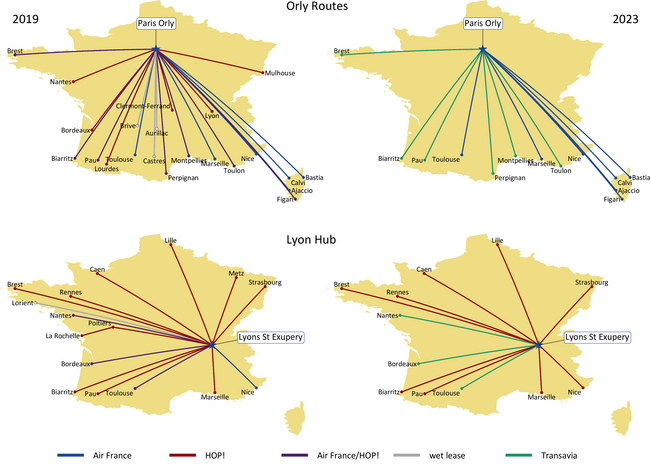
The maps show the extent of the changes that Air France is planning by 2023 (these exclude some 175 small transversal regional routes, of which 70% have already been cut).
Hop! will stop operating from Orly entirely. Air France will continue to operate the shuttle (Navette) services to Nice, Marseilles and France’s second largest city Toulouse; and routes to Corsica. Transavia, newly liberated to operate domestically, will assume a handful of routes to Brest, Biarritz, Pau, Perpignan, Montpelier and Toulon. Other routes to the hinterland — not all conveniently on the TGV network — will be axed. By 2023 the company expects that Transavia will have nearly 30% of the Group’s domestic capacity out of Orly. The company says it has already achieved 60% of the changes
Hop! will continue to operate out of Lyons, but with much reduced flying. Here also Transavia is seen to take on a handful of higher density routes to end up with just over 30% of seat capacity. The future for Hop! is very uncertain (indeed the scurrilous story circulating in Paris is that it is now mainly a depository for Air France executives who do not share the new vision for the airline).
On short-medium haul, there is an opportunity to revisit its operational strategy through the acquisition of 60 A220s. Historically the company has focused on maximising feed from medium and short haul services on to long haul operations. However, one of its strengths is to be based in a highly populated city with a large catchment area and good natural point-to-point O&D traffic — second to London in Western Europe and way ahead of Frankfurt. The new management team seems to recognise (as British Airways worked out twenty years ago) that the pursuit of transfer traffic for its own sake can generate too a high proportion of very low yield leisure-oriented transfer traffic (the deepest discount a network airline can offer). There is the possibility that the use of small and cost-efficient aircraft feeding smaller widebodies will lead to the profitable improvement in passenger revenues that Ben Smith targets in the restructuring plan.
The overall medium term plan seems still to be in place, just somewhat delayed. The group expects to get back to 2019 levels of capacity by 2024. When it does, it expects that its unit costs will be 10% lower than pre-crisis levels and that it should be able to generate mid-cycle group operating margins of 7-8%. The current management team is very probably the airline’s and the government’s best chance of completing the turnaround, but then there is always French politics in the background.
| Dec 2019 | Jun 2021 | |||||||||||
|---|---|---|---|---|---|---|---|---|---|---|---|---|
| Air France | KLM | Transavia | Group | Air France | KLM | Transavia | Group | Avg Age | On Order | |||
| Widebody | 747 | 8 | 8 | |||||||||
| 777 | 68 | 29 | 97 | 64 | 31 | 95 | 14.5 | |||||
| 787 | 9 | 17 | 26 | 10 | 19 | 29 | 3.7 | 8 | ||||
| A380† | 10 | 10 | ||||||||||
| A350 | 3 | 3 | 10 | 10 | 1.1 | 28 | ||||||
| A340 | 4 | 4 | ||||||||||
| A330 | 15 | 13 | 28 | 15 | 13 | 28 | 16.1 | |||||
| 109 | 67 | 176 | 99 | 63 | 162 | 12.0 | 36 | |||||
| Narrowbody | 737NG | 52 | 80 | 132 | 49 | 89 | 138 | 11.6 | ||||
| A220 | 60 | |||||||||||
| A318 | 18 | 18 | 18 | 18 | 16.3 | |||||||
| A319 | 33 | 33 | 31 | 31 | 20.0 | |||||||
| A320 | 44 | 44 | 44 | 44 | 12.0 | |||||||
| A321 | 20 | 20 | 19 | 19 | 19.0 | |||||||
| 115 | 52 | 80 | 247 | 112 | 49 | 89 | 250 | 13.6 | 60 | |||
| Regional | ATR42/72 | 4 | 4 | |||||||||
| CRJ700/1000 | 25 | 25 | 20 | 20 | 12.0 | |||||||
| E195E2 | 4 | 4 | 0.5 | 21 | ||||||||
| E190 | 15 | 32 | 47 | 17 | 32 | 49 | 9.4 | |||||
| E170/175 | 15 | 17 | 32 | 15 | 17 | 32 | 8.9 | |||||
| E145† | 17 | 17 | 8.3 | |||||||||
| 76 | 49 | 125 | 52 | 53 | 105 | 9.4 | 21 | |||||
| Freight | 747-F | 4 | 4 | 4 | 21.4 | |||||||
| 777-F | 2 | 2 | 2 | 12.8 | ||||||||
| 2 | 4 | 2 | 4 | 6 | 18.5 | |||||||
| Total | 302 | 172 | 80 | 554 | 265 | 169 | 89 | 523 | 12.3 | 117 | ||
