Virgin Atlantic: Desperately
Seeking Capital
Jul/Aug 2021

Few cities in the world can support two directly competing home airlines. American plays second fiddle to United at Chicago; JAL and ANA enjoy a comfortable duopoly in Tokyo; and Virgin Atlantic competes aggressively against IAG’s British Airways in London. But Virgin only flies long haul, with a heavy focus on the Atlantic, and had a relatively small overall footprint in London — with 3% of the slots at Heathrow in 2019 and 1.5% of those at Gatwick. Long haul operations have been badly hit by the coronavirus crisis, and are expected to take a long time to recover to pre-pandemic levels.
Recent press reports suggest that Virgin Atlantic may be contemplating an IPO on the London Stock Exchange as early as autumn this year. This is likely to see the flamboyant Richard Branson relinquish majority control (51% owned by Virgin Group, 49% by Delta Airlines) for the first time since the airline was founded nearly forty years ago. It will also open the carrier to greater financial scrutiny than that to which the unconventional entrepreneur has been accustomed. But it may go some way to restore a balance sheet almost fatally harmed by the effects of the Covid pandemic.
And 2020 was disastrous for Virgin Atlantic. It saw an 80% decline in passenger numbers (from 6m in 2019 to 1.2m) and passenger revenues (down to £446m from £2bn) — although cargo revenues were up by 50% to £319m. Operating losses before exceptional items amounted to £514m (down from a restated £72.5m profit) and total net losses reached £864m compared with losses of £55m in the prior year period.
On top of all this it had to write off its 30% stake in FlyBe, strategically acquired in 2019 presumably in an attempt to generate much-needed feed to it long haul operations, when that regional UK airline fell into bankruptcy in March 2020.
Virgin Atlantic reacted as best it could to mitigate the crisis. It got rid of its four-engined widebody aircraft — sending its eight 747s and three A340s into early retirement — sacked 3,100 staff (a third of its workforce) and closed operations at London Gatwick to concentrate on services out of Heathrow and Manchester (aiming to return to Gatwick when demand returns). The company also announced plans to consolidate all operations under a single brand — with Virgin Holidays becoming Virgin Atlantic holidays — in order “to drive a 10x growth mindset when recovery begins”.
Despite pleas for help, the UK government did not go out of its way to help the aviation sector through the crisis, and Virgin’s balance sheet was too weak to allow it to take advantage of the Government-backed Coronavirus Loan Scheme.
With the prospect of running out of cash at the end of September, Virgin Atlantic was the first UK company to use the process of a court sanctioned solvent Restructuring Plan (in a procedure hastily appended to the UK Companies Act 2006 at the start of the pandemic), coinciding with a filing for Chapter 15 court protection to allow the plan to be recognised in the US.
The headline to the announcement mentioned a refinancing package worth £1.2bn over the following 18 months “with the unanimous support of our shareholders and creditors”.
Not that much hard cash was involved. Hedge fund Davidson Kempner Capital provided £170m of secured financing and the airline’s largest creditors and suppliers contributed an additional £450m by way of payment deferrals. Shareholders Delta Airlines and Virgin Group provided £600m — a £200m cash injection from Virgin and £400m in deferral of brand fees (to Virgin) and JV fees (to Delta). (Delta is constrained by the terms of the CARES Act from on the forms of investment it can make). It also got rid of another 1,500 staff.
The balance sheet (see table) seems to show this as a £100m introduction of capital (in accounting terms equivalent to a gift from the majority shareholder) and a £375m issue of preference shares.
| £m | 2020 | 2019 |
|---|---|---|
| Fixed Assets | 1,952 | 2,228 |
| Defd tax & other | 19 | 31 |
| Intangibles | 460 | 183 |
| Cash | 115 | 353 |
| Restricted cash | 77 | 97 |
| Stock | 30 | 39 |
| Drs | 162 | 288 |
| Derivatives | 2 | 20 |
| Current Assets | 386 | 796 |
| ST debt | (111) | (248) |
| Crs | (346) | (516) |
| Defd revenue | (263) | (523) |
| Provisions | (40) | (30) |
| Derivatives | (13) | (34) |
| Current Liabilities | (773) | (1,352) |
| Net Current Liabilities | (388) | (555) |
| Assets | 2,043 | 1,886 |
| LT Debt | (2,369) | (1,967) |
| Crs | (192) | (4) |
| Defd revenue | (3) | (2) |
| Provisions | (55) | (100) |
| Derivatives | (5) | |
| Liabilities | (2,619) | (2,077) |
| Net Assets | (576) | (190) |
| Represented by | ||
| Equity capital | 100 | 100 |
| Preference capital | 426 | 50 |
| Reserves | (187) | (290) |
| Retained earnings | (915) | (51) |
| Shareholders funds | (576) | (190) |
Even after the restructuring plan, the balance sheet is sickly. Assets of £2bn do not quite support loans and other long term liabilities of £2.6bn. Net unrestricted cash stood at £4m at the end of December — although liquidity has since been boosted by an additional £160m support “from our shareholders and creditors” in March, and a $260m sale and leaseback of two 787s to repay a (presumably expensive) loan taken out during the crisis.
But those assets also include intangibles of another £460m — in the 2020 accounts the company decided to capitalise its extended joint venture agreement with Delta and Air France-KLM, which came into force (with meticulous timing) in February 2020. The shareholders' deficit is realistically probably somewhere between the published £576m and a cynical analysts approximation of £1bn.
CFO Oliver Byers is keen to point out that the balance sheet does not include an estimated £423m value of slots the group has not officially capitalised (surprisingly up from £350m at the end of 2019). noting that its total UK slot portfolio had a year-end market value of over £500m (although its Heathrow slots, representing by far the majority, had already been put up as security to a £220m bond issued in 2016). It is probably just as well for Virgin that Heathrow’s proposed third runway looks now as least likely as ever to be built any time soon.
| Current | |||||
|---|---|---|---|---|---|
| End 2019 | In Service | Parked | Total | On Order | |
| 747 | 8 | ||||
| 787 | 16 | 16 | 1 | 17 | |
| A330 | 14 | 5 | 8 | 13 | 14 |
| A340 | 3 | ||||
| A350 | 4 | 7 | 7 | 6 | |
| Total | 45 | 28 | 9 | 37 | 20 |
Finding an investment story
In its report of a potential IPO, Sky News mentioned that “City sources” had said that institutions' response to management presentations led by the airline’s executives had been positive. Virgin Atlantic declined to comment; it would be nice to know what positive spin it could present to suggest that an investment would be attractive. The airline’s stated core values — Think Red, Make Friends, and Be Amazing — are not enough.
The airline industry is one that requires profitable growth to be able to stand still. In the decade leading up to 2020’s pandemic Virgin Atlantic has neither grown nor been profitable. In 2019, its capacity in ASK terms was 10% lower than in the peak of the previous cycle, while the total number of passengers carried has fluctuated around 5.5-6m. In the decade leading up to 2019 it raked up total operating losses of £132m, generating an operating profit in only five of the ten years, and effectively breaking even at the net level only after exceptional items and tax. A peak operating margin of 2.5% was achieved in 2019 on revenues of £2.9bn.
It has advantages. It is based in London. And Heathrow in particular has the strongest natural long haul O&D demand worldwide, and stands as the prime gateway to Europe. The UK itself, in normal times, is one of the largest generators of international air travel, and has strong historical and cultural links with English speaking nations, former colonies and protectorates.
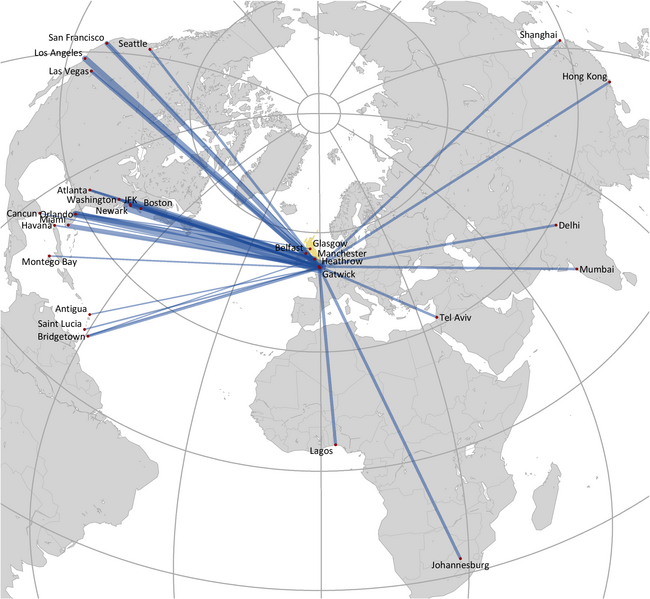
The strongest routes in its portfolio, and those that in normal times would be profitable, we estimate to be the business oriented routes from London to New York, Boston, Los Angeles and San Francisco; leisure-oriented routes to Orlando, Miami and Las Vegas and the leisure and VFR oriented routes to the Caribbean; its routes to Lagos and South Africa where it enjoyed a virtual duopoly with British Airways in the face of relatively high yields and weak or non-existent competition. Hong Kong may have had a positive contribution in the past, but the attractions of routes into the UK’s former colony are likely to have waned following the introduction of the new national security laws.
Virgin Atlantic is also now part of the extended immunised joint venture with Delta and Air France-KLM — which covers routes on the Atlantic and through on to the Indian subcontinent. This may be enough to enable it to make sense of its routes to Delhi, Bombay and Tel Aviv, while connections into Delta’s hubs in Atlanta and Boston may give it sufficient US originating traffic.
Virgin Atlantic also has disadvantages. It has had difficulty diversifying: three quarters of its operations were on the Atlantic and three quarters of its sales originates in the UK. (For those who like to reference Freddy Laker in reference to Virgin Atlantic, it was that dependence on Sterling income that sent Laker into administration when the pound fell from $2.40 to $1.80).
It lacks domestic and regional feed: although a handful of long haul routes out of London can be supported by point-to-point demand — the ones it originally cherry-picked from British Airways — many only work with transfer traffic. It is dependent to an extent on high yield traffic: and long haul business traffic will take a very long time to recover.
Secondly its prime routes are subject to the very same cherry-picking by new entrants. Although Norwegian’s attempts to create a long haul low cost operation has failed, its presence was highly disruptive. Norwegian’s successor Norse, with much cheaper equipment, is in the process of applying for a UK AoC to take Norwegian’s place in Gatwick.
JetBlue, which had successfully disrupted the US transcontinental market and engineered a permanent reduction in average fares there, is starting operations from New York and Boston into the London airports with its small capacity but highly efficient long range A321neos.
Aer Lingus similarly will be spearheading an attack on the Atlantic with its A321s out of Manchester, in direct competition with Virgin, under its own new UK AoC.
In 2017, Richard Branson had announced a deal to sell a 31% stake in Virgin Atlantic (out of Virgin Group’s 51% majority holding) to Air France-KLM for £220m (in which Delta and China Eastern had recently injected funds). The was undoubtedly linked with Delta’s plan to include Virgin Atlantic in the Skyteam immunised joint venture on the Atlantic — which came into effect at the beginning of 2020.
That deal never took place but perhaps indicated Branson’s willingness to reduce his stake and give up on his once-held ambition to build up a network of Virgin-branded airlines around the world — see Aviation Strategy, August 2009 — and concentrate on space adventures.
Virgin America, which started operations in 2007, was acquired by the Alaska Air Group in 2016, with the Virgin brand phased out by 2019. The Virgin Group lost its remaining 10% stake in Virgin Australia (formerly Virgin Blue, launched in 2000) when that carrier, in poor financial health, succumbed to Covid-19 last year (see Aviation Strategy December 2019). Elsewhere Lagos-based Virgin Nigeria (which started operations in 2005) was always sub-scale and lossmaking, despite (or because of) being the Nigerian flag-carrier, and the Virgin Group escaped its investment in 2010. Brussels-based (and loss-making) low cost carrier Virgin Express merged with SN, the successor to the rump of Belgian flag carrier Sabena (which had died in 2001), to form SN Brussels in 2007. It is possibly also worth mentioning that Delta acquired its 49% stake in Virgin Atlantic from Singapore Airlines in 2012 for £224m — half the price that SIA paid in 2000.
But potential investors should perhaps ignore the history of the returns generated by Virgin Atlantic under Virgin Group’s control. Richard Branson is an unconventional entrepreneur and views total returns somewhat differently from the run-of-the-mill equity market investor. Apart from anything else there are brand license agreements which guarantee a return on revenue (Virgin Group presumably still receives a fee from the re-incarnated Virgin Australia).
If there were to be an IPO, Delta would presumably remain a major (and may end up the largest) shareholder — although because of the CARES Act provisions it is unlikely to be able to partake. It should be able to persuade potential investors that it knows how to run an airline profitably. But, in the meantime, the hole in the balance sheet is very deep and very red.